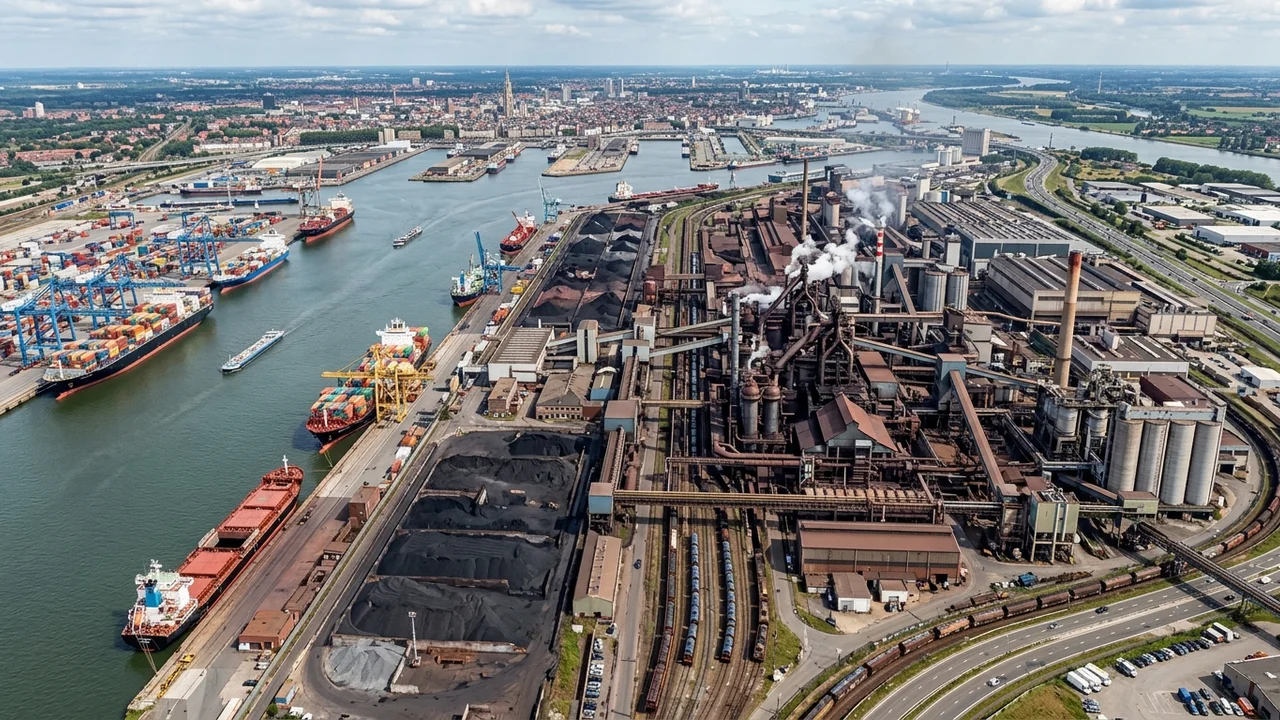
Belgium handles a disproportionately large share of EU CBAM-covered goods flows relative to its domestic import demand, because the Port of Antwerp-Bruges is one of the two largest container and bulk commodity ports in Europe and serves as the entry point for carbon-intensive goods destined for importers across multiple EU member states. Belgian companies established for VAT purposes in Belgium must obtain authorized declarant status from the SPF Santé publique Climate Change Service, Belgium's designated National Competent Authority (NCA) under Regulation (EU) 2023/956, to legally import steel, cement, aluminium, fertilizers, electricity, and hydrogen from third countries under the definitive phase that began January 1, 2026. This article covers Antwerp's CBAM exposure, the SPF authorization process, the sectors most affected for Belgian importers, and the full compliance chain through the September 30, 2027 first declaration deadline.
Caption: The Port of Antwerp-Bruges processes significant volumes of CBAM-covered bulk goods including steel coils, aluminium ingots, and fertilizers entering the EU customs territory.
What Is CBAM and Why Does It Matter for Belgian Importers
CBAM is a certificate-based mechanism under Regulation (EU) 2023/956 requiring EU importers to surrender certificates proportional to embedded CO₂ in their imports, priced at the EU ETS carbon price, to prevent carbon leakage.
The definitive phase is in force from January 1, 2026. CBAM is not a tariff, not a border tax, and not a carbon duty. It is a regulated certificate obligation running parallel to customs procedures, administered at the member state level through designated NCAs.
Belgian importers face two distinct layers of CBAM relevance. The first is the standard importer obligation applicable to any EU-established company importing Annex I goods above the 50-tonne annual de minimis threshold under Article 2(3a) of Regulation (EU) 2023/956, as amended by Regulation (EU) 2025/2083. The second is the port-of-entry dimension: goods entering the EU via Antwerp that are consigned to an importer established in another member state do not create a CBAM obligation for the Belgian port operator or customs agent. The CBAM obligation follows the authorized declarant, meaning the company that places the goods under free circulation under its own customs declaration. Understanding the full EU CBAM framework is therefore the starting point before engaging the SPF Climate Change Service.
The de minimis threshold excludes importers whose total annual mass of CBAM-covered goods across all sectors falls below 50 tonnes per year. Electricity and hydrogen are excluded from this threshold entirely, and all electricity and hydrogen imports trigger CBAM obligations regardless of volume.
The SPF Climate Change Service: Belgium's CBAM National Competent Authority
The SPF Climate Change Service processes all CBAM authorized declarant applications for importers established in Belgium. Belgium's NCA sits within the SPF Santé publique, Sécurité de la Chaîne alimentaire et Environnement (the Federal Public Service for Public Health, Food Chain Safety, and Environment). This institutional placement positions Belgium among the 20 of 27 EU member states that designated an environment or public health body as NCA, reflecting CBAM's basis in Article 192(1) TFEU as an environmental policy instrument rather than a purely fiscal one.
The SPF Climate Change Service accesses the Authorization Management Module (AMM) of the EU CBAM Registry at cbam.ec.europa.eu, the centralized platform operated by DG TAXUD. Belgian importers submit applications through the AMM using EU Customs Trader Portal authentication credentials (EORI-linked UUM&DS access, the same authentication system used for EU ETS Registry access). Companies already registered in EU ETS operations in Belgium find the registry authentication flow structurally identical.
The application deadline for continued provisional importing under the definitive phase was March 31, 2026, established by Article 17(7a) of Regulation (EU) 2023/956 as inserted by Regulation (EU) 2025/2083. Belgian importers who submitted complete applications by this date may continue importing CBAM goods on a provisional basis while the SPF Climate Change Service processes their authorization. The SPF has a maximum of 120 days from receipt of a complete application to issue its decision, as specified by Article 4(1) of Implementing Regulation (EU) 2025/486. The 120-day period pauses if the SPF requests additional information. Importers must respond promptly to avoid delays that push the decision beyond the provisional import window.
What Belgian Importers Must Submit to the SPF
The application documentation required under IR 2025/486, Articles 4 through 8, represents the baseline for any authorized declarant application across the EU. Belgian importers must assemble all of the following before filing through the AMM:
- Valid EORI number and Belgian company registration (BCE/KBO number)
- Belgian tax identification number (BTW/TVA number)
- Audited financial statements for the preceding 2 to 3 financial years, or a bank guarantee for companies established less than 2 years
- Evidence of 5-year customs and tax compliance history: no serious customs violations, no convictions for tax fraud, smuggling, money laundering, or environmental offenses, and no active insolvency proceedings
- Description of all CBAM goods intended for import, including CN codes, estimated annual tonnage, countries of origin, and the name, address, and geographic coordinates of each production installation
- Identity of the individual within the company legally responsible for CBAM compliance
- A written internal CBAM compliance procedures document
The SPF Climate Change Service may refuse authorization on grounds including serious customs violations within the prior 5 years, active insolvency proceedings, or inclusion on the EU consolidated financial sanctions list. Refusal decisions are subject to administrative appeal within the Belgian court system, with final escalation to the Court of Justice of the European Union for constitutional interpretive questions.
Once authorization is granted, the SPF creates a CBAM account in the EU CBAM Registry. The account contains the importer's authorization details, CBAM certificate holdings, import transaction records automatically forwarded from Belgian customs, declaration history, and verification report references. Discrepancies between customs records and CBAM declarations are automatically flagged for SPF review.
Antwerp Port and the CBAM Goods Flow Challenge
The Port of Antwerp-Bruges processes over 280 million tonnes of cargo annually, making it one of Europe's highest-throughput maritime entry points for bulk and break-bulk commodities. Significant volumes of CBAM-relevant goods, including steel coils, aluminium ingots, fertilizer granules, and clinker, transit Antwerp before distribution across Belgium, the Netherlands, Germany, France, and other EU markets.
A critical compliance distinction applies at Antwerp: port entry does not determine CBAM obligation. The importer's country of establishment determines which NCA handles authorization. A German steel trader whose goods arrive at Antwerp under a Belgian freight forwarder's customs declaration placed under the German company's EORI number faces authorization requirements from DEHSt in Germany, not from the SPF in Belgium. Belgian EU importer obligations under CBAM attach to the legal entity established in Belgium that places goods under free circulation on its own customs account.
Belgian importers working through indirect customs representatives at Antwerp bear legal responsibility for their CBAM compliance regardless of the representative arrangement. Article 5(2a) of Regulation (EU) 2023/956 requires non-EU-established importers to appoint an indirect customs representative established in the EU to hold authorized declarant status on their behalf. A Belgian-established importer retains direct personal liability regardless of the representative arrangement used.
The table below illustrates the CBAM cost parameters for the primary goods sectors transiting Antwerp, calculated at the late March 2026 EU ETS reference price of approximately €70 per tonne CO₂, which fluctuates daily:
| Sector | Emission Factor | Gross CBAM Cost @ €70 | Net Cost 2026 (2.5% factor) | Indirect Emissions Priced |
|---|---|---|---|---|
| Steel (BF-BOF) | ~2.0 tCO₂/t | ~€140/t | ~€3.50/t | No |
| Steel (EAF scrap) | ~0.5 tCO₂/t | ~€35/t | ~€0.88/t | No |
| Cement (Portland) | ~0.83 tCO₂/t | ~€58/t | ~€1.46/t | Yes |
| Primary aluminium | ~1.5 tCO₂/t | ~€105/t | ~€2.63/t | No |
| Urea fertilizer | ~2.5 tCO₂e/t | ~€175/t | ~€4.38/t | Yes |
Net costs in 2026 are low because the CBAM factor is 2.5% (97.5% of free allocation remains under the EU ETS phase-out schedule). The financial exposure intensifies sharply: the CBAM factor reaches 48.5% in 2030 and 100% in 2034. Belgian importers who treat 2026 as a low-stakes year without building compliance infrastructure face substantial financial exposure within 4 years.
Steel Sector: Belgium's Primary CBAM Exposure
Steel imports represent the dominant CBAM sector for Belgian-established importers through Antwerp, given Belgium's downstream steel processing and distribution industry. The primary CBAM-covered steel products, including hot-rolled coils, wire rod, sections, and semi-finished products such as blooms and billets, arrive from Turkey (approximately 6 million tonnes per year to the EU), India (approximately 3 million tonnes per year), and South Korea (approximately 2 million tonnes per year). None of these three countries currently has a qualifying carbon pricing scheme recognized by the Commission for Article 9 deduction purposes.
Importers relying on Turkish steel must note that Turkey's Climate Law No. 7552, enacted July 2025, established a pilot ETS with full free allocation, meaning no "effectively paid" carbon price exists for Article 9 deduction calculation. South Korea's K-ETS (Korea Emissions Trading Scheme) is under Commission assessment and is the most likely among major steel-exporting nations to achieve Article 9 recognition, but at a current price of approximately $6 to $7 per tonne CO₂, even full recognition would cover only approximately 9% of CBAM certificate liability at €70.
The steel sector under CBAM article covers CN codes for chapters 72 and 73, production route classification between BF-BOF and EAF, and default value application in full detail.
Compliance Steps for Belgian Importers in 2026
Belgian importers in the definitive phase follow an 11-step obligation chain from CBAM applicability determination through records retention. The most time-critical steps for Belgian companies in the current period are authorization, embedded emissions data collection, and verifier engagement, in that order of priority.
The 4 immediate actions for Belgian importers in April 2026 are listed below:
- Confirm authorized declarant status with the SPF Climate Change Service, or submit an application through the AMM without further delay if not yet filed
- Classify all Annex I goods import flows by CN code, production installation, country of origin, and estimated annual tonnage to identify total CBAM exposure
- Contact non-EU producers to request specific embedded emissions data under the format required by Article 7 and Implementing Regulation (EU) 2025/2547, using the Commission's CBAM Operators Portal and Communication Template to standardize data requests
- Identify and contract an accredited verifier for the 2026 reporting period, noting that verifier registration in the CBAM Registry does not open until September 1, 2026, and the first declaration is due September 30, 2027
Verifier capacity represents the most significant operational risk for Belgian importers. The physical site visit to each non-EU production installation is mandatory for the first reporting period covering 2026 imports. Remote verification is not permitted for the first period. Verifier fees range from €5,000 to €50,000 per installation depending on complexity. A Belgian importer sourcing from 20 installations across Turkey, India, and Egypt faces first-cycle verification costs of €100,000 to €1,000,000. The Commission's European Accreditation Task Force on CBAM was established only in March 2026, and verifier capacity globally remains critically short relative to the volume of installations requiring first-time physical site visits.
Caption: The SPF Santé publique Climate Change Service processes authorized declarant applications for all importers established in Belgium through the AMM of the EU CBAM Registry.
How the CBAM Certificate Obligation Works for Antwerp-Based Importers
CBAM certificate purchases open on February 1, 2027 through each NCA's Common Central Platform, which operates as the only legal purchase mechanism. No secondary market, exchange trading, or bilateral transfers are permitted. For Belgian importers, the SPF Climate Change Service administers certificate sales.
The certificate price for 2026 imports is calculated as the quarterly average of EU ETS auction clearing prices during the quarter of importation, as specified by Article 22(1a) inserted by Regulation (EU) 2025/2083. For 2027 imports onwards, the price shifts to the weekly average of EU ETS auction closing prices under Article 22(1). At the current EU ETS price of approximately €70 per tonne CO₂ (late March 2026 market data, which fluctuates daily), the gross certificate cost per tonne of BF-BOF steel is approximately €140. The 2026 net cost, after applying the 2.5% CBAM factor, is approximately €3.50 per tonne.
The quarterly holding requirement under Article 22(2) as amended by Regulation (EU) 2025/2083 applies from 2027 onward: at the end of each calendar quarter, Belgian authorized declarants must hold in their CBAM registry account at least 50% of the cumulative embedded emissions of all CBAM goods imported since the start of that calendar year. Failure to meet this threshold triggers a formal notice from the SPF, and the shortfall remains a liability even after the notice.
Authorized declarants may buy back up to 50% of certificates purchased in a given year at original purchase price by October 31 of the surrender year, under Article 23 as amended. Certificates not surrendered or bought back by November 1 are cancelled under Article 24(1). The annual CBAM declaration is due September 30, with the first declaration covering calendar year 2026 imports due September 30, 2027.
What Happens If Belgian Importers Do Not Comply
Penalties under Article 26 as amended by Regulation (EU) 2025/2083 apply uniformly across all member states. The penalty for an authorized declarant who fails to surrender sufficient certificates is €100 per tonne CO₂e not covered, inflation-adjusted. This penalty does not extinguish the obligation. The importer must still procure and surrender the missing certificates on top of the penalty, making the total cost of under-surrender approximately €170 per tonne CO₂e at current ETS prices.
Importing CBAM goods without authorization triggers a higher penalty of €300 to €500 per tonne CO₂e, representing 3 to 5 times the standard rate. Belgian customs authorities automatically validate authorized declarant status through the CBAM Registry before releasing CBAM goods for free circulation from January 1, 2026. Goods from an importer without authorization are blocked at the border.
Frequently Asked Questions: CBAM Belgium
Does CBAM apply to goods that arrive at Antwerp but are consigned to a company in another EU country?
CBAM obligations follow the authorized declarant, not the port of entry. Goods arriving at Antwerp that are placed under free circulation on the customs account of a company established in Germany, France, or the Netherlands create CBAM obligations for that non-Belgian company under its own member state's NCA. The Belgian freight forwarder or customs agent acting as indirect customs representative does not bear CBAM declarant liability unless they hold authorized declarant status and explicitly accept liability under Article 5(2a) of Regulation (EU) 2023/956.
Is the SPF Climate Change Service the same body that handles EU ETS in Belgium?
The SPF Santé publique Climate Change Service manages both CBAM authorized declarant authorization and Belgium's interface with the EU ETS Registry for Belgian operators. Belgian companies familiar with EU ETS compliance procedures find that the CBAM Registry uses the same UUM&DS authentication system, and the AMM application module at cbam.ec.europa.eu is accessed with the same EU Customs Trader Portal credentials. The institutional overlap reduces the learning curve for Belgian ETS participants entering CBAM compliance.
Can a Belgian company use default values instead of actual verified emissions for its 2026 declaration?
Default values from Implementing Regulation (EU) 2025/2621 are permitted when an importer cannot obtain specific embedded emissions data from the non-EU producer. Default values carry a mark-up of 10% above the calculated country-specific and product-specific default in 2026, rising to 20% in 2027 and 30% from 2028. Using default values does not require third-party verification, which reduces short-term compliance costs. However, default values are set conservatively: the Turkey Portland cement default of approximately 1.584 tCO₂e per tonne compares to actual Turkish cement production emissions of approximately 0.88 tCO₂e per tonne, meaning importers using defaults pay certificate costs on emissions approximately 80% higher than the actual production figure. Belgian importers with high-volume sourcing from Turkey, India, or Egypt face a strong financial incentive to secure verified actual values rather than accept punitive default mark-ups.
What is the de minimis threshold under CBAM and how does it affect small Belgian importers?
The de minimis threshold under Article 2(3a) of Regulation (EU) 2023/956 as amended is 50 tonnes of annual net mass of CBAM goods per importer across all covered sectors. Belgian importers whose combined annual CBAM goods imports fall below 50 tonnes are exempt from all CBAM obligations including authorization. Electricity and hydrogen are excluded from the de minimis threshold, and all electricity and hydrogen imports trigger full CBAM obligations regardless of volume. Belgian companies importing small quantities of steel hardware, aluminium profiles, or fertilizer specialty products should calculate their total annual Annex I goods tonnage before assuming exemption applies.
When do Belgian authorized declarants need to purchase CBAM certificates?
Certificate sales open on February 1, 2027 through the SPF Climate Change Service operating the Common Central Platform. For 2026 imports, the certificate price is the quarterly average of EU ETS auction clearing prices during the quarter of importation, known in advance at the time of certificate purchase in early 2027. The quarterly holding requirement begins from 2027 onward, requiring Belgian declarants to hold at least 50% of cumulative embedded emissions in their CBAM account at each quarter end. The full authorized declarant authorization guide at cbamguide.com covers the certificate purchase process and quarterly holding calculation in detail.
Additional Compliance Resources for Belgian Importers
CBAM Compliance Checklist for Belgian Companies
Belgian importers managing the full CBAM obligation chain benefit from working through each step systematically before the September 30, 2027 declaration deadline. The CBAM compliance checklist at cbamguide.com covers each of the 11 steps from applicability determination through records retention with specific action items and document templates.
Understanding CBAM Certificate Obligations
The CBAM certificate obligations article covers certificate pricing, purchase mechanics, the quarterly holding requirement under Article 22(2), buyback provisions under Article 23, and the cancellation schedule under Article 24(1) in full. Belgian importers managing large import volumes at Antwerp face the greatest exposure to quarterly holding shortfalls given the concentration of flows through a single port entry point.
CBAM Declaration Requirements for 2027
The annual CBAM declaration under Article 6 of Regulation (EU) 2023/956 requires Belgian authorized declarants to report total imported quantities by goods type and country of origin, total embedded emissions per goods type, the number of CBAM certificates being surrendered, and any Article 9 deductions for carbon prices paid in the country of origin. The CBAM declaration requirements guide provides the complete declaration content checklist, the registry filing workflow, and the record-keeping obligations under Article 6(6) that extend to the end of the 4th year following the declaration year.
Does the 50-Tonne Threshold Apply Per Shipment or Per Year?
The 50-tonne de minimis threshold applies on an annual aggregate basis per importer, not per shipment. Belgian companies importing 3 tonnes of steel per month under separate consignments accumulate 36 tonnes annually and remain below the threshold. A company importing 4.5 tonnes per month crosses the 54-tonne annual threshold and faces the full CBAM obligation chain including authorization. The calculation uses net mass of goods, not gross weight including packaging. Electricity and hydrogen have no threshold at any import volume.