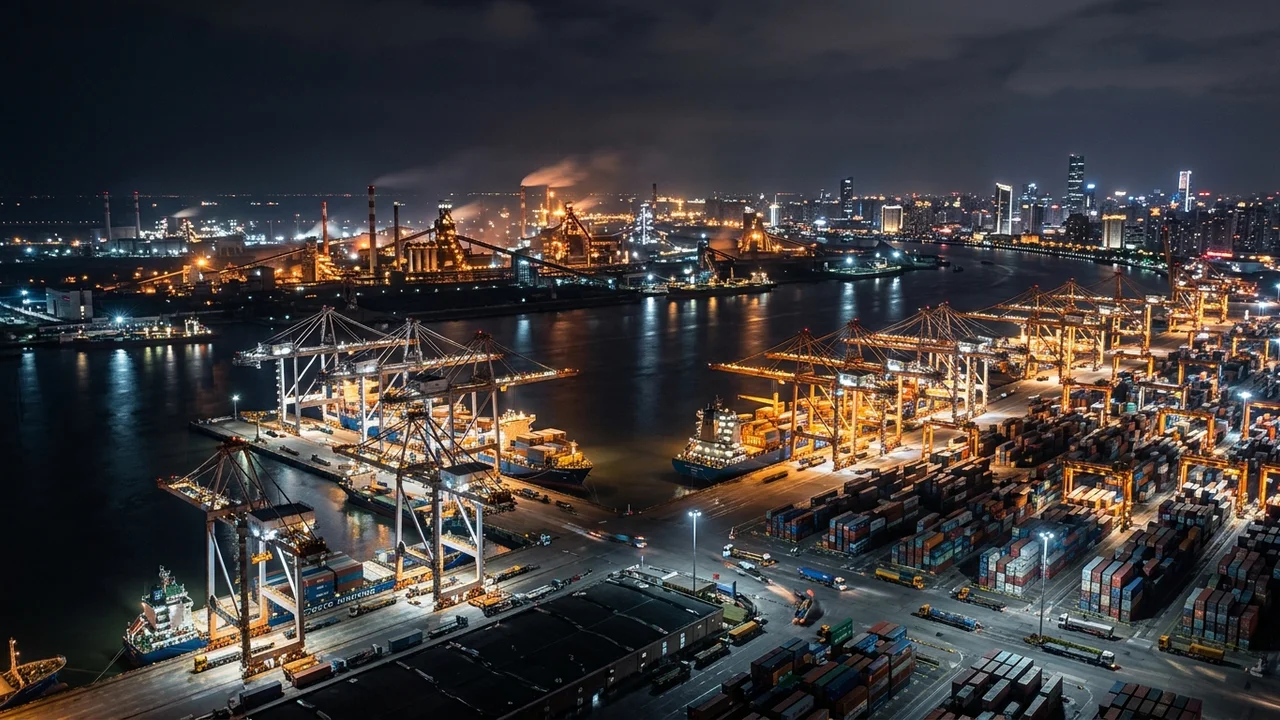
CBAM China exposure is defined by a single critical number: the default embedded emissions value for Chinese steel slab is 3.167 tCO₂e per tonne, established under Implementing Regulation (EU) 2025/2621, more than double the BF-BOF benchmark of 1.370 tCO₂e/t. China accounts for roughly 15% of all EU-bound CBAM-covered imports, concentrated in steel and aluminium, making it one of the highest-exposure exporting nations by volume. The unresolved Article 9 question (whether China's expanding National ETS qualifies for a carbon price deduction) shapes every compliance calculation for EU importers of Chinese goods in 2026.
Image brief: Aerial view of a Chinese blast furnace steel complex at dusk, with industrial silhouette. Text overlay: "3.167 tCO₂e Default: CBAM China 2026". Commission as branded illustration with cbamguide.com logo.
What Is China's CBAM Exposure in 2026?
China faces CBAM obligations across steel and aluminium EU exports, with combined annual trade value estimated at €8–12 billion. The exposure is anchored in iron and steel production via the blast furnace–basic oxygen furnace (BF-BOF) route, which is the dominant production method across Chinese mills. Aluminium adds a secondary layer of risk: China is the world's largest primary aluminium producer, and its coal-intensive electricity grid gives Chinese smelters among the highest indirect emissions of any exporting country.
CBAM China exposure differs structurally from that of other major exporters. Turkey, for example, sends approximately 6 million tonnes of steel to the EU annually and has near-zero alternative markets due to geographic proximity. China exports significantly less steel to the EU in volume terms relative to its total production capacity, meaning EU-directed trade is commercially significant but not existentially so. This market diversification provides Chinese exporters with strategic flexibility that Turkish or Ukrainian producers do not have.
The EU carbon border adjustment mechanism, established by Regulation (EU) 2023/956 in its definitive phase from January 1, 2026, prices the embedded emissions of CBAM-covered goods at the EU ETS carbon price. For EU importers of Chinese steel and aluminium, this creates a direct certificate-purchase obligation proportional to the embedded CO₂ of each tonne imported. The EU ETS price as of late March 2026 stands at approximately €70 per tonne of CO₂, providing the reference price for all CBAM calculations this year.
China's Steel Default Value: 3.167 tCO₂e/t and Why It Matters
The 3.167 tCO₂e/t default value for Chinese steel slab under IR 2025/2621 creates a punitive cost burden for any EU importer using defaults rather than verified actual emissions data.
To understand the scale of this penalty, compare the default value against the official BF-BOF benchmark of 1.370 tCO₂e/t: Chinese exporters using default values carry an embedded emissions basis that is 131% above the benchmark. At the current EU ETS price of approximately €70 per tonne CO₂, a tonne of Chinese steel imported using the default value carries a gross CBAM cost of roughly €221.69 per tonne (3.167 × €70). Under verified actual emissions data, a Chinese BF-BOF producer emitting closer to 2.0 tCO₂/t would face a gross cost of €140 per tonne, a difference of approximately €81.69 per tonne.
This gap is the central compliance lever for CBAM China steel exporters. The 2026 net obligation remains small because the CBAM factor stands at only 2.5% (97.5% of free allocation remains in the EU ETS). The effective net cost using defaults in 2026 is approximately €5.54 per tonne (3.167 × €70 × 2.5%). Using actual data near 2.0 tCO₂/t, that figure falls to approximately €3.50 per tonne. The absolute difference in 2026 is modest, but the trajectory is steep: by 2030, when the CBAM factor reaches 48.5%, the default-versus-actual gap translates to roughly €39.62 per tonne in additional net CBAM cost. By 2034, at 100% CBAM factor, Chinese exporters using the 3.167 tCO₂e/t default face costs exceeding €221 per tonne gross, compared to approximately €140 per tonne for those providing verified actual data.
Chinese producers with access to the CBAM Operators Portal have a clear financial incentive to engage accredited EU verifiers and submit installation-level emissions data before the first CBAM declaration deadline of September 30, 2027 (covering calendar year 2026). The cost of verification is recoverable within a single shipping season for any producer exporting at scale.
The table below summarizes China's CBAM-covered sectors, the applicable default values, and estimated gross costs at the current EU ETS price:
| Sector | Default Value (tCO₂e/t) | Gross CBAM Cost @ €70/tCO₂ | BF-BOF Benchmark (tCO₂e/t) | 2026 Net Cost (2.5% factor) |
|---|---|---|---|---|
| Steel slab (BF-BOF) | 3.167 | ~€221.69/t | 1.370 | ~€5.54/t |
| Steel (EAF scrap route) | ~0.5 (actual-based) | ~€35/t | 0.072 | ~€0.88/t |
| Primary aluminium (direct emissions only) | ~1.5–2.1 | ~€105–147/t | N/A | ~€2.63–3.68/t |
| Steel articles (Chapter 73) | Country-specific default applies | Varies by CN code | Benchmark depends on route | Varies |
Source: IR 2025/2621; EU ETS price as of late March 2026 (~€70/tCO₂); net 2026 cost = gross × 2.5% CBAM factor. All figures are gross before any Article 9 deduction.
The EU carbon border adjustment mechanism requires EU importers to hold CBAM certificates quarterly at a minimum of 50% of cumulative embedded emissions since the start of the calendar year, with full surrender by September 30, 2027. EU importers purchasing Chinese CBAM steel under default values therefore carry significantly higher certificate obligations than those sourcing from countries where actual emissions data is available.
Does China's ETS Qualify for Article 9 Deduction?
China's National ETS does not currently qualify for an Article 9 deduction under Regulation (EU) 2023/956, and the EU Commission has not yet made a determination on eligibility.
Article 9 of the CBAM regulation permits EU importers to deduct the carbon price effectively paid in the country of origin when calculating their CBAM certificate obligations. This deduction reduces the net financial burden on EU importers and indirectly benefits exporters through lower landed costs. For a deduction to apply, the third-country carbon pricing scheme must be legally binding, effectively enforced, and cover the relevant production installations.
China's National ETS (CN-ETS) launched in 2021 covering the power sector only. In March 2025, China dramatically expanded the ETS to include steel, cement, and aluminium sectors, adding approximately 3 billion tonnes of CO₂ and roughly 1,500 entities to the scheme. This expansion is a significant structural development with direct relevance to CBAM China compliance planning. However, two obstacles prevent Article 9 recognition as of April 2026.
The first obstacle is the price differential. The CN-ETS price stands at approximately $11 per tonne of CO₂ (approximately CNY 67 per tonne), compared to the EU ETS price of approximately €70 per tonne. Even if the scheme qualified, the Article 9 deduction would offset only approximately 15% of the CBAM certificate obligation for Chinese steel producers.
The second and more fundamental obstacle is the system's structure. The CN-ETS operates on an intensity-based cap rather than an absolute cap on total emissions. Under an intensity-based system, total emissions can increase while the system is technically in compliance, because the cap is set per unit of production rather than as a fixed ceiling. The EU Commission's assessment framework for Article 9 eligibility requires that a carbon pricing scheme be "effectively enforced" in a manner consistent with genuine emission reductions. China has signaled a transition toward absolute caps after 2027, but the transition remains incomplete as of the publication date of this article.
The practical implication for CBAM China compliance is that EU importers of Chinese-origin goods cannot apply any Article 9 deduction to their certificate calculations in 2026. All embedded emissions must be covered at the full EU ETS price. If China's ETS transitions to an absolute cap and the Commission grants recognition, the deduction would reduce obligations retrospectively from the date of recognition, but this outcome remains uncertain and no formal assessment timeline has been published.
China's Aluminium Exposure Under CBAM
China's primary aluminium exports to the EU carry CBAM liability on direct emissions only, totaling approximately €3.9 billion in annual trade value based on 2024 Eurostat data.
The EU carbon border adjustment mechanism prices only direct emissions for aluminium (listed in Annex II of Regulation (EU) 2023/956), covering CO₂ from carbon anode consumption and perfluorocarbon (PFC) emissions from the Hall-Héroult electrolysis process. Indirect emissions from electricity consumption are excluded, despite the fact that Chinese primary aluminium production relies heavily on coal-fired power, generating approximately 12–16 tCO₂e per tonne of total lifecycle emissions.
This exclusion creates an asymmetry that is commercially significant for CBAM China aluminium calculations. A Chinese smelter powered by a coal grid with an electricity emission factor of approximately 0.7 tCO₂ per MWh, consuming 15 MWh per tonne of primary aluminium, generates approximately 10.5 tCO₂ per tonne in indirect emissions that carry zero CBAM liability. The direct emissions basis of approximately 1.5–2.1 tCO₂e per tonne represents only a fraction of the total carbon footprint.
CBAM aluminium rules therefore significantly understate the full carbon intensity of Chinese primary aluminium relative to competitors using hydroelectric or nuclear power. EU Commission Recital 67 of the original regulation acknowledges this gap and signals intent to extend indirect coverage in a future review, but no proposal exists as of April 2026. Chinese aluminium producers benefit from this structural loophole in the short term, though its eventual closure would materially increase their CBAM exposure.
PFC emissions, specifically CF₄ (tetrafluoromethane, GWP of 6,630) and C₂F₆ (hexafluoroethane, GWP of 11,100), do fall within CBAM scope for aluminium. Legacy Chinese smelters with higher anode effect frequencies may carry significant PFC-related CBAM liability beyond the CO₂ component. Exporters of Chinese primary aluminium are advised to obtain installation-level PFC emission data to avoid default values that may overstate or understate the PFC component depending on the specific smelter.
Image brief: Interior of a primary aluminium electrolysis hall showing rows of reduction cells with visible carbon anodes. Text overlay: "CBAM Aluminium: Direct Emissions Only". Commission as branded illustration with cbamguide.com logo.
How Does China Compare to Other Major Steel Exporters?
The 3.167 tCO₂e/t default value for CBAM China steel positions Chinese exports as among the most cost-intensive under default calculations. The comparison below illustrates the differential across the leading steel-exporting nations and their current carbon pricing status.
The 4 compliance postures facing steel exporters under CBAM China and peer nations are categorized as follows:
- No carbon price, using defaults: Maximum CBAM certificate cost for the EU importer; no Article 9 offset; exporters face the strongest pressure to provide actual emissions data. China and Turkey fall into this category.
- Carbon price that does not yet qualify for Article 9: Exporters from countries with developing or intensity-based schemes (China with CN-ETS, Japan with GX-ETS) carry the full CBAM obligation with no deduction recognized.
- Carbon price pending Article 9 recognition: South Korea's K-ETS covers approximately 70% of national emissions and meets basic binding-and-enforced criteria; Commission assessment is ongoing.
- No significant CBAM-exposed exports: Countries where trade volumes fall below the 50-tonne de minimis threshold face no obligation, regardless of carbon pricing status.
China's position in the first two categories simultaneously (no qualifying carbon price for Article 9, combined with a punitive default value for steel) creates compound financial pressure on the CBAM China supply chain that accelerates from 2028 as the CBAM factor rises toward 48.5% in 2030.
What Is China's Government Response to CBAM?
China has raised concerns about CBAM China impacts through multilateral channels, including the WTO and the BRICS group, but has not filed a formal WTO dispute as of April 2026.
China's position aligns with the BASIC group (Brazil, India, South Africa, China), which collectively argues that CBAM revenues are recycled into the EU budget rather than returned to developing nations for decarbonization finance. Under Regulation (EU) 2023/956 and the EU Own Resources Decision, 75% of CBAM revenues flow to the EU budget and 25% to member states. The BASIC countries view this revenue allocation as evidence that CBAM is structurally inequitable, prioritizing EU fiscal interests over genuine climate cooperation.
China is also monitoring the circumvention risk dimension. Chinese steel exported to Vietnam for further processing and re-export to the EU triggers anti-circumvention provisions under CBAM. The regulation requires that embedded emissions be calculated based on the original production installation, not the country of final processing. EU importers sourcing Chinese-origin steel via third countries remain liable for embedded emissions at Chinese production-route defaults, making circumvention through Vietnamese processing commercially ineffective.
The strategic response from Chinese industry has focused on accelerating ETS expansion and the transition toward absolute caps, which would potentially unlock future Article 9 recognition. The March 2025 CN-ETS expansion to industrial sectors is the most concrete step in this direction. Belt and Road Initiative markets provide alternative demand for Chinese-origin CBAM China-exposed goods if EU competitiveness pressures intensify through the 2028–2030 CBAM acceleration period.
CBAM China Compliance: Practical Steps for EU Importers
EU importers of Chinese steel, aluminium, and related articles under CBAM China exposure face a structured compliance obligation that begins with the 2026 calendar year.
The 5 compliance priorities for EU importers of Chinese goods are listed below, ordered by financial materiality:
- Request actual emissions data from Chinese suppliers via the CBAM Operators Portal. The difference between the 3.167 tCO₂e/t default and actual verified emissions near 2.0 tCO₂/t represents approximately €81.69 per tonne in gross CBAM cost reduction. From 2030 onward, the net saving after the 48.5% CBAM factor reaches approximately €39.62 per tonne.
- Identify the correct production route (BF-BOF, EAF scrap, or DRI-EAF) for each Chinese installation. Route misclassification results in incorrect benchmark application and potential compliance shortfalls.
- Calculate quarterly holding requirements at no less than 50% of cumulative embedded emissions since January 1, 2026. Certificate sales begin February 1, 2027; the obligation period for 2026 is declared by September 30, 2027.
- Monitor the Article 9 CN-ETS recognition process. If the EU Commission grants deduction eligibility for the CN-ETS in a future determination, EU importers of Chinese goods may need to retroactively apply deductions from the recognition date. Systems for tracking carbon prices paid by Chinese suppliers should be built now.
- Assess de minimis exemption eligibility at 50 tonnes annual mass. EU importers purchasing Chinese goods below this threshold face no CBAM obligation regardless of default or actual emissions status.
For full guidance on CBAM default values and how to transition from default to actual emissions calculations, the CBAM Operators Portal provides installation-level submission tools that Chinese exporters can use directly.
CBAM China in the Broader Trade Context
CBAM China compliance sits at the intersection of carbon policy, trade law, and industrial strategy, making it one of the most complex country-specific CBAM questions in 2026.
Does China's WTO Position Affect EU Importers' CBAM Obligations?
China's participation in BRICS and BASIC multilateral criticism of CBAM does not affect the legal obligations of EU importers under Regulation (EU) 2023/956. WTO challenges, including Russia's formal DS639 filing from May 2025, do not suspend CBAM obligations during litigation. The EU's legal defense rests on GATT Article XX(b) (measures necessary to protect human, animal, and plant life) and Article XX(g) (conservation of exhaustible natural resources). EU importers must comply with CBAM China obligations regardless of WTO dispute outcomes, which may take years to resolve and face enforcement uncertainty given the non-functional WTO Appellate Body.
Will the CN-ETS Expansion Change CBAM China Costs?
The March 2025 CN-ETS expansion to steel, cement, and aluminium is a necessary but not sufficient condition for Article 9 recognition. Recognition requires the Commission to formally determine that the scheme is "effectively enforced" and produces carbon prices "effectively paid" at the installation level. The intensity-based structure of the CN-ETS, combined with the price differential of approximately $11/tCO₂ versus €70/tCO₂ EU ETS, means that even a recognized deduction would offset only a fraction of CBAM China liability. The structural incentive for Chinese producers to decarbonize below the default value benchmark remains stronger than any foreseeable Article 9 deduction.
How Does CBAM China Compare to CBAM Turkey?
CBAM Turkey represents the highest absolute commercial exposure of any non-EU country, with approximately €19 billion in CBAM-affected exports constituting nearly 8% of Turkey's total export value. China's EU-directed CBAM-exposed exports are estimated at €8–12 billion. The CBAM Turkey article covers the Customs Union legal argument and Turkey's pilot ETS development, which parallels the CN-ETS expansion question for China. Both countries face the same Article 9 eligibility gap: carbon pricing schemes exist or are developing, but neither currently qualifies for deduction recognition. For guidance on the exporter-side compliance process, CBAM compliance for exporters provides the full obligation chain from data submission to verification.
Is China Subject to CBAM for All Goods?
CBAM China applies only to the 6 product sectors covered by Annex I of Regulation (EU) 2023/956: iron and steel, cement, aluminium, fertilizers, electricity, and hydrogen. The vast majority of Chinese exports to the EU, including electronics, machinery, textiles, and consumer goods, fall outside CBAM scope entirely. The proposed downstream expansion under COM(2025)989 would extend coverage to approximately 180 additional product categories from 2028, which could materially increase China's CBAM exposure if approved, but this proposal remains pending as of April 2026.
What Verification Does China Need for Actual Emissions Data?
EU importers using actual emissions data from Chinese installations require third-party verification by a verifier accredited under Implementing Regulation (EU) 2025/2621. The verifier must assess installation-level emission reports against the calculation methodology specified in IR 2025/2547. Verifier registration opens September 1, 2026. Chinese exporters aiming to use actual data for the 2026 declaration year (due September 30, 2027) should begin engaging EU-recognized verifiers no later than Q3 2026 to ensure data is auditable against the full calendar year.