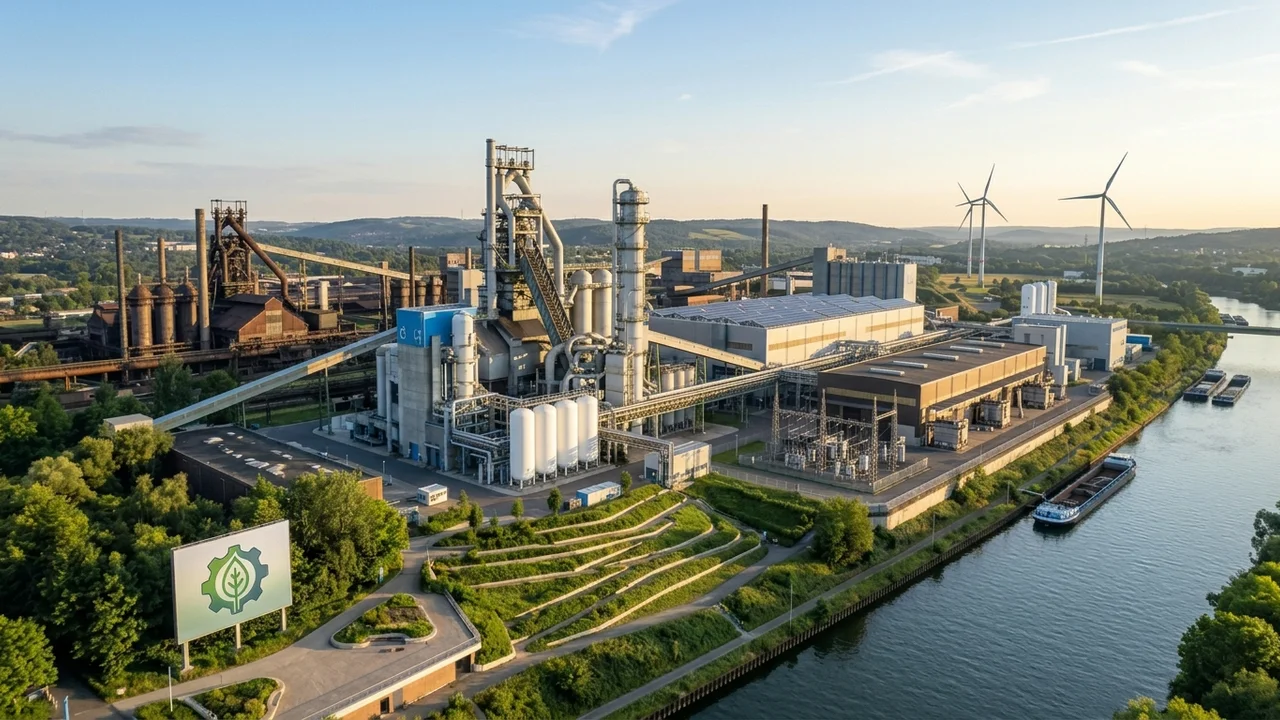
Germany accounts for the largest share of CBAM-covered import volume among all 27 EU member states, with German companies representing a significant portion of the 12,000+ authorized declarant applications filed across the bloc as of January 2026. The National Competent Authority (NCA) for German importers is Deutsche Emissionshandelsstelle (DEHSt), the federal emissions trading office operating under the Federal Environment Agency (Umweltbundesamt, UBA). German importers of steel, aluminium, and fertilizers face the full compliance chain under Regulation (EU) 2023/956, including authorization with DEHSt, embedded emissions data collection, third-party verification, and annual certificate surrender beginning September 30, 2027. This article covers every obligation a German importer must satisfy in 2026.
Caption: DEHSt operates within the Federal Environment Agency (UBA) and serves as Germany's National Competent Authority for CBAM authorized declarant applications.
What Is CBAM and Why Does It Matter for German Importers
CBAM is a certificate-based regulatory mechanism under Regulation (EU) 2023/956 that requires EU importers of carbon-intensive goods to purchase certificates proportional to the embedded CO₂ emissions in their imports, priced at the EU Emissions Trading System carbon price, to prevent carbon leakage. The definitive phase began January 1, 2026. CBAM is not a tariff, not a carbon tax, and not a customs duty — it is a compliance certificate obligation that runs parallel to EU customs procedures.
For German companies, the practical consequence is a new category of regulatory obligation administered entirely by DEHSt. German importers must obtain authorized declarant status before importing CBAM goods, register with the EU CBAM Registry, collect verified emissions data from non-EU production installations, and surrender CBAM certificates each year by September 30, covering imports from the prior calendar year. The first declaration covering 2026 imports is due September 30, 2027.
Germany's industrial structure makes this obligation substantial. The country imports large volumes of steel from Turkey, India, and South Korea; aluminium from the UAE and Russia-adjacent supply chains; and nitrogen fertilizers from Egypt, Algeria, and historically Russia. Each of these product categories falls within Annex I of Regulation (EU) 2023/956, and the corresponding CN codes trigger the full importer obligation chain. Understanding the EU CBAM framework in full is the first step before engaging DEHSt, and the EU CBAM guide at cbamguide.com covers the regulation's mechanics from legal basis through certificate surrender.
DEHSt Authorization: The German Application Process
German companies must apply to DEHSt for authorized CBAM declarant status. DEHSt processes applications through the Authorization Management Module (AMM) of the EU CBAM Registry, accessible at cbam.ec.europa.eu. The application requires EU Customs Trader Portal authentication using EORI credentials via the UUM&DS system — the same authentication platform German companies already use for EU ETS registry access.
The application deadline for continued provisional importing during the definitive phase was March 31, 2026, as established by Article 17(7a) of Regulation (EU) 2023/956, inserted by the Omnibus amendment Regulation (EU) 2025/2083. Importers who submitted a complete application by that date may continue importing pending DEHSt's authorization decision. DEHSt has a maximum of 120 days from receipt of a complete application to issue a decision, as set by Article 4(1) of Implementing Regulation (EU) 2025/486.
The documents required for the DEHSt application are specified in IR 2025/486, Articles 4 through 8. The required submission set includes the following items, all of which must be current and complete at the time of submission:
- Valid EORI number and business registration documentation
- Tax identification number (Steuernummer or USt-IdNr)
- Audited financial statements for the preceding 2 to 3 financial years, or a bank guarantee for entities established less than 2 years
- Evidence of 5-year customs and tax compliance history: no serious customs violations, no convictions for tax fraud, smuggling, money laundering, or environmental offenses, and no active insolvency proceedings
- Description of the CBAM goods to be imported, including CN codes, estimated annual tonnage, countries of origin, and production installation names with addresses and geographic coordinates
- Identity of the person within the company legally responsible for CBAM compliance
- An internal CBAM compliance procedures document
DEHSt may refuse authorization on grounds including serious customs violations in the prior 5 years, active insolvency proceedings, or inclusion on the EU consolidated financial sanctions list. The authorization covers all CBAM goods the importer intends to declare; updates to the CN code list or installation roster require notifying DEHSt under the amendment procedures.
Once DEHSt issues authorization, German importers access their CBAM account in the EU CBAM Registry. The registry holds certificate holdings, import transaction records automatically populated from customs data, declaration history, and verification report links. German importers already familiar with EU ETS registry access find the UUM&DS authentication flow identical in structure.
For German companies evaluating whether authorization applies to their business, the full set of CBAM for EU importers obligations is covered in detail at cbamguide.com, including how to determine whether the 50-tonne annual de minimis threshold under Article 2(3a) exempts smaller import flows.
Germany's Key CBAM Import Sectors
Germany imports CBAM-covered goods across three primary sectors: iron and steel, aluminium, and fertilizers. The embedded emission factors, CBAM cost calculations, and compliance requirements differ across these sectors, and German importers managing mixed-sector sourcing must track each separately in their CBAM registry account.
The table below summarizes the key parameters for each sector relevant to German importers under the current EU ETS reference price of approximately €70 per tonne CO₂ (late March 2026 market data, which fluctuates daily):
| Sector | Key CN Codes | Emission Factor | Gross CBAM Cost @ €70 | Indirect Emissions Priced |
|---|---|---|---|---|
| Steel (BF-BOF) | 7207, 7208–7217 | ~2.0 tCO₂/t | ~€140/t | No |
| Steel (EAF scrap) | 7207, 7208–7217 | ~0.5 tCO₂/t | ~€35/t | No |
| Primary aluminium | 7601, 7604–7607 | ~1.5 tCO₂/t (direct) | ~€105/t | No |
| Urea fertilizer | 3102 10 | ~2.5 tCO₂e/t | ~€175/t | Yes |
| Ammonium nitrate | 3102 30 | ~1.5–2.0 tCO₂e/t | ~€105–140/t | Yes |
Net CBAM cost in 2026 is significantly lower than the gross figures above. The CBAM factor for 2026 is 2.5% (reflecting 97.5% remaining free allocation under the EU ETS phase-out schedule). A German importer sourcing 5,000 tonnes of BF-BOF steel at €70 ETS generates a gross CBAM obligation of €700,000, but the net obligation in 2026 is approximately €17,500 (€700,000 × 2.5%). This net cost rises sharply as free allocation phases out: the CBAM factor reaches 48.5% in 2030 and 100% in 2034.
Steel Imports and German CBAM Obligations
German steel importers source heavily from Turkey (the EU's largest steel supplier at approximately 6 million tonnes per year), India (approximately 3 million tonnes per year), and South Korea (approximately 2 million tonnes per year). None of these countries currently has a qualifying carbon pricing scheme for Article 9 deduction purposes. Turkey's pilot emissions trading system launched in 2026 under Climate Law No. 7552 but provides full free allocation, meaning no "effectively paid" carbon price exists. Indian and South Korean carbon pricing schemes are under Commission assessment but have not yet been formally recognized as qualifying for the Article 9 deduction mechanism.
German steel importers who cannot obtain verified actual emissions data from Turkish or Indian producers must use default values from Implementing Regulation (EU) 2025/2621. Default values carry a mark-up of 10% above the calculated default in 2026, rising to 20% in 2027 and 30% from 2028. For BF-BOF steel from these countries, actual producer emissions often fall below the default, which means that securing verification for actual values reduces certificate obligations. The first physical site visit for verification is mandatory — remote verification is not permitted for the first reporting period covering 2026 imports.
The CBAM steel sector guide at cbamguide.com covers CN codes, production route classification, and default value calculations in full.
Aluminium Imports and PFC Emissions
Aluminium presents a specific technical challenge for German importers: the sector covers both CO₂ and perfluorocarbon (PFC) emissions, specifically CF₄ with a global warming potential of 6,630 and C₂F₆ with a global warming potential of 11,100. Indirect emissions from electricity consumption are not priced under CBAM for aluminium, unlike cement and fertilizers. German importers of primary aluminium must track direct embedded emissions only.
Germany's aluminium import exposure includes supply from UAE (Emirates Global Aluminium), Bahrain (Alba), and other Gulf producers, as well as secondary aluminium from various sources. Norway-origin aluminium is exempt from CBAM under Annex III (EEA exemption). The CBAM aluminium sector guide details the PFC calculation methodology, Annex II classification, and the distinction between primary and secondary aluminium emission factors.
What Does Authorized Declarant Status Require from German Importers
Obtaining authorized declarant status from DEHSt is the prerequisite for all other CBAM obligations. Without DEHSt authorization, a German company cannot legally import CBAM goods under the definitive phase. Importing without authorization triggers the penalty of €300 to €500 per tonne CO₂e under Article 26(2) of Regulation (EU) 2023/956, as amended by Regulation (EU) 2025/2083. This penalty applies at 3 to 5 times the standard rate of €100 per tonne CO₂e that applies to authorized declarants who fail to surrender sufficient certificates.
The full process for obtaining how to get CBAM authorized declarant status includes the DEHSt application, registry access configuration, and post-authorization quarterly obligations.
Caption: German importers follow a 10-step compliance chain from DEHSt authorization through annual certificate surrender, with verifier engagement as the critical 2026 bottleneck.
After authorization, German importers carry ongoing obligations across every import cycle. The key annual milestones are listed below in chronological order:
- February 1, 2027: CBAM certificate sales begin via DEHSt (Common Central Platform)
- End of each calendar quarter from 2027: Hold CBAM certificates equal to at least 50% of cumulative embedded emissions imported since January 1
- September 30, 2027: First annual CBAM declaration covering all 2026 imports
- October 31, 2027: Deadline for certificate buyback (up to 50% of certificates purchased)
- November 1, 2027: Unused certificates from prior periods are cancelled by the registry
The quarterly holding requirement is a rolling obligation. By the end of Q2 2027, for example, a German importer who has brought in goods representing 10,000 tonnes CO₂e in embedded emissions since January 1, 2027, must hold at least 5,000 CBAM certificates in their DEHSt-linked registry account. DEHSt issues a formal notice if the holding threshold is not met.
How DEHSt Compares to Other EU National Competent Authorities
DEHSt administers CBAM authorization within Germany's existing emissions trading governance framework. Twenty of 27 EU member states designated environment or energy departments as their NCA; 7 designated financial or tax departments. DEHSt falls firmly in the environment category, operating under the Federal Environment Agency (UBA), which also administers Germany's participation in the EU ETS. This institutional alignment means German companies with existing EU ETS experience find the DEHSt CBAM process administratively familiar: the same registry authentication system, the same accreditation framework for verifiers, and consistent regulatory interpretation between ETS compliance and CBAM compliance.
The key distinction from NCAs in some other member states is DEHSt's technical depth. Because UBA hosts both the ETS and CBAM competence in the same institution, DEHSt guidance documents draw on detailed sector-specific knowledge for steel, aluminium, and energy-intensive industries, all of which are central to Germany's import exposure. German importers benefit from this compared to importers filing through NCAs designated for purely fiscal reasons in other jurisdictions.
Frequently Asked Questions on CBAM Germany
What is DEHSt and what is its role in CBAM?
DEHSt (Deutsche Emissionshandelsstelle) is Germany's National Competent Authority for CBAM under Regulation (EU) 2023/956. DEHSt processes authorized declarant applications from German companies, manages German importers' accounts in the EU CBAM Registry, conducts authorization assessments within 120 days, and sells CBAM certificates to authorized declarants from February 1, 2027. DEHSt operates within the Federal Environment Agency (UBA) and applies the same verification and accreditation standards used for EU ETS compliance.
What is the DEHSt application deadline for CBAM authorization?
The application deadline was March 31, 2026, under Article 17(7a) of Regulation (EU) 2023/956 as inserted by the Omnibus amendment Regulation (EU) 2025/2083. German importers who submitted a complete application by that date may continue importing CBAM-covered goods provisionally while DEHSt processes the application. Importers who missed the deadline and import without authorization face penalties of €300 to €500 per tonne CO₂e.
Do German importers need to verify emissions data from foreign suppliers?
Verification by an accredited third-party verifier is required when submitting actual embedded emissions data (rather than default values) in the annual CBAM declaration. Accredited verifiers must be registered in the CBAM Registry from September 1, 2026. Physical site visits to non-EU production installations are mandatory for the first verification period covering 2026 imports. Verifier fees range from €5,000 to €50,000 per production installation. German importers sourcing from many installations should engage verifiers by mid-2026 to secure capacity before the September 2026 registration opening.
Can German importers use default emissions values?
German importers may use default values from Implementing Regulation (EU) 2025/2621 when actual verified data is unavailable. Default values do not require third-party verification. However, default values carry a mark-up of 10% above the calculated default in 2026, 20% in 2027, and 30% from 2028. For steel and aluminium imports from countries with carbon-intensive production, defaults often exceed verified actual emissions, making actual measurement financially advantageous from 2027 onward.
Is there a de minimis threshold for German CBAM importers?
The de minimis threshold is 50 tonnes annual net mass per importer across all CBAM sectors, as established by Article 2(3a) of Regulation (EU) 2023/956, as amended. German importers whose total annual CBAM goods imports fall below 50 tonnes are exempt. Electricity and hydrogen are excluded from the de minimis provision — all volumes of electricity and hydrogen imports are subject to CBAM obligations regardless of quantity. Details on the threshold calculation are covered in the CBAM de minimis threshold guide.
Are CBAM certificates traded on a secondary market?
CBAM certificates are not traded on any secondary market. German importers purchase certificates exclusively from DEHSt via the Common Central Platform, and sell them back only to DEHSt, at the original purchase price. The maximum buyback is 50% of certificates purchased in that calendar year, with a deadline of October 31 of the surrender year. The CBAM certificates guide covers purchase procedures, quarterly holding calculations, and surrender mechanics in full.
What penalty applies if a German importer fails to surrender enough certificates?
An authorized declarant who fails to surrender sufficient CBAM certificates by the September 30 annual deadline faces a penalty of €100 per tonne CO₂e not covered, under Article 26(1) of Regulation (EU) 2023/956 as amended by Regulation (EU) 2025/2083. The penalty does not extinguish the surrender obligation — the importer must still procure and surrender the missing certificates in addition to paying the penalty. The total cost of non-compliance therefore equals approximately €170 per tonne CO₂e (€100 penalty plus ~€70 certificate cost at current ETS prices).
Does Germany's EU ETS membership reduce CBAM obligations for German importers?
No. Germany's participation in the EU ETS as a domestic emitter is separate from CBAM obligations as an importer. The EU ETS governs domestic production and energy facilities inside Germany. CBAM governs the embedded emissions in goods produced outside the EU and imported into the EU. A German steelmaker operating a domestic blast furnace is an EU ETS participant; the same company importing steel from Turkey is a CBAM authorized declarant. These two regulatory identities are independent, though both are administered through DEHSt.