Italy ranks among the top five EU member states by volume of CBAM-regulated imports, with steel, cement, and aluminium collectively representing more than 70% of Italian importers' annual CBAM exposure across over 2,400 authorized operators registered as of early 2026. The EU CBAM entered its definitive phase on January 1, 2026, requiring Italian companies that import carbon-intensive goods to obtain authorization, quantify embedded emissions, and ultimately surrender certificates proportional to verified CO₂e. Understanding which sectors carry the highest financial exposure, how Italy's competent authority ISPRA processes authorization applications, and what the compliance calendar looks like through 2027 gives Italian importers the operational clarity needed to act before the September 30, 2027 first-declaration deadline.
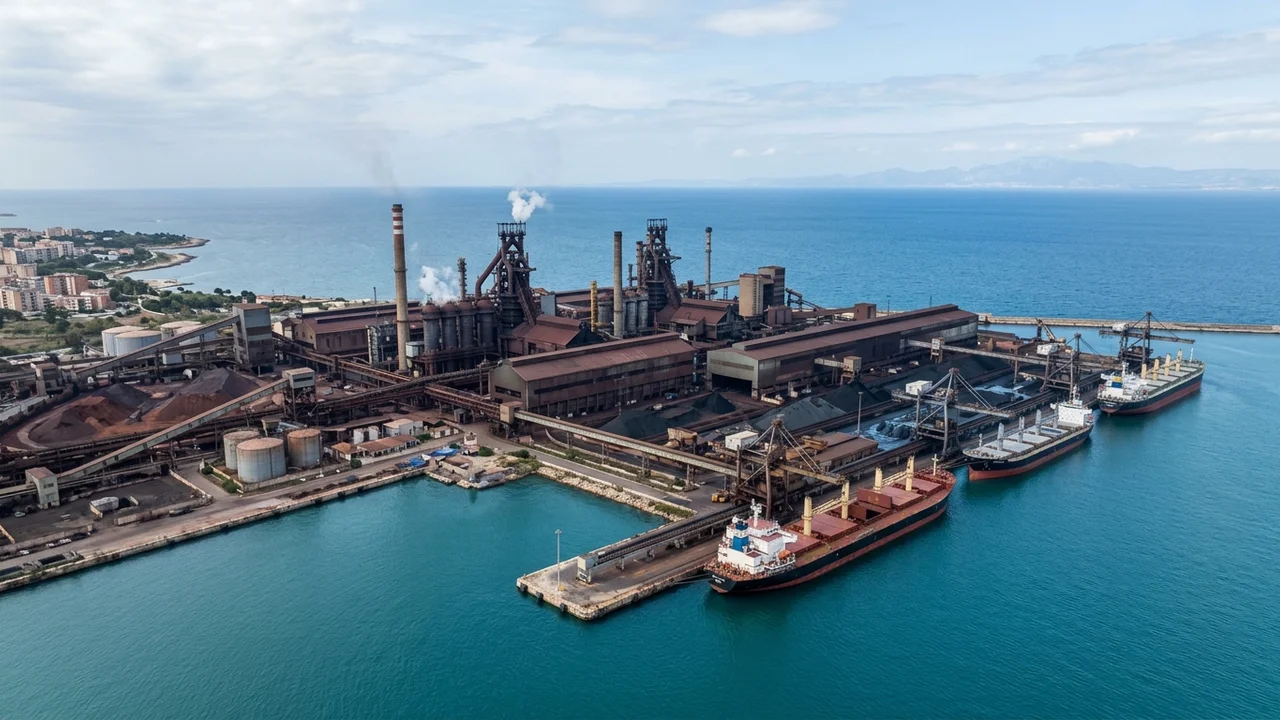
Caption: Major northern Italian port handling bulk steel and aluminium imports, two of the three highest-exposure CBAM sectors for Italian operators.
Why Italy Faces High CBAM Exposure Across Three Sectors
Italy's CBAM exposure concentrates in three sectors, including steel (flat and long products), cement clinker, and primary aluminium, each of which carries distinct embedded-emission profiles and sourcing geographies that determine the ultimate certificate burden on Italian importers.
Italy is a net importer of primary aluminium and a significant importer of blast-furnace steel, two product categories that generate the highest gross CBAM costs per tonne. At the current EU ETS reference price of approximately €70 per tonne of CO₂ (late March 2026), blast-furnace steel produced via the BF-BOF route carries an embedded-emission factor of roughly 2.0 tCO₂ per tonne, translating to a gross CBAM cost of approximately €140 per tonne before the free-allocation adjustment. Primary aluminium (direct emissions only) carries approximately 1.5 tCO₂ per tonne, equivalent to a gross cost of roughly €105 per tonne. Portland cement sits at approximately 0.83 tCO₂ per tonne, or about €58 per tonne gross.
Those gross figures matter less in 2026 than they will from 2028 onward. The net certificate obligation in 2026 is calculated by multiplying the gross cost by the current CBAM factor of 2.5%, because 97.5% of EU ETS free allocation remains in place this year. A representative Italian importer bringing in 5,000 tonnes of BF-BOF steel faces a 2026 certificate cost of approximately €17,500 at €70 per tCO₂ (10,000 tCO₂ × 2.5% = 250 certificates × €70). That same transaction generates a certificate cost of approximately €340,000 in 2030, when only 51.5% of free allocation remains. The planning window is narrow: Italian companies that treat 2026 as a low-stakes transition year risk being structurally unprepared for 2028 to 2030 exposure.
The steel sector under CBAM deserves particular attention from Italian operators because Italy's flat-rolled steel import mix includes significant volumes from Turkey, India, and South Korea, three countries with differing carbon pricing regimes, each of which affects whether an Article 9 deduction is available to the Italian importer.
Italy's Competent Authority: What ISPRA Does Under CBAM
ISPRA serves as Italy's national competent authority (NCA) for CBAM, operating under the formal designation of the Comitato nazionale per la gestione della direttiva 2003/87/CE, housed within the Ministry of Environment. ISPRA processes all Italian authorization applications, manages authorized declarant accounts in the EU CBAM Registry, sells certificates to Italian operators (from February 1, 2027), and conducts risk-based inspections under Article 15 of Regulation (EU) 2023/956.
Italian importers file authorization applications through the Authorization Management Module (AMM) of the CBAM Registry at cbam.ec.europa.eu, using their EORI credentials via the UUM&DS authentication system. ISPRA then receives the application through the same platform and has a maximum of 120 days from receipt of a complete application to issue a decision, per Article 4(1) of Implementing Regulation 2025/486.
The application deadline for continued provisional importing during the definitive phase was March 31, 2026, per Article 17(7a) inserted by Regulation (EU) 2025/2083. Importers who filed by that date may continue importing while their authorization decision is pending. Importers who missed the deadline and have not yet applied face the unauthorized-importer penalty of €300 to €500 per tonne CO₂e under Article 26(2) of the amended regulation, which represents 3 to 5 times the standard certificate penalty rate.
ISPRA's enforcement culture follows the Italian Ministry of Environment's established practice from EU ETS oversight, meaning the authority is well-versed in emissions accounting standards. Italian operators can expect consistent treatment with the broader EU ETS compliance framework. The five-year compliance history check, which covers customs violations, tax fraud convictions, and active insolvency proceedings, follows the same criteria applied to EU ETS operators under Italian law.
CBAM Compliance Calendar for Italian Importers
Italian importers operating under the definitive phase face six binding deadlines between now and end-2027. The compliance calendar below reflects values from Regulation (EU) 2023/956 as amended by Regulation (EU) 2025/2083.
| Deadline | Date | Obligation | Regulatory Basis |
|---|---|---|---|
| Authorization application (new entrants) | March 31, 2026 | File for authorized declarant status with ISPRA | Article 17(7a), Reg. 2025/2083 |
| Quarterly holding check (Q2 2027) | June 30, 2027 | Hold certificates covering ≥50% of cumulative 2027 embedded emissions | Article 22(2), as amended |
| Verifier engagement deadline (practical) | July 2027 (recommended) | Contract accredited verifier for all 2026-import production installations | DR 2025/2551 |
| Certificate purchase window opens | February 1, 2027 | Purchase CBAM certificates from ISPRA via Common Central Platform | Reg. 2025/2083 |
| First CBAM declaration | September 30, 2027 | Submit 2026 annual declaration and surrender certificates | Article 6, as amended |
| Certificate buyback deadline | October 31, 2027 | Sell back surplus certificates (up to 50% of purchased) | Article 23, as amended |
Four features of this calendar demand attention from Italian compliance teams. First, verifiers cannot register in the CBAM Registry until September 1, 2026, creating a 13-month window from registration to the first declaration deadline, a window that is tight given that thousands of global production installations require first-time physical site visits. Italian importers sourcing from Turkey, India, and China face particularly constrained verifier availability in those geographies. Engaging verifiers in Q2 2026 rather than waiting for registry opening in September materially reduces the risk of missing the September 30, 2027 deadline.
Second, the quarterly holding requirement of at least 50% of cumulative embedded emissions (Article 22(2)) does not begin in 2026 but applies from 2027 onward, coinciding with the start of certificate sales. Italian importers need to model their expected 2027 import volumes and embedded emissions now, so they can purchase certificates at the right pace from February 2027.
Third, the penalty for failing to surrender sufficient certificates is €100 per tonne CO₂e (Article 26(1)), and this penalty does not discharge the underlying obligation. The importer still owes the certificates. The total non-compliance cost equals the €100 penalty plus the certificate purchase price at current ETS rates, giving a minimum exposure of approximately €170 per tonne CO₂e at current prices.
Fourth, the record-keeping obligation runs until the end of the fourth year following the declaration year, approximately four to five years from date of import. Italian importers must retain customs declarations, producer emissions data, monitoring plan documentation, verification reports, and certificate purchase confirmations throughout this period.
How Italian Importers Obtain Embedded Emissions Data
Embedded emissions data from non-EU production installations is the operationally most challenging requirement for Italian CBAM compliance. Italian importers must obtain specific direct embedded emissions per tonne of goods from each non-EU producer, and for cement and fertilizers also the specific indirect embedded emissions, per Article 7 and Implementing Regulation 2025/2547.
Three data-collection scenarios face Italian importers. The first is full cooperation from the producer: the non-EU facility provides a complete emissions dataset verified under the CBAM Operators Portal, and the Italian importer submits actual verified values with a zero mark-up. The second is partial cooperation: the producer provides data but lacks a qualifying monitoring plan, requiring the importer and verifier to assess whether actual values can be substantiated. The third is refusal or incapacity: the producer cannot supply verified data, and the Italian importer must fall back on default values from Implementing Regulation 2025/2621.
Default values carry a 10% mark-up above the calculated country default in 2026, rising to 20% in 2027 and 30% from 2028 onward (except fertilizers, which carry a 1% mark-up). For Italian steel importers sourcing from Turkey specifically, this creates a significant cost gap. The Turkish Portland cement default under "other countries" is approximately 1.584 tCO₂e per tonne, compared with typical Turkish actual emissions of approximately 0.88 tCO₂e per tonne. At €70 per tCO₂, this default overstates cost by roughly €49 per tonne, which exceeds the FOB price in competitive cement segments. Italian cement importers sourcing from Turkey have a powerful financial incentive to engage Turkish producers in actual-data collection rather than accepting defaults.
For Italian aluminium importers, sourcing geography matters directly. Primary aluminium from the UAE (EGA), Bahrain (ALBA), and other non-EEA producers falls within CBAM scope. Norway, as an EEA member, is exempt. Russian aluminium from RUSAL, historically a significant supply source for Italian downstream fabricators, is both sanctions-impacted and subject to CBAM for any volumes that do reach EU shores. The EU ETS price trajectory from 2028 to 2030 makes default-value aluminium imports increasingly expensive for Italian operators who have not secured actual-value verification.
What Italian Importers Must Submit to ISPRA in 2027
The annual CBAM declaration, submitted via the CBAM Registry to ISPRA by September 30, 2027 for calendar year 2026 imports, contains six mandatory elements under Article 6 of the amended regulation.
The six required declaration elements are listed below.
- Total quantity of CBAM goods imported during 2026, broken down by product type and country of origin, expressed in tonnes
- Total specific embedded emissions per product type and country of origin, expressed in tCO₂e per tonne
- Total number of CBAM certificates to be surrendered, calculated after any Article 9 deductions and SEFA free-allocation adjustments
- Carbon prices effectively paid in the country of origin, with supporting documentation, where an Article 9 deduction is claimed
- References to verification reports for all production installations where actual values are used
- Free allocation adjustment calculation (SEFA) where applicable to EU-producing installations
Italian importers claiming an Article 9 deduction benefit from a reduction in the number of certificates they must surrender. The deduction applies only where the non-EU producer paid a legally binding carbon price for the specific embedded emissions of the goods exported to Italy. Voluntary carbon offsets and internal corporate carbon prices are categorically excluded. As of April 2026, South Korea's K-ETS is the carbon pricing scheme most likely to receive Commission recognition, though the formal assessment is pending. Italian steelmakers sourcing significant volumes from POSCO or Hyundai Steel should monitor Commission announcements on K-ETS recognition closely.
Caption: CBAM compliance process for Italian authorized declarants from ISPRA authorization through annual declaration to certificate surrender by September 2027.
How Does CBAM Affect Italian Importers in Practice?
Italian companies that import CBAM goods face obligations under EU importer obligations that cover authorization, emissions data collection, third-party verification, certificate purchase, and annual declaration. The practical burden varies significantly by sector, import volume, and the carbon intensity of the non-EU production installation.
For a mid-sized Italian steel distributor importing 15,000 tonnes per year of BF-BOF flat products from Turkey, the 2026 net CBAM certificate cost at €70 per tCO₂ is approximately €52,500 (30,000 tCO₂ × 2.5% × €70). The same importer in 2030, with free allocation at 51.5%, faces a certificate cost of approximately €1,020,750 for the same import volume. The difference between these two figures (a 19-fold increase over four years) represents the central financial planning challenge for Italian importers.
Third-party verification fees add a separate cost layer. Italian importers sourcing from five production installations in Turkey, India, or China face first-cycle verification costs of €25,000 to €250,000 depending on installation complexity, per the €5,000 to €50,000 range per installation. Verification costs apply regardless of import volume above the de minimis threshold of 50 tonnes per year.
Supplementary Compliance Guidance for Italian Operators
Does the 50-Tonne De Minimis Threshold Apply to Italian Importers?
Italian importers fall below the CBAM obligation if their total annual imports of CBAM goods across all covered sectors remain at or below 50 tonnes per importer per year, per Article 2(3a) as amended by Regulation (EU) 2025/2083. The threshold is calculated across all Annex I products combined, not per sector. An Italian company importing 30 tonnes of steel profiles and 25 tonnes of aluminium extrusions exceeds the threshold in aggregate. Electricity and hydrogen imports have no de minimis threshold regardless of volume.
The 50-tonne threshold replaced the prior pre-Omnibus framing of €150 per consignment. Italian importers who previously assessed their CBAM exposure under the old framework must recalculate using the annual aggregate mass rule. Small Italian fabricators that source limited quantities of CBAM goods from non-EU producers should calculate their total annual import mass carefully before concluding they are exempt.
How Does ISPRA Handle Authorization Refusals for Italian Companies?
ISPRA issues authorization refusals based on the grounds enumerated in Article 17 of Regulation (EU) 2023/956: serious customs violations within the prior five years, criminal convictions for tax fraud or smuggling, active insolvency proceedings, or subject to EU financial sanctions. Italian importers can appeal a refusal through the Italian administrative court system, with final escalation to the Court of Justice of the European Union if a constitutional interpretation of the regulation is contested. No dedicated EU-level CBAM appeals tribunal exists.
Italian operators that receive a refusal should act immediately. Unauthorized importation of CBAM goods after March 31, 2026 carries the €300 to €500 per tonne CO₂e penalty, and Italian customs authorities automatically block CBAM-classified goods at the border if the importer's authorization status cannot be confirmed in real time via the CBAM Registry.
What Is the Authorized Declarant Process for Italian Companies New to CBAM?
The authorized declarant authorization process for an Italian company involves filing through the AMM at cbam.ec.europa.eu, providing a valid EORI number, business registration documents, a tax identification number, audited financial statements for the prior two to three years, evidence of five-year customs and tax compliance history, and a description of the CBAM goods to be imported including CN codes, estimated annual tonnage, and country-of-origin details. Italian companies that are already registered in the EU ETS Registry can use their existing UUM&DS authentication credentials.
The 120-day processing clock from ISPRA begins only when the application is complete. Submitting an incomplete application (missing CN code detail, missing installation addresses, or missing compliance-history documentation) delays the clock restart and risks a gap in authorized importing status.
Can Italian Importers Use Default Values Instead of Actual Emissions?
Italian importers can use default values from Implementing Regulation 2025/2621 when actual verified emissions data from the non-EU producer is unavailable. Using defaults does not require third-party verification. The CBAM compliance checklist covers the conditions under which defaults apply and the financial consequences of relying on them beyond 2026.
Default values are punitive by design. A 10% mark-up above the calculated country default applies in 2026, a 20% mark-up in 2027, and a 30% mark-up from 2028 onward. For Italian aluminium importers sourcing from coal-grid-intensive producers, the default total emissions (including electricity) can reach 9 to 12 tCO₂ per tonne, compared with 1.5 tCO₂ per tonne for direct emissions only. The gap between default and actual values represents a direct financial incentive for Italian operators to work with their suppliers to produce verified actual-value data before the 2027 declaration deadline.
Do Italian Steel Importers Face Different Rules Than Aluminium Importers?
CBAM steel importers and aluminium importers share the same authorization, declaration, and certificate-surrender process under Regulation (EU) 2023/956, but the emissions scope differs by sector. For steel, only direct emissions are priced under CBAM; indirect emissions (electricity consumed in production) are excluded. For aluminium, both CO₂ and perfluorocarbons (PFCs, specifically CF₄ and C₂F₆) within direct emissions are priced, but indirect emissions are not priced by CBAM, though they are incorporated into default values.
This distinction matters for Italian importers comparing actual-value versus default-value strategies. Italian steel importers sourcing from electric arc furnace (EAF) producers, such as those operating in Turkey on scrap-based routes, benefit from an emission factor of approximately 0.5 tCO₂ per tonne rather than the 2.0 tCO₂ per tonne BF-BOF rate. Selecting suppliers by production route, not just country of origin, is one of the most direct levers Italian importers control to reduce their CBAM certificate obligations.
Is CBAM a Tax on Italian Importers?
CBAM is not a tax on Italian importers. CBAM is a certificate-based mechanism established under Regulation (EU) 2023/956 that requires EU importers to purchase and surrender certificates proportional to the verified embedded CO₂e in their imported goods, priced at the EU ETS auction price. The certificate price is not fixed by legislation but follows EU ETS market prices, currently approximately €70 per tCO₂ (late March 2026). This design differs fundamentally from a border tax or tariff, which would impose a fixed levy independent of actual emissions content.
Italian importers do not pay CBAM to EU customs authorities on import; they purchase certificates from ISPRA via the Common Central Platform (opening February 1, 2027) and surrender those certificates in their annual declaration by September 30 of the following year. The two-year gap between import (2026) and certificate surrender (September 2027) gives Italian operators time to obtain verified emissions data and price certificates accurately.