The UK CBAM covers 6 industrial sectors from January 1, 2027: steel, aluminium, ceramics, cement, fertilizers, and hydrogen. Each sector carries embedded emissions obligations under HMRC's direct tax mechanism, and each differs in which greenhouse gases are priced, whether indirect emissions from electricity count, and how embedded emissions are calculated. The single most important difference from the EU carbon border adjustment mechanism is that the UK covered sectors include ceramics, a category entirely absent from EU CBAM scope, while the UK system excludes electricity, which the EU mechanism does cover.
This article breaks down each of the 6 UK CBAM covered sectors: what falls within scope, what embedded emissions are priced, how the sector compares to its EU counterpart, and what the carbon cost exposure looks like for importers at current UK ETS price levels.
What Are the 6 UK CBAM Covered Sectors?
The 6 UK CBAM covered sectors are steel, aluminium, ceramics, cement, fertilizers, and hydrogen, all taking effect January 1, 2027 under the UK carbon border adjustment tax administered by HMRC. The table below compares each UK CBAM sector against EU CBAM coverage, showing where the two systems align and where they diverge.
| Sector | UK CBAM (from Jan 2027) | EU CBAM (from Jan 2026) | Direct Emissions Priced | Indirect Emissions Priced | Key GHGs |
|---|---|---|---|---|---|
| Steel | Yes | Yes | Yes | No | CO2 |
| Aluminium | Yes | Yes | Yes | No | CO2, PFCs |
| Ceramics | Yes | No | Yes | No | CO2 |
| Cement | Yes | Yes | Yes | Yes | CO2 |
| Fertilizers | Yes | Yes | Yes | Yes | CO2, N2O |
| Hydrogen | Yes | Yes | Yes | No | CO2 |
| Electricity | No | Yes | Yes | N/A | CO2 |
Ceramics is the sector unique to UK CBAM. Electricity is the sector unique to EU CBAM. The 5 sectors covered by both systems are steel, aluminium, cement, fertilizers, and hydrogen, though the precise product-level scope within each sector is defined by UK commodity codes rather than EU Combined Nomenclature (CN) codes.
Caption: The 6 UK CBAM covered sectors include ceramics as a UK-only addition, while electricity is present in EU CBAM but absent from UK CBAM at launch.
UK CBAM Steel Sector
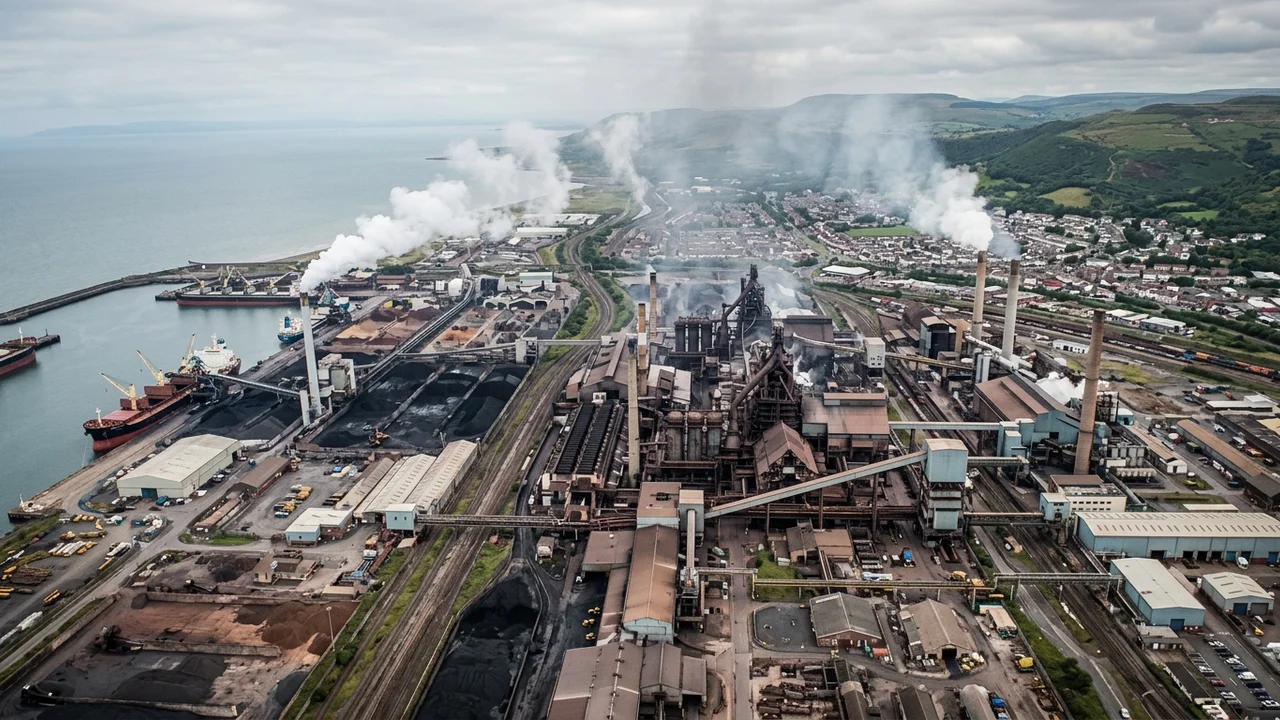
Steel is the largest-volume UK CBAM covered sector by import tonnage. The UK CBAM taxes direct embedded CO2 emissions from steel production, with no pricing of indirect emissions from electricity consumption in the steelmaking process.
2 principal production routes determine the embedded emissions intensity for imported steel. Blast furnace-basic oxygen furnace (BF-BOF) production, which processes iron ore using coking coal, generates approximately 2.0 tonnes of CO2 per tonne of steel. Electric arc furnace (EAF) production using scrap steel generates approximately 0.5 tCO2 per tonne, reflecting the much lower carbon intensity of scrap melting relative to primary ore reduction.
At a UK ETS carbon price reference in the range of GBP 40 to GBP 70 per tonne CO2, UK CBAM adds GBP 80 to GBP 140 per tonne of BF-BOF steel, and GBP 20 to GBP 35 per tonne of EAF scrap steel, for imports without a qualifying carbon price deduction. The UK's primary steel import sources include Turkey, India, South Korea, and China, none of which operates a fully equivalent carbon pricing system that would qualify for a complete UK CBAM deduction.
The CBAM steel sector page covers EU CBAM steel scope in full, including CN codes, calculation methods, and benchmark emission factors applicable under EU rules.
UK CBAM Aluminium Sector
Aluminium is covered by UK CBAM on direct embedded emissions only, placing it alongside steel as a sector where indirect electricity-based emissions carry no UK CBAM charge. Direct embedded emissions for primary aluminium production average approximately 1.5 tCO2 per tonne of product, reflecting fuel combustion and process emissions in the smelter.
The indirect emissions gap for aluminium is material. Primary aluminium smelting consumes approximately 14 to 16 MWh of electricity per tonne of product. At a coal-heavy grid carbon intensity of 0.7 tCO2 per kWh, indirect process emissions reach 9.8 to 11.2 tCO2/t, far exceeding the direct emissions covered by UK CBAM. This mirrors the structural limitation in EU CBAM aluminium scope, where indirect emissions are similarly excluded, meaning coal-powered and hydropower-powered aluminium face identical CBAM treatment despite radically different total carbon footprints.
Aluminium also triggers pricing of perfluorocarbon (PFC) emissions, specifically CF4 and C2F6, released during anode effect events in the electrolysis process. Both the UK CBAM and EU CBAM price PFC emissions for aluminium, using global warming potential conversion factors to express them in CO2-equivalent terms.
The CBAM aluminium sector guide covers the EU CBAM treatment of PFC emissions and the indirect emissions limitation in detail.
UK CBAM Ceramics Sector
Ceramics is the defining feature of the UK CBAM covered sectors: it is the only sector present in UK CBAM that does not appear in EU CBAM. This asymmetry creates compliance obligations for ceramics importers in the UK that have no EU CBAM parallel.
The ceramics sector under UK CBAM covers products manufactured through high-temperature kiln firing, including wall and floor tiles, sanitaryware (basins, toilets, baths), tableware and cookware, technical ceramics, and refractory products used in furnaces and kilns. Production processes involve both fuel combustion for kiln heating and calcination reactions that release CO2 from raw mineral inputs, generating direct embedded emissions of approximately 0.4 to 0.8 tCO2 per tonne of product depending on product type and kiln technology.
UK ceramics imports are sourced primarily from Italy, China, Spain, Portugal, and Turkey. None of these origins currently qualifies for a full UK CBAM deduction on the basis of an equivalent carbon pricing system. The ceramics sector's inclusion in UK CBAM was confirmed during the UK consultation process on the basis that kiln-fired ceramics production is energy-intensive, traded at significant volumes from high-emission origins, and competitive with domestic UK production operating under UK ETS costs.
EU CBAM does not cover ceramics at launch under Regulation (EU) 2023/956, nor is ceramics sector expansion included in the COM(2025)989 downstream product proposal, which focuses on steel- and aluminium-intensive downstream goods.
UK CBAM Cement Sector
Cement is one of 2 UK CBAM sectors where both direct and indirect embedded emissions are priced (fertilizers is the other). Direct emissions from cement production arise from 2 sources: fuel combustion for kiln heating and calcination, the chemical decomposition of limestone (CaCO3) into lime (CaO) and CO2. Calcination alone accounts for approximately 60% of total cement production emissions, making cement one of the most emissions-intensive covered products by tonne.
Embedded emissions for Portland cement average approximately 0.83 tCO2 per tonne of product. At a UK ETS carbon price reference of GBP 50 per tonne CO2, UK CBAM liability on a tonne of imported Portland cement without any deduction runs approximately GBP 41.50. Indirect emissions from electricity consumption are priced because electricity intensity in cement grinding and processing is high enough to be material to the total carbon footprint.
The CBAM cement sector article covers EU CBAM cement scope, including the cement clinker precursor chain and the CN codes brought into scope under Regulation (EU) 2023/956 Annex I.
UK CBAM Fertilizers Sector
Fertilizers is the second of the 2 UK CBAM sectors that prices both direct and indirect embedded emissions. Direct emissions arise from the Haber-Bosch ammonia synthesis process, which reforms natural gas (steam methane reforming, SMR) to produce hydrogen, then combines it with nitrogen. The process releases substantial CO2 from the reforming reaction, and N2O (nitrous oxide, with a global warming potential of approximately 265 times CO2 over 100 years) from nitric acid production used in nitrogen fertilizer manufacturing.
Embedded emissions for urea fertilizer, the most widely traded nitrogen fertilizer, average approximately 2.5 tCO2e per tonne of product. Indirect emissions from electricity use in fertilizer plant operations are also priced, reflecting the same rationale as cement: electricity intensity is material to total carbon cost.
The nitrogen fertilizer supply chain involves ammonia as a precursor. Ammonia carries its own embedded emissions, and fertilizer products made from imported ammonia must account for ammonia's upstream carbon content in the total UK CBAM calculation, making fertilizers a complex goods category where supply chain data requirements extend upstream to ammonia producers.
UK CBAM Hydrogen Sector
Hydrogen is a UK CBAM covered sector with an extremely wide range of possible embedded emissions, depending entirely on the production route. The 3 primary production routes and their approximate embedded emissions intensity are listed below.
The 3 hydrogen production routes subject to UK CBAM, ranked by emissions intensity, are as follows:
- Grey hydrogen (steam methane reforming without carbon capture): approximately 9 to 12 tCO2 per tonne of hydrogen. The most common commercially available form and the highest-emission type, grey hydrogen generates substantial UK CBAM liability.
- Blue hydrogen (steam methane reforming with carbon capture and storage): approximately 1 to 4 tCO2 per tonne, depending on the capture efficiency rate at the production facility. Carbon capture reduces but does not eliminate UK CBAM exposure.
- Green hydrogen (electrolysis using renewable electricity): approximately 0 to 0.5 tCO2 per tonne, depending on the carbon intensity of the electricity source. Near-zero embedded emissions mean near-zero UK CBAM liability, making green hydrogen the only hydrogen type where carbon border tax costs are negligible.
The emissions range between grey and green hydrogen spans more than 9 to 12 tCO2/t, meaning UK CBAM liability varies by a factor of 20 or more depending on production route. At GBP 50 per tonne CO2, grey hydrogen imports incur UK CBAM of GBP 450 to GBP 600 per tonne of hydrogen, while green hydrogen incurs less than GBP 25 per tonne. This differential creates a direct financial incentive for UK importers to source from green hydrogen producers once credible verification of production route emissions is available.
UK CBAM Sectors vs EU CBAM Sectors: Full Comparison
The sector-level comparison between UK CBAM covered sectors and EU CBAM scope is the most important structural reference for businesses importing into both markets. The 2 key divergences are ceramics (UK-only) and electricity (EU-only).
Importers of ceramics into the UK face UK CBAM liability with no equivalent EU obligation. EU imports of electricity via interconnectors carry EU CBAM obligations but attract no UK CBAM charge. For the 5 sectors shared between both systems (steel, aluminium, cement, fertilizers, hydrogen), UK and EU obligations run in parallel but use separate product classifications, separate emission calculation methodologies, separate verification requirements, and separate administrative processes.
A detailed analysis of how both carbon border systems compare across all structural dimensions, including sector scope, mechanism type, price reference, and double-payment risk, is available in the UK CBAM vs EU CBAM comparison guide.
Caption: UK CBAM and EU CBAM share 5 overlapping sectors. Ceramics is present only in UK CBAM. Electricity is present only in EU CBAM. Both systems cover 6 sectors in total.
How UK CBAM Covered Sectors Handle Indirect Emissions
Of the 6 UK CBAM covered sectors, 2 sectors price indirect embedded emissions: cement and fertilizers. The remaining 4 sectors (steel, aluminium, ceramics, and hydrogen) price direct emissions only. This mirrors the EU CBAM treatment, where cement and fertilizers are the sectors with indirect emissions in scope.
Indirect embedded emissions are defined as greenhouse gas emissions from the production of electricity consumed during the manufacturing process of the covered goods. Pricing indirect emissions for cement and fertilizers reflects their high electricity intensity relative to other covered sectors. Steelmaking's electricity use (in EAF production) and aluminium smelting's extreme electricity consumption are not priced on indirect emissions, a known limitation acknowledged in both the UK and EU regulatory design.
For importers, the practical consequence is that cement and fertilizer supply chain data requirements extend to the carbon intensity of the electricity grid at the production location, not only to the direct process emissions from fuel and reaction chemistry. Suppliers in high-carbon-grid countries (coal-dependent electricity systems) face higher total embedded emissions calculations for cement and fertilizer products, even if their direct process efficiency matches lower-grid-intensity producers.
Is UK CBAM Coverage the Same as the EU CBAM Carbon Border Mechanism?
UK CBAM sector coverage is close to EU CBAM coverage but is not identical, and the differences matter for compliance planning. This section answers the most frequently asked questions about UK CBAM covered sectors.
Does UK CBAM Cover Electricity?
No. The UK CBAM does not cover electricity at launch on January 1, 2027. The EU CBAM covers electricity imports under Annex I of Regulation (EU) 2023/956. Electricity transmitted via interconnectors from the UK to the EU or from EU member states into the EU's territory carries EU CBAM obligations. No equivalent UK CBAM charge applies to electricity imports as of January 2027. This is the second major sector divergence between the two carbon border systems, after ceramics.
Does UK CBAM Cover Ceramics?
Yes. Ceramics is the one sector present in UK CBAM covered products that has no EU CBAM equivalent. UK ceramics importers face direct UK CBAM tax liability from January 2027. EU importers of ceramics face no EU CBAM obligation because ceramics are not listed in Annex I of Regulation (EU) 2023/956 and are not proposed for inclusion in the COM(2025)989 downstream expansion.
Are the Same Steel Products Covered in Both Systems?
Steel products covered by UK CBAM broadly correspond to the steel goods in scope under EU CBAM, but the product classification systems differ. EU CBAM uses Combined Nomenclature (CN) codes under Annex I of Regulation (EU) 2023/956. UK CBAM uses UK commodity codes. Importers must confirm product scope against the applicable UK commodity code list rather than assuming EU CN code coverage automatically maps to UK CBAM scope.
Does UK CBAM Apply to Downstream Steel and Aluminium Products?
At launch, UK CBAM applies to primary steel and aluminium products, not to all downstream goods containing steel or aluminium. EU CBAM is similarly limited at launch, with downstream expansion of approximately 180 products proposed under COM(2025)989 from January 2028 for the EU system. UK downstream CBAM expansion has not been confirmed as of April 2026. Importers of complex manufactured goods, such as vehicle parts, machinery, or appliances containing covered metals, are not subject to UK CBAM at launch in either market.
Is Scrap Steel Covered by UK CBAM?
Steel produced from scrap in electric arc furnaces falls within UK CBAM scope as a covered steel product. The embedded emissions of EAF scrap steel are substantially lower than BF-BOF primary steel, at approximately 0.5 tCO2/t versus 2.0 tCO2/t. This difference directly reduces UK CBAM liability for EAF-origin steel, creating a compliance cost advantage for importers sourcing from EAF producers. Pre-consumer scrap itself, as a raw material input, is not a finished covered product.