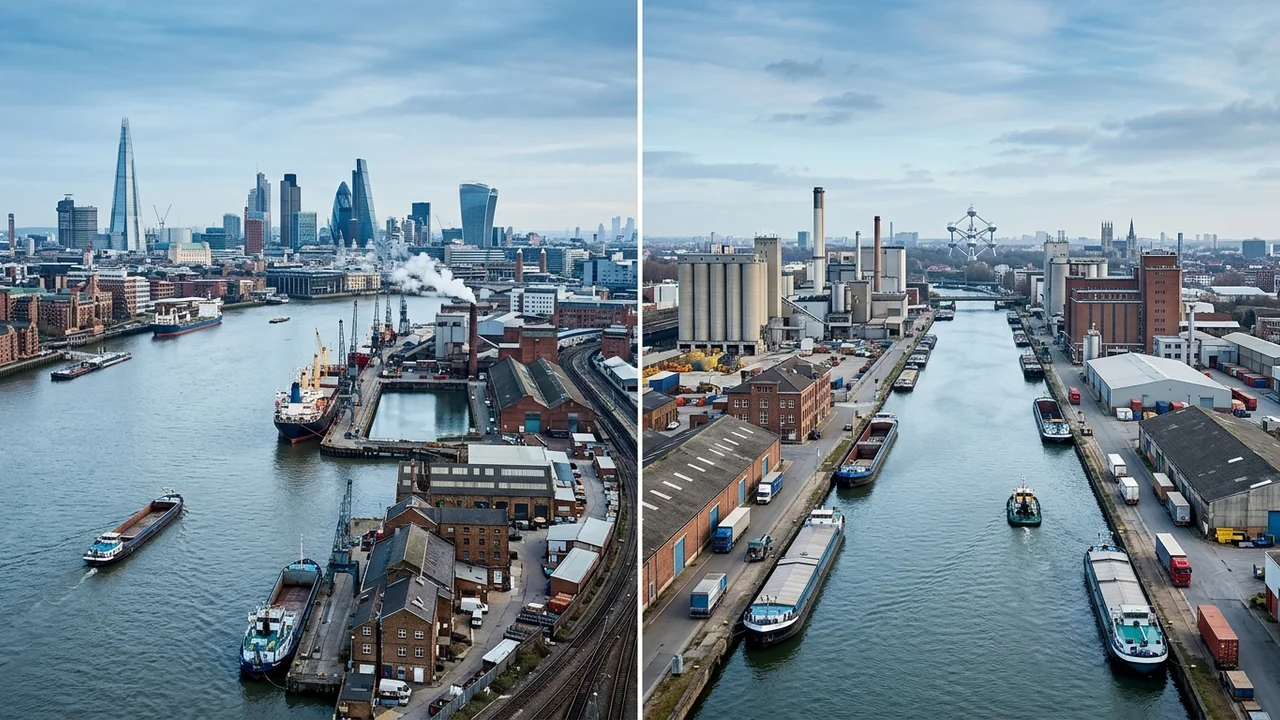
The UK CBAM and EU CBAM carbon border systems share the same policy goal (preventing carbon leakage), but they operate through fundamentally different legal and financial mechanisms, apply to different mixes of sectors, launch on different dates, and are administered by entirely separate government bodies. Importers trading into both markets face 7 structural differences that determine their compliance cost, filing obligation, and double-payment exposure. Understanding these differences is essential before the UK carbon border system goes live on January 1, 2027.
Caption: The UK and EU carbon border systems use different financial mechanisms (direct tax versus certificate purchase), producing distinct compliance obligations for importers.
How Do the UK CBAM and EU CBAM Carbon Border Systems Compare?
The EU CBAM is a certificate-based mechanism linked to the EU ETS carbon price, while the UK CBAM is a direct tax administered by HMRC and priced against the UK ETS. These two carbon border systems diverge across 7 dimensions: mechanism type, price-setting method, launch date, sector coverage, scope, administration, and double-payment risk. The table below captures all 7 differences before each is explained in detail.
| Dimension | EU CBAM | UK CBAM |
|---|---|---|
| Mechanism type | Certificate purchase (not a tax) | Direct tax payment to HMRC |
| Price linkage | EU ETS auction price (~€70/tCO₂ as of Q1 2026) | UK ETS price, set administratively by HM Treasury |
| Launch date | January 1, 2026 (definitive phase) | January 1, 2027 |
| Sectors covered | 6: iron/steel, cement, aluminium, fertilizers, electricity, hydrogen | 6: iron/steel, aluminium, fertilizers, electricity, hydrogen, ceramics |
| Scope | EU importers of Annex I goods | UK importers of in-scope goods |
| Administration | National Competent Authorities + CBAM Registry (DG TAXUD) | HMRC (single national authority) |
| Double-payment risk | N/A on its own | Importers into both markets face charges on same goods |
7 Differences Between the UK CBAM and EU CBAM
1. Mechanism Type: Certificate Purchase vs. Direct Tax
The EU carbon border system requires importers to purchase CBAM certificates, each corresponding to 1 tonne of CO₂e of embedded emissions, and surrender them annually through the CBAM Registry. The UK CBAM operates as a direct tax: importers calculate the carbon content of their goods and pay a financial charge to HMRC, without any certificate or registry infrastructure. This distinction matters because the EU mechanism creates a tradable instrument whose price fluctuates with the EU ETS market, while the UK mechanism produces a fixed tax liability determinable in advance.
For EU importers, the EU CBAM guide details the full certificate purchase, holding, and surrender cycle under Regulation (EU) 2023/956. The EU certificate price in Q1 2026 averaged approximately €70/tCO₂, within a range of €66–90 across the quarter.
2. Price Linkage: EU ETS Auction vs. HM Treasury Rate
The EU CBAM certificate price tracks the EU ETS auction clearing price, calculated as a quarterly average in 2026 and a weekly average from 2027 onward under IR (EU) 2025/2548. Importers cannot predict the exact certificate price in advance because it moves with carbon markets. The UK CBAM price is determined administratively by HM Treasury, linked to the UK ETS carbon price but set through a separate regulatory process, providing UK importers with greater near-term predictability than their EU counterparts. Both carbon border systems price embedded emissions, but through different reference mechanisms.
3. Launch Date: January 2026 vs. January 2027
The EU carbon border system entered its definitive phase on January 1, 2026, under Article 36(2) of Regulation (EU) 2023/956. The first CBAM declaration covering calendar year 2026 emissions is due September 30, 2027. The UK CBAM launches one full year later, on January 1, 2027. This 12-month gap means importers trading exclusively into the UK market have additional time to prepare their embedded emissions data, verification processes, and internal compliance workflows. Importers exposed to both systems operate under EU CBAM rules now and must build UK-compatible processes before the end of 2026.
4. Sector Coverage: Same Count, Different Mix
Both carbon border systems cover 6 sectors, but the sector lists are not identical. The EU covers iron/steel, cement, aluminium, fertilizers, electricity, and hydrogen. The UK covers iron/steel, aluminium, fertilizers, electricity, hydrogen, and ceramics. Ceramics replace cement in the UK scope. Importers of cement from non-UK third countries face EU CBAM liability but no UK CBAM charge. Importers of ceramics face UK CBAM liability but no EU CBAM charge. The 5 overlapping sectors (iron/steel, aluminium, fertilizers, electricity, and hydrogen) create the largest area of shared compliance burden for importers active in both markets.
5. Scope: Importers in Both Markets
Both carbon border systems target importers of physical goods rather than exporters. In the EU, only an authorized CBAM declarant, a person established in the EU customs territory and registered under IR (EU) 2025/486, can legally import Annex I goods during the definitive phase. In the UK, HMRC administers the equivalent registration and declaration requirement. The scope definition aligns in its basic structure, but the authorization processes, registration systems, and documentation requirements differ between the two carbon border systems. Businesses importing into both markets must maintain separate registrations and file separate declarations.
The annual CBAM declaration requirements differ between systems: the EU declaration covers embedded emissions for the prior calendar year and is due September 30, while UK declaration timelines follow HMRC's own schedule. Failing to understand which declaration system applies to which goods imported into which market produces direct compliance risk.
6. Administration: 27 Competent Authorities vs. HMRC
The EU CBAM operates through a two-layer administrative structure. National Competent Authorities (27 in total, one per member state) handle individual importer authorization, account management, inspections, and penalties at the national level. DG TAXUD (the European Commission's taxation directorate) operates the central CBAM Registry and coordinates across member states. Germany's authority is DEHSt, France uses DGEC, and the Netherlands operates through the NEa. The UK CBAM uses a single national authority, HMRC, eliminating the multi-jurisdiction complexity present in the EU system. Importers operating in multiple EU member states must manage their CBAM status through the authority of their member state of establishment, not through each market of import.
7. Double-Payment Risk: The Critical Exposure for Cross-Market Importers
Importers trading goods into both the UK and EU markets face a double-payment risk that exists uniquely at the intersection of these two carbon border systems. A UK manufacturer importing steel from a third country may pay the UK CBAM tax on those inputs. When processed goods derived from that steel cross into the EU market, EU CBAM applies independently, with no automatic recognition of the UK charge already paid. EU Article 9 allows a deduction for carbon prices paid in the country of origin, but the UK is not the country of origin for the embedded emissions. The UK is an intermediate processing location, and the Article 9 deduction mechanism does not address this scenario.
The grey-areas-disputes analysis published in April 2026 confirms this as an unresolved issue: whether UK ETS costs paid on UK-origin goods qualify for an Article 9 deduction under EU CBAM depends on Commission guidance not yet finalized as of Q2 2026. Cross-market importers should map their supply chains against both systems before July 2026 to quantify their double-payment exposure.
Caption: The UK carbon border system includes ceramics where the EU includes cement, a sector difference that affects which importers face charges under one system but not the other.
Which Importers Are Exposed to Both Carbon Border Systems?
Importers exposed to both the UK CBAM and EU CBAM carbon border systems fall into 3 categories, ranked by compliance complexity.
The 3 categories of dual-system exposure are listed below.
- Cross-market manufacturers: UK-based companies that import raw materials subject to UK CBAM and then export processed goods into the EU, triggering EU CBAM on those goods at the EU border.
- Multi-jurisdiction trading businesses: Companies with separate UK and EU import operations for the same product categories (for example, steel or aluminium), requiring parallel authorization, declaration, and payment processes under each carbon border system.
- Third-country exporters with split EU/UK buyers: Non-UK, non-EU producers (such as Turkish steel mills or Indian aluminium smelters) whose customers include both UK importers (UK CBAM applies from January 2027) and EU importers (EU CBAM applies now), requiring them to provide embedded emissions data in formats compatible with both systems.
The 5 sectors covered by both carbon border systems (iron/steel, aluminium, fertilizers, electricity, and hydrogen) define the scope of dual exposure. Ceramics importers face UK-only liability; cement importers face EU-only liability.
Does the EU CBAM Apply to UK-Origin Goods?
Yes. The EU CBAM applies to goods imported from all third countries, including the United Kingdom, that are not listed in Annex III of Regulation (EU) 2023/956. The UK is not an Annex III exempt territory because it left the EU single carbon market when it exited the EU ETS linkage. UK-origin goods containing embedded emissions are subject to full EU CBAM certificate obligations when imported into the EU. EU importers buying UK steel, UK aluminium, or UK hydrogen must obtain embedded emissions data from UK production installations and surrender EU CBAM certificates corresponding to those emissions.
The UK CBAM guide details the full UK carbon border system structure, sector definitions, and HMRC registration process for UK-side obligations.
Is There Any Coordination Between the UK and EU Carbon Border Systems?
No formal coordination mechanism exists between the UK CBAM and EU CBAM carbon border systems as of April 2026. The two systems were designed independently, use incompatible financial mechanisms (tax vs. certificate), and are administered by separate authorities with no data-sharing agreement. The UK-EU Trade and Cooperation Agreement does not include a CBAM coordination clause. EU importers cannot use UK CBAM tax receipts to offset EU certificate obligations, and UK importers cannot use EU CBAM certificates to satisfy HMRC tax liabilities. Each system operates in full legal independence from the other.
The CBAM regulation page covers the EU legal basis under Article 192(1) TFEU and the full text of Regulation (EU) 2023/956 as amended by Regulation (EU) 2025/2083.
Are UK CBAM Penalties Different from EU CBAM Penalties?
Yes. EU CBAM penalties are fixed at €100 per tonne CO₂e for authorized declarants who fail to surrender sufficient certificates, rising to €300–500 per tonne CO₂e for unauthorized importers under Article 26 as amended by Regulation (EU) 2025/2083. UK CBAM penalties are administered by HMRC under UK tax law, following a different penalty structure aligned with existing UK customs and excise enforcement frameworks rather than the EU's ETS-linked penalty scale. The two carbon border systems operate distinct penalty regimes with no cross-recognition.
Can an Importer Use the EU CBAM Certificate System to Meet UK Obligations?
No. EU CBAM certificates are issued, held, and surrendered exclusively through the EU CBAM Registry operated by DG TAXUD. They are not recognized by HMRC as satisfying UK CBAM tax obligations. The CBAM certificates system exists only within the EU mechanism framework. UK importers must make direct tax payments to HMRC using the UK CBAM process, which does not involve certificates. An importer active in both markets must satisfy both systems independently and cannot net obligations across them.
Does the UK CBAM Have a De Minimis Threshold?
The EU CBAM de minimis threshold is 50 tonnes of annual import mass per importer (excluding electricity and hydrogen, which carry no threshold) under Article 2(3a) inserted by Regulation (EU) 2025/2083. The UK CBAM has a separate de minimis threshold defined under UK domestic legislation, not aligned to the EU's 50-tonne figure. Importers with small volumes into both markets must check each threshold independently, as the two carbon border systems apply different exemption criteria.