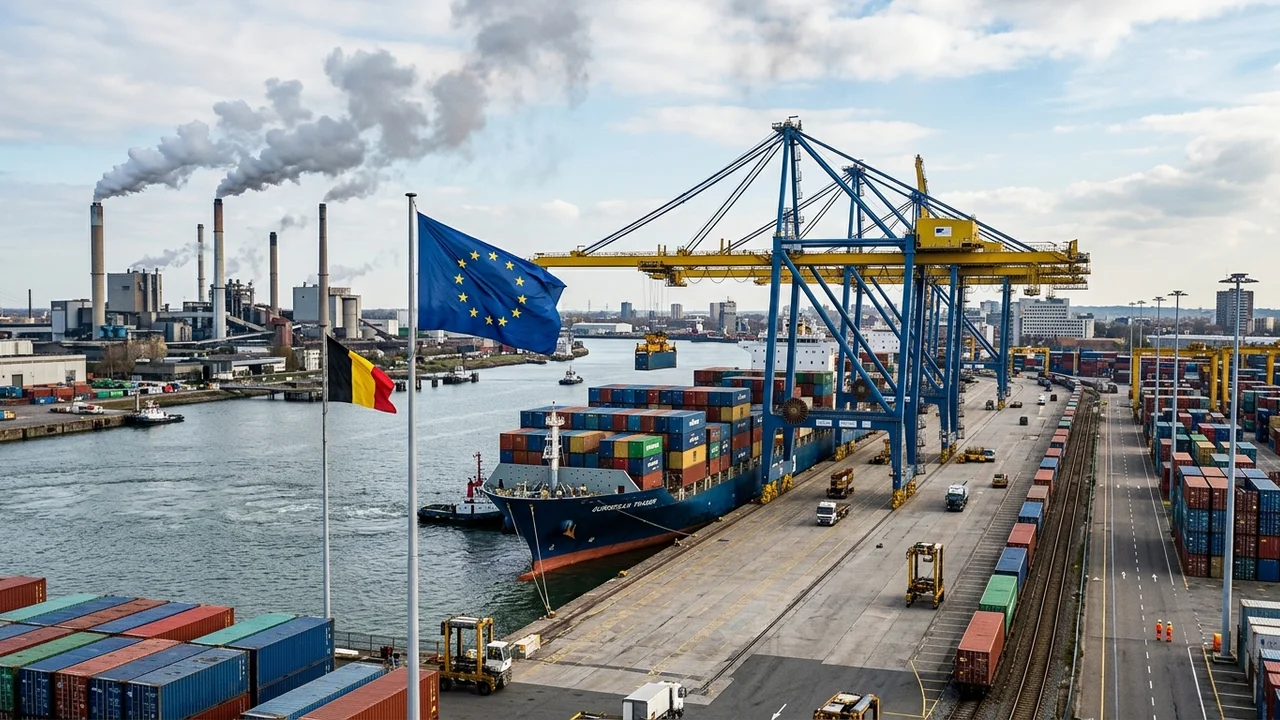
CBAM covers 6 carbon-intensive sectors and forces EU importers to hold certificates priced at the EU carbon market rate, creating a financial obligation that grows each year through 2034. The mechanism entered its definitive phase on January 1, 2026, ending a two-year transitional reporting period with no financial consequences and replacing it with real certificate obligations, authorization requirements, and penalties of €100 per tonne CO₂e for non-compliance. Understanding the CBAM meaning precisely matters because this regulation is already generating costs, shaping supply chain decisions, and rewarding exporters who can demonstrate lower embedded emissions.
Image brief: Flowchart showing goods entering the EU, customs validation of CBAM authorization, and certificate surrender to a competent authority. Text overlay: "CBAM: Certificate-Based, Not a Tariff". Branded with cbamguide.com logo. No stock photos.
General Summary: What Does CBAM Mean in Plain English?
CBAM is the EU regulatory system established by Regulation (EU) 2023/956 that requires EU importers of carbon-intensive goods to purchase and surrender electronic certificates, each corresponding to one tonne of CO₂e of embedded emissions, at a price linked to the EU ETS auction price. CBAM is not a carbon tax, not a tariff, and not a border duty. It is a certificate-based mechanism tied to the same carbon price that EU producers pay under the EU Emissions Trading System.
The CBAM full form is Carbon Border Adjustment Mechanism. The mechanism operates at the EU level, applies to goods classified under specific CN codes in Annex I of the regulation, and is administered by national competent authorities in each of the 27 EU member states. CBAM applies to goods imported from any country that does not operate an equivalent carbon pricing scheme recognized by the EU.
The core logic of the CBAM definition is carbon cost equalization. EU manufacturers pay for their carbon emissions through the EU ETS. Without CBAM, a foreign competitor exporting to the EU faces no equivalent cost, creating an incentive to move carbon-intensive production outside the EU and then export the product back in. CBAM closes this gap by requiring that imported goods carry the same carbon cost as equivalent EU-produced goods. This is what the EU Commission means when it describes CBAM as preventing carbon leakage.
The CBAM regulation assigns the obligation to the EU importer, not the foreign producer. An importer in Germany buying steel from Turkey pays CBAM certificates. A Turkish steel mill pays nothing directly to the EU, though its customers now factor CBAM costs into purchase decisions and supply chain strategy.
What Is CBAM: The Six-Sector Scope and Who It Applies To
CBAM applies to 6 sectors, covering goods listed in Annex I of Regulation (EU) 2023/956 and identified by their CN codes. The sectors were chosen for their high carbon intensity and their high exposure to carbon leakage risk under the EU ETS.
The 6 covered sectors and their key emission characteristics are listed below.
| Sector | Direct Emissions | Indirect Emissions | GHGs Covered | Emission Factor (tCO₂e/t) |
|---|---|---|---|---|
| Iron and steel (BF-BOF) | Priced | Not priced | CO₂ | ~2.0 |
| Iron and steel (EAF scrap) | Priced | Not priced | CO₂ | ~0.5 |
| Cement (Portland) | Priced | Priced | CO₂ | ~0.83 |
| Aluminium (primary) | Priced | Not priced | CO₂ + PFCs | ~1.5 (direct only) |
| Fertilizers (urea) | Priced | Priced | CO₂ + N₂O | ~2.5 |
| Electricity | Priced | N/A | CO₂ | Country-specific |
| Hydrogen | Priced | Not priced | CO₂ | ~9–12 (grey); ~0 (green) |
Cement and fertilizers are the 2 sectors where indirect emissions (from electricity consumption during production) are also priced. For all other sectors, CBAM covers only direct emissions from the production process itself.
The EU CBAM mechanism applies to imports into the customs territory of the EU from any third country, with 4 exemptions. The exempted territories are Iceland, Liechtenstein, Norway, and Switzerland. These territories participate in the EU ETS or have equivalent carbon pricing integrated with the EU internal electricity market, so the carbon cost is already internalized. No other country currently qualifies for exemption.
A de minimis threshold of 50 tonnes annual mass per importer applies under Article 2(3a), as inserted by Regulation (EU) 2025/2083. Importers whose total annual CBAM-covered goods fall at or below this threshold are exempt from CBAM obligations for that year. Electricity and hydrogen are excluded from the de minimis threshold; these 2 sectors have no minimum quantity exemption.
For a complete explanation of scope, sectors, and EU CBAM mechanics in the broader regulatory context, the EU CBAM guide covers the mechanism at the root documentation level.
How CBAM Works: The Certificate Mechanism Step by Step
CBAM works through a certificate system, not through customs duties or tax collection. The obligation runs in 4 stages: authorization, import and customs validation, quarterly certificate holding, and annual declaration with surrender.
The 4 stages of the CBAM certificate obligation are described below.
-
Authorization: The EU importer must obtain authorized CBAM declarant status before importing CBAM-covered goods during the definitive phase. Authorization is granted by the national competent authority in the member state where the importer is established. Without authorization, importing CBAM goods carries a penalty of €300 to €500 per tonne CO₂e, which is 3 to 5 times the standard rate.
-
Import and customs validation: When CBAM goods cross an EU border, customs authorities in real time validate whether the importer holds authorized declarant status. Importers who applied for authorization by March 31, 2026 may continue importing on a provisional basis while their application is processed (decision within 120 days under IR 2025/486).
-
Quarterly holding requirement: At the end of each calendar quarter, the authorized declarant must hold CBAM certificates equal to at least 50% of the cumulative embedded emissions of all CBAM goods imported since January 1 of that year, per Article 22(2) as amended by Regulation (EU) 2025/2083. Certificates are purchased through the CBAM Registry once sales open on February 1, 2027.
-
Annual declaration and surrender: By September 30, 2027 (covering imports from calendar year 2026), the authorized declarant submits the first annual CBAM declaration to its competent authority, reporting total embedded emissions and surrendering the corresponding number of certificates.
The CBAM certificate price is not fixed. In 2026, the price is calculated as the quarterly average of EU ETS auction clearing prices under Article 22(1a), inserted by Regulation (EU) 2025/2083. From 2027 onward, the price switches to the weekly average of EU ETS auction closing prices under Article 22(1). As of late March 2026, the EU ETS price is approximately €70 per tonne CO₂. This price fluctuates daily and across trading sessions.
The cost implications differ sharply by product and production route. The table below shows gross CBAM costs at the current EU ETS price of approximately €70 per tonne CO₂.
| Product | Emission Factor (tCO₂e/t) | Gross CBAM Cost @ €70/tCO₂ |
|---|---|---|
| Steel, blast furnace (BF-BOF) | ~2.0 | ~€140 per tonne |
| Steel, electric arc scrap (EAF) | ~0.5 | ~€35 per tonne |
| Cement, Portland | ~0.83 | ~€58 per tonne |
| Primary aluminium (direct only) | ~1.5 | ~€105 per tonne |
| Urea fertilizer | ~2.5 | ~€175 per tonne |
| Grey hydrogen (SMR) | ~9–12 | ~€630–840 per tonne |
| Green hydrogen | ~0 | ~€0 per tonne |
These are gross costs. The net cost in 2026 is substantially lower, because 97.5% of EU ETS free allocation still remains for CBAM sectors. The CBAM factor in 2026 is 2.5%, meaning the effective net obligation is approximately 2.5% of the gross figure. A tonne of BF-BOF steel with a gross cost of €140 carries a net 2026 obligation of approximately €3.50. This figure rises steeply: by 2030, the CBAM factor reaches 48.5%, and by 2034, free allocation is fully eliminated and the gross cost becomes the net cost.
An authorized CBAM declarant who has purchased too many certificates can resell up to 50% of those certificates back to the competent authority at the price paid, under the buyback provision of Article 23 as amended by Regulation (EU) 2025/2083. This buyback must be requested by October 31 of the surrender year. Unsold and unsurrendered certificates are cancelled on November 1.
The entity in the EU that holds the certificate obligation is always the authorized CBAM declarant, which is a person established in the customs territory of the Union who has been granted authorization by the competent authority of their member state. Non-EU exporters have no direct financial obligation under the CBAM regulation, though they play a critical role in supplying verified emissions data.
Image brief: Line graph showing EU ETS price movement from 2023 to Q1 2026 with a CBAM certificate price overlay. Text overlay: "CBAM Certificate Price = EU ETS Average". Branded with cbamguide.com logo. No stock photos.
What Is the CBAM Meaning in Terms of Embedded Emissions?
CBAM obligations are calculated on the basis of embedded emissions, which are the greenhouse gas emissions produced during the manufacture of the imported goods. Embedded emissions per unit of goods are expressed as specific embedded emissions, measured in tonnes of CO₂e per tonne of product (or per MWh for electricity).
For most sectors, embedded emissions consist only of direct emissions from the production process. Cement and fertilizers are the 2 exceptions, where indirect emissions from electricity consumed during production are also included in the CBAM calculation.
The embedded emissions of complex goods, meaning goods produced using precursors that are themselves listed in Annex I, include the embedded emissions of those precursors. A steel pipe produced from steel billets carries the embedded emissions of the billet plus the processing emissions. This precursor traceability requirement is one reason why CBAM compliance involves the entire upstream supply chain.
An EU importer has 2 pathways for determining the embedded emissions it will declare. The first pathway uses actual emissions data from the specific production installation where the goods were manufactured, verified by an accredited third-party verifier. The second pathway uses default values published by the European Commission under IR (EU) 2025/2621. Default values represent the average emission intensity for the relevant country and product type, with a punitive mark-up applied: 10% in 2026, 20% in 2027, and 30% from 2028 onward. Fertilizer default values carry a lower mark-up of 1%.
Importers who have embedded emissions data from foreign producers that is below the default value have a financial incentive to use actual verified data. Importers who cannot obtain data from their suppliers may use defaults but will pay the mark-up penalty. For further detail on what gets calculated and how, the CBAM embedded emissions guide provides the full methodology.
Why CBAM Exists: Carbon Leakage and the EU ETS Connection
CBAM exists because the EU Emissions Trading System (EU ETS) creates a cost asymmetry between EU manufacturers and their foreign competitors. The EU ETS forces domestic producers in the 6 CBAM sectors to pay for their carbon emissions through allowances. A cement producer in Poland, for example, pays approximately €70 per tonne CO₂ on its emissions. A cement producer in Turkey exporting to Poland pays nothing equivalent to the EU carbon price.
Without a carbon border mechanism, this asymmetry incentivizes 2 outcomes that undermine the EU's climate goals. First, EU producers lose market share to cheaper carbon-intensive imports, weakening EU industry. Second, global emissions do not fall because production simply moves to jurisdictions with lower or no carbon pricing, a phenomenon called carbon leakage.
The EU's legal basis for CBAM is Article 192(1) of the Treaty on the Functioning of the European Union (TFEU), which covers environmental policy. This is significant because it classifies CBAM as an environmental measure, not a trade measure, which shapes how the EU defends the mechanism at the World Trade Organization.
The EU has historically used free allocation of ETS allowances as the primary carbon leakage protection tool. Free allocation means EU producers in CBAM sectors receive a portion of their allowances at no cost, reducing their net carbon cost. CBAM replaces free allocation as the leakage protection mechanism, because free allocation undermines the "polluter pays" principle and reduces the environmental effectiveness of the ETS. The phase-out schedule is synchronized: as CBAM phases in from 2026 to 2034, free allocation for CBAM sectors phases out simultaneously. In 2026, 97.5% of free allocation remains. By 2034, zero free allocation remains for CBAM sectors.
An exporter whose country operates a qualifying carbon pricing scheme can reduce the EU importer's CBAM certificate obligation under Article 9. The carbon price already paid in the country of origin is deductible, provided the scheme is legally binding and effectively enforced. No country currently qualifies for a full deduction: Turkey's Climate Law No. 7552 established a legal basis for a Turkish ETS in July 2025, but the pilot phase provides full free allocation, meaning no effective carbon price is paid yet.
CBAM Key Dates and the 2026 Compliance Timeline
CBAM's regulatory timeline is governed by Regulation (EU) 2023/956 as amended by Regulation (EU) 2025/2083 (the Omnibus simplification). The amendment changed 6 key parameters from the original regulation: the de minimis threshold, the declaration deadline, the certificate sales start date, the quarterly holding percentage, the penalty structure, and the buyback limit.
The key CBAM dates for 2026 through 2034 are listed below.
| Milestone | Date | Regulation / Article |
|---|---|---|
| Definitive phase start | January 1, 2026 | Article 36(2), Reg. 2023/956 |
| Authorization application deadline (provisional importing) | March 31, 2026 | Article 17(7a), inserted by Reg. 2025/2083 |
| Verifier registration opens | September 1, 2026 | Reg. 2025/2083 |
| Certificate sales begin | February 1, 2027 | Reg. 2025/2083 |
| First CBAM declaration deadline | September 30, 2027 | Article 6, amended by Reg. 2025/2083 |
| Certificate buyback deadline | October 31, 2027 | Article 23, amended by Reg. 2025/2083 |
| Certificate cancellation | November 1, 2027 | Article 24(1), amended |
| Free allocation fully phased out | January 1, 2034 | ETS Directive amendment |
The transitional period ran from October 1, 2023 through December 31, 2025. During the transitional period, importers submitted quarterly CBAM reports but had no financial obligation. No certificates existed during the transitional period. The sole consequence of non-reporting during the transitional period was a penalty of €10 to €50 per unreported tonne CO₂e under IR 2023/1773, which is 2 to 10 times lower than the definitive phase penalty.
As of January 1, 2026, the transitional period rules no longer apply. All 6 sectors are simultaneously under full financial obligation.
How CBAM Is Defined in EU Law: The Precise Legal Definition
CBAM is defined at the intersection of 4 legal concepts in Regulation (EU) 2023/956: the mechanism (certificate obligation), the obligation holder (authorized CBAM declarant), the obligation object (embedded emissions), and the obligation price (EU ETS price). Each concept has an exact legal definition under Article 3 of the regulation.
The 4 foundational legal definitions that together constitute the full CBAM definition are described below.
-
CBAM certificate (Article 3(10)): A certificate in electronic format corresponding to one tonne of CO₂e of embedded emissions in goods covered by this regulation. Certificates are issued, held, surrendered, and cancelled exclusively through the CBAM Registry operated by DG TAXUD.
-
Authorized CBAM declarant (Article 3(15)): A person established in the customs territory of the Union who has been granted authorization by the competent authority of the member state of establishment to make CBAM declarations and surrender CBAM certificates.
-
Embedded emissions (Article 3(4)): The combination of direct embedded emissions and, where applicable, indirect embedded emissions associated with the production of CBAM goods.
-
CBAM declaration (Article 3(16)): The annual declaration submitted by an authorized CBAM declarant containing the total quantity of each type of imported goods, the total embedded emissions, the CBAM certificates surrendered, and where applicable the evidence of carbon prices paid in countries of origin.
The CBAM definition in plain English is therefore: an EU importer of carbon-intensive goods must register, measure the carbon footprint of what it imports, purchase electronic certificates at the EU carbon price, and surrender those certificates once a year. Every layer of this definition connects to specific legal articles and implementing regulations, covering 13 implementing and delegated regulations in addition to the 2 primary regulations.
CBAM is not defined in EU law as a tax, a tariff, or a customs duty. Calling it any of these is legally imprecise. The certificate-based structure is deliberate: it mirrors the EU ETS allowance mechanism and ensures that the carbon cost on imported goods is equivalent in nature and price to the carbon cost on domestically produced goods.
What Is CBAM's Relationship to the EU ETS: A Parallel System
CBAM and the EU ETS operate as a parallel and synchronized pair. The EU ETS caps total emissions from 6 industrial sectors, including all 6 CBAM sectors, by requiring operators to hold allowances for each tonne of CO₂ emitted. The CBAM mechanism creates an equivalent requirement for imported goods in the same sectors.
The linkage is deliberate and structural. CBAM certificate prices are calculated directly from EU ETS auction prices. As the ETS price rises, CBAM costs rise proportionally. As ETS free allocation phases out from 2026 to 2034, the net CBAM obligation grows at the same rate. The 2 systems are designed so that by 2034, an EU steel producer and a foreign steel exporter to the EU face identical carbon costs per tonne of embedded emissions.
The EU ETS applies to approximately 10,500 installations across the EU, primarily in power generation and heavy industry. CBAM extends the carbon pricing signal beyond the EU border, reaching the roughly 50 production installations in 15 key third countries that supply the largest share of CBAM-covered goods to the EU.
The CBAM regulation also affects domestic EU producers indirectly. EU producers lose free allocation as CBAM phases in, which increases their ETS compliance cost. At the same time, the CBAM-created level playing field removes the competitive disadvantage that EU producers previously faced from unpriced foreign competition. The net effect on EU industry competitiveness depends on the ETS price level and the emission intensity of each producer's specific production route.
Contextual Border: How CBAM Compares to Similar Carbon Border Mechanisms
CBAM is the first operational carbon border adjustment mechanism at major-economy scale. The UK has announced its own mechanism, and other jurisdictions are at earlier design stages. Understanding what distinguishes CBAM from these EU-adjacent systems clarifies where CBAM's specific requirements apply.
How Does CBAM Differ from the UK CBAM?
The UK CBAM takes effect on January 1, 2027, targeting the same 6 sectors as the EU mechanism. The UK design is a tax-based system, not a certificate-based system. UK importers pay a carbon tax directly to HMRC based on the carbon content of imports; they do not purchase and surrender electronic certificates through a registry. The UK CBAM price is set quarterly by the UK government with reference to the UK ETS price, not the EU ETS price.
The UK and EU mechanisms create a potential double payment problem for goods moving through UK-EU trade corridors. A steel product manufactured in Turkey, exported to the UK, and then further processed and re-exported to the EU could in theory face both UK CBAM and EU CBAM obligations. As of April 2026, neither the UK nor the EU has issued definitive guidance resolving this overlap.
Does CBAM Apply to Countries with Existing Carbon Prices?
CBAM applies to all third countries by default. Countries with qualifying carbon pricing schemes can reduce the CBAM certificate obligation of their EU importers under Article 9, by providing evidence of the carbon price effectively paid in the country of origin. The deduction cannot exceed the CBAM obligation that would otherwise apply. Countries that currently qualify for a full or partial Article 9 deduction number zero: no third country currently operates a carbon pricing scheme that the EU has formally recognized as equivalent for Article 9 purposes.
Is CBAM Compatible with WTO Rules?
The WTO compatibility of CBAM is legally contested. The EU's legal defense rests on GATT Article XX exceptions: Article XX(b) (measures necessary to protect human, animal, or plant life) and Article XX(g) (measures relating to conservation of exhaustible natural resources). Russia filed WTO dispute DS639 in May 2025, the first formal WTO challenge to CBAM. No ruling has been issued. The WTO's Appellate Body remains non-functional due to US blocking of appointments, which limits the enforceability of any panel ruling even if one is issued.
Can Carbon Price Deductions Eliminate the CBAM Cost Entirely?
Yes, in principle but not in current practice. Article 9 allows importers to deduct from the certificate obligation the carbon price effectively paid in the third country of production. The deduction cannot exceed the full CBAM obligation. In 2026, no importer qualifies for a full deduction because no third country has an EU-recognized equivalent carbon pricing scheme producing a real carbon cost. Partial deductions remain theoretically possible for specific transactions where a demonstrably effective carbon price is paid, but the evidentiary requirements are substantial.
What Penalties Apply for Non-Compliance with CBAM?
CBAM imposes 2 tiers of financial penalties under Article 26 as amended by Regulation (EU) 2025/2083. The first tier applies to authorized declarants who fail to surrender sufficient certificates: €100 per tonne CO₂e not covered, adjusted for inflation from the base year. The second tier applies to persons who import CBAM goods without authorization: €300 to €500 per tonne CO₂e, which is 3 to 5 times the standard rate. The penalty for unauthorized importing is higher because it bypasses the entire compliance infrastructure, not merely the certificate surrender obligation.
What Is the CBAM Full Form in Different Languages?
The CBAM full form in English is Carbon Border Adjustment Mechanism. In French, the mechanism is called Mécanisme d'ajustement carbone aux frontières (MACF). In German: CO₂-Grenzausgleichsmechanismus. In Spanish: Mecanismo de Ajuste en Frontera por Carbono (CBAM is used as the abbreviation across all EU official languages). The official EU legal text uses CBAM and Carbon Border Adjustment Mechanism throughout all language versions of Regulation (EU) 2023/956.
How Is the CBAM Registry Accessed?
The CBAM Registry is operated by DG TAXUD (the European Commission's Directorate-General for Taxation and Customs Union) and uses the same UUM&DS authentication infrastructure as the EU ETS Registry. Authorized declarants access the registry through their national competent authority accounts. The registry manages 4 functions: account management for authorized declarants, certificate issuance and tracking, quarterly and annual declaration filing, and customs-to-registry real-time validation of import authorizations under IR 2025/2619.
Key Compliance Steps for EU Importers: CBAM Explained Operationally
CBAM compliance for EU importers involves 5 core steps, each linked to a specific regulatory requirement in Regulation (EU) 2023/956 and its implementing regulations.
The 5 compliance steps for EU importers are listed below.
-
Apply for authorization: Submit an authorization application to the national competent authority in your EU member state. Applications must meet the criteria in IR 2025/486, including a 5-year history of customs and tax compliance. Importers who applied by March 31, 2026 may continue importing on a provisional basis during the 120-day decision window.
-
Collect embedded emissions data from suppliers: Contact production installations outside the EU to obtain specific embedded emissions data and supporting documentation. This data feeds into the annual declaration. Where data is unavailable, default values from IR 2025/2621 apply, with a 10% mark-up in 2026.
-
Arrange third-party verification: Engage an accredited verifier to verify the embedded emissions data from the production installation. Verifier accreditation is governed by DR 2025/2551. Verifiers can register in the CBAM Registry from September 1, 2026.
-
Purchase CBAM certificates: Buy certificates through the CBAM Registry from February 1, 2027. Maintain quarterly holdings of at least 50% of cumulative embedded emissions per Article 22(2). The certificate price equals the quarterly average of EU ETS auction prices in 2026 and the weekly average from 2027.
-
File the annual CBAM declaration and surrender certificates: Submit the declaration to your national competent authority by September 30, 2027 for the 2026 import year. Surrender the certificates corresponding to your declared embedded emissions. Retain records for 4 years after the declaration year.
The legal basis for each step sits in a specific implementing regulation, from IR 2025/486 governing authorization to IR 2025/2547 governing calculation methodology. The full 13-regulation architecture is set out in the CBAM regulation reference.
For the complete operational step-by-step detail, including authorization applications, registry access, and the quarterly holding calculation, the CBAM certificates guide covers the certificate purchase and surrender process end-to-end.
CBAM Meaning for Non-EU Exporters: The Indirect Obligation
Non-EU exporters have no direct financial obligation under Regulation (EU) 2023/956. The CBAM certificate obligation falls exclusively on the EU importer. However, the CBAM mechanism creates 3 powerful indirect pressures on exporters that function as de facto obligations in commercial practice.
The 3 indirect pressures on non-EU exporters are described below.
-
Data supply obligation: EU importers are legally required to declare the embedded emissions of their imported goods. Importers who cannot obtain verified emissions data from the foreign production installation must use default values with a punitive mark-up. This creates a commercial incentive for EU buyers to pressure their foreign suppliers to provide actual emissions data. Suppliers who provide data below the default value make their EU buyers' CBAM certificates cheaper, creating a pricing advantage over competitors who cannot supply data.
-
Price competitiveness: CBAM costs add to the landed cost of imported goods in the EU. At an EU ETS price of approximately €70 per tonne CO₂, a tonne of grey hydrogen carries a gross CBAM cost of €630 to €840. Even at 2026's 2.5% CBAM factor, this is a material competitive signal. EU buyers increasingly factor embedded emissions intensity into supplier selection, because lower-emission suppliers translate directly into lower CBAM costs.
-
Decarbonization incentive: Exporters who invest in lower-emission production routes, including switching to electric arc furnace steelmaking, deploying carbon capture on cement kilns, or sourcing green electricity for fertilizer production, reduce the CBAM burden on their EU customers. This creates a direct financial reward for decarbonization that did not exist before CBAM.
The EU Commission estimated in its Article 30 review report (December 2025) that approximately €1.4 billion in annual CBAM revenue is expected at full phase-in by 2028. The cumulative effect of these indirect pressures on global supply chains is the mechanism's primary climate policy instrument: realigning investment toward lower-carbon production globally, not just within the EU.
Image brief: Split diagram showing EU importer on the left purchasing CBAM certificates, non-EU exporter on the right supplying verified emissions reports, connected by an arrow labeled "embedded emissions data". Text overlay: "CBAM Data Flow: Exporter to Importer". Branded with cbamguide.com logo. No stock photos.
CBAM Explained: Common Misconceptions Corrected
CBAM is frequently described inaccurately in business and media coverage. The 4 most common misconceptions are listed below, each with the correct characterization drawn directly from Regulation (EU) 2023/956.
-
Misconception: CBAM is a carbon tax on imports. Correct: CBAM is a certificate obligation. EU importers purchase electronic certificates through the CBAM Registry; no payment goes to a tax authority as a tax. The financial mechanics differ materially from a tax: certificates can be bought in advance, resold (up to 50%), and the price fluctuates with the EU ETS market rather than being set by a government decision.
-
Misconception: CBAM applies immediately to all imports. Correct: CBAM applies only to goods classified under specific CN codes in Annex I of Regulation (EU) 2023/956. Goods outside these 6 sectors are not covered. The 50-tonne de minimis threshold also exempts small importers below this annual volume for most sectors.
-
Misconception: CBAM is the same as a tariff. Correct: A tariff is a customs duty applied as a percentage of the commercial value of goods. CBAM is applied on the basis of the embedded greenhouse gas emissions, not the commercial value. Two shipments of steel with the same commercial value but different production routes carry different CBAM obligations.
-
Misconception: Foreign exporters pay CBAM. Correct: The authorized CBAM declarant, an EU-based legal entity, holds the certificate obligation. Non-EU exporters may absorb CBAM costs commercially by lowering export prices to offset their EU customer's CBAM obligation, but no legal obligation exists for them under the regulation.
Supplementary: CBAM Terminology Reference
What Does CBAM Stand For?
CBAM stands for Carbon Border Adjustment Mechanism. The official abbreviation appears throughout Regulation (EU) 2023/956 and all 13 implementing regulations. The regulation never uses any alternative abbreviation. In EU legal texts in languages other than English, CBAM remains the standard cross-language abbreviation; for example, the French text of the regulation uses "MACF" (Mécanisme d'ajustement carbone aux frontières) and "CBAM" interchangeably in official communications.
What Is the CBAM Definition Under Article 3?
The CBAM definition under Article 3 of Regulation (EU) 2023/956 covers 28 defined terms that together specify what the mechanism is and how its obligations operate. The central definitional cluster includes CBAM certificate (Article 3(10)), authorized CBAM declarant (Article 3(15)), embedded emissions (Article 3(4)), specific embedded emissions (Article 3(5)), precursor (Article 3(7)), complex goods (Article 3(8)), and simple goods (Article 3(9)). These definitions establish the perimeter of the certificate obligation with legal precision.
Does CBAM Apply to Services?
No. CBAM applies exclusively to physical goods classified under specific CN codes in Annex I of Regulation (EU) 2023/956. Services are not subject to CBAM obligations, regardless of their carbon intensity. The mechanism targets goods for which embedded emissions can be measured, calculated, and verified at the production installation level.
Is CBAM Permanent?
CBAM is structured as a permanent mechanism within EU environmental law, with no sunset clause in Regulation (EU) 2023/956. The phase-in schedule ends in 2034 when free allocation is fully eliminated, but the mechanism itself continues beyond 2034. The European Commission's Article 30 review report (December 2025) proposed expanding the scope to approximately 180 downstream steel- and aluminium-intensive products from January 2028 under proposal COM(2025)989. This expansion is subject to ordinary legislative procedure and requires approval from the European Parliament and the Council.
Can an Importer Use Default Values Instead of Verified Emissions?
Yes. An importer who cannot obtain specific emissions data from the foreign production installation uses default values published under IR (EU) 2025/2621. Default values represent average country- and product-specific emission intensities, plus a mark-up of 10% in 2026, 20% in 2027, and 30% from 2028 onward. Fertilizer defaults use a 1% mark-up. Using defaults is legally permitted but financially penalized relative to verified actual values, particularly from 2027 onward when the mark-up percentage doubles.
What Happens If an Importer Fails to Surrender Enough Certificates?
Failure to surrender sufficient certificates by the September 30 declaration deadline results in a penalty of €100 per tonne CO₂e not covered, per Article 26(1) as amended by Regulation (EU) 2025/2083. This penalty is inflation-adjusted from the base year. The penalty applies in addition to the underlying certificate obligation, which remains outstanding. Systematic non-compliance can also result in revocation of authorized declarant status, which prohibits all further importing of CBAM-covered goods.
Is CBAM the Same in All EU Member States?
The CBAM obligation is uniform across all 27 EU member states, because Regulation (EU) 2023/956 is a directly applicable EU regulation. However, 27 different national competent authorities administer the mechanism at the member state level, including authorization decisions, inspection powers, and penalty enforcement. Germany's competent authority is the Deutsche Emissionshandelsstelle (DEHSt) at the Federal Environment Agency; France's is the Direction Générale de l'Énergie et du Climat (DGEC); the Netherlands operates through the Nederlandse Emissieautoriteit (NEa). While the rules are identical, the administrative experience and processing speed may vary by member state.