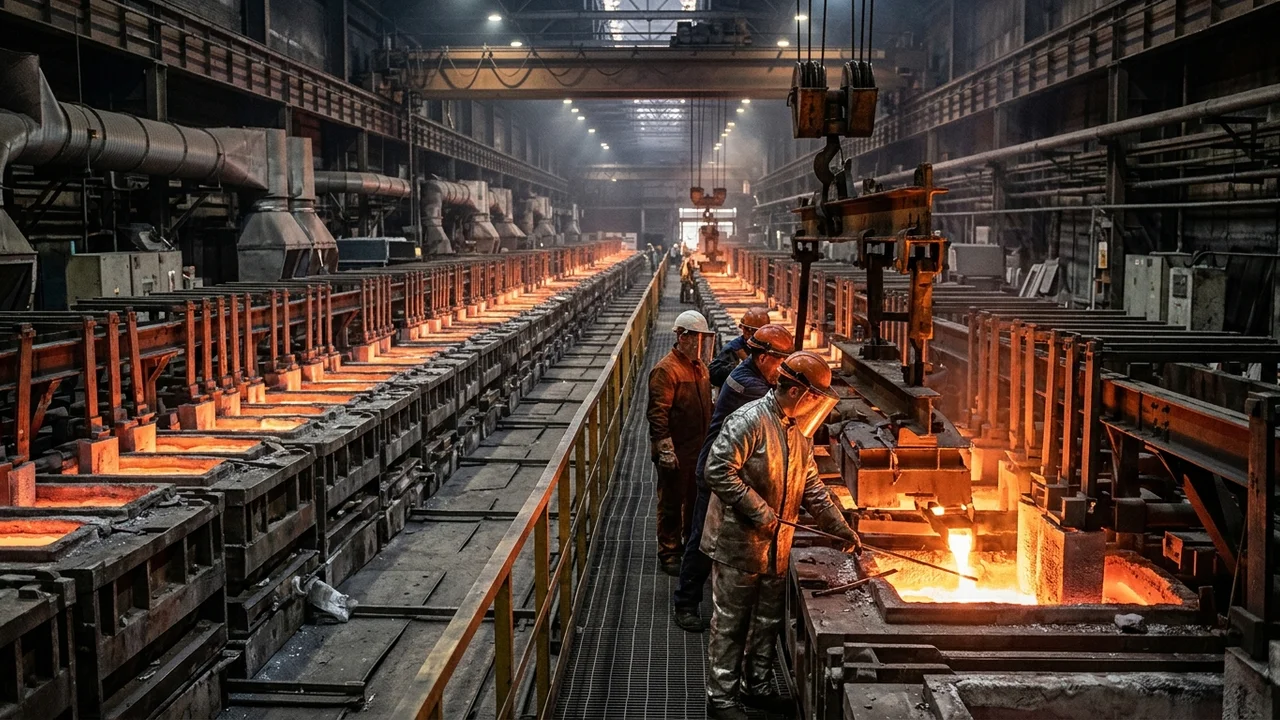
CBAM aluminium rules price only the direct embedded emissions and perfluorocarbon gases from primary smelting, leaving up to ~13 tCO₂/t of indirect electricity emissions untouched for coal-powered importers. The EU importer's cost obligation for primary aluminium is calculated on a benchmark of approximately 1.5 tCO₂e per tonne of direct emissions, under Regulation (EU) 2023/956 as amended by Regulation (EU) 2025/2083. This gap between what CBAM prices and what a coal-grid smelter actually emits is the aluminium sector's defining compliance issue in 2026.
This article explains what embedded emissions count, why indirect electricity is excluded, how the PFC calculation works, what the cost looks like at current EU ETS prices, and why secondary aluminium faces near-zero CBAM liability.
Image brief: Split-bar chart comparing direct CO₂ and PFC emissions (~1.5 tCO₂e/t) against total lifecycle emissions including electricity (~12–16 tCO₂e/t) for primary aluminium. Text overlay: "CBAM Aluminium: Direct Only". Commission as branded illustration with cbamguide.com logo.
What Does CBAM Price for Aluminium Imports?
CBAM for aluminium prices only direct embedded emissions, including CO₂ from carbon anode consumption and perfluorocarbon gases, but excludes indirect emissions from grid electricity used in smelting. The EU importer reports and pays certificates on this narrower scope. For primary aluminium produced via the Hall-Héroult electrolysis route, that direct benchmark stands at approximately 1.5 tCO₂e per tonne.
Aluminium is listed in Annex II of Regulation (EU) 2023/956, which restricts CBAM liability to direct emissions for the goods in that list. This is the same treatment applied to steel and hydrogen. Cement and fertilizers, by contrast, include indirect electricity emissions because domestic EU producers of those goods do not receive EU ETS state aid compensation for indirect carbon costs.
For EU importers, the practical consequence is that the CBAM declaration filed by September 30, 2027 (covering calendar year 2026) reflects only the direct-scope embedded emissions verified against the primary smelter's actual process data or a default value. Indirect electricity consumption at the smelter is not included in that declaration.
Understanding both the EU carbon border adjustment mechanism and how it applies per sector is essential before calculating any cost obligations, because the scope differences between sectors change the financial exposure significantly.
How Are Embedded Emissions Calculated for Aluminium?
The calculation method for embedded emissions in CBAM aluminium imports distinguishes between two production categories with very different emission profiles.
The four variables that determine an aluminium shipment's embedded emissions are listed below.
- Production type: primary (Hall-Héroult electrolysis from alumina) or secondary (re-melting of recycled scrap)
- Carbon anode consumption: direct CO₂ released during electrolysis as carbon anodes oxidize
- PFC gas emissions: perfluorocarbons generated during the electrolysis process at certain facilities
- Scrap content ratio: proportion of recycled input material, which is zero-rated for embedded emissions
For primary aluminium, the direct emission factor covers both CO₂ from anode combustion and CO₂-equivalent emissions from PFC gases. For secondary aluminium, only the energy used in the re-melting furnace contributes, giving emission factors as low as 0.05–0.1 tCO₂/t. This means an EU importer sourcing secondary aluminium from recycled scrap carries a near-zero CBAM cost.
The detailed methodology governing how embedded emissions are calculated under the definitive phase applies standard mass-balance allocation principles when an aluminium product contains both primary and recycled content.
What Is the CBAM Cost for Primary Aluminium in 2026?
The gross CBAM cost for primary aluminium at the current EU ETS price of approximately €70/tCO₂ (as of late March 2026, with a Q1 2026 range of €66–90) is approximately €105 per tonne. The net cost in 2026 is much lower because 97.5% of free allocation remains in place under the phase-out schedule (Regulation (EU) 2023/956, Article 36(2) and the ETS Directive amendment schedule).
The table below shows the cost trajectory for primary aluminium at three ETS price reference points across the phase-out period.
| Year | CBAM Factor | Net Cost @ €70/tCO₂ | Net Cost @ €100/tCO₂ | Net Cost @ €126/tCO₂ |
|---|---|---|---|---|
| 2026 | 2.5% | ~€2.63/t | ~€3.75/t | ~€4.73/t |
| 2027 | 5% | ~€5.25/t | ~€7.50/t | ~€9.45/t |
| 2028 | 10% | ~€10.50/t | ~€15/t | ~€18.90/t |
| 2030 | 48.5% | ~€50.93/t | ~€72.75/t | ~€91.67/t |
| 2034 | 100% | ~€105/t | ~€150/t | ~€189/t |
All net costs calculated as: emission factor (1.5 tCO₂/t) × ETS price × CBAM factor. Gross cost basis before free allocation reduction.
The 2026 net obligation is modest, but the 2030 jump is material. EU importers sourcing primary aluminium from non-exempt countries should treat 2026 planning as preparation for the 2029–2030 phase-in cliff, where the CBAM factor rises from 22.5% to 48.5% in a single year.
Why Are Indirect Electricity Emissions Excluded From CBAM Aluminium?
Indirect electricity emissions from aluminium smelting are excluded from CBAM because aluminium smelters' EU domestic competitors receive state aid compensation for indirect carbon costs under Article 10a(6) of the EU ETS Directive. Including indirect emissions in CBAM while compensating domestic EU producers would create structural asymmetry between domestic and imported goods.
Primary aluminium smelting consumes approximately 14–16 MWh of electricity per tonne of metal produced. The carbon intensity of that electricity varies by a factor of roughly 80 across different supply grids. An EU importer purchasing primary aluminium from a coal-heavy grid in China or India is importing metal whose full carbon footprint can reach 12–16 tCO₂/t. CBAM prices approximately 1.5 tCO₂/t of that total.
This gap is the indirect loophole. A Chinese primary smelter powered by coal electricity (emitting approximately 13 tCO₂/t from the grid) pays CBAM only on the approximately 2 tCO₂/t of direct smelting emissions. The EU regulation's Recital 67 acknowledges this and states the Commission intends to extend indirect emissions coverage "as soon as possible," but no legislative proposal exists as of April 2026.
The Commission's own cross-sector comparison confirms the asymmetry. Cement and fertilizers include indirect emissions precisely because those sectors' domestic EU producers do not receive equivalent indirect compensation. The table below illustrates the scope difference.
| Sector | Direct Emissions | Indirect Emissions | Annex II (Direct Only) |
|---|---|---|---|
| Aluminium | Priced | Not priced | Yes |
| Steel | Priced | Not priced | Yes |
| Cement | Priced | Priced | No |
| Fertilizers | Priced | Priced | No |
| Hydrogen | Priced | Not priced | Yes |
What Are PFC Emissions and Why Do They Matter for CBAM?
Perfluorocarbon gases are the second greenhouse gas category that CBAM aluminium declarations must cover, alongside CO₂. PFCs arise specifically from the electrolytic reduction of alumina in the Hall-Héroult process during an event known as the anode effect, when the alumina concentration in the electrolytic bath drops below a critical threshold, causing the electrolysis voltage to spike and generating CF₄ (tetrafluoromethane, with a global warming potential of 6,630) and C₂F₆ (hexafluoroethane, with a global warming potential of 11,100).
The PFC emission rate varies significantly across facilities. Modern smelters using advanced process control systems minimize anode effect frequency to near zero. Legacy facilities in Russia, China, and certain Gulf Cooperation Council countries produce measurable PFC emissions per tonne of metal because their control systems are older or because production economics discourage retrofit investment.
For CBAM reporting purposes, an EU importer must obtain the verified PFC emission data from the producing facility or use the applicable default value from Implementing Regulation (EU) 2025/2621. Unverified PFC emissions default to values that include a 10% mark-up over the calculated default in 2026, rising to 20% in 2027 and 30% from 2028 onward. Facilities with below-default PFC rates have a growing financial incentive to provide verified data as the mark-up schedule increases.
Primary vs. Secondary Aluminium: The CBAM Cost Gap
Secondary aluminium, produced by re-melting recycled scrap, carries embedded emissions of approximately 0.05–0.1 tCO₂/t under CBAM, versus approximately 1.5 tCO₂/t for primary aluminium. This difference creates a structural cost advantage for EU importers sourcing recycled content, because scrap aluminium is zero-rated for embedded emissions purposes.
The cost comparison at current and projected ETS prices reinforces why EU importers are actively working to shift supply chains toward secondary aluminium where product specifications permit.
The two aluminium production categories are compared below.
| Production Type | Direct Emission Factor | CBAM Cost @ €70 (2026 net) | CBAM Cost @ €70 (2030 net) |
|---|---|---|---|
| Primary (Hall-Héroult) | ~1.5 tCO₂e/t | ~€2.63/t | ~€50.93/t |
| Secondary (recycled scrap) | ~0.05–0.1 tCO₂/t | ~€0.09–0.18/t | ~€1.70–3.40/t |
The secondary aluminium advantage grows proportionally as the CBAM factor increases each year. By 2030, at a consensus ETS forecast of approximately €126/tCO₂, primary aluminium CBAM net cost reaches approximately €91.67/t gross while secondary aluminium remains under €6/t. EU importers in the automotive, packaging, and construction sectors who are substituting primary with secondary alloys are responding to a price signal that CBAM is making increasingly concrete.
Image brief: Line chart showing CBAM net cost per tonne for primary aluminium (steep upward curve) versus secondary aluminium (near-flat line) from 2026 through 2034 at €70 and €100 ETS price scenarios. Text overlay: "Primary vs Secondary: CBAM Cost Gap". Commission as branded illustration with cbamguide.com logo.
CBAM Aluminium and the Contextual Border: Which Countries and Codes Apply?
For an EU importer to determine whether a shipment triggers CBAM aluminium obligations, the goods must fall under one of the CN codes listed in Annex I of Regulation (EU) 2023/956 and the import volume must exceed the de minimis threshold of 50 tonnes annual mass from a given non-exempt origin country.
What CN Codes Cover CBAM Aluminium?
The CN codes subject to CBAM aluminium obligations in 2026 are listed below.
- 7601: Unwrought aluminium (7601 10 not alloyed; 7601 20 alloys)
- 7603: Aluminium powders and flakes
- 7604: Aluminium bars, rods, and profiles
- 7605: Aluminium wire
- 7606: Aluminium plates, sheets, and strip (thickness above 0.2 mm)
- 7607: Aluminium foil (thickness 0.2 mm or less)
- 7608: Aluminium tubes and pipes
- 7609: Fittings for aluminium tubes and pipes
- 7610: Aluminium structures and structural parts
- 7616: Other articles of aluminium
CN code 7602 (aluminium waste and scrap) is excluded from CBAM entirely. CN code 7615 (table, kitchen, and household aluminium articles) is also excluded. EU importers should use the dedicated aluminium CN codes lookup to confirm coverage before filing, because product classification determines whether an obligation exists at all.
Does China Have the Largest CBAM Aluminium Exposure?
China is the dominant source of primary aluminium imports subject to CBAM, with approximately €3.9 billion in annual EU-bound aluminium trade. China's primary smelting is heavily coal-grid dependent, meaning actual total emissions per tonne often reach 12–16 tCO₂/t, though CBAM prices only the direct component. For EU importers buying from Chinese producers, the relevant compliance question is whether verified actual data from the smelter falls below the applicable default value from IR 2025/2621, with the 10% mark-up making defaults increasingly expensive from 2027 onward. The full exposure picture for Chinese exports across all CBAM sectors is covered at CBAM China.
Norway (approximately €4.4 billion in EU aluminium trade) and Iceland (approximately €2.1 billion) are the two largest aluminium trade partners but are both exempt from CBAM as EEA members. Switzerland (approximately €1.7 billion) is also exempt because of its linked ETS arrangement.
Is CBAM Aluminium Treatment Similar to Steel?
Both CBAM aluminium and CBAM steel price only direct emissions and exclude indirect electricity emissions, placing both in Annex II of Regulation (EU) 2023/956. The key structural difference is that aluminium must also account for PFC gases, which steel does not produce. The top-line direct emission factor for primary aluminium (~1.5 tCO₂/t) is lower than blast-furnace steel (~2.0 tCO₂/t), but the indirect loophole in aluminium is proportionally larger because smelting electricity intensity (~14–16 MWh/t) is far greater than steelmaking.
Is Secondary Aluminium Exempt From CBAM?
Secondary aluminium is not exempt from CBAM as a category, but the embedded emissions from recycled scrap input are zero-rated. This means that an EU importer of secondary aluminium whose verified declaration shows an emission factor in the 0.05–0.1 tCO₂/t range faces a CBAM cost very close to zero in 2026, rising to approximately €3–6/t by 2030 at consensus ETS price forecasts. The practical compliance obligation remains: the declaration must be filed, and the emission data must either be verified or default values applied.
How Can EU Importers Estimate Their CBAM Aluminium Cost?
EU importers can model gross and net CBAM aluminium cost using the current EU ETS price and the verified or default emission factor for their specific supply source. The CBAM cost calculator supports this calculation across all six sectors, allowing importers to compare actual versus default value scenarios and project obligations through the free allocation phase-out schedule.
The penalty for failing to surrender sufficient certificates is €100 per tonne CO₂e not covered (Article 26(1), as amended by Regulation (EU) 2025/2083). For importers operating without authorization, the penalty rises to €300–500 per tonne CO₂e. Both penalty levels apply without a cap, making accurate cost modeling and timely authorization filing the primary risk management priorities for any EU importer of aluminium goods from non-exempt origins.
Frequently Asked Questions: CBAM Aluminium
Does CBAM apply to recycled aluminium?
CBAM applies to all aluminium imports under the covered CN codes regardless of whether the metal is primary or recycled. Recycled scrap input is zero-rated for embedded emissions, so the CBAM certificate obligation for secondary aluminium is near zero in practice. The declaration obligation still applies to EU importers above the 50-tonne annual mass de minimis threshold.
What is the CBAM default value for primary aluminium?
The default value for primary aluminium under Implementing Regulation (EU) 2025/2621 reflects actual average emission intensity by origin country for direct emissions including PFCs, with a 10% mark-up applied in 2026, rising to 20% in 2027 and 30% from 2028. An EU importer using defaults rather than verified actual data pays a progressively higher cost relative to the actual emission rate as the mark-up schedule escalates.
Which aluminium exporting countries are exempt from CBAM?
Norway, Iceland, and Liechtenstein are exempt as EEA members. Switzerland is exempt under its linked ETS arrangement. All EU member states are exempt as internal market participants. All other aluminium-exporting countries, including China, UAE, Bahrain, Russia, India, and Turkey, are subject to CBAM under the definitive phase that started January 1, 2026. South Korea is also subject to CBAM for aluminium, though its K-ETS carbon price makes it a candidate for the Article 9 deduction that would reduce EU importers' certificate obligation proportionally.