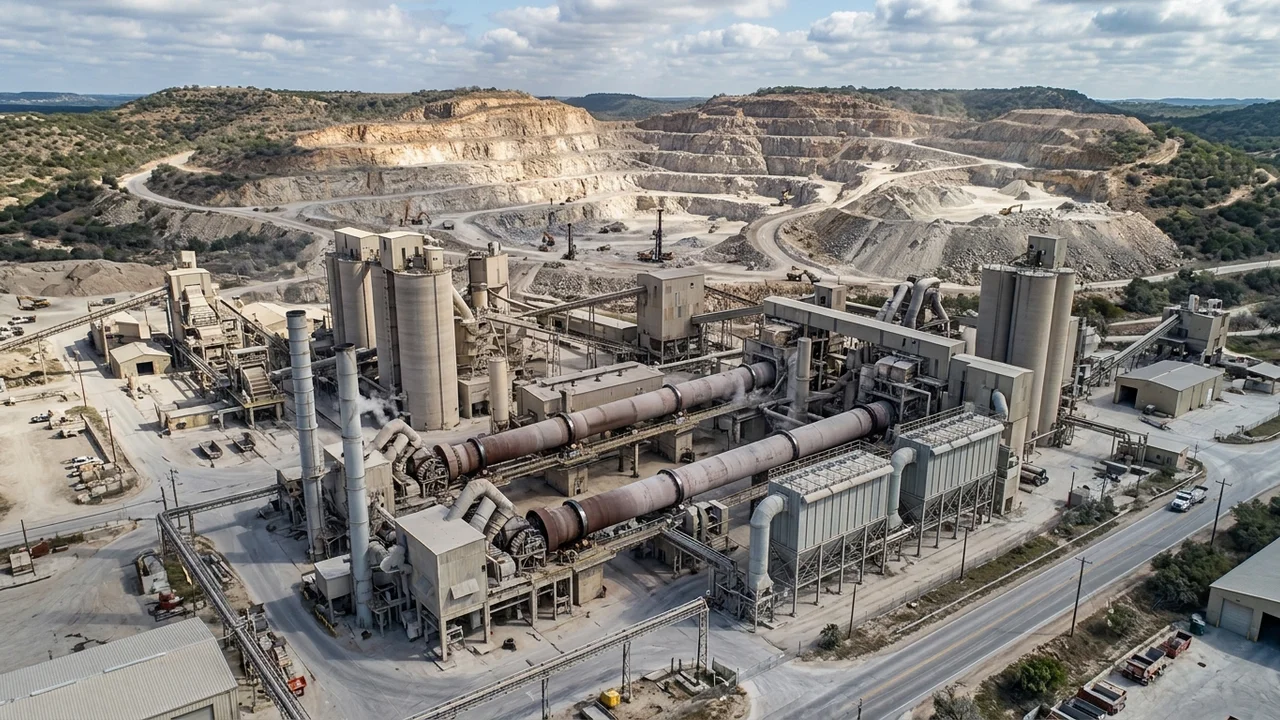
CBAM cement carries an official benchmark of 0.83 tCO₂e per tonne of Portland cement, making it the sector with the highest unavoidable process emissions per unit of output among all six CBAM sectors. At the current EU ETS price of approximately €70/tCO₂ (late March 2026), that benchmark translates to a gross compliance cost of roughly €58 per tonne of Portland cement before the free allocation adjustment. Two chemical facts explain why cement holds this position: the decomposition of limestone during clinker production releases CO₂ regardless of the energy source used, and cement is one of only two goods (fertilizers being the other) for which CBAM prices both direct and indirect embedded emissions simultaneously. EU importers bringing cement or clinker across the border need to understand how the embedded emissions calculation works, which CN codes are in scope, and what the 2026 cost burden means in practice.
Image brief: Industrial rotary furnace cross-section showing limestone feed entering at one end and clinker exiting at the other, with CO₂ emissions labeled at the calcination zone. Text overlay: "0.83 tCO₂e/t — CBAM Cement Benchmark". Commission as branded illustration with cbamguide.com logo.
What Is CBAM Cement and Which Products Are in Scope?
CBAM cement covers clinker, Portland cement, aluminous cement, and other hydraulic cements under Chapter 25 CN codes, with five distinct embedded emissions profiles determined by clinker content. The CN code distinctions matter because clinker carries higher embedded emissions per tonne than finished cement.
The distinction between clinker and finished cement is operationally significant. Clinker (CN 2523 10 00) is the intermediate product fired at high temperature before grinding; it carries the highest embedded emissions per tonne because it contains all the process CO₂ from limestone calcination. Portland cement (CN 2523 21 00 for white and 2523 29 00 for other Portland) is clinker ground with gypsum and, in blended varieties, with supplementary cementitious materials such as blast furnace slag or fly ash that dilute the clinker fraction and reduce total embedded emissions. Importers who ship blended cements with lower clinker ratios can declare lower embedded emissions, but they must document the clinker-to-cement ratio with verified data.
The table below lists the CN codes in scope under Annex I of Regulation (EU) 2023/956, together with the emissions profile for each product type.
| CN Code | Product | Emissions Profile |
|---|---|---|
| 2523 10 00 | Cement clinker | ~0.83–0.87 tCO₂/t (highest; all calcination-derived) |
| 2523 21 00 | White Portland cement | ~0.81–0.83 tCO₂/t (near-full clinker content) |
| 2523 29 00 | Other Portland cement (CEM I–V) | ~0.40–0.83 tCO₂/t (depends on clinker ratio) |
| 2523 30 00 | Aluminous cement (high alumina) | Variable; different calcination chemistry |
| 2523 90 00 | Other hydraulic cements (slag, supersulfate) | ~0.40–0.65 tCO₂/t (lower clinker fractions) |
One upstream precursor, calcined kaolinite clay (CN 2507 00 80), also appears in the CBAM cement scope. Downstream products made from cement, such as concrete blocks or precast panels covered under Chapter 68, are not in Annex I and are therefore not currently subject to CBAM obligations, though the downstream expansion proposal (COM(2025)989) could change this from January 1, 2028 if approved.
CBAM requires EU importers to comply with Regulation (EU) 2023/956, the regulatory framework that established CBAM as a certificate-based mechanism linked to the EU ETS carbon price. The wider structure of the EU carbon border adjustment mechanism places cement compliance within a broader set of obligations covering authorization, certificate purchasing, and annual declarations due by September 30, 2027 for the calendar year 2026.
Why Cement Has the Highest Embedded Emissions Per Tonne
Cement has the highest unavoidable process emissions per tonne because the limestone decomposition reaction CaCO₃ → CaO + CO₂ is chemically fixed and independent of any fuel or energy efficiency improvement. This process emission, called calcination, accounts for approximately 60% of total cement carbon footprint. Fuel combustion in the kiln contributes roughly 35%, and electricity consumption in grinding and conveying adds the remaining 5%.
The calcination mechanism operates at kiln temperatures between 1,400°C and 1,500°C. Limestone (CaCO₃) is the primary raw material, and the CO₂ embedded in the calcium carbonate molecule escapes as a gas when the material reaches decomposition temperature. No amount of switching to renewable energy or improving thermal efficiency can eliminate this emission source. A cement plant running entirely on green hydrogen as kiln fuel still releases approximately 0.50 tCO₂ per tonne of clinker from calcination alone. Only two interventions can reduce process emissions: replacing clinker with supplementary cementitious materials such as blast furnace slag or fly ash, or capturing the CO₂ at the kiln stack using carbon capture and storage technology.
This irreducibility makes CBAM cement clinker structurally different from steel or aluminium, where technology improvements can progressively reduce the embedded emissions per tonne. The embedded emissions for CEM I (ordinary Portland cement, 95–100% clinker content) are near the maximum of the benchmark range. CEM III (blast furnace slag cement, 5–64% clinker) carries embedded emissions as low as 0.40 tCO₂/t because the slag substitutes for clinker without requiring new calcination.
Understanding how embedded emissions are calculated for cement under Implementing Regulation (EU) 2025/2547 clarifies exactly how the clinker-to-cement ratio feeds into the declaration. Importers who cannot provide verified actual data fall back on the default value for the country of production, which for Turkey under the definitive phase carries a default of approximately 1.584 tCO₂e/t. That default, which includes indirect emissions and the 10% mark-up prescribed by Implementing Regulation (EU) 2025/2621, is roughly 80% higher than Turkey's actual average emission intensity of approximately 0.88 tCO₂/t. The financial incentive to measure and verify actual emissions is therefore large.
How CBAM Cement Embedded Emissions Are Calculated
CBAM cement embedded emissions are calculated under Equation 64 of Implementing Regulation (EU) 2025/2547, which bases the specific embedded emissions of Portland cement on the clinker-to-cement ratio in the final product. The calculation proceeds in two stages: first, the embedded emissions of the clinker precursor are established; second, those clinker emissions are allocated proportionally to the cement produced from that clinker input.
Cement is one of the two CBAM sectors where both direct and indirect embedded emissions are priced. Direct embedded emissions cover CO₂ from limestone calcination and fuel combustion in the production furnace. Indirect embedded emissions cover the CO₂ equivalent of electricity consumed across the production process, including grinding mills, fans, conveyors, and control systems. This dual scope applies because EU cement producers do not receive ETS compensation for their indirect electricity costs, and including indirect emissions for imports while excluding them for domestic producers would create an asymmetry that CBAM is designed to prevent.
The three inputs required for a cement declaration are listed below. Each must be accompanied by a verification report from an accredited CBAM verifier from September 1, 2026 onward.
The 3 required inputs for a cement embedded emissions declaration are as follows:
- Clinker-to-cement ratio in the specific shipment, expressed as mass fraction (for example, 0.92 for CEM I)
- Specific direct emissions of the clinker production installation, in tCO₂/t clinker produced, covering limestone calcination and fuel combustion
- Specific indirect emissions from electricity consumption, in tCO₂/t cement produced, calculated using the grid emission factor of the country of production
Where verified actual data are unavailable, the importer uses the default value published for the country of origin. The 10% mark-up on cement defaults in 2026 rises to 20% in 2027 and 30% from 2028 onward, making defaults progressively more punitive over the phase-in period.
CBAM Cement Compliance Costs: What EU Importers Pay in 2026
CBAM cement compliance costs in 2026 are modest in absolute terms because the CBAM factor for 2026 is only 2.5%, reflecting the 97.5% of EU ETS free allocation that domestic cement producers still receive. The gross CBAM cost at €70/tCO₂ for Portland cement using the benchmark is approximately €58/t. The net 2026 obligation after applying the 2.5% CBAM factor is approximately €1.45/t. However, this figure escalates sharply as free allocation phases out through 2034 at the rate set in the amended EU ETS Directive.
The table below shows gross and net CBAM costs for Portland cement under three EU ETS price scenarios across key phase-in years. All values use the 0.83 tCO₂/t benchmark. Net costs reflect the CBAM factor (% of free allocation phased out) applied to the gross figure.
| Year | CBAM Factor | Gross Cost @ €70/t | Net Cost @ €70/t | Gross Cost @ €100/t | Net Cost @ €100/t |
|---|---|---|---|---|---|
| 2026 | 2.5% | €58.10/t | €1.45/t | €83.00/t | €2.08/t |
| 2028 | 10% | €58.10/t | €5.81/t | €83.00/t | €8.30/t |
| 2030 | 48.5% | €58.10/t | €28.18/t | €83.00/t | €40.26/t |
| 2034 | 100% | €58.10/t | €58.10/t | €83.00/t | €83.00/t |
Gross costs are calculated at the stated ETS price. Net costs apply the CBAM factor (proportion of free allocation phased out). All figures use the 0.83 tCO₂/t benchmark for Portland cement. Source: Regulation (EU) 2023/956 as amended by (EU) 2025/2083; CBAM factor schedule per EU ETS Directive amendment.
Two scenarios increase costs above the benchmark figures. First, importers using the Turkish default value of approximately 1.584 tCO₂e/t face a gross cost of approximately €110.88/t at €70/tCO₂, which in many cases exceeds the FOB export price of the cement shipment itself. Second, certificate prices are not fixed: the Q1 2026 ETS price ranged between €66 and €90/tCO₂, and consensus analyst forecasts put the price at approximately €126/tCO₂ by 2030. At that price with a 48.5% CBAM factor, the net cost for Portland cement using verified actual emissions at the benchmark reaches approximately €48.87/t.
The penalty for failing to surrender sufficient certificates is €100 per tonne CO₂e not covered, per Article 26(1) of Regulation (EU) 2023/956 as amended by (EU) 2025/2083. Importing without authorization triggers a penalty of €300–500 per tonne CO₂e.
Image brief: Bar chart with years 2026, 2028, 2030, 2034 on the x-axis and net CBAM cost per tonne on the y-axis, showing the escalation from €1.45/t to €58.10/t for Portland cement at €70/tCO₂. Text overlay: "CBAM Cement Cost Phase-In 2026–2034". Commission as branded illustration with cbamguide.com logo.
Which Countries Export Cement to the EU and Why Turkey Dominates
Turkey supplies approximately 35–39% of EU cement and clinker imports, making it by far the largest single exporter of CBAM cement to the EU. Algeria accounts for approximately 19%, Ukraine approximately 13% (though severely disrupted by the ongoing war), Tunisia approximately 8%, and Egypt approximately 4–9%.
Turkey's dominant position reflects proximity to major EU import markets in southern Europe, substantial overcapacity in the Turkish cement industry relative to domestic demand, and competitive production costs historically unencumbered by carbon pricing. Turkey operates no qualifying carbon pricing scheme as of April 2026, meaning EU importers cannot apply an Article 9 deduction to reduce the CBAM certificate obligation. Turkey's actual average emission intensity for Portland cement is approximately 0.88 tCO₂/t, slightly above the CBAM benchmark of 0.83 tCO₂/t, but well below the default value of approximately 1.584 tCO₂e/t. Turkish producers face the strongest financial incentive of any cement exporting country to install measurement systems and engage accredited verifiers.
Egypt's cement exports carry higher embedded emissions than Turkey's because a larger share of Egyptian cement plants burn coal as primary fuel, producing higher direct emissions and a higher default value. Vietnam and Morocco represent smaller but growing sources of cement imports, primarily through intermediary trade routes rather than direct shipments.
CBAM Cement and the EU Industry Position
The EU cement industry's response to CBAM is the strongest industry endorsement of any CBAM sector. Major producers, including HeidelbergMaterials, Cemex, and Holcim, publicly and consistently support CBAM as a mechanism that levels the competitive field between EU producers paying the EU ETS price and non-EU producers historically facing no equivalent carbon cost. This position reflects the structural exposure of the EU cement industry: it cannot relocate production offshore to avoid carbon costs, and imported cement competes directly with domestically produced cement in the same end markets.
The EU cement industry's CBAM support also reflects the sector's limited decarbonization options. Because calcination emissions are process-bound, EU producers face a carbon cost that competitors in countries without carbon pricing do not face, and they cannot reduce that cost through incremental efficiency improvements alone. CBAM corrects this asymmetry by applying an equivalent cost to imports.
CBAM Cement in the Context of All Six CBAM Sectors
CBAM cement sits at a distinctive position among the six covered sectors: it has the highest per-tonne process emissions of any sector where those emissions are genuinely unavoidable, and it is one of only two sectors where CBAM prices both direct and indirect embedded emissions simultaneously.
For comparison, the CBAM steel sector prices direct emissions only, meaning the large electricity consumption in electric arc furnace steelmaking is excluded from CBAM obligations. Cement carries no equivalent exclusion: every tonne of electricity used in cement production contributes to the declared embedded emissions. This makes the cement calculation more comprehensive and, for energy-intensive cement plants in countries with coal-heavy electricity grids, more burdensome.
CBAM Cement: Country, Cost, and Compliance Questions
The practical questions that EU importers and non-EU cement exporters encounter most frequently when preparing for CBAM compliance are addressed below.
What CN Codes Apply to CBAM Cement Clinker?
The CN code for CBAM cement clinker is 2523 10 00, covering all intermediate clinker product regardless of the type of cement it is subsequently ground into. Clinker carries the highest embedded emissions per tonne of any CBAM cement product because no supplementary cementitious materials dilute the calcination-derived CO₂. An importer bringing clinker into the EU and then grinding it domestically into Portland cement still declares the embedded emissions of the clinker at import. The three most frequently traded CBAM cement codes are 2523 10 00 (clinker), 2523 21 00 (white Portland cement), and 2523 29 00 (other Portland cement). Use the cement CN codes lookup to confirm the full eight-digit code for a specific product classification.
What Is the 0.83 tCO₂e/t Benchmark and How Is It Used?
The 0.83 tCO₂e/t benchmark for Portland cement is the official CBAM default benchmark published in Implementing Regulation (EU) 2025/2621. It is used when a verified actual emission value is available for a specific production installation and that value falls at or below the benchmark. Importers whose suppliers have verified actual emissions at or near this level face a CBAM cost of approximately €58/t gross at €70/tCO₂. The benchmark value reflects direct emissions only for the clinker calcination and fuel combustion steps. When indirect emissions are added for countries without verified electricity data, the effective value rises. The benchmark is not a "free pass": even at 0.83 tCO₂/t, the full CBAM cost applies, subject only to the CBAM factor representing the phased-out share of free allocation.
Does CBAM Apply to Cement Imported Below the De Minimis Threshold?
No. CBAM does not apply to cement importers whose total annual mass of CBAM goods from a single country falls below 50 tonnes per calendar year, per Article 2(3a) of Regulation (EU) 2023/956 as amended by (EU) 2025/2083. This de minimis threshold covers all CBAM sectors combined from a single exporting country. An importer bringing 30 tonnes of Portland cement and 25 tonnes of steel from the same country in one calendar year crosses the 50-tonne threshold and owes CBAM obligations on both commodities. The 50-tonne threshold applies to annual mass, not to individual consignment value, which was the pre-Omnibus rule. Electricity and hydrogen are excluded from the de minimis exemption entirely.
Is Turkey's Cement Subject to a Higher CBAM Cost Than the Benchmark Suggests?
Yes. Turkish cement imported using the default value faces a CBAM cost substantially higher than the benchmark calculation implies, because Turkey's default value under CBAM is approximately 1.584 tCO₂e/t. At €70/tCO₂, that default produces a gross cost of approximately €110.88/t. The difference between Turkey's verified actual emission intensity (approximately 0.88 tCO₂/t) and the default (1.584 tCO₂e/t) is an 80% premium that creates a direct financial incentive for Turkish producers to register with the CBAM registry, engage an accredited verifier, and supply verified actual data to their EU customers. Use the CBAM Turkey country guide for a detailed breakdown of Turkey's cement export volumes, verification obligations, and strategic compliance options.
Are Blended Cements With Low Clinker Content Treated Differently Under CBAM?
Yes. Blended cements with low clinker content carry lower embedded emissions under CBAM because the embedded emissions calculation is proportional to the clinker fraction in the product. A CEM III/B blast furnace slag cement containing only 20% clinker carries embedded emissions of approximately 0.17–0.19 tCO₂/t, compared to 0.81–0.83 tCO₂/t for CEM I. The importer must declare the clinker content and provide either verified actual data for the clinker-producing installation or use the country default for clinker production. Importers who switch suppliers to producers with higher slag substitution rates can reduce their CBAM obligation materially, though the verifier must confirm the clinker ratio for each shipment.
Can an EU Cement Importer Deduct Carbon Costs Already Paid Abroad?
Yes, but only under Article 9 of Regulation (EU) 2023/956, which allows deductions for a carbon price effectively paid in the country of origin, provided the carbon pricing scheme meets qualifying criteria and has been formally assessed by the European Commission. As of April 2026, neither Turkey, Egypt, Vietnam, nor Morocco operates a qualifying carbon pricing scheme for cement production, meaning no Article 9 deduction is available for imports from those countries. The deduction only becomes financially significant after 2030, when the CBAM factor rises above 48.5% and the absolute certificate obligation increases to levels where a €5–10/tCO₂ equivalent credit in a third-country scheme produces measurable savings. The CBAM cost calculator models the net effect of Article 9 deductions across different country carbon price levels and ETS price scenarios.