Cement clinker carries the highest embedded emissions of any product in the CBAM cement sector, with the limestone calcination reaction alone generating approximately 0.50 tCO₂ per tonne of clinker produced. That single unavoidable chemistry step explains why cement clinker faces a gross CBAM cost of roughly €58 per tonne at the current EU ETS price of €70/tCO₂, and why no energy efficiency program alone can eliminate that liability. Understanding the split between process emissions and fuel emissions is the first step toward accurate CBAM compliance planning for any importer of CN code 2523 10 00.
Under the EU CBAM guide, cement is one of six sectors covered by Regulation (EU) 2023/956 from January 1, 2026. Clinker sits at the top of the cement carbon hierarchy because it is the intermediate product with the least dilution: no supplementary materials have yet been blended in to reduce the clinker-to-cement ratio.
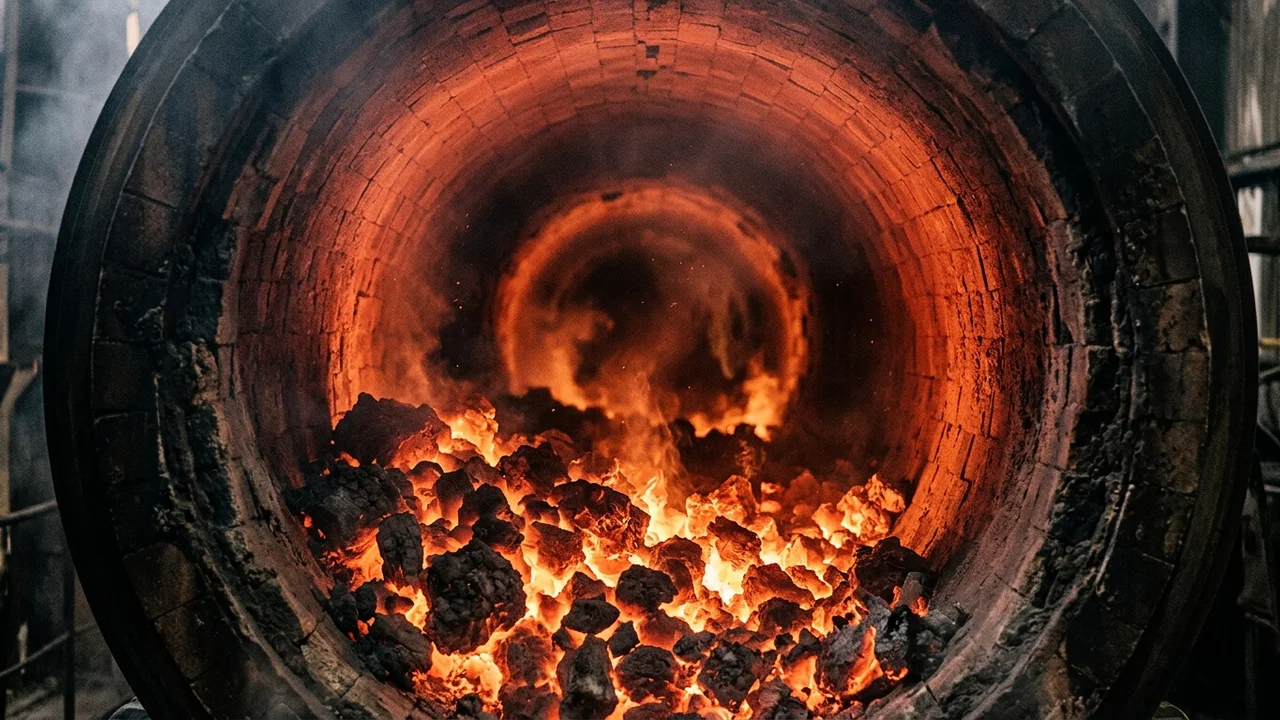
Caption: Inside a cement kiln, the calcination zone reaches 900°C where CaCO₃ decomposes irreversibly into CaO and CO₂.
What Makes Clinker the Most Carbon-Intensive Cement Product
Cement clinker is the intermediate product formed when limestone (CaCO₃) is heated beyond 900°C in a rotary kiln, decomposing irreversibly into calcium oxide (CaO) and carbon dioxide (CO₂) in a reaction that cannot be reversed through energy management. This process emission is chemically fixed: one tonne of clinker requires approximately 1.28 tonnes of limestone as input, and the stoichiometry of the calcination reaction releases roughly 0.53 tCO₂/t from the limestone alone, before any fuel combustion is counted.
Three emission sources combine to form clinker's total carbon footprint. The three sources are ranked below by magnitude for a standard dry-process kiln.
The 3 emission sources for cement clinker are listed by share of total footprint:
- Limestone calcination (process emission): approximately 60% of total CO₂. This share is chemically determined by the calcium carbonate content of the raw meal. Kilns burning higher-calcium limestone produce proportionally more calcination CO₂.
- Fuel combustion in the kiln: approximately 35% of total CO₂. Coal, petcoke, and alternative fuels power the kiln to the 1,450°C temperature required for clinkerization. Switching to lower-carbon fuels reduces this portion.
- Electricity consumption: approximately 5% of total CO₂. Cement is covered for both direct and indirect emissions under CBAM, meaning the electricity used in grinding and conveying is also priced.
The clinker-to-cement ratio in a finished cement product determines how much of the clinker carbon footprint transfers to the final good. CEM I (ordinary Portland cement) contains 95–100% clinker. CEM III (blast furnace slag cement) contains as little as 5–64% clinker. Importers must specify this ratio in their CBAM declarations per Implementing Regulation (EU) 2025/2547, Equation 64.
How CBAM Prices Clinker Emissions in 2026
CBAM requires EU importers to surrender certificates proportional to the embedded CO₂ of imported clinker. The certificate price equals the quarterly average of EU ETS auction clearing prices, which stood at approximately €70/tCO₂ in late March 2026. Gross CBAM liability for clinker calculates as follows.
The table below shows gross CBAM cost for cement clinker at three ETS price scenarios, using the CBAM benchmark emission factor of 0.83 tCO₂/t from Implementing Regulation (EU) 2025/2621.
| ETS Price (€/tCO₂) | Emission Factor (tCO₂/t clinker) | Gross CBAM Cost (€/t clinker) | Net 2026 Cost (×2.5% factor) |
|---|---|---|---|
| €50 | 0.83 | €41.50 | €1.04 |
| €70 | 0.83 | €58.10 | €1.45 |
| €100 | 0.83 | €83.00 | €2.08 |
Net cost in 2026 is small because 97.5% of free allocation in the EU Emissions Trading System remains intact this year, and the CBAM factor is only 2.5%. That cost trajectory changes sharply from 2029 onward: at the 48.5% CBAM factor applicable in 2030, the net cost at €70/tCO₂ rises to approximately €28.17 per tonne of clinker.
Importers who rely on CBAM default values rather than verified actual data face an additional penalty. The default value for Portland cement from Turkey, the EU's dominant cement supplier at approximately 35–39% of EU cement imports, is approximately 1.584 tCO₂e/t including indirect emissions and the 10% mark-up applied under Implementing Regulation (EU) 2025/2621 in 2026. Turkish kilns actually emit approximately 0.88 tCO₂/t, creating an 80% gap between actual and default. That gap translates directly into avoidable cost for importers who fail to obtain verified production data.
The full methodology for how embedded emissions are calculated across the clinker and cement supply chain is covered in the dedicated guide to how embedded emissions are calculated.
Caption: Net CBAM cost per tonne of clinker rises from under €2 in 2026 to over €80 by 2034 as free allocation phases out under the ETS Directive amendment schedule.
Why Clinker Emissions Cannot Be Eliminated Through Energy Efficiency
The calcination reaction is the central compliance challenge for the cement sector under CBAM. Fuel switching and electrification reduce the 35% fuel combustion share and the 5% electricity share. They have no effect on the 60% calcination share.
Four strategies exist to reduce clinker's process emissions. Those strategies and their current deployment status are listed below:
- Clinker substitution: Replacing clinker with supplementary cementitious materials (SCMs), including blast furnace slag, fly ash, and calcined clay, directly reduces the clinker content of finished cement and therefore the embedded emissions per tonne of product. This is the most commercially deployed strategy in 2026.
- Carbon capture and storage (CCS): Capturing CO₂ at the kiln exhaust stack and storing it geologically is the only method that neutralizes calcination emissions without reducing clinker content. As of 2026, fewer than five commercial-scale CCS installations operate at cement plants globally.
- Alternative raw materials: Low-calcium raw meals reduce the stoichiometric CO₂ yield per tonne of clinker, though blending options are constrained by clinker quality specifications.
- Electrification of kiln heating: Electrically heated kilns powered by renewable energy eliminate combustion CO₂ (the 35% fuel share). Two demonstration projects were operating in Europe as of early 2026.
Importers procuring clinker from suppliers with high SCM substitution rates or partial CCS installation can document those reduced emissions through verified actual data, provided the verification meets accredited third-party standards. The financial incentive to do so increases every year as the CBAM factor rises toward 100% in 2034.
How CBAM Applies to Clinker Imports: The Contextual Border
The CBAM cement sector guide covers the full compliance workflow for all cement CN codes. Clinker-specific obligations require particular attention because clinker (CN 2523 10 00) is both a standalone CBAM good and a precursor embedded in the emissions of downstream Portland cement and blended cement products.
An EU importer purchasing cement clinker directly faces CBAM obligations at the full clinker emission factor. An EU importer purchasing Portland cement (CN 2523 29 00) faces CBAM obligations calculated from the clinker content in that cement. Declarations must specify the clinker ratio to determine the precise embedded emission per tonne of the final product imported.
What CN Code Covers Cement Clinker Under CBAM?
Cement clinker falls under CN code 2523 10 00 in Annex I of Regulation (EU) 2023/956. This is the only CN code in Chapter 25 assigned exclusively to unground clinker before blending into finished cement. Importers of this code face the highest per-tonne emission factor in the cement sub-sector at approximately 0.83–0.87 tCO₂/t, compared to 0.81 tCO₂/t for finished Portland cement.
The CBAM default value for clinker from countries without verified actual data is set at a higher level than the benchmark, with the 10% mark-up under Implementing Regulation (EU) 2025/2621 applying in 2026. For the complete list of CN codes and their applicable emission factors, review the CBAM cement CN codes reference page.
Does the De Minimis Threshold Apply to Clinker Imports?
The de minimis threshold of 50 tonnes annual mass per importer applies to cement clinker imports. Importers whose total CBAM-covered cement goods, including clinker, fall below 50 tonnes in a calendar year are exempt from CBAM obligations for that year under Article 2(3a) of Regulation (EU) 2023/956 as amended by Regulation (EU) 2025/2083. This threshold applies per importer, not per shipment, and the electricity and hydrogen sectors are excluded from this threshold.
Is Turkey's Clinker Exempt from CBAM?
Turkey is not exempt from CBAM. Turkey supplies approximately 35–39% of EU cement imports and has no qualifying carbon pricing scheme that would allow an Article 9 deduction under Regulation (EU) 2023/956. Turkish clinker importers carry the full gross CBAM liability. At the default value of approximately 1.584 tCO₂e/t and the current ETS price of €70/tCO₂, the gross default-based cost reaches approximately €111/t, which in some trade lanes exceeds the FOB export price of the clinker itself.
Importers of Turkish clinker have a strong financial incentive to obtain verified actual emission data from Turkish producers to reduce CBAM costs below the punitive default, as described in the CBAM default values guide.
What Is the First CBAM Declaration Deadline for Clinker Importers?
The first CBAM declaration covering calendar year 2026 is due by September 30, 2027, per Article 6 of Regulation (EU) 2023/956 as amended by Regulation (EU) 2025/2083. Importers must record the embedded emissions of all clinker imported throughout 2026, surrender the corresponding certificates by that deadline, and retain supporting records for four years after the declaration year. CBAM certificate sales begin on February 1, 2027, giving importers approximately eight months to purchase and surrender certificates before the first deadline.
Can Clinker Importers Use Default Values Instead of Actual Emissions?
Clinker importers can use CBAM default values in 2026, but the financial penalty for doing so is significant. The default value system applies a 10% mark-up above the calculated benchmark in 2026, rising to 20% in 2027 and 30% from 2028 onward under Implementing Regulation (EU) 2025/2621. For Turkey and Egypt, where actual kiln emissions are substantially below the default, the cost difference between defaulting and using verified actual data exceeds €20/t at the current ETS price. Importers planning beyond 2026 should begin working with their cement suppliers on accredited verification programs now, before the 2027 mark-up doubles. For a full compliance workflow, see CBAM compliance for cement importers.
Does the Calcination Reaction Affect All Cement Types Equally?
The calcination reaction affects all clinker-based cement types, but its impact on finished cement depends on the clinker ratio. CEM I (95–100% clinker) carries nearly the full calcination burden. CEM II (blended cement, 65–94% clinker) reduces embedded emissions in proportion to the supplementary materials used. CEM III (slag cement, 5–64% clinker) achieves the largest reduction. Cement exporters supplying blended products to the EU market retain a material CBAM cost advantage over pure Portland cement suppliers. Exporters seeking to understand the full competitive picture can review the CBAM impact on cement exporters analysis.