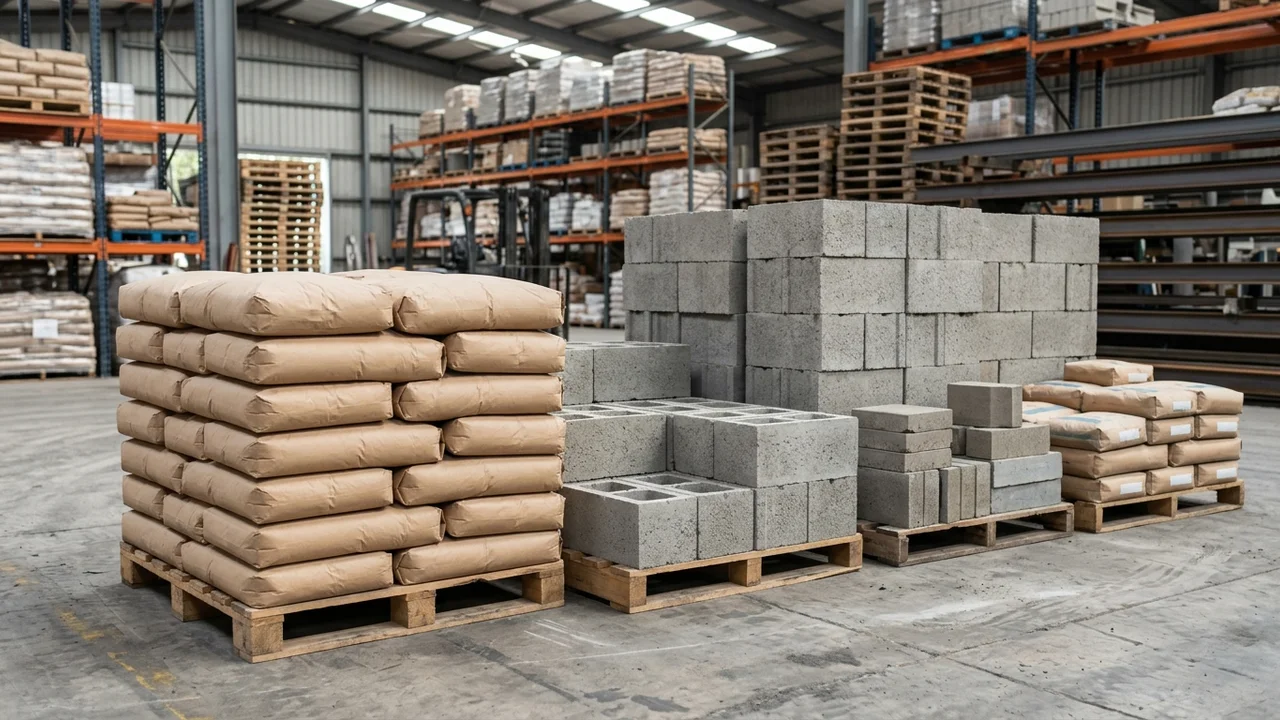
CBAM cement CN codes cover 6 distinct product headings under Chapter 25 of the Combined Nomenclature, with clinker (2523 10 00) carrying the highest embedded emissions of any heading in the cement sector at approximately 0.83–0.87 tCO₂ per tonne. EU importers classifying shipments under these codes must account for both direct and indirect emissions, making cement the only major CBAM sector where electricity consumption in production is fully priced. Understanding which CN codes fall within Annex I of Regulation (EU) 2023/956 determines whether an import triggers certificate obligations under the EU CBAM guide.
Caption: Chapter 25 of the Combined Nomenclature contains all six CBAM-covered cement product headings, from calcined kaolinite clays through hydraulic cements.
Which CN Codes Does CBAM Cover for Cement?
CBAM covers 6 CN code headings for cement, spanning calcined kaolinite clays as a precursor through Portland, aluminous, and other hydraulic cements listed in Annex I of Regulation (EU) 2023/956. The definitive phase began January 1, 2026, meaning all imports classified under these codes now trigger certificate obligations rather than the reporting-only requirements of the transitional period.
The table below lists every CBAM-covered cement CN code, the product description, and the benchmark emission factor from Implementing Regulation (EU) 2025/2621.
| CN Code | Product Description | Emission Factor (tCO₂/t) | Notes |
|---|---|---|---|
| 2507 00 80 | Calcined kaolinite clays | Precursor | Upstream input; embedded emissions flow to cement |
| 2523 10 00 | Cement clinker | ~0.83–0.87 | Highest per-tonne emissions in the sector |
| 2523 21 00 | White Portland cement | ~0.81 | High clinker content (95–100%) |
| 2523 29 00 | Other Portland cement | ~0.70–0.83 | Clinker ratio determines exact factor |
| 2523 30 00 | Aluminous cement (high alumina) | Variable | Declared on clinker-to-cement ratio |
| 2523 90 00 | Other hydraulic cements (slag, supersulfate) | ~0.40–0.65 | Lower clinker ratio = lower emissions |
Annex I of Regulation (EU) 2023/956 defines the precise scope. Concrete articles, precast panels, and other Chapter 68 products manufactured from cement are not included in Annex I. CBAM applies to cement itself, not to downstream fabricated products.
CBAM Clinker CN Code: Why 2523 10 00 Carries the Highest Obligation
The CBAM clinker CN code 2523 10 00 represents the intermediate product produced by heating limestone to approximately 1,450 °C in a rotary kiln, and it generates more embedded CO₂ per tonne than any other heading in the cement sector. The limestone calcination reaction, CaCO₃ → CaO + CO₂, is chemically unavoidable and accounts for approximately 60% of clinker's total carbon footprint. Fuel combustion in the kiln contributes a further 35%, while electricity consumption in grinding and auxiliary processes adds the remaining 5%.
The chemical irreversibility of the calcination step is what distinguishes cement from steel or aluminium in the CBAM framework. An EU importer of clinker cannot present evidence of energy efficiency improvements to reduce the calcination emission below the stoichiometric minimum. Reducing embedded emissions in clinker requires either clinker substitution materials, such as blast furnace slag, fly ash, or calcined clay, or carbon capture and storage integrated into the kiln exhaust.
For importers, the practical consequence is this: a shipment of 1,000 tonnes of clinker classified under 2523 10 00 carries approximately 830–870 tonnes of embedded CO₂. At the current EU ETS price of approximately €70/tCO₂ (late March 2026 market data, which fluctuates daily), the gross CBAM cost on that shipment reaches approximately €58,100–€60,900. The net obligation in 2026 reflects a CBAM factor of 2.5% (because 97.5% of free allocation remains), reducing the net certificate cost to approximately €1,453–€1,523 for that 1,000-tonne consignment this year. That net figure rises steeply through 2034.
For full details on the CBAM cement sector guide, including kiln technology comparisons and country-specific default values, the sector guide covers the full calculation methodology under Implementing Regulation (EU) 2025/2547.
Portland Cement CN Codes Under CBAM: 2523 21 00 and 2523 29 00
Portland cement CN codes 2523 21 00 (white Portland) and 2523 29 00 (other Portland cement) together account for the majority of cement import volumes into the EU and represent the highest-value compliance category for most importers.
The 4 key compliance facts for Portland cement importers are listed below.
- White Portland cement (2523 21 00) uses a higher-purity limestone that reduces iron and manganese content, producing a clinker-to-cement ratio of 95–100% and therefore embedded emissions nearly identical to pure clinker.
- Other Portland cement (2523 29 00) includes CEM I through CEM V product types; the exact clinker content governs the embedded emissions calculation and must be declared accurately.
- Both direct emissions from kiln combustion and calcination and indirect emissions from electricity consumption are priced under CBAM for Portland cement, unlike steel where only direct emissions apply.
- Default values for Portland cement from countries such as Turkey reach approximately 1.584 tCO₂e/t when the mark-up from Implementing Regulation (EU) 2025/2621 is applied, compared with Turkey's actual emission intensity of approximately 0.88 tCO₂/t, a differential of approximately 80%.
The default mark-up schedule increases from 10% above the calculated default in 2026 to 30% from 2028 onward. Exporters and their EU importer counterparts who provide verified actual emissions data avoid this mark-up entirely, which at scale represents a substantial financial advantage.
Other Hydraulic Cement CN Codes: 2523 30 00 and 2523 90 00
Aluminous cement (2523 30 00) and other hydraulic cements (2523 90 00) complete the CBAM cement CN code list. These products carry lower embedded emissions than Portland cement because they incorporate a higher proportion of supplementary cementitious materials and a lower clinker ratio.
Other hydraulic cements classified under 2523 90 00 include slag cement, supersulfate cement, and pozzolanic cement. Their embedded emissions range from approximately 0.40 to 0.65 tCO₂/t, reflecting a clinker content typically between 5% and 64%. Implementing Regulation (EU) 2025/2547, Equation 64, governs the calculation: specific embedded emissions are derived from the clinker-to-cement ratio declared by the importer.
EU importers handling blended or low-clinker hydraulic cements have a compliance incentive to document the exact clinker content in their declarations. The difference between declaring a blended product under a high-clinker default versus providing verified clinker ratio data can reduce the CBAM certificate obligation by 30–50% per tonne. Importers importing less than 50 tonnes of covered cement goods annually from a single country qualify for the CBAM de minimis threshold exemption under Article 2(3a) of Regulation (EU) 2023/956 as amended by Regulation (EU) 2025/2083.
How to Use CBAM Cement CN Codes in Practice
Accurate CN code classification is the first compliance checkpoint for every cement import under CBAM. Misclassifying clinker as a non-covered calcined clay product, or misreporting clinker content in a blended hydraulic cement, constitutes a fraudulent emissions declaration and attracts penalty rates aligned with the EU ETS excess emissions penalty structure under Article 26 of Regulation (EU) 2023/956.
The 5 classification steps for cement importers are listed below.
- Identify the product at the six-digit HS heading level: 2507 (clays), 2523 (cements), using the importer's commercial invoice and technical data sheet.
- Extend to the eight-digit CN subheading: 2523 10 00 for clinker, 2523 21 00 for white Portland, 2523 29 00 for other Portland, 2523 30 00 for aluminous, and 2523 90 00 for other hydraulic cements.
- Confirm the product is not a Chapter 68 article (precast concrete, fiber cement board, asbestos-free panels) — these fall outside Annex I scope entirely.
- Obtain the clinker-to-cement ratio from the manufacturer's specification sheet or third-party verification report, as this directly determines the embedded emissions figure used in the CBAM declaration.
- Calculate annual import volumes across all consignments per country to assess whether the 50-tonne de minimis threshold applies and whether authorized declarant status is required before March 31, 2026.
Caption: The rotary kiln calcination process converts limestone to clinker, releasing the CO₂ emissions that determine CBAM certificate obligations for CN code 2523 10 00 importers.
What CBAM Cement Importers Need to Know
Frequently Asked Questions on CBAM Cement CN Codes
Is cement clinker (2523 10 00) always subject to CBAM?
Cement clinker classified under 2523 10 00 is subject to CBAM when imported into the EU customs territory from any third country not listed as exempt in Annex III of Regulation (EU) 2023/956. Exempt territories are those where the EU ETS applies directly or where a linked equivalent carbon pricing scheme is recognized. No cement-exporting country currently holds exempt status under Annex III.
Does CBAM apply to ready-mixed concrete or precast panels?
CBAM does not apply to ready-mixed concrete, precast panels, or other cement-containing articles classified under Chapter 68 of the Combined Nomenclature. Annex I of Regulation (EU) 2023/956 covers only the cement products themselves, stopping at the finished cement stage. Downstream fabricated products incorporating cement are outside the current scope, although COM(2025)989 proposes expanding coverage to downstream products from January 1, 2028, pending legislative approval.
What is the difference in CBAM cost between clinker and blended hydraulic cement?
A tonne of clinker (2523 10 00) carries embedded emissions of approximately 0.83–0.87 tCO₂/t, while blended hydraulic cement under 2523 90 00 with a clinker ratio of 30% carries approximately 0.25–0.28 tCO₂/t. At €70/tCO₂, gross CBAM costs are approximately €58–€61 per tonne for clinker versus approximately €17–€20 per tonne for the blended product, a differential of approximately €40 per tonne before the free allocation factor is applied.
Are there Boolean thresholds that determine whether CBAM applies to a cement shipment?
Two Boolean thresholds govern cement import obligations under CBAM. First, does the importing entity's annual mass of covered cement products from a specific third country exceed 50 tonnes? Importers below this threshold qualify for the de minimis exemption and are not required to hold authorized declarant status or surrender certificates. Second, is the importing entity registered as an authorized declarant by March 31, 2026? Entities importing above the 50-tonne threshold without authorization face the unauthorized importer penalty of €300–500 per tonne CO₂e under Article 26(2) of Regulation (EU) 2023/956.
Does the CBAM default value or actual emissions data produce a lower certificate cost for cement?
In 2026, for cement importers using default values, the interaction between the 10% default mark-up and the 2.5% CBAM factor can in some cases produce a net obligation that differs only marginally from actual values. From 2027, the default mark-up increases to 20% and then to 30% from 2028 onward, while the CBAM factor rises steeply toward full phase-in by 2034. Exporters with actual verified emissions below the default benchmark have a growing financial incentive to invest in third-party verification from 2027 onward.
Supplementary Resources for Cement Importers
For operational compliance on certificate purchasing, authorized declarant registration, and quarterly holding requirements, the CBAM compliance for cement importers guide covers the full obligation chain from customs declaration to annual CBAM declaration due September 30, 2027.
Non-EU cement producers in Turkey, Egypt, and Algeria who export to EU buyers face strategic pricing and competitiveness decisions that extend beyond CN code classification. The CBAM impact on cement exporters page addresses verified emissions reporting, default value exposure, and Article 9 deduction eligibility in detail.
Importers who need to verify CN code status for specific product descriptions outside the standard headings can use the CBAM CN code lookup tool to cross-reference product descriptions against Annex I.
For certificate pricing, the quarterly average of EU ETS auction clearing prices determines CBAM certificate values in 2026 under Article 22(1a) of Regulation (EU) 2023/956 as amended. Importers using CBAM default values for their embedded emissions calculations are not required to submit third-party verified data in 2026, but those defaults increasingly carry a financial penalty relative to verified actual data as the decade progresses.