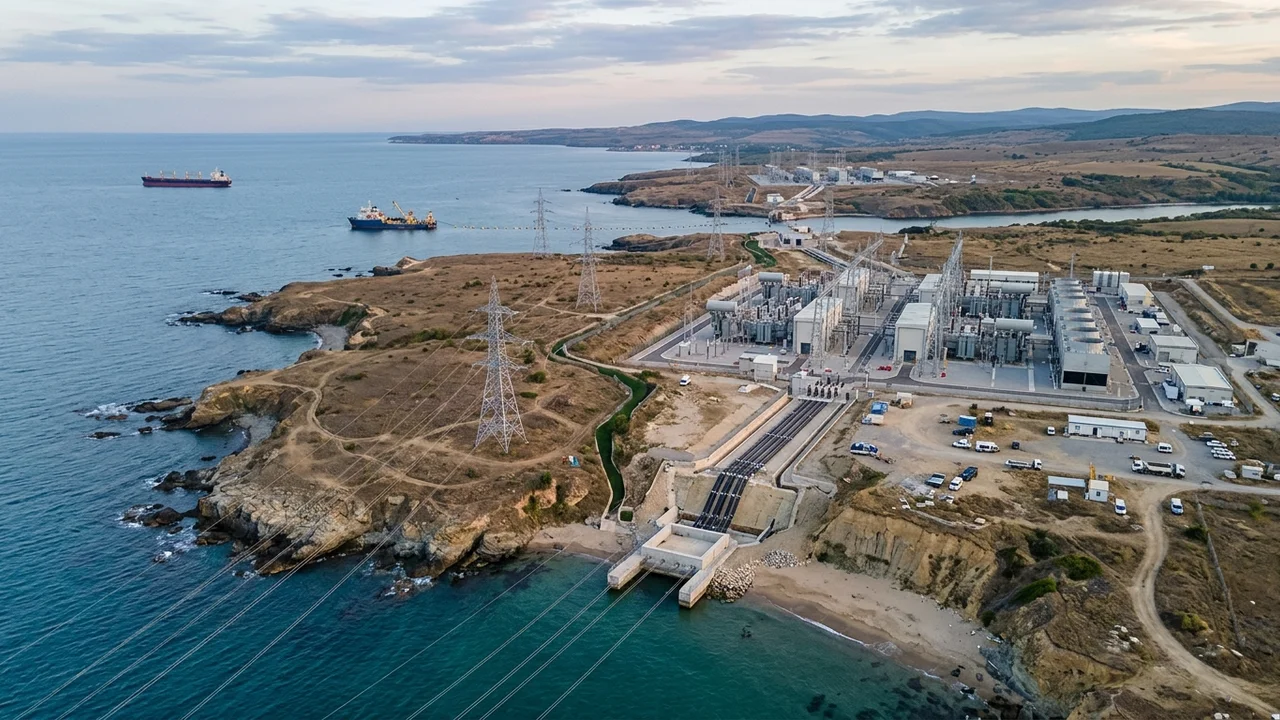
CBAM electricity interconnectors are the physical transmission lines through which cross-border electricity flows into the EU — and as of January 1, 2026, every megawatt-hour passing through these cables carries a potential carbon obligation under Regulation (EU) 2023/956. Six distinct interconnector corridors currently expose EU electricity importers to CBAM, linking the UK, Morocco, Ukraine, and Turkey to the European grid. Understanding which cables are in scope, how embedded emissions are measured per corridor, and what the de facto default-value regime means for compliance is the practical core of electricity CBAM.
Caption: Physical interconnection infrastructure at the EU border — the point where CBAM carbon accounting for imported electricity begins.
What CBAM Means for Electricity Interconnectors
CBAM applies to electricity imported into the EU via physical interconnectors, priced at the embedded CO₂ per MWh generated in the exporting country, calculated using country-specific default emission factors under CN code 2716 00 00. No de minimis threshold applies to electricity: unlike the 50-tonne annual mass exemption that covers steel, cement, aluminium, fertilizers, and hydrogen, every megawatt-hour imported through a non-exempt interconnector is in scope from the first unit.
The electricity sector holds a unique position within CBAM. Because electricity cannot be "imported" from a non-adjacent country — electrons travel through a connected grid, not a shipping container — trade is physically constrained to countries sharing active interconnectors with EU member states. This geographical fact limits the universe of potentially liable parties to a small, identifiable set of corridors, each with its own emission profile and compliance implications.
To understand the full framework within which interconnectors operate, the EU CBAM guide sets out the certificate purchase timeline, authorization requirements, and the September 30, 2027 declaration deadline covering calendar year 2026.
Active Interconnectors Subject to CBAM
Seven interconnector groups currently connect non-exempt countries to the EU grid. The table below lists the active corridors, their capacities, and the CBAM status of the exporting country as of April 2026.
| Interconnector | Countries | Capacity | CBAM Exposure | Exporter Carbon Price |
|---|---|---|---|---|
| IFA (Interconnexion France-Angleterre) | UK to France | 2 GW | Yes | UK ETS (not linked) |
| IFA2 | UK to France | 1 GW | Yes | UK ETS (not linked) |
| ElecLink | UK to France (via Channel Tunnel) | 1 GW | Yes | UK ETS (not linked) |
| BritNed | UK to Netherlands | 1 GW | Yes | UK ETS (not linked) |
| Nemo Link | UK to Belgium | 1 GW | Yes | UK ETS (not linked) |
| Viking Link | UK to Denmark | 1.4 GW | Yes | UK ETS (not linked) |
| Turkey to Greece/Bulgaria (400 kV lines) | Turkey to EU | ~0.7 GW | Yes | None |
| Morocco to Spain (Gibraltar AC link) | Morocco to Spain | ~0.7 GW | Yes | None |
| Ukraine to ENTSO-E | Ukraine to EU | Varies | Conditional | None qualifying |
Norway, Iceland, Liechtenstein, and Switzerland are exempt under Annex III of Regulation (EU) 2023/956 because they participate in the EU ETS or operate a linked carbon pricing scheme. The Baltic states disconnected from the Russian BRELL ring in February 2025 and synchronized with ENTSO-E, removing that corridor from CBAM scope entirely.
How Embedded Emissions Are Calculated for Interconnector Electricity
Actual emission values for interconnector electricity require five conditions to be met simultaneously under Annex III, point 5 of Regulation (EU) 2023/956. Those conditions include a power purchase agreement with a specific generator, direct connection to the EU grid with no network congestion, emissions not exceeding 550 g CO₂/kWh, firm nomination to allocated interconnection capacity, and hourly matching between nominated and actual production within one-hour periods.
In practice, this five-factor test eliminates actual values for the overwhelming majority of cross-border electricity trades. Market coupling and wholesale trading over interconnectors — the dominant commercial model across all six corridors — cannot satisfy the hourly matching requirement at scale. Importers therefore rely on country-specific default emission factors, and those defaults become the operative measure of CBAM liability.
The CBAM electricity sector guide covers the full methodology for both default and actual value calculations, including the precise Annex III criteria that must be satisfied simultaneously for actual values to apply.
The UK Interconnector Corridor: Largest Single Exposure
The UK accounts for the largest single block of non-exempt interconnector capacity into the EU. Five interconnectors totaling 6.4 GW of nameplate capacity run from Great Britain to France (4 GW across IFA, IFA2, and ElecLink), the Netherlands (BritNed at 1 GW), Belgium (Nemo Link at 1 GW), and Denmark (Viking Link at 1.4 GW, operational from December 2024).
The UK ETS exists and covers the electricity generation sector, but the UK ETS is not linked to the EU ETS. This means the UK does not appear in Annex III of Regulation (EU) 2023/956 as an exempt jurisdiction. UK electricity exports to the EU are subject to CBAM certificate obligations. Whether an Article 9 deduction for UK ETS costs paid at the point of generation applies to UK electricity remains an unresolved interpretive question as of April 2026. The Commission has not published implementing guidance specifically addressing UK electricity deductions.
The UK grid emission factor has declined substantially over the past decade as coal generation has been phased out. In 2025, the UK grid averaged approximately 170–200 g CO₂/kWh, compared to the EU default for the UK of approximately 268 g CO₂/kWh under transitional period defaults. This gap between actual grid intensity and the conservative default creates a financial incentive for UK generators to pursue actual value certification — though the hourly matching requirement remains the practical barrier.
Morocco-Spain: The Renewable Growth Corridor
Morocco connects to Spain via the Gibraltar AC interconnector at approximately 0.7 GW of capacity. Morocco has no qualifying carbon pricing scheme, placing all Moroccan electricity exports squarely within CBAM scope.
Morocco's electricity grid carries a distinctive profile. The country has invested heavily in concentrated solar power (CSP) and onshore wind, anchored by the 580 MW Noor Ouarzazate CSP complex and the 300 MW Tarfaya wind farm. These low-carbon generation assets mean that electricity flowing through the Morocco-Spain interconnector at certain times carries significantly lower embedded emissions than Morocco's national grid average would suggest. However, the hourly matching requirements make actual value certification difficult for most traded volumes.
The Morocco-Spain corridor is strategically significant beyond its current 0.7 GW capacity. Morocco's OCP Group and MASEN energy authority are developing large-scale renewable capacity targeting EU energy markets. Future interconnector expansions, including a proposed 2 GW subsea cable to Portugal under the ELMED interconnection framework, would substantially increase Moroccan electricity flows and the associated CBAM compliance volumes.
Turkey-Greece and Turkey-Bulgaria: High-Carbon Exposure
Turkey connects to the EU grid through several 400 kV lines crossing into Greece and Bulgaria, with approximately 0.7 GW of combined capacity. Turkey operates no qualifying carbon pricing scheme, and the Turkish grid's emission factor — driven by substantial coal and gas generation — is among the highest of any interconnector source country.
The Turkish grid averaged approximately 430–460 g CO₂/kWh in 2024, meaning electricity flowing through the Turkey-Greece and Turkey-Bulgaria interconnectors carries among the highest default CBAM liabilities of any corridor. At the current EU ETS price of approximately €70/tCO₂ as of late March 2026, a 1 MWh import from Turkey at 450 g CO₂/kWh carries a gross CBAM cost of approximately €31.50/MWh.
Turkey's renewables capacity is growing, with significant hydro, wind, and solar additions in recent years. Actual emission data, if the five-factor test could be satisfied for specific renewable generation sources, would produce materially lower CBAM costs than the grid-average default. This creates a long-term incentive for Turkish renewable generators to structure power purchase agreements and grid allocation arrangements that meet the Annex III criteria.
Ukraine: Emergency Grid Synchronization and CBAM Status
Ukraine synchronized its electricity grid with the ENTSO-E Continental European grid on an emergency basis in March 2022 following the Russian invasion. Ukraine has maintained this synchronization and has gradually expanded cross-border trading capacity with EU member states, particularly Poland, Slovakia, Hungary, and Romania.
Ukraine does not currently qualify for market coupling exemption under Article 2(7)-(12) of Regulation (EU) 2023/956. That exemption requires full electricity market integration with EU market rules and a credible commitment pathway to EU ETS participation — conditions Ukraine has not yet formally met as of April 2026. Ukrainian electricity exports are therefore subject to CBAM default values.
Ukraine's grid emission factor is complicated by the ongoing conflict. Pre-war, Ukraine relied heavily on nuclear generation (approximately 50–55% of generation), which carries near-zero direct emission factors. Hydro generation contributed another 5–8%. The war damaged thermal generation infrastructure and disrupted normal dispatch patterns, making grid-average emission factors volatile. The how embedded emissions are calculated page explains the methodology used when country grid data is disrupted or unavailable.
Caption: Geographic distribution of CBAM-affected electricity interconnectors at EU borders — each corridor carries a distinct carbon intensity and compliance profile.
Navigating CBAM Compliance for Interconnector Electricity
CBAM compliance for electricity operates through the authorized declarant system under Regulation (EU) 2023/956 as amended by Regulation (EU) 2025/2083. The key compliance steps for electricity importers are listed below.
The compliance obligations for electricity interconnector importers under the definitive phase fall into four sequential actions:
- Obtain authorized declarant status by the March 31, 2026 application deadline, or confirm provisional importing rights during the authorization decision period of up to 120 days
- Record each electricity import by MWh, interconnector corridor, and calendar month, using country-specific default emission factors unless the five-factor Annex III test is satisfied
- Maintain quarterly holding of CBAM certificates covering at least 50% of cumulative embedded emissions from January 1, 2026 onward, using the quarterly average EU ETS auction price for 2026 certificates
- Submit the first annual CBAM declaration by September 30, 2027, covering all electricity imports for calendar year 2026, and surrender sufficient certificates to cover embedded emissions
Frequently Asked Questions on CBAM Electricity Interconnectors
Is electricity from Norway or Switzerland subject to CBAM?
No. Norway, Iceland, Liechtenstein, and Switzerland are listed in Annex III of Regulation (EU) 2023/956 as exempt jurisdictions. Norway and Iceland are EEA members that fully participate in the EU ETS. Switzerland operates a linked ETS under a bilateral agreement with the EU. Electricity imports from all four countries are treated as internal market flows for CBAM purposes and carry no certificate obligation.
Does the de minimis threshold apply to electricity interconnector imports?
No. The 50-tonne annual mass de minimis threshold does not apply to electricity or hydrogen. Article 2(3a) of Regulation (EU) 2023/956, as amended by Regulation (EU) 2025/2083, explicitly excludes electricity and hydrogen from the mass-based exemption. Every megawatt-hour of electricity imported from a non-exempt country is in scope from the first unit.
Can UK electricity exporters claim an Article 9 deduction for UK ETS costs?
This remains an open question as of April 2026. Article 9 of Regulation (EU) 2023/956 allows authorized declarants to deduct a carbon price paid in the country of origin when calculating net CBAM liability. The UK ETS covers electricity generation, and UK generators do pay a carbon price. However, the Commission has not issued implementing guidance confirming whether and how UK ETS costs satisfy the Article 9 criteria for electricity specifically. UK electricity importers should consult their competent authority. The UK CBAM guide covers the UK's own parallel CBAM regime launching in January 2027.
Are there exemptions for renewable electricity imported through interconnectors?
No categorical exemption applies to renewable electricity. Annex III, point 5 allows actual emission values to approach zero for certified renewable generation, but this requires satisfying all five conditions simultaneously — including the one-hour temporal matching requirement and a direct connection to the EU grid with no network congestion. Most renewable electricity traded over interconnectors through wholesale markets cannot satisfy these conditions. Importers using CBAM default values will pay based on the exporting country's grid average, which blends renewable and non-renewable generation.
Is Viking Link (UK-Denmark) subject to CBAM even though Denmark is in the EU?
Yes. Viking Link connects Great Britain to Denmark. The UK end of the cable originates outside the EU. When electricity flows from the UK into Denmark via Viking Link, it is an import of electricity from a third country (the UK) into the EU, and CBAM applies based on the UK's grid emission factor. When electricity flows in the opposite direction, from Denmark to the UK, no CBAM obligation arises because the EU is the exporter, not the importer.
What happens to CBAM obligations when interconnector flows reverse direction?
CBAM applies only to electricity flows entering the EU from a non-exempt third country. Reverse flows, where the EU member state is exporting electricity to the non-EU country, carry no CBAM obligation for the EU importer. In practice, interconnector flows reverse frequently based on price differentials, and CBAM liability is calculated on a net import basis over each measurement period. For detailed compliance tracking obligations, the CBAM compliance for electricity importers page sets out the record-keeping structure.