CBAM ammonia falls under two CN codes within the fertilizers sector: 2814 10 00 for anhydrous ammonia and 2814 20 00 for ammonia in aqueous solution, both subject to full CBAM obligations under Regulation (EU) 2023/956 from January 1, 2026. EU importers bringing either form across the border must account for direct and indirect embedded emissions, assign the correct CN code, and prepare for certificate surrender by September 30, 2027. This article covers the CN code structure, the production emissions that generate CBAM liability, and the calculation method applied under the definitive phase.
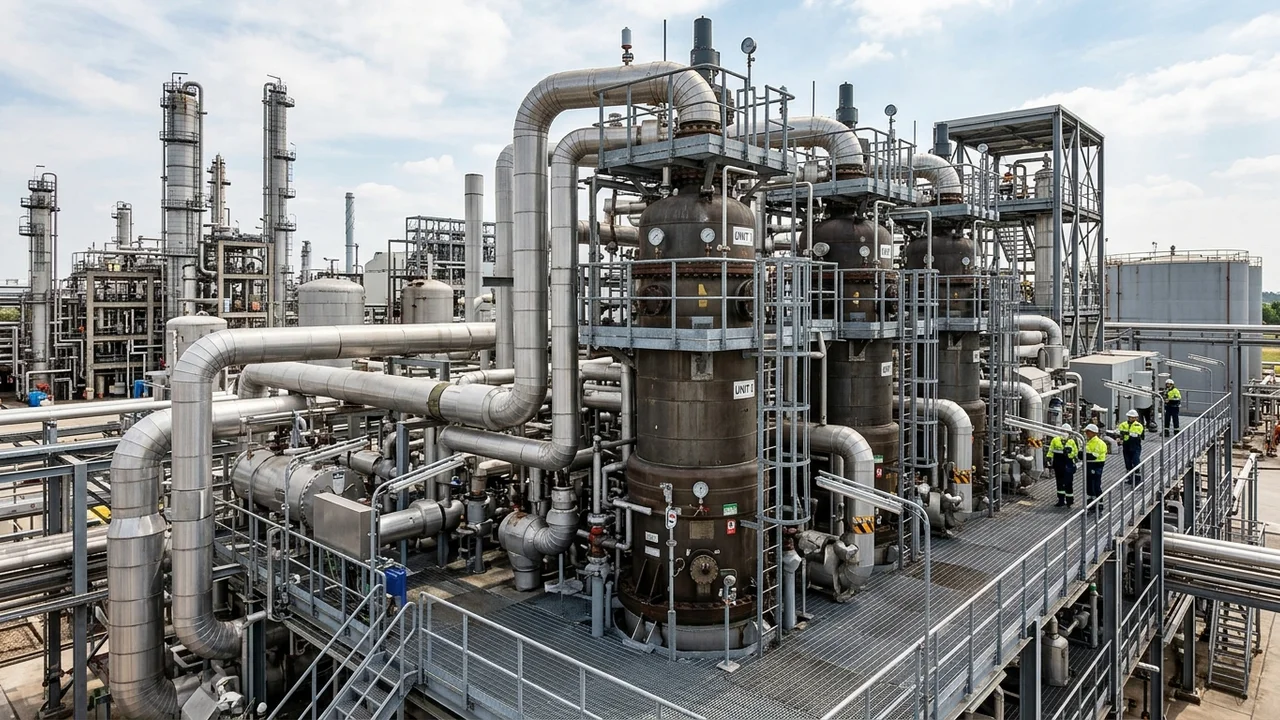
Caption: Natural gas-based ammonia production via the Haber-Bosch process accounts for more than 99% of global ammonia output and drives the embedded emissions that CBAM targets.
What Is CBAM Ammonia and Which CN Codes Apply?
CBAM ammonia refers to ammonia imported into the EU that carries a mandatory embedded emissions obligation under Regulation (EU) 2023/956, classified under CN heading 2814 in the EU Combined Nomenclature. The heading splits into two sub-codes with different physical forms but equivalent CBAM treatment.
The two active CN codes under heading 2814 are listed in the table below. Both trigger the same CBAM obligations, but their emission intensities differ because aqueous solution is diluted with water, reducing the embedded CO2e per tonne of product weight.
| CN Code | Description | Physical State | Typical N Content |
|---|---|---|---|
| 2814 10 00 | Anhydrous ammonia | Pressurized liquid or gas | ~82% N by weight |
| 2814 20 00 | Ammonia in aqueous solution | Aqueous solution (ammonia water) | Variable (typically 20–35% N) |
Ammonia is the upstream precursor for all nitrogen fertilizers, including urea (3102 10), ammonium nitrate (3102 30), and UAN solutions (3102 80). Its embedded emissions flow through to derivative products when those products are imported as finished fertilizers. Importers who source ammonia directly rather than finished fertilizers carry the full upstream emissions burden at the 2814 level. For a broader view of how CBAM applies across the fertilizers sector, the EU CBAM guide explains the certificate mechanism and its relationship to EU ETS pricing.
How Ammonia Embedded Emissions Are Calculated Under CBAM
Anhydrous ammonia carries a transitional default of 2.68 tCO2e per tonne under Implementing Regulation (EU) 2023/1773, reflecting natural gas-based production via steam methane reforming. This default is higher than the general emission factor range cited for ammonia in some industry sources because it incorporates both the CO2 from gas reforming and the indirect electricity consumption at the production facility.
The two emission sources that constitute ammonia's CBAM scope are described below.
The first source is direct CO2 from steam methane reforming. Natural gas reacts with steam in a reformer to produce a synthesis gas mixture: CH4 + H2O produces CO and 3H2, followed by a water-gas shift reaction that converts CO to CO2 and additional hydrogen. This direct CO2 from the reforming reaction accounts for approximately 1.6 to 2.4 tonnes CO2 per tonne of ammonia produced, depending on feedstock gas composition, reformer efficiency, and plant age.
The second source is indirect emissions from electricity consumption at the ammonia plant. Fertilizer production is not listed in Annex II of Regulation (EU) 2023/956, which means both direct and indirect emissions are priced for the fertilizers sector. Electricity consumed in compressors, refrigeration, and auxiliary systems generates an indirect CO2 obligation proportional to the grid emission factor of the producing country.
The formula for specific embedded emissions per tonne of ammonia follows Implementing Regulation (EU) 2025/2547, Equation 65. The calculation applies the actual or default emission factor for natural gas consumption, adds the indirect electricity contribution using the installation's electricity consumption and the applicable country or regional grid emission factor, and sums the result in tCO2e per tonne of product. For detailed guidance on how this formula works across all CBAM fertilizer products, the CBAM fertilizers sector guide provides the full methodology.
Default Values for Ammonia and the Mark-Up Schedule
Importers who cannot obtain verified actual emissions from their ammonia supplier use the CBAM default values published in Implementing Regulation (EU) 2025/2621. The default for anhydrous ammonia is 2.68 tCO2e per tonne (transitional, applying through the early definitive phase).
The fertilizers sector benefits from a favorable mark-up schedule compared to other CBAM sectors. The default value mark-up for fertilizers is only +1% in 2026, 2027, and 2028 onwards, compared to the +10% mark-up in 2026 and +30% from 2028 applied to steel, cement, aluminium, and hydrogen. This policy reflects the EU's concern over agricultural price sensitivity and food security. The financial difference between using default values and actual measured emissions is therefore smaller for ammonia importers than for steel or cement importers.
At the current EU ETS price of approximately €70 per tCO2 (late March 2026), the gross CBAM cost for anhydrous ammonia using the default value is approximately €187.60 per tonne (2.68 tCO2e × €70). The net cost in 2026 is much smaller because the CBAM factor for 2026 is only 2.5%, meaning free allocation still covers 97.5% of the obligation. The net 2026 cost is approximately €4.69 per tonne (€187.60 × 2.5%).
This 2026 figure increases sharply through the free allocation phase-out schedule. By 2030 the CBAM factor reaches 48.5%, raising the net cost to approximately €90.99 per tonne at €70 ETS pricing, and free allocation is fully eliminated from January 1, 2034.
CBAM Ammonia and Downstream Fertilizer Products
How Ammonia Emissions Flow Through to Urea and Other Fertilizers
Ammonia is the chemical foundation of all nitrogen fertilizers covered by CBAM. When an EU importer purchases anhydrous ammonia under CN 2814 10 00 and uses it as a production input within the EU, the CBAM obligation attaches at the ammonia import stage. When an importer purchases finished urea (3102 10) or ammonium nitrate (3102 30), the embedded emissions of the ammonia used to produce those fertilizers are embedded within the reported emissions of the finished product.
Producers in exporting countries who supply both ammonia and downstream fertilizers must track the ammonia emissions at the synthesis stage and carry those values forward into declarations for finished nitrogen fertilizers. The proportional allocation follows the nitrogen content pathway: ammonia containing approximately 82% nitrogen by weight carries its full CO2e burden when converted to urea at 46% nitrogen content, and the calculation scales accordingly per Equation 65 of IR 2025/2547.
Is N2O from Ammonia Production Included in CBAM?
N2O from soil application of nitrogen fertilizers is not included in CBAM scope. N2O produced during nitric acid manufacturing, which is part of the production chain for ammonium nitrate and UAN solutions, is included as a direct emission when the installation produces nitric acid as an intermediate. For pure ammonia imports under CN 2814, N2O emissions are not a significant factor because ammonia synthesis does not generate N2O as a process byproduct; the N2O relevance arises in the downstream nitric acid and ammonium nitrate production stages. Understanding how how embedded emissions are calculated for each step of the fertilizer production chain is essential for importers who move between ammonia and finished fertilizer procurement.
Does the De Minimis Threshold Apply to Ammonia Imports?
The de minimis threshold of 50 tonnes annual mass per importer applies to ammonia imports under CN 2814. Importers whose total annual mass of CBAM goods from a single non-EU country falls below 50 tonnes are exempt from CBAM obligations for that country's goods. Electricity and hydrogen are excluded from the de minimis threshold, but ammonia is not excluded. For small-volume ammonia importers, this threshold provides a practical exemption that eliminates reporting requirements for minor procurement volumes.
What Are the Top Exporting Countries for CBAM Ammonia?
Russia and Belarus historically supplied approximately 34% of EU nitrogen fertilizer imports, including significant ammonia volumes. As of July 2025, Russia faces cumulative cost burdens that have reduced its EU market position substantially: an existing 6.5% ad valorem customs duty, an additional EU tariff rising from €40 to €45 per tonne initially toward €315 to €430 per tonne by July 2028, and the CBAM certificate obligation beginning in 2027. Post-July 2025 data shows Russian urea imports to the EU dropped by approximately two-thirds. Egypt (now supplying approximately 41% of EU urea imports), Algeria (approximately 17%), and Trinidad and Tobago are the primary alternative suppliers. These countries produce ammonia via natural gas-based Haber-Bosch plants with emission intensities in the 1.6 to 2.4 tCO2e per tonne range, generally below the 2.68 default but subject to verification requirements.
The four key exporting countries and their CBAM exposure profile for ammonia are summarized below.
- Russia: Natural gas SMR production; 2.68 default applies; no carbon pricing scheme qualifying for Article 9 deduction; compounded tariff burden
- Egypt: Natural gas feedstock; competitive energy costs; no qualifying carbon pricing; Article 9 deduction not applicable
- Algeria: State-owned Fertial production facilities; natural gas-based; no qualifying carbon pricing; EU import share growing
- Trinidad and Tobago: Atlantic Basin supplier; natural gas-based SMR; no qualifying carbon pricing; primarily Atlantic market oriented
How Do CBAM Ammonia Costs Compare to CBAM Urea Costs?
Ammonia and urea carry different per-tonne CBAM costs because urea incorporates CO2 into its molecular structure during synthesis. The CBAM urea and embedded emissions page covers the urea-specific calculation in detail, but the gross cost comparison at €70 ETS pricing is instructive. Anhydrous ammonia at 2.68 tCO2e per tonne produces a gross cost of approximately €187.60 per tonne. Urea at approximately 2.3 to 2.5 tCO2e per tonne produces a gross cost of approximately €161 to €175 per tonne. The difference reflects that urea, despite incorporating the ammonia-derived emissions, benefits from CO2 that is incorporated into the urea molecule and subsequently released in the field, creating a slightly different accounting treatment under the CBAM calculation rules.
Importers who source multiple nitrogen fertilizers, including both ammonia and finished products, should review the CBAM fertilizer CN codes page to confirm correct classification across the full Chapter 28 and Chapter 31 scope.
For compliance planning and financial forecasting, importers may also use the CBAM default values reference and the CBAM compliance for fertilizer importers operational guide, which covers the authorization, declaration, and certificate surrender workflow in full.
Caption: Ammonia storage and loading terminals in exporting countries are the point at which production-stage emissions must be measured or verified for CBAM declaration purposes.