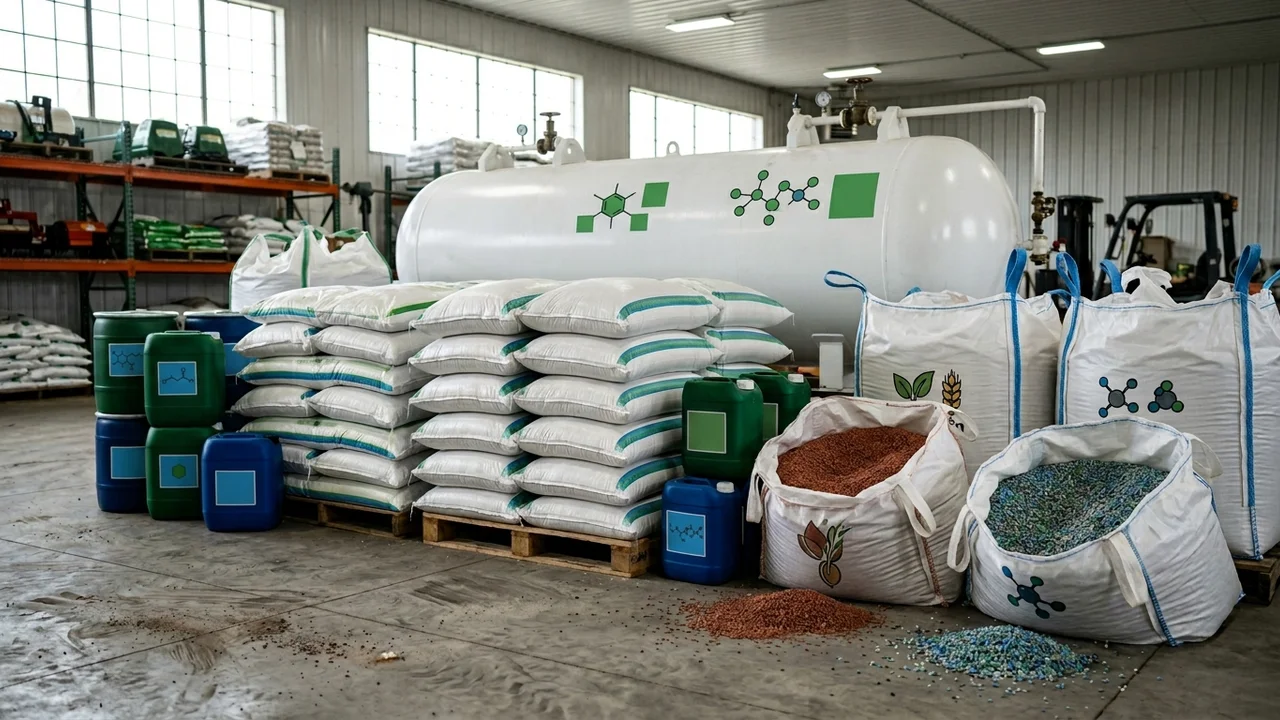
CBAM fertilizer CN codes span 12 commodity codes across two chapters of the EU Combined Nomenclature, covering every major nitrogen-based product from anhydrous ammonia to mixed NPK fertilizers. Understanding which codes fall inside Annex I of Regulation (EU) 2023/956 is the first step for any EU importer preparing their first declaration, due September 30, 2027. This reference lists every in-scope code, clarifies the exclusions, and explains how each product's embedded emissions are calculated under the definitive phase that began January 1, 2026.
Caption: Chapter 28 covers ammonia and inorganic precursors; Chapter 31 covers finished nitrogen fertilizers subject to CBAM in the definitive phase.
What Are the CBAM Fertilizer CN Codes?
CBAM fertilizer CN codes are the 12 commodity codes listed in Annex I of Regulation (EU) 2023/956 that identify nitrogen-containing products whose embedded CO₂ and N₂O emissions are subject to the Carbon Border Adjustment Mechanism. Four codes appear in Chapter 28 (inorganic chemicals), covering ammonia and nitric acid. Eight codes appear in Chapter 31 (fertilizers), covering urea, ammonium nitrate, and mixed mineral fertilizers containing nitrogen.
The split between Chapter 28 and Chapter 31 reflects the production chain. Ammonia (CN 2814) is both a standalone traded chemical and the upstream precursor for every finished nitrogen fertilizer. EU importers bringing in goods under any of these 12 codes are required to hold CBAM certificates proportional to the verified embedded emissions of those imports. The first obligation under the EU CBAM guide framework is authorization as a declarant, with the March 31, 2026 deadline already passed for provisional importing during the definitive phase.
Both direct emissions (from fossil fuel combustion and the Haber-Bosch synthesis reaction) and indirect emissions (from electricity consumption in production) are priced for fertilizers. This dual-scope treatment applies because fertilizers are not listed in Annex II of Regulation (EU) 2023/956, which restricts certain sectors to direct emissions only.
Chapter 28 CBAM Fertilizer CN Codes
Chapter 28 contains 4 CN codes covering the inorganic chemical precursors in the fertilizer production chain. These products are included because they are either direct inputs to nitrogen fertilizer manufacture or carry significant embedded emissions from the Haber-Bosch process and nitric acid production.
The 4 Chapter 28 codes in scope are listed below.
| CN Code | Product Description | GHGs Covered | Emissions Scope |
|---|---|---|---|
| 2808 00 00 | Nitric acid; sulfonitric acids | CO₂ + N₂O | Direct + Indirect |
| 2814 10 00 | Anhydrous ammonia | CO₂ | Direct + Indirect |
| 2814 20 00 | Ammonia in aqueous solution | CO₂ | Direct + Indirect |
| 2834 21 00 | Potassium nitrate | CO₂ + N₂O | Direct + Indirect |
Anhydrous ammonia (2814 10 00) carries an embedded emission factor of approximately 2.68 tCO₂e per tonne under the transitional default values published in Implementing Regulation (EU) 2023/1773. This is the highest per-tonne embedded emission factor among the Chapter 28 codes and reflects the energy intensity of steam methane reforming (SMR), the process by which natural gas is converted into the hydrogen feedstock for ammonia synthesis. At the current EU ETS reference price of approximately €70 per tonne CO₂ (late March 2026), gross CBAM costs for anhydrous ammonia reach approximately €175 per tonne before free allocation adjustment.
Nitric acid (2808 00 00) is a critical code because N₂O emissions from the nitric acid production process carry a global warming potential of 265 (per IPCC AR5), making even small volumes of unabated N₂O highly material to CBAM calculations. Modern nitric acid plants with catalytic N₂O abatement systems can dramatically reduce these emissions, giving exporters with verified abatement a structural cost advantage over those using default values.
Chapter 31 CBAM Fertilizer CN Codes
Chapter 31 contains 8 CN codes covering finished nitrogen fertilizers and mixed mineral fertilizers containing nitrogen. These represent the bulk of traded fertilizer volumes subject to CBAM.
The 8 Chapter 31 codes in scope are listed in the table below.
| CN Code | Product Description | Approximate CO₂e (tCO₂e/t) | CBAM Cost at €70/tCO₂ |
|---|---|---|---|
| 3102 10 | Urea (greater than 45% N by weight) | 2.3–2.6 | ~€175/t |
| 3102 21 | Ammonium sulphate | 1.0–1.5 | ~€80/t |
| 3102 30 | Ammonium nitrate (AN) | 1.5–2.0 | ~€123/t |
| 3102 40 | Calcium ammonium nitrate (CAN) | 1.2–1.7 | ~€103/t |
| 3102 50 | Sodium nitrate | 0.8–1.2 | ~€70/t |
| 3102 60 | Double salts and mixtures of CAN | 1.2–1.7 | ~€103/t |
| 3102 80 | Mixtures of urea and ammonium nitrate (UAN solutions) | 1.0–1.5 | ~€88/t |
| 3105 | Mixed NPK fertilizers containing N, P, and K (excluding 3105 60 00) | Calculated per N content | Variable |
Urea (3102 10) represents the highest traded volume among CBAM fertilizer codes. At 46% nitrogen by weight and an embedded emission factor of approximately 2.3–2.6 tCO₂e per tonne, urea carries a gross CBAM cost of approximately €175 per tonne at €70/tCO₂. Russia and Egypt are the two largest sources of urea imports into the EU, and both face full CBAM obligations with no qualifying carbon pricing deduction available under Article 9 of Regulation (EU) 2023/956.
The 3105 code for mixed NPK fertilizers requires special attention. Only mixed fertilizers containing nitrogen qualify for inclusion. The code 3105 60 00 (phosphorus-potassium fertilizers with no nitrogen) is explicitly excluded from Annex I because no nitrogen is present and therefore no N₂O or nitrogen-related CO₂ emissions arise. For all in-scope 3105 products, embedded emissions are calculated proportionally to the actual nitrogen content in kg per tonne of product, following the methodology in Implementing Regulation (EU) 2025/2547 (Equation 65).
For a full overview of the fertilizer sector's compliance obligations, financial exposure, and supply chain context, the CBAM fertilizers sector guide covers each of these points in depth.
Which Fertilizer CN Codes Are Excluded from CBAM?
Three categories of products commonly associated with fertilizers fall outside CBAM scope. Understanding these exclusions prevents misclassification and unnecessary declaration obligations.
The excluded categories are as follows.
- 3105 60 00 (phosphorus-potassium fertilizers, no nitrogen): excluded from Annex I because no nitrogen is present, so no N₂O or nitrogen-linked CO₂ emissions arise at the production stage
- Phosphoric acid and phosphate-based fertilizers (Chapter 28 codes such as 2809, and Chapter 31 phosphate-only codes): not listed in Annex I; only nitrogen-bearing products qualify
- N₂O emissions from fertilizer soil application: the N₂O released when nitrogen fertilizers are applied to agricultural soils is a significant greenhouse gas source globally, but it is explicitly outside the CBAM scope under the current regulation; only production-stage emissions are measured
The de minimis threshold under Article 2(3a) of Regulation (EU) 2023/956 as amended by Regulation (EU) 2025/2083 is 50 tonnes of annual net mass per importer across all CBAM goods combined. Importers whose total CBAM-scope imports across all sectors remain below this threshold are exempt from the authorization and declaration obligations. Details on how this threshold interacts with smaller consignments are explained in the CBAM de minimis threshold article.
Caption: Embedded emission factors vary significantly across nitrogen fertilizer types, with urea carrying the highest CO₂e intensity among finished fertilizer products.
How Are Embedded Emissions Calculated for Fertilizer CN Codes?
Embedded emissions for CBAM fertilizer CN codes are calculated using the verified actual emissions of the production installation, or where actual data is unavailable, the default values set by Implementing Regulation (EU) 2025/2621. For fertilizers, the default value mark-up is 1% above the calculated default (compared to 10–30% for other CBAM sectors), reflecting agricultural price sensitivity and food security considerations.
This 1% mark-up means fertilizer defaults are substantially closer to actual production values than defaults in the steel or cement sectors. The practical consequence is that the financial incentive to commission third-party verified actual emissions data is smaller for fertilizers in 2026 and 2027 than for other covered sectors. The calculation methodology follows Equation 65 in Implementing Regulation (EU) 2025/2547, which allocates emissions proportionally to the nitrogen content of each specific product type.
Both direct and indirect emissions enter the calculation for all 12 fertilizer CN codes. Direct emissions arise from natural gas combustion in reforming, process CO₂ incorporated into urea synthesis, and N₂O from nitric acid production. Indirect emissions arise from electricity consumption in the production facility. An installation that sources electricity from verified renewable generation can reduce its indirect emissions figure accordingly, provided the sourcing is documented and verifiable.
Frequently Asked Questions About CBAM Fertilizer CN Codes
What is the CN code for CBAM ammonia?
Two CN codes cover ammonia under CBAM: 2814 10 00 for anhydrous ammonia and 2814 20 00 for ammonia in aqueous solution. Both fall under Chapter 28 of the Combined Nomenclature and both are listed in Annex I of Regulation (EU) 2023/956. Anhydrous ammonia carries an embedded emission factor of approximately 2.68 tCO₂e per tonne under transitional default values.
What is the CN code for CBAM urea?
The CN code for urea under CBAM is 3102 10, which covers urea with a nitrogen content greater than 45% by weight. This is Chapter 31 of the Combined Nomenclature and represents the highest-volume traded product in the CBAM fertilizer sector. At the current EU ETS reference price of approximately €70 per tonne CO₂, gross CBAM costs for urea reach approximately €175 per tonne.
Are all Chapter 31 fertilizers subject to CBAM?
No. CBAM covers only the nitrogen-containing products listed in Annex I of Regulation (EU) 2023/956. Phosphorus-potassium fertilizers classified under 3105 60 00 are explicitly excluded. Phosphate-based and potash-based fertilizers with no nitrogen content do not appear in Annex I and generate no CBAM obligation. Only products containing nitrogen as a fertilizing element are in scope, because nitrogen production via Haber-Bosch is the primary source of embedded emissions in the sector.
Does the CBAM de minimis threshold apply to fertilizer imports?
Yes. The 50-tonne annual mass threshold under Article 2(3a) of Regulation (EU) 2023/956 as amended by Regulation (EU) 2025/2083 applies to fertilizer imports, as it does to all CBAM sectors except electricity and hydrogen. Importers whose total CBAM-scope imports across all product categories remain below 50 tonnes per calendar year are exempt from authorization and declaration obligations. The threshold is assessed at the importer level, not per consignment or per CN code.
Is N₂O from fertilizer application included in CBAM calculations?
No. CBAM covers only production-stage emissions. The N₂O released when nitrogen fertilizers are applied to agricultural soils is not within the scope of Regulation (EU) 2023/956. The regulation prices the CO₂ from natural gas reforming in ammonia synthesis, the process CO₂ incorporated into urea, and the N₂O generated during nitric acid manufacturing. Post-production emissions from field application are excluded.
Do fertilizer importers need a different approach to default values versus other sectors?
The default value mark-up for fertilizers is 1% above the calculated default under Implementing Regulation (EU) 2025/2621, compared to 10% for steel, cement, aluminium, and hydrogen in 2026, rising to 30% by 2028. This narrower mark-up means that fertilizer default values remain close to actual production emission factors, and the cost differential between using defaults and using verified actual data is smaller than in other CBAM sectors. Importers handling large volumes of urea or ammonium nitrate should still assess whether verified data would reduce their CBAM certificate obligation, particularly as CBAM factors increase toward 2030 and beyond.
How to Identify Your Product's CBAM Status
The 4-step process for confirming whether a fertilizer import triggers CBAM obligations is described below.
- Confirm the 8-digit CN code used on the import customs declaration matches one of the 12 in-scope codes listed above
- Verify the product contains nitrogen as a fertilizing element (products without nitrogen are outside scope)
- Apply the 50-tonne de minimis threshold check: if total annual CBAM-scope imports across all sectors remain below 50 tonnes, no declaration is required
- Check whether the exporting country operates a qualifying carbon pricing scheme under Article 9 of Regulation (EU) 2023/956, which can reduce the net certificate obligation
For practical CN code lookup support, the CBAM CN code lookup tool allows importers to search by product description or CN code and receive a scope confirmation instantly.
Importers already working with nitrogen fertilizers from Russia, Egypt, or Algeria face the largest financial exposure given the absence of qualifying carbon pricing in each of those three countries. CBAM compliance for fertilizer importers requires authorization, verified or default emission data for each product, and certificate purchase beginning February 1, 2027. For step-by-step guidance on the full obligation chain, CBAM compliance for fertilizer importers covers authorization, the declaration process, and certificate management.
Non-EU producers exporting nitrogen fertilizers to the EU should note that providing verified actual emission data below the default value directly reduces the CBAM cost burden borne by EU importers. Given the Russia sanctions adding €40–45 per tonne in additional tariffs (rising to €315–430 per tonne by July 2028), producers in Egypt, Algeria, and Trinidad and Tobago that can demonstrate lower embedded emissions than the default create a tangible competitive advantage. The strategic pricing and decarbonization implications are analyzed in CBAM impact on fertilizer exporters.
For certificate cost planning, the CBAM default values reference explains how default values are structured across sectors, how the mark-up schedule applies to fertilizers, and how to use defaults correctly in the CBAM declaration.