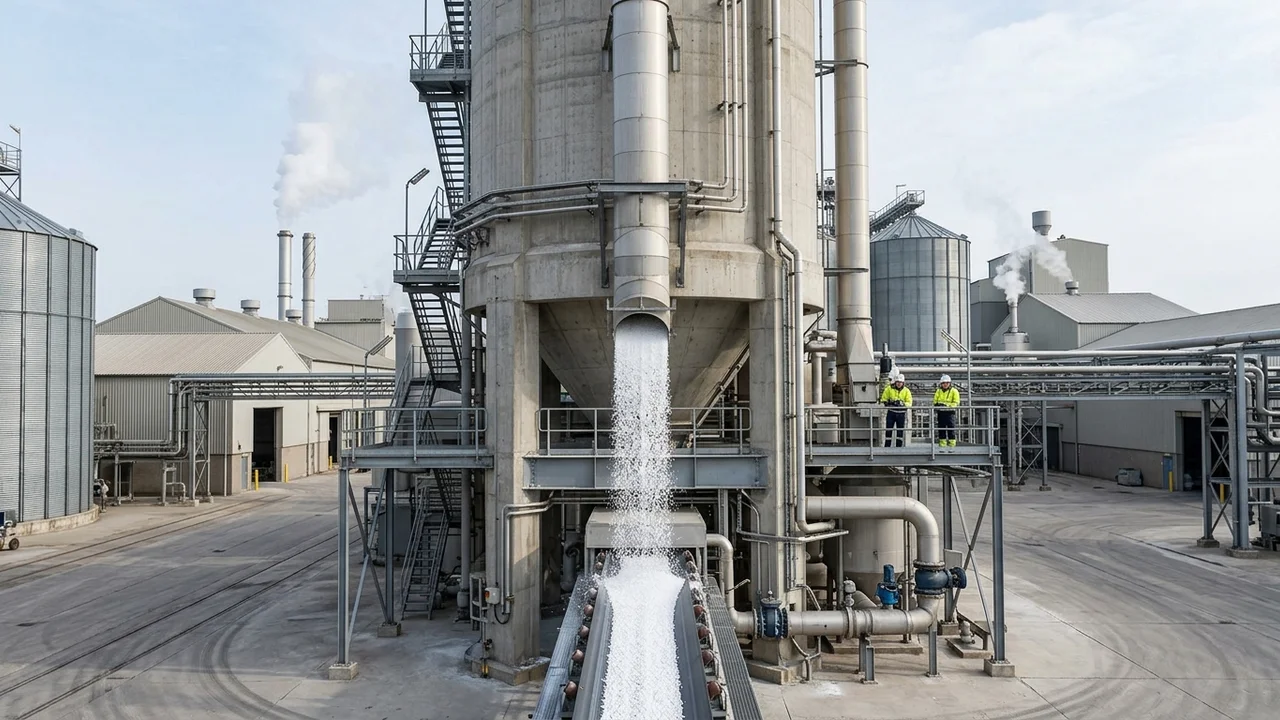
Urea carries the highest embedded emission factor of any nitrogen fertilizer under CBAM, at approximately 2.5 tCO₂e per tonne of product. At the current EU ETS price of approximately €70/tCO₂ (late March 2026), that translates to a gross CBAM cost of around €175 per tonne of imported urea, placing it above every other fertilizer category covered by Regulation (EU) 2023/956. Understanding where that figure comes from, and what it costs operators across different ETS price scenarios, is what this article covers.
Caption: Urea's 46% nitrogen content drives its carbon-intensive production process, producing approximately 2.5 tCO₂e per tonne under CBAM default calculations.
What Is the CBAM Emission Factor for Urea?
Urea's embedded emission factor under CBAM is approximately 2.3–2.6 tCO₂e per tonne, with 2.5 tCO₂e/t used as the standard reference value. Both direct CO₂ from production and indirect emissions from electricity use in processing are priced, because fertilizers are not listed in Annex II of Regulation (EU) 2023/956. This two-scope pricing structure distinguishes urea from steel and aluminium, where indirect emissions are excluded.
The 2.5 tCO₂e/t figure reflects two distinct emission sources within the production chain. The first is CO₂ released during natural gas reforming, which generates the hydrogen feedstock for the Haber-Bosch process. The second is CO₂ incorporated into the urea molecule itself during synthesis, which is later released when urea is applied to agricultural soil. Both are counted in the production-stage CBAM calculation. N₂O from soil application after field use is not included in CBAM scope.
Understanding the full production pathway matters for compliance accuracy. The EU CBAM guide sets out the general obligation framework, while the urea-specific mechanics trace back to the Haber-Bosch synthesis route: N₂ + 3H₂ → 2NH₃, followed by the reaction CO₂ + 2NH₃ → CO(NH₂)₂ + H₂O. Natural gas is the feedstock for 99% of global urea production, and its reforming step generates approximately 1.3 tCO₂ per tonne of urea before accounting for captured CO₂ reused in synthesis.
Why Urea Has Higher Embedded Emissions Than Other Nitrogen Fertilizers
Urea generates higher per-tonne embedded emissions than competing nitrogen fertilizers for three reasons: nitrogen concentration, production chemistry, and emissions scope.
The 3 primary factors that drive urea's higher CBAM cost relative to other nitrogen products are listed below.
- Nitrogen concentration at 46% by weight requires proportionally more ammonia per tonne of finished product, which in turn requires more hydrogen feedstock from natural gas reforming.
- CO₂ incorporation and re-release means the synthesis step captures CO₂ (which reduces immediate stack emissions) but that CO₂ re-enters the CBAM accounting when released during field application, adding to the total embedded figure.
- Both direct and indirect emission scope applies to all fertilizers, unlike steel and aluminium, meaning production electricity consumption in energy-intensive urea plants is also priced.
By comparison, ammonium nitrate (AN) carries approximately 1.5–2.0 tCO₂e/t, and UAN solution carries approximately 1.0–1.5 tCO₂e/t due to dilution (UAN solutions contain roughly 30% nitrogen by weight). Urea consistently sits at the top of the fertilizer emissions range.
The following table compares CBAM costs across nitrogen fertilizers at the current reference ETS price of approximately €70/tCO₂. For a full breakdown of how these emission factors are verified, the CBAM fertilizers sector guide covers all covered CN codes and calculation rules.
| Fertilizer Product | Emission Factor (tCO₂e/t) | Gross CBAM Cost @ €70/tCO₂ | Gross CBAM Cost @ €100/tCO₂ |
|---|---|---|---|
| Urea (CN 3102 10) | ~2.5 | ~€175/t | ~€250/t |
| Ammonium nitrate (CN 3102 30) | ~1.5–2.0 | ~€105–140/t | ~€150–200/t |
| UAN solution (CN 3102 80) | ~1.0–1.5 | ~€70–105/t | ~€100–150/t |
| Anhydrous ammonia (CN 2814 10) | ~1.6–2.0 | ~€112–140/t | ~€160–200/t |
Gross CBAM cost = emission factor × ETS price per tonne CO₂. Net cost in 2026 applies a 2.5% CBAM factor (reflecting 97.5% free allocation remaining), making the actual financial obligation approximately €4.38/t at €70/tCO₂ in 2026. This rises steeply toward 2030 and beyond.
How Embedded Emissions Are Calculated for Urea Imports
The calculation method for urea follows Implementing Regulation (EU) 2025/2547, which sets out Equation 65 for nitrogen fertilizers. Emissions are allocated proportionally to the exact nitrogen content in kilograms per tonne of product.
EU importers of urea have two options for determining embedded emissions. The first is actual verified emissions data, obtained from the exporting installation under a verification report from an accredited verifier. The second is CBAM default values, set by Implementing Regulation (EU) 2025/2621. The detailed rules for how embedded emissions are calculated cover both pathways with worked examples.
For urea, the default value mark-up is only 1% above the calculated default benchmark, compared to 10% for steel, cement, and aluminium in 2026, rising to 30% by 2028. The reduced mark-up reflects agricultural price sensitivity and food security considerations embedded in the regulatory design. This means fertilizer defaults are much closer to actual values than in other sectors, reducing the financial incentive to commission verified actual-data reports.
Caption: Net CBAM obligation for urea imports increases from approximately €4/t in 2026 to approximately €188/t in 2034, tracking free allocation phase-out and ETS price levels.
What Does the CBAM Cost Trajectory Look Like for Urea Importers?
The net CBAM cost for urea is minimal in 2026 but escalates sharply by 2030 as EU ETS free allocation phases out. The 2.5% CBAM factor applied in 2026 rises to 48.5% in 2030 and reaches 100% by January 1, 2034, when free allocation disappears entirely under the amended EU ETS Directive.
The 4 reference cost points below show how urea's gross CBAM cost translates to net obligation across the phase-out schedule, assuming a stable ETS price of €75/tCO₂.
- 2026 (CBAM factor 2.5%): Net obligation approximately €4.69/t — the 2026 lull is real but temporary.
- 2028 (CBAM factor 10%): Net obligation approximately €18.75/t — cost already significant for high-volume importers.
- 2030 (CBAM factor 48.5%): Net obligation approximately €90.94/t — the steepest increase falls in the 2029–2030 window.
- 2034 (CBAM factor 100%): Net obligation approximately €187.50/t — full CBAM cost at €75/tCO₂.
How CBAM Urea Compliance Works in Practice
The Russia Dimension and Shifting Supplier Geography
Russia and Belarus historically supplied approximately 34% of EU nitrogen fertilizer imports, with EuroChem and PhosAgro as the dominant exporters. The trade picture as of 2026 reflects two compounding cost burdens that have restructured EU urea supply. First, the existing 6.5% ad valorem customs duty applies. Second, the EU additional tariff enacted in July 2025 runs from €40–45/t initially and rises to €315–430/t by July 2028. CBAM certificate obligations layer on top from 2027 onward. Post-July 2025 data shows Russian urea imports to the EU dropped by approximately two-thirds, with Egypt now supplying approximately 41% of EU urea imports and Algeria contributing approximately 17%.
Egypt's rise as the primary urea supplier introduces its own CBAM compliance considerations. Egyptian production relies on natural gas feedstock and does not currently operate under a qualifying carbon pricing scheme, meaning EU importers of Egyptian urea cannot apply an Article 9 deduction to reduce their certificate obligation.
Does Egypt Qualify for Any CBAM Carbon Price Deduction?
Egypt does not qualify for an Article 9 carbon price deduction under CBAM because no recognized equivalent emissions pricing scheme is in force for Egyptian urea producers. EU importers sourcing from Egypt pay the full certificate cost based on embedded emissions. For those sourcing urea from countries with qualifying carbon pricing, guidance on CBAM default values and the deduction calculation appears at CBAM default values.
How Does CBAM Urea Compare to CBAM Ammonia?
Ammonia is both a CBAM-covered product in its own right (CN 2814 10 for anhydrous ammonia) and the direct precursor for urea production. Anhydrous ammonia carries approximately 1.6–2.0 tCO₂e/t under CBAM, while urea, which is synthesized from ammonia, carries approximately 2.5 tCO₂e/t because the synthesis step incorporates additional CO₂ that is counted in the embedded emissions figure. Importers buying ammonia directly pay a lower per-tonne CBAM cost than those importing finished urea, but the nitrogen content per tonne is also lower for ammonia (approximately 82% N for anhydrous ammonia versus 46% N for urea). For a full comparison of ammonia's CBAM treatment, CBAM ammonia and embedded emissions provides the calculation basis and CN code details.
Is Urea Subject to CBAM Default Values or Actual Emissions?
Both pathways apply to urea importers. Actual verified emissions from the production installation are accepted when accompanied by a verification report from a registered verifier (verifier registration opens September 1, 2026). Where actual data is unavailable, CBAM default values from Implementing Regulation (EU) 2025/2621 apply, with the fertilizer-specific 1% mark-up. Because the 1% mark-up is far lower than the 10–30% mark-up for other sectors, the financial gap between defaulting and verifying is narrower for urea than for steel or cement. Importers whose suppliers operate below the default emission factor do benefit from actual data verification, particularly as the CBAM factor rises post-2026.
What Do Fertilizer Importers Need to Do for CBAM Compliance?
CBAM compliance for fertilizer importers follows the standard authorized declarant pathway. The 4 primary obligations, in chronological order, are listed below.
- Authorization by March 31, 2026: Apply to the competent authority in the EU member state of establishment for authorized declarant status under Article 17(7a) of Regulation (EU) 2023/956 as amended by Regulation (EU) 2025/2083.
- Embedded emissions tracking (January 1, 2026 onward): Record the embedded emissions per tonne for each urea shipment imported, using either supplier-verified data or CBAM default values.
- Quarterly certificate holding (from February 1, 2027): Hold CBAM certificates covering at least 50% of cumulative embedded emissions since the start of the calendar year.
- Annual declaration by September 30, 2027: Submit the first CBAM declaration covering calendar year 2026, with certificates surrendered to match total embedded emissions. Failure to surrender sufficient certificates triggers a penalty of €100 per tonne CO₂e not covered.
Full compliance pathway documentation is available at CBAM compliance for fertilizer importers.
What Should Urea Exporters Outside the EU Know?
Non-EU urea producers whose EU customers import their product carry an indirect but real CBAM exposure. The certificate cost falls legally on the EU importer, but commercially, EU buyers incorporate CBAM costs into pricing negotiations. Exporters operating at emission factors below the CBAM default value gain a competitive advantage by providing verified actual emissions data, allowing their EU buyers to pay lower certificate costs. Exporters from Egypt, Algeria, Trinidad and Tobago, and the United States all face this commercial dynamic. The strategic options available to non-EU urea producers are set out in CBAM impact on fertilizer exporters.
Is Urea the Most Expensive CBAM Sector Overall?
Urea is the most expensive fertilizer under CBAM but not the most expensive CBAM-covered product overall. Grey hydrogen carries approximately 9–12 tCO₂/t, producing a gross CBAM cost of €630–840/t at €70/tCO₂. BF-BOF steel carries approximately 2.0 tCO₂/t, producing a gross CBAM cost of approximately €140/t. Urea at approximately €175/t gross sits above steel but far below grey hydrogen. Within the fertilizer sector specifically, urea's 2.5 tCO₂e/t emission factor makes it the most carbon-intensive product category covered by CBAM, and no other nitrogen fertilizer comes close on a per-tonne basis.