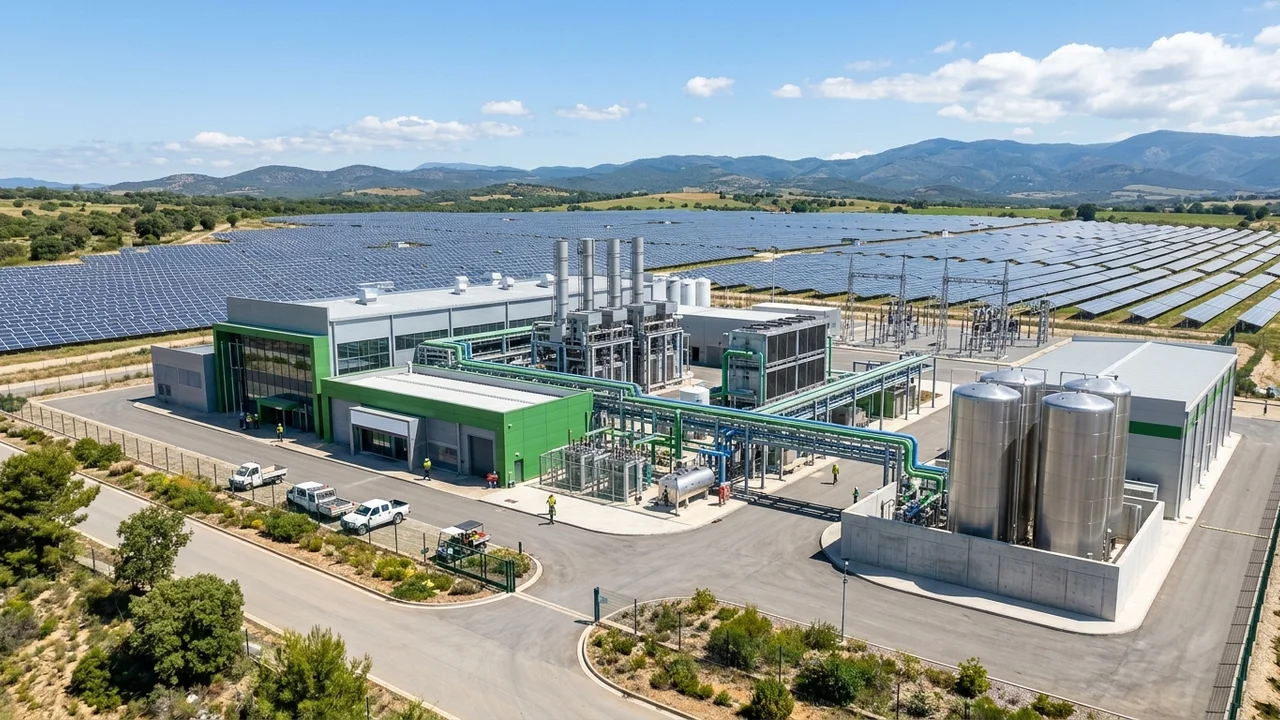
CBAM hydrogen costs diverge by approximately €700 per tonne depending solely on production method, making hydrogen the sector with the single largest cost gap between compliant and non-compliant imports under Regulation (EU) 2023/956. Grey hydrogen, produced via steam methane reforming (SMR) without carbon capture, carries embedded emissions of 9–12 tCO₂ per tonne of hydrogen, while certified green hydrogen produced by electrolysis using renewable electricity carries emissions approaching zero. At the current EU ETS carbon price of approximately €70/tCO₂ (Q1 2026 range: €66–90), that emissions difference translates directly into a certificate obligation worth €630–840 per tonne for grey imports versus effectively €0 for green.
Understanding why this gap exists, how it is calculated, and what it means for EU importers in 2026 requires examining production chemistry, CBAM's Annex II emissions scope, and the RFNBO certification framework that qualifies green hydrogen for a zero embedded-emission factor.
Caption: Production route determines embedded CO₂, which determines CBAM certificate obligation for all hydrogen imports.
What CBAM Covers for Hydrogen Imports
CBAM covers hydrogen under CN code 2804 10 00 (pure hydrogen), pricing only direct emissions under Annex II of Regulation (EU) 2023/956, with no de minimis mass threshold applicable. Unlike steel or cement, where imports below 50 tonnes of annual mass per importer fall outside CBAM scope, hydrogen carries no such exemption. Every tonne of hydrogen imported into the EU under this CN code is subject to the full certificate obligation from the definitive phase that began on January 1, 2026.
Hydrogen is listed in Annex II of the regulation, meaning only direct emissions are priced. Indirect emissions from the electricity consumed during electrolysis are excluded from the CBAM calculation in principle. However, for green hydrogen certified as a Renewable Fuel of Non-Biological Origin (RFNBO) under Delegated Regulation (EU) 2023/1184, the electricity emission factor is set to zero by definition, making the distinction academic for compliant green hydrogen imports.
For a complete overview of how CBAM operates as a regulatory mechanism across all six covered sectors, the EU CBAM guide provides the foundational framework that governs hydrogen alongside steel, cement, aluminium, fertilizers, and electricity.
The absence of a de minimis threshold for hydrogen mirrors the treatment of electricity and reflects the regulatory view that hydrogen imports, however small, carry material decarbonization policy significance. The first CBAM declaration covering calendar year 2026 imports is due September 30, 2027. Certificate sales open February 1, 2027, meaning the practical financial obligation arrives in 2027 despite the legal obligation beginning in January 2026.
Grey Hydrogen and CBAM: The Emission Mechanics
Grey hydrogen production generates 9–12 tCO₂ per tonne of hydrogen through the steam methane reforming process, making it the most carbon-intensive production route subject to CBAM certificate obligations.
Steam methane reforming is the dominant global production method for hydrogen, accounting for over 95% of current production. The core chemical reaction, CH₄ + H₂O → CO + 3H₂, releases carbon monoxide as a byproduct, which then undergoes the water-gas shift reaction (CO + H₂O → CO₂ + H₂) to extract additional hydrogen while generating CO₂. Both CO₂ streams are typically vented to atmosphere in grey hydrogen production, creating the high embedded emission figure that determines CBAM liability.
The CBAM default value for grey hydrogen, which applies when importers cannot provide verified actual emissions data, is 10.4 tCO₂/t (the transitional default from Implementing Regulation (EU) 2023/1773). Under Implementing Regulation (EU) 2025/2621, default values for hydrogen carry a 10% mark-up in 2026, rising to 20% in 2027 and 30% from 2028 onward. Importers relying on defaults face an escalating penalty for not investing in actual measurement and third-party verification.
The precise method used to calculate embedded emissions matters significantly for importers. The 3 key emission sources contributing to grey hydrogen's carbon footprint are listed below.
The three direct emission sources included in CBAM calculations for grey hydrogen are as follows:
- CO₂ from primary reforming of methane in the reformer furnace
- CO₂ from the water-gas shift reaction, converting carbon monoxide to CO₂ and additional hydrogen
- CO₂ from the pressure swing adsorption (PSA) purge gas, where residual methane and CO are combusted for energy recovery
Importers providing verified actual emissions data rather than relying on defaults have a material financial incentive to do so. A grey hydrogen producer operating a modern, efficient SMR unit at the lower end of the emission range (9 tCO₂/t rather than 12 tCO₂/t) saves approximately €210 per tonne at the current ETS price of €70/tCO₂ compared to an importer applying the upper-range default.
The precise calculation methodology for determining how embedded emissions are calculated under Implementing Regulation (EU) 2025/2547 is explained in the dedicated article on how embedded emissions are calculated.
Green Hydrogen and CBAM: The Zero-Cost Pathway
Green hydrogen certified as RFNBO under Delegated Regulation (EU) 2023/1184 carries an effective embedded emission factor of zero, eliminating CBAM certificate costs entirely for qualifying imports.
Green hydrogen is produced by water electrolysis: 2H₂O → 2H₂ + O₂. The process produces no direct CO₂ emissions. CBAM prices only direct emissions for Annex II goods (which includes hydrogen), so a green hydrogen producer using electrolysis generates zero direct CO₂ by chemistry alone. The critical compliance question is whether the electricity powering the electrolyser also qualifies as zero-emission under the EU's RFNBO framework.
Delegated Regulation (EU) 2023/1184 sets three cumulative criteria that the renewable electricity used in electrolysis must satisfy. The three RFNBO criteria, each of which must be met simultaneously, are as follows:
- Additionality: The renewable electricity must come from generation capacity installed no more than 36 months before the electrolyser. This prevents green hydrogen producers from simply buying existing renewable power certificates from long-established wind or solar plants.
- Temporal correlation: Electricity consumption for electrolysis and renewable generation must be matched within the same calendar hour (from 2030) or the same calendar month (transitional rule applicable until 2030). Hourly matching is the definitive standard.
- Geographical correlation: The renewable electricity source must be in the same or an adjacent bidding zone as the electrolyser. Imports of green hydrogen from projects in Morocco, Chile, or Saudi Arabia must demonstrate that the electricity generation meets these geographical constraints relative to the production installation.
Caption: Three RFNBO criteria govern whether renewable electrolysis electricity qualifies for zero emission factor treatment under CBAM.
Meeting all three criteria qualifies the electricity consumed in electrolysis for a zero emission factor. Since hydrogen is an Annex II good (direct emissions only), and direct emissions from electrolysis are zero by chemistry, a fully RFNBO-certified green hydrogen import carries zero embedded emissions and therefore zero CBAM certificate obligation. This is the structural zero-cost pathway.
The €700 Per Tonne Cost Gap: Calculation Breakdown
The approximately €700 per tonne cost difference between grey and green hydrogen under CBAM follows directly from emission factors and the current ETS price, and this gap widens as both the ETS price and the CBAM factor increase through 2034.
The table below compares CBAM costs across all five hydrogen production types at the current ETS price of approximately €70/tCO₂, alongside the 2030 consensus forecast of approximately €126/tCO₂. All gross costs shown are before the free allocation factor, which in 2026 stands at 2.5% (meaning only 2.5% of the gross obligation becomes a net payment in the first year of the definitive phase).
| Production Route | Method | Direct CO₂ (tCO₂/t H₂) | CBAM Cost @ €70/tCO₂ (Gross) | CBAM Cost @ €126/tCO₂ (2030 forecast, Gross) |
|---|---|---|---|---|
| Grey | SMR, no CCS | ~9–12 | €630–840/t | €1,134–1,512/t |
| Blue | SMR + CCS | ~0.5–1.0 | €35–70/t | €63–126/t |
| Turquoise | Methane pyrolysis | ~0–1 | €0–70/t | €0–126/t |
| Pink | Nuclear electrolysis | ~0–0.5 | €0–35/t | €0–63/t |
| Green (RFNBO-certified) | Renewable electrolysis | ~0 | €0/t | €0/t |
The headline €700 per tonne figure represents the midpoint of grey hydrogen's CBAM cost range (€630–840) at €70/tCO₂, using the median emission factor of 10 tCO₂/t. The gross cost at the midpoint is €700/t (10 × €70). Net cost in 2026, applying the 2.5% CBAM factor, is approximately €17.50/t (€700 × 2.5%). This appears modest in isolation, but the net cost escalates to approximately €339.50/t by 2030 (€700 × 48.5% CBAM factor) as free allocation phases out.
By 2034, when free allocation reaches zero and the CBAM factor reaches 100%, grey hydrogen imports face the full gross cost. At a consensus ETS forecast price of €126/tCO₂ and a median emission factor of 10.4 tCO₂/t (the transitional default), the full-phase cost reaches approximately €1,310/t for grey hydrogen, against €0 for RFNBO-certified green.
Blue hydrogen, produced via SMR combined with carbon capture and storage (CCS), occupies the middle ground. Residual emissions after CCS (typically 0.5–1.0 tCO₂/t, as capture efficiency rarely exceeds 95%) create a CBAM obligation of €35–70/t at current prices. Blue hydrogen importers must provide verified CCS efficiency data to claim the lower emission factor rather than the grey default.
How the CBAM Factor Affects Net Hydrogen Costs in 2026
The net CBAM obligation for hydrogen imports in 2026 is small in absolute terms, but the structural exposure is large and grows on a known schedule set by EU regulation through January 1, 2034.
In 2026, the CBAM factor stands at 2.5% because 97.5% of free allocation in the EU ETS remains in place. CBAM certificates are proportional to the free allocation phase-out: importers pay certificate costs only for the fraction of emissions that are no longer offset by EU producers receiving free allowances. The phase-out schedule under Article 10a(1a) of Directive 2003/87/EC accelerates steeply in the period from 2029 to 2030, when the CBAM factor jumps from 22.5% to 48.5%.
For hydrogen importers evaluating supply contracts with terms extending three or more years, the relevant cost is not the 2026 net figure but the 2029–2030 figure, where grey hydrogen costs move from approximately €157/t net (€700 × 22.5%) to approximately €340/t net (€700 × 48.5%) within a single year.
Importers who have not yet applied for authorized declarant status face an additional exposure. The deadline for authorization applications that allow provisional importing during the definitive phase was March 31, 2026 (Article 17(7a) as inserted by Regulation (EU) 2025/2083). Unauthorized importers face penalties of €300–500 per tonne CO₂e, compared with the standard authorized declarant penalty of €100 per tonne CO₂e for failure to surrender certificates.
Importers managing grey hydrogen supply chains alongside green hydrogen alternatives can use the CBAM de minimis threshold article to confirm that hydrogen falls outside the 50-tonne annual mass exemption available to other CBAM sectors, ensuring no import volume is incorrectly treated as exempt.
What the Cost Gap Means for Hydrogen Trade Strategy
The €700 per tonne gross cost gap between grey and green hydrogen under CBAM functions as a structural trade filter that rewards green hydrogen exporters as the EU ETS price rises and free allocation phases out through 2034.
The EU's current hydrogen import base is minimal. Major green hydrogen projects targeting EU supply are at pre-Final Investment Decision stage as of April 2026, including OCP Group's green ammonia platform in Morocco (approximately $7 billion investment), the NEOM green hydrogen facility in Saudi Arabia (4 GW solar and wind capacity), HIF Global's e-fuel pilot in Chile, and the SoutH2 corridor from North Africa. None of these projects had reached full commercial operation as of April 2026. The European Court of Auditors declared the EU's 20 Mt hydrogen-by-2030 target (10 Mt domestic production plus 10 Mt imports) unrealistic under current project timelines.
For EU importers with existing grey hydrogen supply relationships, the financial pressure created by CBAM increases in a non-linear way. The most acute pressure arrives between 2029 and 2030, when the CBAM factor nearly doubles. Planning for green hydrogen alternatives, blue hydrogen transitional contracts, or verified emissions measurement programs should begin at least 3 years before the target transition date, given the 36-month additionality requirement for RFNBO certification.
For non-EU exporters, the opportunity is clear: any producer capable of certifying green hydrogen under the RFNBO framework arrives at the EU market with a structural cost advantage of up to €700/t over grey competitors at today's ETS price, rising toward €1,310/t by 2034 at consensus price forecasts.
Hydrogen as a CBAM Precursor for Fertilizers and Steel
CBAM hydrogen functions not only as a traded commodity but also as an upstream precursor whose embedded emissions carry forward into ammonia, urea, and hydrogen-reduced iron, making hydrogen's CBAM status relevant to EU importers across the fertilizer and steel sectors.
Hydrogen is the primary feedstock for ammonia synthesis via the Haber-Bosch process: N₂ + 3H₂ → 2NH₃. Ammonia (CN code 2814) and downstream nitrogen fertilizers including urea (3102 10) are CBAM-covered goods. Their embedded emissions include the hydrogen production emissions, meaning grey hydrogen used in ammonia production contributes approximately 1.6–2.4 tCO₂/t of ammonia to the fertilizer's total embedded emission figure. Switching ammonia production from grey to green hydrogen feedstock reduces the CBAM liability for the fertilizer importer downstream.
Similarly, hydrogen-based direct reduced iron (hydrogen-DRI) represents the emerging green steel pathway. In hydrogen-DRI, iron ore reduction uses H₂ instead of carbon monoxide: Fe₂O₃ + 3H₂ → 2Fe + 3H₂O. Green hydrogen-DRI produces near-zero direct emissions, compared with approximately 2.0 tCO₂/t for the blast furnace route. EU importers of DRI (CN code 7203) and downstream steel products benefit from the lower embedded emission factor of hydrogen-DRI, directly reducing CBAM certificate obligations.
On-site hydrogen produced within refineries or organic chemical installations exclusively for internal process use is not covered by CBAM. The exemption applies only when the hydrogen is consumed internally and not exported as a traded good under CN code 2804 10 00.
Is CBAM Applicable to All Hydrogen Import Volumes?
CBAM applies to all hydrogen imports regardless of volume, because hydrogen is excluded from the 50-tonne annual mass de minimis threshold that applies to steel, cement, aluminium, and fertilizers.
The de minimis threshold under Article 2(3a) of Regulation (EU) 2023/956 as amended by Regulation (EU) 2025/2083 covers imports of 50 tonnes or less of annual mass per importer per calendar year for steel, cement, aluminium, and fertilizers. Electricity and hydrogen are explicitly excluded from this threshold. A single tonne of grey hydrogen imported in 2026 generates a CBAM certificate obligation.
This design reflects the strategic importance the EU assigns to hydrogen's role in the clean energy transition. A de minimis exemption that allowed small-volume grey hydrogen imports to circumvent CBAM would undermine the incentive for developing-economy green hydrogen exporters to invest in RFNBO-compliant supply chains.
Practical Compliance Steps for CBAM Hydrogen Importers
EU importers of hydrogen under CN code 2804 10 00 face four specific compliance actions that differ from other CBAM sectors in the stringency of their emissions evidence requirements.
The four compliance steps specific to hydrogen imports are described below.
-
Determine production route and emission factor: Obtain from the non-EU hydrogen supplier a declaration of production method. For grey hydrogen, the declared emission factor must reflect actual SMR process data including reformer CO₂, shift CO₂, and PSA purge emissions. For green hydrogen, the supplier must provide RFNBO certification documentation demonstrating additionality, temporal correlation, and geographical correlation compliance.
-
Engage a third-party accredited verifier: Hydrogen embedded emission declarations require third-party verification under Implementing Regulation (EU) 2025/2547. Verifier registration with member state competent authorities opens September 1, 2026. Early engagement with verifiers is advisable given expected demand concentration at registration opening.
-
Apply for authorized declarant status: The March 31, 2026 authorization application deadline determines whether importers can operate legally under CBAM during 2026. Post-deadline applications subject importers to the €300–500 per tonne CO₂e unauthorized importer penalty while applications are processed.
-
Plan certificate procurement from February 1, 2027: CBAM certificates are sold by the CBAM registry from February 1, 2027. The quarterly holding requirement mandates that authorized declarants hold certificates covering at least 50% of cumulative embedded emissions since the start of the calendar year. For a grey hydrogen importer at 10 tCO₂/t with 100 tonnes imported in Q1 2027, the minimum certificate holding at March 31, 2027 would be 50% of 1,000 tCO₂e = 500 CBAM certificates, each priced at the quarterly average EU ETS auction clearing price.
For detailed guidance on the full obligation chain, the CBAM compliance for hydrogen importers guide covers authorization, registry registration, embedded emission calculation, and certificate surrender for the hydrogen sector specifically.
Does Green Hydrogen Completely Eliminate CBAM Costs?
RFNBO-certified green hydrogen eliminates CBAM certificate costs entirely because its direct embedded emissions are zero and the RFNBO certification sets the electricity emission factor to zero under Delegated Regulation (EU) 2023/1184. An importer of certified green hydrogen under CN code 2804 10 00 has no certificate surrender obligation. The compliance obligation does not disappear: the importer must still be an authorized declarant, must still file a CBAM declaration by September 30, 2027 for calendar year 2026 imports, and must still maintain records for the 4-year retention period. The financial certificate cost is zero; the administrative compliance cost remains.
Importers seeking deeper analysis of certification requirements can consult the dedicated guide to green hydrogen and CBAM.
Is Blue Hydrogen Treated the Same as Grey Under CBAM?
Blue hydrogen is not treated the same as grey hydrogen under CBAM. Blue hydrogen produced via SMR with carbon capture and storage (CCS) qualifies for a reduced emission factor that reflects only the residual emissions after capture. A facility achieving 90% CCS efficiency on grey hydrogen at 10 tCO₂/t would have verified residual emissions of 1.0 tCO₂/t, generating a CBAM obligation of €70/t at the current ETS price rather than €700/t.
The key compliance requirement for blue hydrogen is providing verified actual emissions data demonstrating the CCS capture rate. Importers cannot self-declare CCS efficiency; third-party verification under the implementing regulations is required. The default value of 10.4 tCO₂/t applies when actual data is unavailable, which means a blue hydrogen importer without verification would pay the same as a grey hydrogen importer. Verification investment for blue hydrogen is therefore high-value.
For a detailed breakdown of grey hydrogen compliance costs, the grey hydrogen and CBAM guide provides the calculation methodology and country-specific exposure analysis.
Does the EU ETS Price Directly Determine CBAM Hydrogen Costs?
The EU ETS carbon price directly and mathematically determines CBAM certificate prices under Article 22(1a) of Regulation (EU) 2023/956 as amended by Regulation (EU) 2025/2083. In 2026, CBAM certificate prices reflect the quarterly average of EU ETS auction clearing prices. From 2027 onward, they reflect the weekly average of EU ETS auction closing prices. CBAM has no independent price: it tracks ETS. At the current price of approximately €70/tCO₂, grey hydrogen's gross CBAM cost is €630–840/t. If ETS prices rise to the 2030 consensus forecast of approximately €126/tCO₂, grey hydrogen's gross cost rises to €1,134–1,512/t. If ETS prices fall, CBAM costs for grey hydrogen fall proportionally. CBAM amplifies ETS price signals for high-emission goods rather than creating an independent price mechanism.
The EU ETS carbon price article tracks current ETS pricing, historical trends, and the reform discussions that could affect CBAM certificate costs through the phase-in period.
Can Small Hydrogen Importers Avoid CBAM Through the De Minimis Threshold?
No. Hydrogen is explicitly excluded from the 50-tonne annual mass de minimis threshold under Article 2(3a) of Regulation (EU) 2023/956 as amended by Regulation (EU) 2025/2083. Every tonne of hydrogen imported under CN code 2804 10 00 falls within CBAM scope. This applies regardless of importer size, import frequency, or annual volume. Electricity is subject to the same exclusion from de minimis. Importers who assumed the 50-tonne threshold applied to hydrogen should immediately review their authorization status and assess their certificate obligation for 2026 imports, which must be declared by September 30, 2027.
Should Hydrogen Importers Prioritize Switching to Green Supply Now or Wait Until 2030?
Switching analysis favors early transition for importers with multi-year supply contracts, because the net CBAM cost trajectory is determined by a known regulatory schedule rather than market uncertainty. Net costs in 2026 at 2.5% CBAM factor appear modest. The same gross exposure produces net costs approximately 19 times larger in 2030 at the 48.5% factor. Importers locked into long-term grey hydrogen contracts signed in 2024 or 2025, before the definitive phase cost structure was fully visible, face the steepest exposure from the 2029–2030 free allocation cliff.
The CBAM cost calculator allows hydrogen importers to model net CBAM costs year by year under different ETS price scenarios and CBAM factor schedules, using actual or default emission factors for their specific hydrogen supply.