Grey hydrogen carries the highest CBAM certificate cost of any traded commodity under Regulation (EU) 2023/956, with gross liability reaching €700–840 per tonne at the current EU ETS price of approximately €70 per tonne CO₂ as of late March 2026. That figure follows directly from the production process: steam methane reforming (SMR) without carbon capture generates 10–12 tonnes of CO₂ for every tonne of hydrogen produced. Understanding how this cost is calculated, and how it compares to alternative hydrogen production routes, is the first obligation for any EU importer handling hydrogen under CN code 2804 10 00.
The EU CBAM guide explains the certificate mechanism in full, including how quarterly average ETS auction prices set the CBAM certificate price throughout 2026 under Article 22(1a) of the regulation.
What Is the CBAM Cost for Grey Hydrogen?
Grey hydrogen CBAM cost equals the embedded CO₂ emission factor multiplied by the EU ETS carbon price, producing a gross liability of €700–840 per tonne of hydrogen at €70/tCO₂. This is the largest gross CBAM exposure of any product in Annex I because SMR-produced hydrogen carries 10–12 tCO₂ per tonne, roughly five times the emission intensity of blast furnace steel.
The calculation uses direct emissions only. Hydrogen is listed in Annex II of Regulation (EU) 2023/956, which means indirect emissions from electricity consumption during the production process are not priced under CBAM. Only the CO₂ released during the SMR reaction itself enters the liability formula.
Two cost boundaries apply at current ETS levels. At the lower bound of 10 tCO₂/t H₂ and €70/tCO₂, the gross certificate cost reaches €700 per tonne. At the upper bound of 12 tCO₂/t H₂, the same ETS price produces €840 per tonne. The actual figure for any specific shipment depends on verified emission data from the producing installation, or on the transitional default value of 10.4 tCO₂/t established in Implementing Regulation (EU) 2023/1773, which at €70/tCO₂ produces a cost of €728 per tonne of hydrogen.
How the SMR Production Process Drives CBAM Exposure
Steam methane reforming is the production route for more than 95% of global hydrogen supply. The core chemical reaction, CH₄ + H₂O → CO + 3H₂, produces a carbon monoxide intermediate that is subsequently shifted to CO₂ via the water-gas shift reaction. The result is approximately 9–12 tonnes of CO₂ per tonne of hydrogen, with the upper range applying to older, less efficient reformer configurations.
The CBAM framework prices every tonne of that CO₂. No de minimis threshold applies to hydrogen imports, unlike most other covered sectors where the 50-tonne annual mass threshold under Article 2(3a) of Regulation (EU) 2025/2083 excludes smaller shipments. Hydrogen and electricity are the two sectors explicitly excluded from the de minimis provision, meaning every commercial hydrogen import triggers the full certificate obligation from the first kilogram.
For EU importers managing the CBAM hydrogen sector across a portfolio of purchase contracts, this creates a binary cost structure: grey hydrogen carries the maximum possible CBAM liability within the sector, while certified green hydrogen carries near-zero liability. The gap between these two outcomes at current ETS prices exceeds €700 per tonne of product.
Grey Hydrogen CBAM Cost Table: Scenarios by ETS Price
The table below shows gross CBAM costs for grey hydrogen at three ETS price levels, using the 10–12 tCO₂/t H₂ emission range confirmed in the CBAM knowledge base. Net costs in 2026 are adjusted by the 2.5% CBAM factor, since 97.5% of free allocation remains in force this year.
| ETS Price | Emission Factor | Gross CBAM Cost | Net Cost 2026 (×2.5%) | Net Cost 2030 (×48.5%) |
|---|---|---|---|---|
| €50/tCO₂ | 10 tCO₂/t H₂ | €500/t H₂ | €12.50/t H₂ | €242.50/t H₂ |
| €50/tCO₂ | 12 tCO₂/t H₂ | €600/t H₂ | €15.00/t H₂ | €291.00/t H₂ |
| €70/tCO₂ | 10 tCO₂/t H₂ | €700/t H₂ | €17.50/t H₂ | €339.50/t H₂ |
| €70/tCO₂ | 12 tCO₂/t H₂ | €840/t H₂ | €21.00/t H₂ | €407.40/t H₂ |
| €100/tCO₂ | 10 tCO₂/t H₂ | €1,000/t H₂ | €25.00/t H₂ | €485.00/t H₂ |
| €100/tCO₂ | 12 tCO₂/t H₂ | €1,200/t H₂ | €30.00/t H₂ | €582.00/t H₂ |
Net costs calculated using the free allocation phase-out schedule from Article 10a(1a) of Directive 2003/87/EC as amended. The 2.5% CBAM factor in 2026 rises to 48.5% by 2030.
The 2026 net cost appears modest. An importer bringing in grey hydrogen at the default emission factor and a €70 ETS price pays €18.20 per tonne net in 2026. That same importer pays approximately €356 per tonne net in 2030, a 20-fold increase driven entirely by the free allocation phase-out, not by any change in the product's emission intensity.
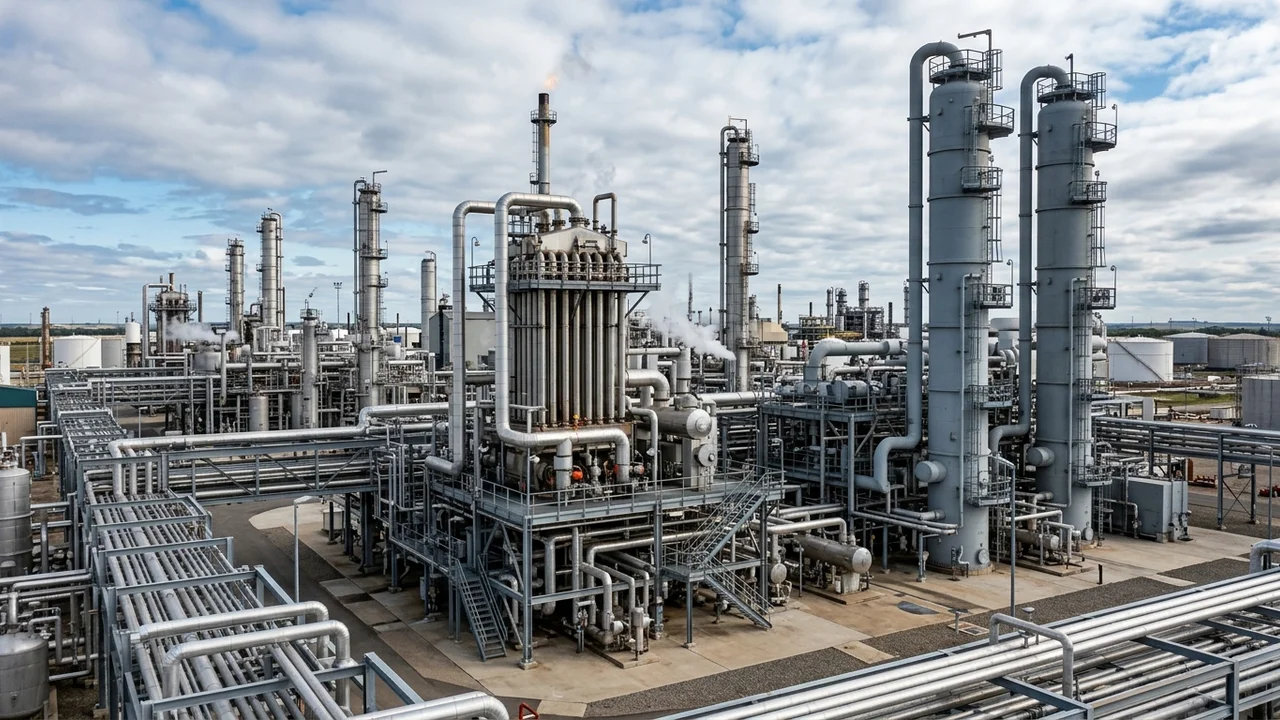
Caption: Steam methane reforming produces 10–12 tCO₂ per tonne of hydrogen, making grey hydrogen the highest-cost CBAM product at current ETS prices.
How Embedded Emissions Are Calculated for Grey Hydrogen
The calculation method for grey hydrogen CBAM liability follows the framework set out in Implementing Regulation (EU) 2025/2547. The specific embedded emissions figure for each tonne of imported hydrogen must reflect the production installation's actual verified data or, where verified data is unavailable, the applicable default value with the 10% mark-up applied in 2026 under Implementing Regulation (EU) 2025/2621.
The three key inputs required from the exporting installation are listed below. Each must be supplied to the EU authorized declarant before the annual CBAM declaration, due September 30, 2027 for the 2026 calendar year.
- Fuel consumption per tonne of hydrogen produced, expressed in gigajoules per tonne H₂
- CO₂ emission factor for the natural gas feedstock, expressed in tCO₂ per gigajoule
- Any CO₂ captured and permanently stored on-site, which reduces the embedded emission figure proportionally
Exporters who cannot supply verified data from an accredited verifier fall to the default value of 10.4 tCO₂/t, to which the 10% 2026 mark-up applies, producing an effective default of 11.44 tCO₂/t and a gross CBAM cost of approximately €800.80 per tonne at €70/tCO₂. This default-plus-mark-up structure is designed to incentivize verification: producers with actual emissions below 11.44 tCO₂/t benefit financially from submitting verified data.
Understanding precisely how embedded emissions are calculated under the implementing regulations determines whether an importer uses actual or default values, and controls the difference between the minimum and maximum possible CBAM liability for each shipment.
How Grey Hydrogen CBAM Costs Compare to Other Production Routes
The CBAM framework creates a direct financial gradient across hydrogen production pathways. The four hydrogen types covered by the regulations produce four distinct cost outcomes, all driven by their embedded CO₂ intensity.
| Production Type | Method | Direct CO₂ (tCO₂/t H₂) | Gross CBAM Cost @ €70 |
|---|---|---|---|
| Grey | SMR, no CCS | 10–12 | €700–840/t H₂ |
| Blue | SMR + CCS | 0.5–1.0 | €35–70/t H₂ |
| Turquoise | Methane pyrolysis | 0–1 | €0–70/t H₂ |
| Pink | Nuclear electrolysis | 0–0.5 | €0–35/t H₂ |
| Green | Renewable electrolysis (RFNBO certified) | ~0 | €0/t H₂ |
The difference between grey hydrogen and certified green hydrogen under CBAM represents a competitive swing of €700–840 per tonne at current ETS prices. Blue hydrogen, produced via SMR with carbon capture and storage that reduces direct emissions to 0.5–1.0 tCO₂/t, occupies the middle ground with a gross cost of €35–70 per tonne. The practical implication for importers is clear: production route selection by their supplier determines CBAM liability almost entirely, since the ETS price is the only other variable and importers cannot control it.
Where Grey Hydrogen CBAM Costs Are Heading Through 2034
The 2026 net CBAM cost for grey hydrogen understates the long-term exposure significantly. The free allocation phase-out schedule runs from 2.5% in 2026 to 100% in 2034, meaning the net cost converges on the gross cost over an eight-year window. At a consensus ETS price forecast of €126/tCO₂ for 2030 and a 10 tCO₂/t emission factor, the gross CBAM cost reaches €1,260 per tonne of grey hydrogen, with the 48.5% CBAM factor applying in 2030 producing a net cost of €611 per tonne.
Analysts at the European Court of Auditors have noted that the EU's 20 Mt by 2030 import target for hydrogen (10 Mt domestic and 10 Mt imported) is "unrealistic under current timelines." This context matters for CBAM planning: actual grey hydrogen import volumes in 2026 remain minimal, meaning the certificate obligation today is strategic rather than operationally significant. The financial exposure grows as EU hydrogen trade scales.
How Does Grey Hydrogen CBAM Compare to Green Hydrogen?
Green hydrogen certified as a Renewable Fuel of Non-Biological Origin (RFNBO) under Delegated Regulation (EU) 2023/1184 carries an embedded emission factor of approximately zero for the electricity consumed in electrolysis. The CBAM cost gap between grey and green hydrogen is therefore the full €700–840 per tonne at current ETS prices, and this gap widens as the ETS price rises. For EU importers evaluating long-term hydrogen procurement contracts, CBAM makes the production route of the supplier a financial variable as significant as the commodity price itself. A detailed comparison of production types and their CBAM treatment appears in the green hydrogen and CBAM guide.
Does the Grey Hydrogen Default Value Benefit or Penalize Importers?
The default value of 10.4 tCO₂/t H₂, with the 10% mark-up applied in 2026, produces an effective default of 11.44 tCO₂/t. Installations that operate efficient modern SMR units with verified emissions at the lower end of the 10–12 tCO₂/t range benefit from submitting actual data. Installations with older reformers operating above 11.44 tCO₂/t may find the default advantageous in 2026 specifically, due to the interaction between the mark-up schedule and the remaining free allocation. This reverses from 2027 onward, when the default mark-up rises to 20% and actual verified data almost always produces a lower CBAM liability than the default. The CBAM default values page covers the full mark-up schedule and when verification becomes financially mandatory.
Is There a De Minimis Threshold for Hydrogen Imports?
No threshold applies. Hydrogen is explicitly excluded from the 50-tonne annual mass de minimis under Article 2(3a) of Regulation (EU) 2025/2083 alongside electricity. Every commercial hydrogen import, regardless of volume, triggers the full CBAM certificate obligation. This is particularly relevant for pilot-scale or test imports of hydrogen, where the administrative burden of CBAM compliance applies even to small shipments that would be exempt under the de minimis rule for steel, cement, or aluminium.
What Authorization Do EU Hydrogen Importers Need?
EU importers of hydrogen require authorization as an authorized declarant under Article 17 of Regulation (EU) 2023/956. The deadline for submitting an authorization application was March 31, 2026, for importers seeking to continue hydrogen imports during the definitive phase. Applications submitted after that date do not benefit from the provisional importing period. Importers importing without authorization face penalties of €300–500 per tonne CO₂e under Article 26(2) of the regulation as amended by Regulation (EU) 2025/2083, representing three to five times the standard €100/tCO₂e rate. The full compliance workflow for authorized declarants is set out in the CBAM compliance guide for hydrogen importers.
Will a Rising EU ETS Price Increase Grey Hydrogen CBAM Costs?
Yes. CBAM certificate prices track the EU ETS auction price directly under Article 22(1) of the regulation. The EU ETS price ranged from €66 to €90 per tonne CO₂ in Q1 2026, settling near €70 as of late March 2026. Analyst consensus places the 2030 ETS price at approximately €126/tCO₂. At that price and a 10 tCO₂/t H₂ emission factor, the gross CBAM cost for grey hydrogen reaches €1,260 per tonne. The EU ETS carbon price page tracks current ETS auction data and how price movements translate into CBAM certificate costs for hydrogen importers.
Caption: Net CBAM cost for grey hydrogen rises approximately 20-fold between 2026 and 2030 as free allocation phases out under the ETS Directive schedule.