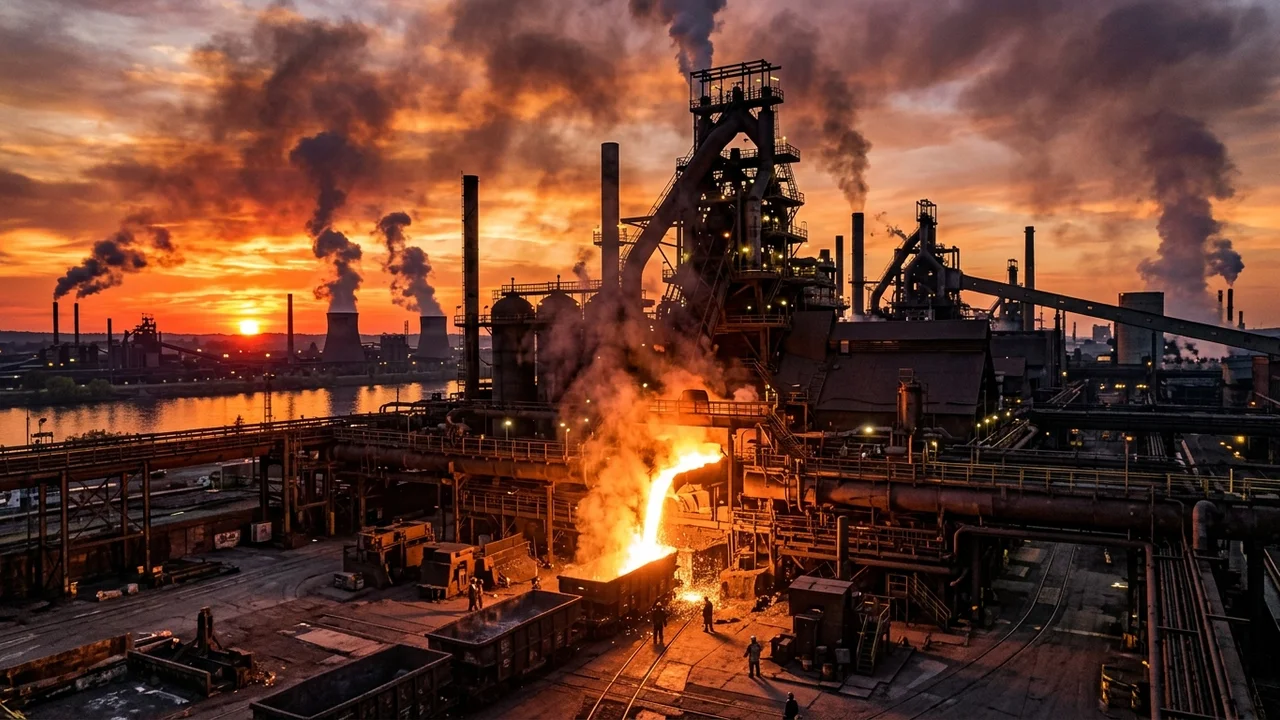
CBAM steel covers the largest single trade flow in the EU Carbon Border Adjustment Mechanism, with iron and steel imports to the EU exceeding €15 billion annually across more than 50 CN code positions spanning Chapters 72 and 73. Three official production-route benchmarks apply: BF-BOF at 1.370 tCO₂e per tonne of crude steel, DRI-EAF at 0.481 tCO₂e/t, and scrap-EAF at 0.072 tCO₂e/t, as set by Implementing Regulation (EU) 2025/2621. Every EU importer of CBAM steel must understand which codes trigger obligations, how embedded emissions are assigned by route, and what certificate costs look like at the current EU ETS price of approximately €70/tCO₂. This guide covers the complete CN code list, official benchmark values, cost calculations by production route, and the compliance steps EU importers must complete before the first CBAM declaration deadline of September 30, 2027.
Image brief: Cross-section diagram of a blast furnace and basic oxygen furnace steelmaking route, with arrows showing CO₂ flow to CBAM certificates. Text overlay: "CBAM Steel 1.370 tCO₂e Benchmark". Commission as branded illustration with cbamguide.com logo.
What Is CBAM for Steel and Which Products Are Covered?
CBAM for steel is a certificate-based requirement under Regulation (EU) 2023/956 that obliges EU importers to surrender CBAM certificates proportional to the embedded CO₂ emissions in each tonne of imported iron and steel product. Steel is covered because its production, particularly via the blast furnace and basic oxygen furnace route, generates CO₂ emissions that are priced within the EU Emissions Trading System for European producers but not for competing producers outside the EU. The mechanism prevents carbon leakage by ensuring that imported CBAM steel carries an equivalent carbon cost.
The EU carbon border adjustment mechanism applies to steel goods primarily through two combined nomenclature chapters. Chapter 72 covers iron and steel in primary and semi-finished form, while Chapter 73 covers articles of iron and steel. Together, these chapters contain more than 50 individual CN code positions that can trigger CBAM obligations for the EU importer, depending on the specific product and its production route.
Steel is classified as an Annex II good under Regulation (EU) 2023/956, meaning that only direct CO₂ emissions are priced. Indirect emissions from electricity consumed during steelmaking are excluded from the CBAM steel calculation. This is consistent with the treatment of EU steel producers, who receive state aid compensation for indirect carbon costs under the ETS Directive rather than a direct charge.
CBAM Steel CN Codes: Chapter 72 and Chapter 73 in Full
CN codes for CBAM steel span two chapters, with each chapter covering a distinct stage or category of iron and steel products. The table below sets out the main code groups, product descriptions, and CBAM applicability status.
| CN Code / Range | Product Description | CBAM Applies? |
|---|---|---|
| 7201 | Pig iron and spiegeleisen in pigs or blocks | Yes |
| 7202 | Ferro-alloys (selected: 7202 11/19, 7202 21/29, 7202 30, 7202 41/49, 7202 60) | Yes (selected) |
| 7203 | Ferrous products from direct reduction of iron ore (DRI) | Yes |
| 7204 | Ferrous waste and scrap | No (excluded) |
| 7206 | Iron and non-alloy steel in ingots or other primary forms | Yes |
| 7207 | Semi-finished products of iron or non-alloy steel | Yes |
| 7208–7212 | Flat-rolled products of iron or non-alloy steel | Yes |
| 7213–7217 | Bars, rods, and wire of iron or non-alloy steel | Yes |
| 7218–7229 | Stainless steel semi-finished and finished products | Yes |
| 7301–7302 | Sheet piling and railway track construction material | Yes |
| 7303–7307 | Tubes, pipes, and fittings of cast iron | Yes |
| 7308–7311 | Structures, reservoirs, tanks, containers of iron or steel | Yes |
| 7318 | Screws, bolts, nuts, and rivets | Yes |
| 7326 | Other articles of iron and steel (selected) | Yes (selected) |
CN codes, such as 7207 11 11, 7207 11 14, and 7207 12 10, cover semi-finished products of non-alloy steel and are among the highest-volume positions in CBAM steel declarations because semi-finished goods form the primary feedstock for further EU processing. Flat-rolled products, such as 7208 10, 7209 15, and 7210 11, represent another major volume category and carry embedded emissions that trace back to the crude steel production route used by the exporting facility.
Ferrous waste and scrap (7204) is excluded because scrap material is assigned zero embedded emissions under the CBAM methodology. This zero-rating creates a structural incentive for exporters who use post-consumer scrap as feedstock: higher scrap content directly reduces the embedded emissions attributed to their CBAM steel output.
Which Chapter 73 Products Create the Highest CBAM Exposure?
Chapter 73 products, such as structural sections (7308), pressure vessels (7311), and mechanical fasteners (7318), create elevated CBAM exposure when they are manufactured from BF-BOF crude steel. The embedded emissions of the crude steel input flow through to the finished article via a precursor mass-balance calculation: the EU importer must declare the embedded emissions of the upstream steel from which the downstream article was fabricated. Hot-rolled coil (7208) is the primary precursor for cold-rolled strip (7209) and coated flat products (7210), and its embedded emissions carry through to those downstream goods in proportion to the steel mass used.
EU importers purchasing CBAM steel articles under Chapter 73 from non-EU suppliers must request emissions data from their counterparties, because the default values under Implementing Regulation (EU) 2025/2621 for countries such as China are set at 3.167 tCO₂e/t of steel slab, significantly above the 1.370 BF-BOF benchmark. Using default values for Chinese CBAM steel imports therefore produces a higher certificate obligation than actual verified emissions in most cases.
The EU carbon border adjustment mechanism requires that EU importers identify the production route of every CBAM steel shipment, because the applicable benchmark differs by route and the financial impact is material across the three options.
Official CBAM Steel Benchmarks and Emission Factors
Three production-route benchmarks govern CBAM steel calculations under Implementing Regulation (EU) 2025/2621, adopted by the CBAM Committee in December 2025. These benchmarks are the reference values used to calculate embedded emissions when an EU importer uses the standard calculation method rather than verified actual data.
| Production Route | Official CBAM Benchmark (tCO₂e/t crude steel) | Typical Actual Emission Range |
|---|---|---|
| BF-BOF (Blast Furnace, Basic Oxygen Furnace) | 1.370 | 2.0–2.5 tCO₂/t |
| DRI-EAF (Direct Reduced Iron, Electric Arc Furnace) | 0.481 | 0.4–0.6 tCO₂/t (gas-based) |
| Scrap-EAF (Electric Arc Furnace, scrap-based) | 0.072 | 0.3–0.5 tCO₂/t |
The BF-BOF benchmark of 1.370 tCO₂e/t is the reference value that applies when EU importers source primary CBAM steel from blast furnace producers in countries such as India, China, and Turkey operating on a coal and coke-based reduction process. The actual emission range of 2.0–2.5 tCO₂/t for BF-BOF reflects real-world variation in coal quality, oxygen lance efficiency, and the ratio of scrap charged to the basic oxygen furnace. The benchmark is set below the typical actual range, meaning that exporters with verified actual emissions above 1.370 tCO₂e/t will face a lower declared liability than their real output warrants if using the benchmark, while exporters with genuine actual emissions below 1.370 can present verified data to reduce their EU importer's certificate obligation.
The scrap-EAF benchmark of 0.072 tCO₂e/t is 19 times lower than the BF-BOF benchmark, reflecting the structural carbon advantage of electric arc furnace steelmaking using recycled scrap as the primary charge. Turkey is the most significant EU supplier using this route, with its EAF-dominant steel industry producing at actual emissions in the 0.3–0.5 tCO₂/t range. The gap between the 0.072 benchmark and typical actual EAF emissions means Turkish scrap-EAF exporters have a financial incentive to provide verified actual data to their EU importer counterparts to reduce declared embedded emissions below the benchmark level.
Route classification follows a mass-balance rule. The production route is classified as Scrap-EAF when more than 50% of the crude steel mass originates from scrap, as DRI-EAF when more than 50% originates from direct reduced iron, and as BF-BOF when more than 50% originates from blast furnace pig iron reduction. Exporters operating hybrid furnaces or facilities that switch between charge compositions across production campaigns must document the route split to enable accurate CBAM steel declarations.
How Are CBAM Steel Embedded Emissions Calculated?
Understanding how embedded emissions are calculated for CBAM steel is essential for EU importers who need to determine their exact certificate obligation before the September 30, 2027 declaration deadline. The calculation combines the tonne weight of the imported good, the applicable emission factor (either actual verified or the benchmark default), and any Article 9 deduction for carbon prices already paid in the country of production.
The standard formula applied to CBAM steel is: Embedded Emissions (tCO₂e) = Net mass of imported product (t) × Specific embedded emissions (tCO₂e/t). For a consignment of 500 tonnes of BF-BOF steel slab using the 1.370 benchmark, the declared embedded emissions total 685 tCO₂e. At the current EU ETS price of approximately €70/tCO₂, the gross CBAM certificate obligation for that consignment is €47,950 before applying the CBAM factor adjustment for free allocation remaining.
The net certificate cost in 2026 is reduced by the free allocation phase-out schedule. In 2026, the CBAM factor is 2.5%, meaning that only 2.5% of the gross obligation translates into actual certificate purchases. The net cost for the 685 tCO₂e example above is therefore 685 × €70 × 2.5% = approximately €1,199. This low 2026 net cost rises steeply: at the 48.5% CBAM factor projected for 2030, the same consignment would generate a net certificate cost of approximately €23,226, representing a 20-fold increase from the 2026 starting point.
EU importers should understand how embedded emissions are calculated across the full verification chain, from production facility data collection through to the CBAM declaration submitted to the registry.
CBAM Steel Cost Calculation by Production Route (2026)
The financial impact of CBAM steel on EU importers depends on the production route of the supplier, the EU ETS price at the time of certificate purchase, and the applicable CBAM factor for the year in which the imports occurred. The cost table below applies the official benchmarks from Implementing Regulation (EU) 2025/2621 at an EU ETS price of €70/tCO₂ and the 2026 CBAM factor of 2.5%.
| Production Route | Benchmark (tCO₂e/t) | Gross Cost @ €70/tCO₂ | Net 2026 Cost (2.5% factor) | Net 2030 Cost (48.5% factor) |
|---|---|---|---|---|
| BF-BOF | 1.370 | €95.90/t | €2.40/t | €46.51/t |
| DRI-EAF | 0.481 | €33.67/t | €0.84/t | €16.33/t |
| Scrap-EAF | 0.072 | €5.04/t | €0.13/t | €2.44/t |
| BF-BOF (China default) | 3.167 | €221.69/t | €5.54/t | €107.52/t |
The 2026 net costs appear modest because 97.5% of free allocation for EU steel producers remains in place, and CBAM certificates offset only the 2.5% that has been phased out. The 2030 column illustrates the step-change that occurs when the free allocation phase-out accelerates: BF-BOF CBAM steel imported from countries without a qualifying carbon pricing scheme will carry a net cost of more than €46/t by 2030 at an ETS price of €70, rising further if carbon prices reach analyst consensus forecasts of €100–150/tCO₂ for that period.
The China default value of 3.167 tCO₂e/t, set by Implementing Regulation (EU) 2025/2621 for steel slab, produces a gross CBAM cost of €221.69/t at €70/tCO₂. At this default, Chinese BF-BOF producers face a CBAM steel certificate cost more than twice that of producers who can document actual emissions at or near the 1.370 BF-BOF benchmark. This creates the strongest financial incentive for Chinese steel exporters to invest in verified emissions measurement and third-party accreditation, particularly as the CBAM factor rises toward 100% by 2034.
Image brief: Split diagram showing an electric arc furnace charged with scrap steel on one side and a data panel showing 0.072 tCO₂e/t benchmark versus BF-BOF 1.370 tCO₂e/t on the other. Text overlay: "EAF Scrap 0.072 vs BF-BOF 1.370". Commission as branded illustration with cbamguide.com logo.
How Does the CBAM Steel Compliance Process Work for EU Importers?
EU importers must complete five sequential compliance steps to meet their CBAM steel obligations under Regulation (EU) 2023/956 as amended by Regulation (EU) 2025/2083. The steps are listed below in chronological order.
- Obtain authorized declarant status by submitting an application to the national competent authority of the EU member state where the importer is established. The application deadline for provisional importing during the definitive phase is March 31, 2026, and the competent authority has 120 days to issue a decision.
- Collect embedded emissions data from each non-EU steel supplier for every consignment. Suppliers provide this as verified actual emissions in tCO₂e/t of crude steel, referencing the production route. If actual data is unavailable, the applicable benchmark default from Implementing Regulation (EU) 2025/2621 applies, with a 10% mark-up in 2026.
- Register the imports in the CBAM registry operated by DG TAXUD, recording the CN code, net mass, country of origin, production installation, and embedded emissions factor for each shipment.
- Purchase CBAM certificates in the CBAM registry. Certificate sales open on February 1, 2027. The purchase price reflects the quarterly average of EU ETS auction clearing prices for 2026 imports. Quarterly holding requirements apply: the EU importer must hold certificates covering at least 50% of cumulative embedded emissions from CBAM steel imports since the start of the calendar year.
- Submit the annual CBAM declaration by September 30, 2027 for calendar year 2026 imports. The declaration states total embedded emissions, total certificates surrendered, and any Article 9 deductions for carbon prices paid in the country of production.
EU importers who fail to surrender sufficient certificates face a penalty of €100 per tonne CO₂e not covered under Article 26(1) of Regulation (EU) 2023/956 as amended. Importing CBAM steel without authorization carries a penalty of €300–500 per tonne CO₂e, representing the most severe financial consequence in the compliance framework.
CBAM Steel and Major Exporting Countries: Who Is Most Exposed?
CBAM steel exposure varies significantly across the primary exporting nations based on their production technology mix, annual trade volumes with the EU, and the existence of a qualifying domestic carbon price. The 5 countries with the highest CBAM steel exposure are ranked by a combination of export volume and carbon pricing gap.
The primary exporters of CBAM steel to the EU and their key compliance characteristics are described below.
- India: EU imports approximately 4.33 million tonnes annually at a trade value of €3.9 billion. India's production is BF-BOF dominant, and the Carbon Credit Trading Scheme pilot does not yet qualify for an Article 9 deduction under CBAM. At the BF-BOF benchmark of 1.370 tCO₂e/t, Indian CBAM steel generates 5.93 Mt of declared embedded emissions on 4.33 Mt of imports.
- South Korea: EU imports approximately 3.38 million tonnes at €3.6 billion. South Korea operates the K-ETS carbon pricing system, which may qualify for an Article 9 deduction. The K-ETS price of approximately €6.40/tCO₂ reduces the gross CBAM certificate obligation by approximately €8.77/t of BF-BOF steel at current rates.
- China: EU imports total approximately €16 billion when basic steel products and steel articles are combined. China's ETS covers the power sector only as of 2026; the steel sector is not covered. The default value of 3.167 tCO₂e/t for Chinese steel slab creates the highest per-tonne CBAM steel certificate obligation of any major origin country.
- Turkey: EU imports approximately 2.59 million tonnes of CBAM steel annually. Turkey uses a mixed BF-BOF and scrap-EAF production base. The scrap-EAF segment benefits from the 0.072 tCO₂e/t benchmark, but Turkey has no qualifying carbon pricing scheme, so no Article 9 deduction is available for any production route.
- Ukraine: Despite disruption from the 2022 conflict, Ukraine exports approximately 3.40 million tonnes to the EU, representing 81% of its total finished steel exports. Ukraine's reconstruction trajectory and EAF growth create a different long-term CBAM profile than its current BF-BOF legacy capacity.
What CBAM Means for Steel Importers and Exporters in 2026 and Beyond
CBAM steel obligations are in force as of January 1, 2026, but the financial impact in 2026 remains limited because the CBAM factor of 2.5% applies to only a small fraction of the gross certificate obligation. The critical planning horizon for EU importers is 2029–2030, when the free allocation phase-out accelerates from 22.5% to 48.5% in a single year, producing a near-doubling of net CBAM steel costs in that window.
EU importers who source BF-BOF CBAM steel from high-emission origins, particularly those relying on Chinese steel under default values, face the steepest cost trajectory. An EU importer taking 10,000 tonnes of Chinese BF-BOF steel per year at the 3.167 default will face a net CBAM certificate cost of approximately €55,400 in 2026, rising to approximately €1,075,200 in 2030 at the same ETS price and import volume.
Exporters in third countries who invest in verified emissions measurement, third-party accreditation aligned with Implementing Regulation (EU) 2025/2547, and route documentation before 2027 will be able to demonstrate actual emissions below the applicable benchmark, reducing the EU importer's certificate obligation and creating a commercial price advantage over competitors relying on default values.
CBAM Steel Compliance: Related Countries and Tools
This section covers CBAM steel exposure for specific exporting countries and practical tools that EU importers use to estimate and manage their certificate obligations.
What Is the CBAM Steel Cost for Turkish Exporters?
Turkey represents the most commercially significant CBAM steel case among countries without a qualifying carbon price. EU importers sourcing CBAM steel from Turkey cannot apply any Article 9 deduction, meaning the full gross certificate obligation applies at the current EU ETS price. The scrap-EAF segment of Turkish steel exports benefits from the 0.072 tCO₂e/t benchmark, producing a gross cost of €5.04/t at €70/tCO₂. The BF-BOF segment uses the 1.370 benchmark, producing €95.90/t gross. For the full trade and compliance profile, see CBAM Turkey.
What Is the CBAM Steel Cost for Indian Exporters?
India's CBAM steel exposure is concentrated in the BF-BOF route because India produces more than 75% of its steel via this method. At 4.33 million tonnes of annual EU exports and the 1.370 BF-BOF benchmark, the total declared embedded emissions for Indian CBAM steel approach 5.93 million tCO₂e annually. The Carbon Credit Trading Scheme pilot does not currently qualify as an equivalent carbon pricing system under Article 9. For country-specific trade data and compliance analysis, see CBAM India.
Is Chinese Steel Subject to Higher CBAM Default Values Than Other Countries?
Yes. Chinese CBAM steel faces the highest single-country default value of any major exporter, set at 3.167 tCO₂e/t for steel slab under Implementing Regulation (EU) 2025/2621. This default is 2.31 times higher than the BF-BOF benchmark of 1.370 and reflects the carbon intensity of China's coal-heavy steelmaking infrastructure. Chinese steel producers who supply detailed facility-level verified emissions data to their EU importer counterparts can substitute actual values for the default, but the verification and accreditation requirements under Implementing Regulation (EU) 2025/2547 create significant administrative costs. For the full picture of China's CBAM exposure across all covered sectors, see CBAM China.
Does the CBAM De Minimis Threshold Apply to Steel Imports?
Yes. The de minimis threshold of 50 tonnes annual mass per authorized declarant applies to CBAM steel. EU importers whose total annual imports of steel goods across all CN code positions in Chapters 72 and 73 fall below 50 tonnes are exempt from the certificate purchase and declaration requirement for that year. This threshold is assessed per importer across the full calendar year, not per consignment or per shipment. Electricity and hydrogen are excluded from the de minimis exemption, but CBAM steel qualifies.
Can Scrap-Based Steel Exporters Claim a Zero Emission Factor?
No. The scrap-EAF benchmark of 0.072 tCO₂e/t is not zero, though it is close to zero compared to BF-BOF steel. Scrap material itself is assigned zero embedded emissions in the CBAM methodology, reflecting the zero-rating principle for post-consumer recycled inputs. The 0.072 tCO₂e/t benchmark covers the direct process emissions from the electric arc furnace operation, including electrode consumption and any auxiliary heat inputs, that occur even when using 100% recycled scrap charge. Exporters using high proportions of clean, post-consumer scrap with efficient EAF operations may have actual emissions below the 0.072 benchmark, in which case verified actual data produces a lower declaration than the benchmark default.
Are CBAM Steel Certificates Priced Differently From EU ETS Allowances?
No. CBAM steel certificate prices track the EU ETS directly. The price of each CBAM certificate equals the quarterly average of EU ETS auction clearing prices for the period in which the corresponding imports occurred (covering calendar year 2026 imports). There is no separate CBAM carbon price. Because CBAM has no independent price mechanism, all projections for CBAM steel costs are tied to EU ETS price forecasts. At the current EU ETS price of approximately €70/tCO₂, the gross BF-BOF CBAM steel cost is €95.90/t, with net 2026 costs of approximately €2.40/t after applying the 2.5% CBAM factor. Use the CBAM cost calculator to model certificate obligations at different ETS price scenarios and import volumes.
How Do EU Importers Look Up Specific CN Codes for Steel Products?
EU importers identify the correct CN code for each CBAM steel product using the EU's Combined Nomenclature, which is updated annually. The CN code determines which benchmark applies, whether the product is in scope at all (7204 ferrous scrap is excluded), and which production installation data must be collected from the non-EU supplier. For an interactive lookup covering all CBAM steel positions in Chapters 72 and 73, use the steel CN codes lookup tool.