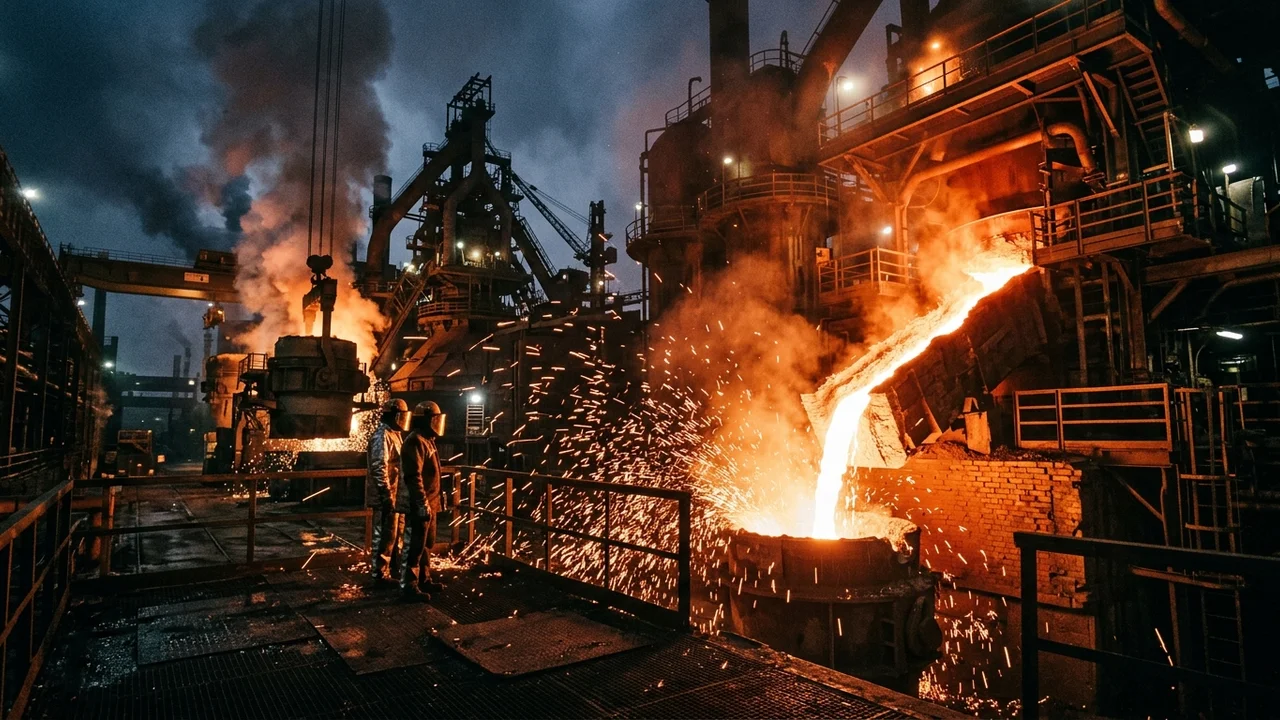
BF-BOF steel carries the highest CBAM benchmark of any steel production route: 1.370 tCO₂e per tonne of crude steel, as established by Implementing Regulation (EU) 2025/2621 and confirmed by the CBAM Committee in December 2025. At the current EU ETS price of approximately €70/tCO₂, that benchmark translates to a gross certificate obligation of €95.90 per tonne, a figure that rises sharply as free allocation phases out through 2034. Understanding this benchmark, how it compares to actual BF-BOF emission ranges, and what drives the gap between the two is the foundation of CBAM compliance planning for blast furnace steel importers.
Caption: Schematic of the BF-BOF production route, from iron ore and coke inputs through to crude steel, showing the primary emission sources at each stage.
What the 1.370 tCO₂e/t BF-BOF CBAM Benchmark Represents
The 1.370 tCO₂e/t benchmark is the official reference value for blast furnace-basic oxygen furnace steel under Regulation (EU) 2023/956, used to calculate CBAM certificate obligations when verified actual emissions data is not available. It is a best-performance benchmark, not an average. It reflects what the most efficient BF-BOF producers achieve, rather than the global mean.
The benchmark's significance lies in what it is not. Actual BF-BOF emission ranges run from 2.0 to 2.5 tCO₂/t depending on coal quality, oxygen efficiency, and scrap charge rate. The benchmark at 1.370 tCO₂e/t sits well below this range, which means any importer who submits verified actual emissions data from a facility operating in that 2.0–2.5 range faces a higher certificate obligation than one using the benchmark. This is the opposite of what most importers expect, and it has material cost consequences.
The EU CBAM guide explains the broader mechanism for understanding how embedded emissions connect to certificate pricing. For blast furnace steel specifically, the benchmark creates a two-tier compliance landscape: producers who can verify emissions near 1.370 benefit from using actual data, while those operating at 2.0+ are financially better served by the benchmark in 2026. This dynamic inverts from 2027 onward as the default value mark-up schedule increases.
How the BF-BOF Route Is Classified Under CBAM
The production route classification that triggers the 1.370 benchmark follows a straightforward mass-balance rule established in IR 2025/2621: when more than 50% of the crude steel mass originates from blast furnace pig iron, the goods are classified under the BF-BOF route. Facilities using significant scrap charge in the BOF that push pig iron content below 50% by mass may qualify for a different route classification.
The three CBAM steel benchmarks differ substantially, reflecting the emissions profile of each route. The table below shows the official benchmark values and the practical cost implications at the current ETS reference price.
| Production Route | CBAM Benchmark (tCO₂e/t) | Gross Cost @ €70/tCO₂ | Typical Actual Range |
|---|---|---|---|
| BF-BOF (Blast Furnace, Basic Oxygen Furnace) | 1.370 | €95.90/t | 2.0–2.5 tCO₂/t |
| DRI-EAF (Direct Reduced Iron, Electric Arc Furnace) | 0.481 | €33.67/t | 0.4–0.6 tCO₂/t |
| Scrap-EAF (Electric Arc Furnace, scrap-based) | 0.072 | €5.04/t | 0.3–0.5 tCO₂/t |
The CBAM steel sector guide covers all three routes in full and explains how precursor embedded emissions carry through from hot-rolled coil to downstream products.
What Chinese Default Values Mean for BF-BOF Importers
The benchmark at 1.370 tCO₂e/t is not the worst-case scenario for every origin. China's steel slab default value, published in IR 2025/2621, is 3.167 tCO₂e/t, which is more than double the benchmark and substantially higher than the 2.0–2.5 range typical of Chinese BF-BOF facilities. At €70/tCO₂, applying the China default produces a gross obligation of approximately €221.69 per tonne.
This gap between the China-specific default (3.167) and the actual emission range of Chinese BF-BOF producers (2.0–2.5) represents the financial incentive for verified data submission. Chinese producers who provide third-party verified actual emissions near 2.0 tCO₂/t would pay roughly €140/t gross instead of €221.69/t, a saving of over €80/t gross. As CBAM factors increase from 2.5% in 2026 toward 100% in 2034, that saving compounds significantly.
Understanding how embedded emissions are calculated explains the methodology importers use to move from facility-level emissions data to the per-tonne figure that drives certificate obligations.
Direct Emissions Only: What BF-BOF Steel Does Not Include in CBAM
BF-BOF steel is listed in Annex II of Regulation (EU) 2023/956, which means only direct emissions are priced under CBAM. Indirect emissions from electricity consumption in the production process are excluded. This is a structural decision made to maintain symmetry with EU domestic steel producers, who receive EU ETS compensation for their indirect electro-intensity costs. Including indirect CBAM liability while compensating domestic producers would create an asymmetry that would disadvantage importers on a different basis.
The practical implication is that the reported embedded emissions for CBAM declarations cover two sources only: CO₂ from coke combustion in the blast furnace, which represents the dominant emission source, and CO₂ from limestone calcination in the basic oxygen furnace, which is secondary. The electricity used to power auxiliary equipment, rolling mills, and on-site logistics does not enter the CBAM calculation.
Importers of flat-rolled products (CN codes 7208 through 7212, including hot-rolled and cold-rolled coil) carry the embedded emissions of the upstream crude steel production through mass-balance allocation. Pig iron (CN 7201) and semi-finished products (CN 7207) are covered goods under Annex I, as are bars, rods, and wire under CN codes 7213 through 7217.
BF-BOF Steel and CBAM: Compliance Pathway for EU Importers
CBAM certificate obligations for blast furnace steel importers follow a defined sequence under Regulation (EU) 2023/956 as amended by Regulation (EU) 2025/2083. The four compliance steps are listed below in order of execution.
- Obtain authorized declarant status before the March 31, 2026 deadline through the CBAM Registry operated by DG TAXUD.
- Request or collect verified embedded emissions data from the exporting BF-BOF facility, or apply the applicable default value (benchmark with mark-up) if verified data is unavailable.
- Maintain a quarterly holding of CBAM certificates equal to at least 50% of cumulative embedded emissions since the start of the calendar year, once certificate sales open on February 1, 2027.
- Submit the annual CBAM declaration by September 30, 2027, covering calendar year 2026 imports, and surrender the required number of certificates.
The penalty for failing to surrender sufficient certificates is €100 per tonne CO₂e not covered. Importing without authorization carries a penalty of €300 to €500 per tonne CO₂e, which is 3 to 5 times the standard rate.
Caption: Net CBAM cost per tonne of BF-BOF steel increases from approximately €2.40/t in 2026 to €95.90/t in 2034 as the CBAM factor rises from 2.5% to 100%.
BF-BOF Steel CBAM Cost Over Time: Why 2026 Numbers Are Misleading
The net CBAM cost for BF-BOF steel in 2026 is approximately €2.40 per tonne at €70/tCO₂ (gross €95.90 × 2.5% CBAM factor). This figure will mislead any importer who uses it for long-term planning. The CBAM factor increases annually as EU ETS free allocation phases out, reaching 48.5% in 2030 and 100% in 2034.
The table below shows net CBAM costs for BF-BOF steel at three ETS price scenarios across key phase-out years.
| Year | CBAM Factor | Net Cost @ €70/tCO₂ | Net Cost @ €100/tCO₂ | Net Cost @ €126/tCO₂ |
|---|---|---|---|---|
| 2026 | 2.5% | €2.40/t | €3.43/t | €4.32/t |
| 2028 | 10% | €9.59/t | €13.70/t | €17.26/t |
| 2030 | 48.5% | €46.51/t | €66.45/t | €83.73/t |
| 2034 | 100% | €95.90/t | €137.00/t | €172.62/t |
The steepest jump occurs between 2029 and 2030, when the CBAM factor rises from 22.5% to 48.5%. BF-BOF steel importers who are not planning for the 2029 to 2030 cliff face sudden cost increases that can exceed €40/t in a single year.
Frequently Asked Questions
What is the CBAM benchmark for BF-BOF steel in 2026?
The official CBAM benchmark for BF-BOF (blast furnace, basic oxygen furnace) steel is 1.370 tCO₂e per tonne of crude steel, as published in Implementing Regulation (EU) 2025/2621. This benchmark applies when verified actual emissions data is not submitted.
Does the BF-BOF CBAM benchmark include electricity emissions?
No. BF-BOF steel is listed in Annex II of Regulation (EU) 2023/956, meaning only direct emissions are priced. Electricity consumption in the production process is excluded from CBAM calculations for steel.
Is it better to use actual emissions data or the 1.370 benchmark?
It depends on the facility's actual emission intensity. Producers operating near or below 1.370 tCO₂/t benefit from submitting verified actual data. Producers operating at 2.0 tCO₂/t or above pay less using the 1.370 benchmark in 2026. From 2027, the 20% default value mark-up reduces the benchmark's financial advantage. CBAM compliance for steel importers covers the verification and submission process in full.
What is the China default value for BF-BOF steel?
IR 2025/2621 sets the China-specific default for steel slab at 3.167 tCO₂e/t, which is significantly higher than the 1.370 benchmark. At €70/tCO₂, this produces a gross obligation of approximately €221.69/t for Chinese steel using default values.
Which CN codes fall under the BF-BOF CBAM route?
CN codes across Chapters 72 and 73 are covered, including pig iron (7201), semi-finished products (7207), flat-rolled coil (7208–7212), and bars and rods (7213–7217). The route classification is determined by the mass-balance rule: more than 50% of crude steel mass from blast furnace pig iron triggers BF-BOF classification. Full benchmarks and calculations are available in the CBAM steel benchmarks 2026 reference.
Is BF-BOF steel subject to the 50-tonne de minimis threshold?
Yes. The de minimis threshold of 50 tonnes annual mass per importer applies to steel, including BF-BOF goods. Importers whose total annual BF-BOF steel imports remain below 50 tonnes are exempt from CBAM obligations under Article 2(3a), as amended by Regulation (EU) 2025/2083.
Does the BF-BOF benchmark change after 2026?
The benchmark value of 1.370 tCO₂e/t is the current official figure from IR 2025/2621. The value is subject to periodic review by the CBAM Committee. The default value mark-up increases from +10% above the benchmark in 2026 to +20% in 2027 and +30% from 2028 onward under the same implementing regulation. The CBAM default values page covers the mark-up schedule and its financial implications.
Supplementary Reference: BF-BOF vs. Other Steel Routes Under CBAM
The 1.370 benchmark places BF-BOF at nearly 19 times the CBAM intensity of scrap-EAF steel (0.072 tCO₂e/t). This differential creates a structural competitive pressure on blast furnace producers in countries without carbon pricing. Turkey exports approximately 6 million tonnes of steel to the EU per year, with a BF-BOF and EAF mix. India exports approximately 4.33 million tonnes annually with BF-BOF dominant. Neither country operates a qualifying carbon pricing scheme as of 2026, meaning Article 9 deductions are not currently available for importers sourcing from these origins.
The CBAM steel calculation guide explains the step-by-step methodology for converting facility-level emissions reports into the per-tonne figure used in CBAM declarations, including precursor allocation for downstream products.
Does the UK BF-BOF Steel Sector Qualify for an Article 9 Deduction?
The UK operates the UK Emissions Trading Scheme (UK ETS), a separate system that is not linked to the EU ETS. The UK is not exempt from CBAM. Whether UK ETS costs qualify for an Article 9 deduction under Regulation (EU) 2023/956 remains unresolved as of April 2026. EU importers sourcing from UK BF-BOF facilities should plan without an Article 9 deduction until the Commission issues formal guidance.
Is BF-BOF Steel at Risk of CBAM Circumvention?
Circumvention risk for BF-BOF steel is rated high by the European Commission. The primary vector involves Chinese BF-BOF steel processed in Vietnam or other third countries, which is then exported to the EU under a different country of origin. COM(2025)989 proposes downstream product expansion and anti-circumvention measures from 2028 onward. Importers sourcing from processing hubs should document the full origin and emission trail of their goods. CBAM compliance for steel importers covers origin documentation requirements.