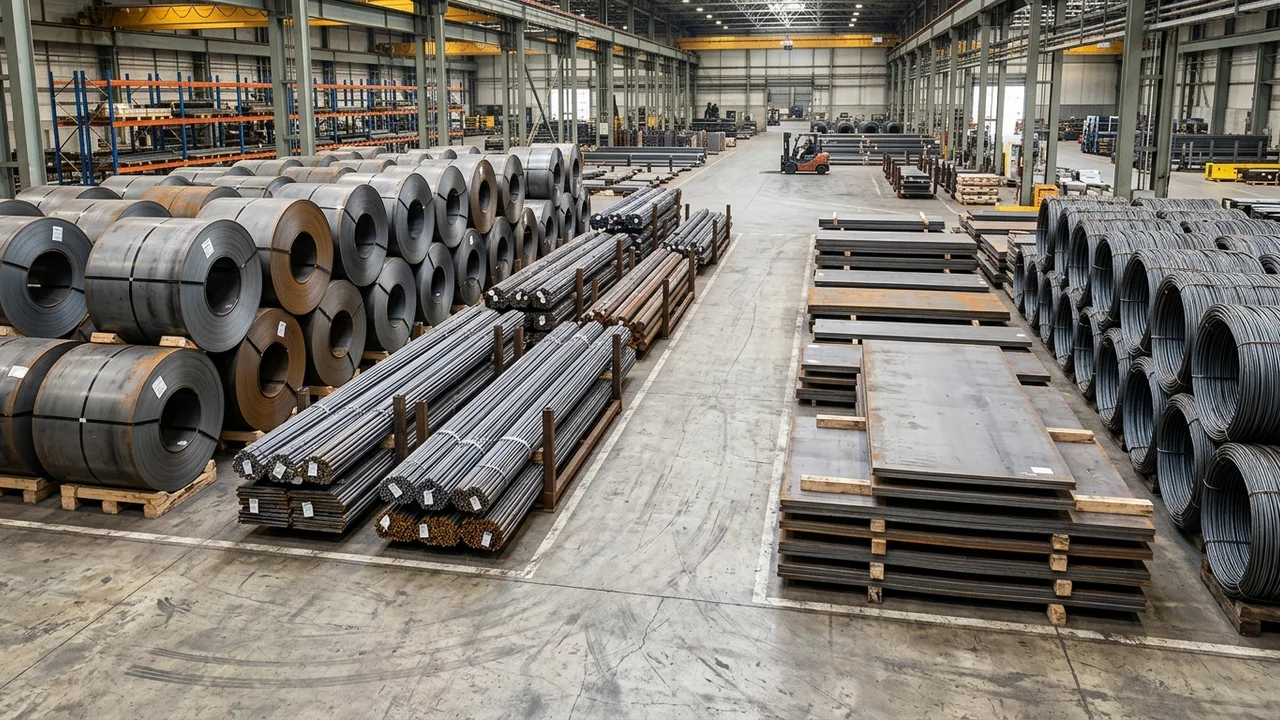
CBAM steel CN codes span two chapters of the Combined Nomenclature, covering more than 54 distinct product headings under Chapters 72 and 73 of Annex I to Regulation (EU) 2023/956. Every EU importer of iron and steel must confirm whether each shipment's CN code appears on the covered list before filing a declaration or calculating certificate obligations. This guide delivers the complete code list, the key exclusions that trip up importers, and the compliance logic that connects each code to an embedded-emissions calculation.
Caption: Annex I of Regulation (EU) 2023/956 organizes covered steel goods under Chapter 72 (iron and steel) and Chapter 73 (articles of iron or steel).
What Are CBAM Steel CN Codes?
CBAM steel CN codes are the 8-digit Combined Nomenclature identifiers assigned to iron and steel products that carry a mandatory CBAM certificate obligation when imported into the EU under Regulation (EU) 2023/956, effective January 1, 2026. A product's CN code determines whether it is in scope, which production-route emission factor applies, and whether a de minimis exemption is available. Understanding the code classification is the first step in any steel importer's compliance workflow.
The EU CBAM guide explains the full certificate mechanism, including how certificate prices track the weekly average EU ETS auction closing price from 2027 onward. For steel specifically, the code list is the longest of all six CBAM sectors, because steel trades in dozens of intermediate and finished forms, each with its own 8-digit position.
CBAM Chapter 72 CN Codes — Iron and Steel
Chapter 72 covers the primary and semi-finished forms of iron and steel. The 22 headings listed below represent the materials most commonly traded by steel mills, integrated producers, and commodity traders. The complete set of Chapter 72 codes covered under Annex I is organized by product group in the table below.
| CN Heading | Product Description | CBAM Status |
|---|---|---|
| 7201 | Pig iron and spiegeleisen in pigs, blocks, or other primary forms | Covered |
| 7202 | Ferro-alloys (selected sub-headings: ferro-manganese, ferro-silicon, ferro-chromium, ferro-nickel) | Covered (selected) |
| 7203 | Ferrous products from direct reduction of iron ore (DRI) | Covered |
| 7204 | Ferrous waste and scrap | Excluded |
| 7206 | Iron and non-alloy steel in ingots or other primary forms | Covered |
| 7207 | Semi-finished products of iron or non-alloy steel | Covered |
| 7208 | Flat-rolled products of iron or non-alloy steel, hot-rolled, width ≥600 mm | Covered |
| 7209 | Flat-rolled products of iron or non-alloy steel, cold-rolled, width ≥600 mm | Covered |
| 7210 | Flat-rolled products of iron or non-alloy steel, clad, plated, or coated | Covered |
| 7211 | Flat-rolled products of iron or non-alloy steel, width <600 mm, not clad | Covered |
| 7212 | Flat-rolled products of iron or non-alloy steel, width <600 mm, clad/plated | Covered |
| 7213 | Bars and rods of iron or non-alloy steel, hot-rolled, in irregularly wound coils | Covered |
| 7214 | Other bars and rods of iron or non-alloy steel | Covered |
| 7215 | Other bars and rods of iron or non-alloy steel (further worked) | Covered |
| 7216 | Angles, shapes, and sections of iron or non-alloy steel | Covered |
| 7217 | Wire of iron or non-alloy steel | Covered |
| 7218 | Stainless steel in ingots or other primary forms; semi-finished products | Covered |
| 7219 | Flat-rolled products of stainless steel, width ≥600 mm | Covered |
| 7220 | Flat-rolled products of stainless steel, width <600 mm | Covered |
| 7221 | Bars and rods of stainless steel, in irregularly wound coils | Covered |
| 7222 | Other bars, rods, angles, shapes, and sections of stainless steel | Covered |
| 7223 | Wire of stainless steel | Covered |
| 7224 | Other alloy steel in ingots or other primary forms; semi-finished products | Covered |
| 7225 | Flat-rolled products of other alloy steel, width ≥600 mm | Covered |
| 7226 | Flat-rolled products of other alloy steel, width <600 mm | Covered |
| 7227 | Bars and rods of other alloy steel, in irregularly wound coils | Covered |
| 7228 | Other bars, rods, angles, shapes, and sections of other alloy steel; hollow drill bars | Covered |
| 7229 | Wire of other alloy steel | Covered |
The most commercially significant exclusion in Chapter 72 is heading 7204 (ferrous waste and scrap). Scrap is excluded because it enters the production process as a zero-rated precursor: embedded emissions are assigned to the steel product made from it, not to the scrap itself. Importers who source EU-bound scrap for their own downstream use are not subject to CBAM on those purchases.
For the specific ferro-alloy sub-headings under 7202, the covered positions are 7202 11, 7202 19 (ferro-manganese), 7202 21, 7202 29 (ferro-silicon), 7202 30 (ferro-silicon-manganese), 7202 41, 7202 49 (ferro-chromium), and 7202 60 (ferro-nickel). Not every ferro-alloy sub-heading under 7202 carries CBAM obligations — importers must verify the exact 8-digit code for each shipment.
CBAM Chapter 73 CN Codes — Articles of Iron or Steel
Chapter 73 covers fabricated and finished articles made from iron or steel. These are downstream products with embedded emissions inherited from the upstream steel they contain. The 9 headings covered under Chapter 73 are listed below.
| CN Heading | Product Description | CBAM Status |
|---|---|---|
| 7301 | Sheet piling of iron or steel; welded angles, shapes, and sections | Covered |
| 7302 | Railway or tramway track construction material (rails, sleepers, fishplates, etc.) | Covered |
| 7303 | Tubes, pipes, and hollow profiles of cast iron | Covered |
| 7304 | Tubes, pipes, and hollow profiles, seamless, of iron or steel | Covered |
| 7305 | Other tubes and pipes of iron or steel (large diameter welded) | Covered |
| 7306 | Other tubes, pipes, and hollow profiles of iron or steel | Covered |
| 7307 | Tube or pipe fittings (couplings, elbows, sleeves) of iron or steel | Covered |
| 7308 | Structures and parts thereof of iron or steel (bridges, towers, columns) | Covered |
| 7309 | Reservoirs, tanks, and vats of iron or steel (capacity >300 liters) | Covered |
| 7310 | Tanks, drums, cans, boxes of iron or steel (capacity ≤300 liters) | Covered |
| 7311 | Containers for compressed or liquefied gas, of iron or steel | Covered |
| 7318 | Screws, bolts, nuts, coach screws, rivets, and similar articles of iron or steel | Covered |
| 7326 | Other articles of iron or steel (selected sub-headings only) | Covered (selected) |
Chapter 73 exclusions include headings 7312 to 7317 (wire rope, stranded wire, barbed wire, chain, nails, and staples) and headings 7319 to 7325 (sewing needles, stoves, sanitary ware, and other household articles). These exclusions were established because their embedded carbon intensity is low relative to their finished-goods value, and their inclusion would create disproportionate compliance costs for importers of small commodity items.
Caption: Chapter 73 CBAM goods include seamless tubes (7304), large-diameter welded pipes (7305), structural sections (7308), and pressure vessels (7311).
How CN Codes Determine CBAM Certificate Obligations
The CN code does not calculate embedded emissions on its own. It determines which production-route benchmark or default value applies to a given import. The three production routes recognized under Implementing Regulation (EU) 2025/2621 are the blast furnace and basic oxygen furnace route (BF-BOF), the direct-reduced iron and electric arc furnace route (DRI-EAF), and the scrap-based electric arc furnace route (scrap-EAF).
The official CBAM benchmark values from IR 2025/2621 are 1.370 tCO₂e per tonne of crude steel for BF-BOF, 0.481 tCO₂e per tonne for DRI-EAF, and 0.072 tCO₂e per tonne for scrap-EAF. When a non-EU exporter cannot provide third-party verified actual emissions data, the importer applies the default value for that product and country of origin. For Chinese steel, the default slab value under IR 2025/2621 is 3.167 tCO₂e per tonne, which is more than double the BF-BOF benchmark of 1.370 — creating a strong financial incentive for Chinese producers to supply verified data.
The CBAM steel sector guide covers how embedded emissions from hot-rolled coil (7208) flow through as precursor emissions into downstream products such as cold-rolled coil (7209) and coated flat products (7210) via mass-balance allocation rules.
At the EU ETS price of approximately €70 per tonne CO₂ as of late March 2026, the gross CBAM cost for BF-BOF steel is approximately €140 per tonne. The net obligation in 2026 is substantially lower because 97.5% of free allocation remains in place, reducing the effective surcharge to approximately €3.50 per tonne for 2026. That net cost rises steeply: by 2030, with 48.5% of free allocation phased out, the same BF-BOF steel faces a net CBAM cost of approximately €67.90 per tonne at the same ETS price.
The CBAM de minimis threshold of 50 tonnes annual mass per importer exempts low-volume traders from the authorization and declaration requirements, though the threshold applies per importer, not per shipment or per CN code.
Using CN Codes in Practice: What Steel Importers Check
Confirming CBAM scope for a steel shipment involves four steps. The steps are presented below in the order an authorized declarant performs them against each import.
- Identify the 8-digit CN code from the customs declaration (box 33 of the SAD or the EU customs data element equivalent under the Union Customs Code).
- Verify that the code appears in Annex I to Regulation (EU) 2023/956 as a covered good, distinguishing between fully covered headings and partially covered headings such as 7202 and 7326.
- Determine the production route (BF-BOF, DRI-EAF, or scrap-EAF) from supplier documentation, then select the applicable benchmark or default value from IR 2025/2621.
- Apply the mass in tonnes and the emission factor to compute gross embedded CO₂e, then adjust for any verified carbon price already paid in the country of origin under Article 9 of Regulation (EU) 2023/956.
Do All Steel Products in Chapters 72 and 73 Fall Under CBAM?
No. Chapters 72 and 73 contain more product headings than CBAM covers. Heading 7204 (ferrous waste and scrap) is explicitly excluded. Headings 7312 to 7317 and 7319 to 7325 in Chapter 73 are also excluded. For partially covered headings such as 7202 and 7326, only specific 8-digit sub-headings carry CBAM obligations. Importers must check the 8-digit level, not just the 4-digit heading.
Is Chapter 26 Iron Ore Covered by CBAM?
Sub-heading 2601 12 00 (agglomerated iron ores) appears as a precursor in the CBAM context but is not itself a declarable CBAM good. Its embedded emissions are upstream inputs that flow into pig iron (7201) and DRI (7203). Importers of iron ore do not file CBAM declarations for the ore itself; the obligation arises at the first processed steel product level.
Does the De Minimis Threshold Apply to Chapter 73 Steel Articles?
Yes. The 50-tonne annual mass de minimis threshold under Article 2(3a) of Regulation (EU) 2023/956, as amended by Regulation (EU) 2025/2083, applies to all steel CN codes in both Chapter 72 and Chapter 73. An importer whose total annual imports of covered steel goods across all CN codes remain below 50 tonnes is exempt from the authorization and declaration requirements for that calendar year.
Can Stainless Steel Importers Use a Single Emission Factor?
No. Stainless steel headings 7218 to 7223 require the same production-route determination as carbon steel. BF-BOF stainless steel, DRI-EAF stainless steel, and scrap-EAF stainless steel each carry different benchmark values from IR 2025/2621. The route classification rule is the same: when more than 50% of the crude steel mass originates from scrap, the scrap-EAF route applies.
Is the CBAM Certificate Obligation the Same for All Chapter 73 Codes?
The certificate calculation method is the same across all covered codes: mass in tonnes multiplied by embedded emissions in tCO₂e, then multiplied by the certificate price. However, Chapter 73 articles may carry embedded emissions from multiple precursor stages, including both the upstream steel slab or billet and any further processing. For complex fabricated articles such as structural assemblies under 7308, the mass-balance allocation of precursor emissions adds complexity to the declaration.
Are There Additional Resources for CN Code Verification?
The dedicated CBAM CN code lookup tool allows importers to search by heading or product description and returns the CBAM status, applicable production routes, and default value reference for each code. Steel importers managing multiple shipment types benefit from the CBAM compliance for steel importers guide, which covers the full authorization, registry, and declaration workflow. Non-EU producers seeking to understand how their CN code classification affects commercial pricing can refer to the CBAM impact on steel exporters page. For situations where verified emissions data is unavailable, the CBAM default values reference page lists the current IR 2025/2621 values by product and country.