EAF scrap steel carries an official CBAM benchmark of just 0.072 tCO₂e per tonne of crude steel, compared to 1.370 tCO₂e per tonne for blast furnace production, producing a ratio of 19x between the two routes. That gap translates directly into certificate costs: at the current EU ETS reference price of approximately €70 per tonne of CO₂, an EU importer of blast furnace steel pays a gross CBAM obligation of roughly €96 per tonne, while an importer of scrap-based electric arc furnace steel pays approximately €5 per tonne on the same gross basis. Understanding why recycled steel achieves this advantage, and how the calculation works under Regulation (EU) 2023/956, is the central question for any importer making sourcing decisions in 2026.
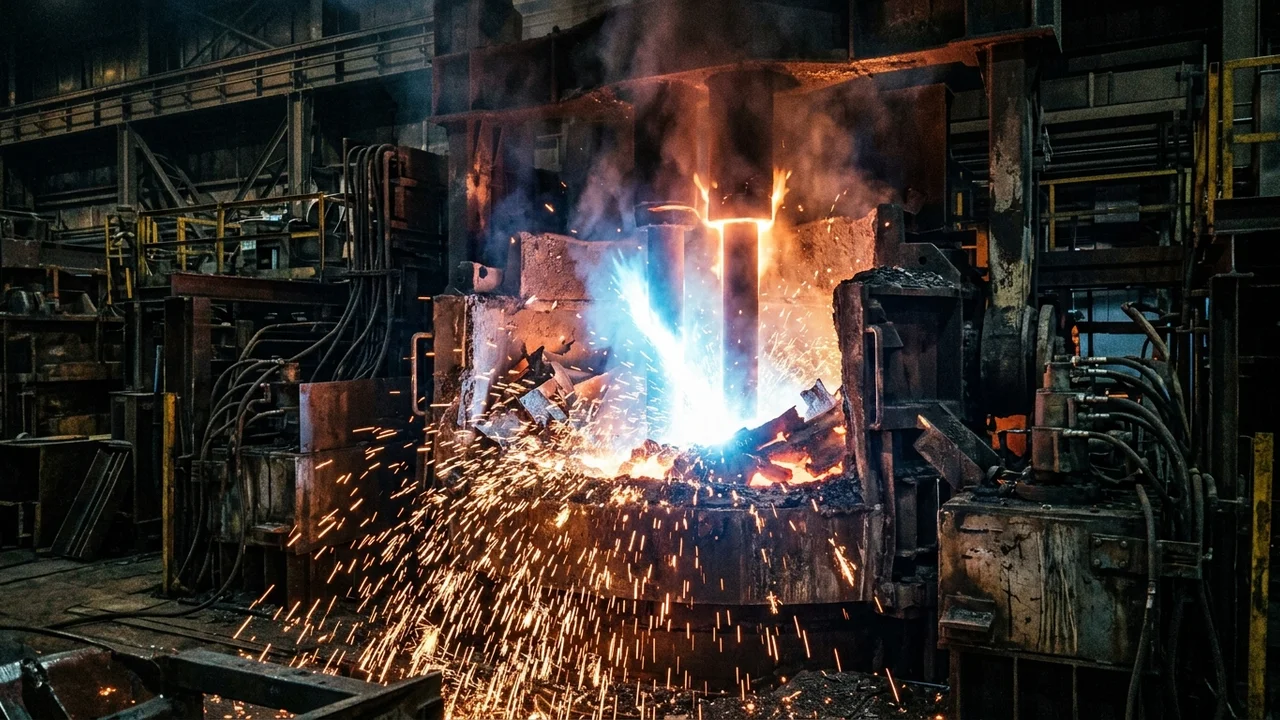
Caption: Scrap-based EAF production accounts for approximately 30% of global crude steel output and produces the lowest embedded emissions of any commercial steelmaking route covered by CBAM.
What Is the CBAM Benchmark for EAF Scrap Steel?
The official CBAM benchmark for scrap-EAF steel is 0.072 tCO₂e per tonne of crude steel, as published in Implementing Regulation (EU) 2025/2621 by the CBAM Committee in December 2025. This value applies when more than 50% of the crude steel mass originates from post-consumer or pre-consumer scrap. The benchmark covers direct emissions only, because iron and steel are listed in Annex II of Regulation (EU) 2023/956, which restricts CBAM pricing to direct process emissions and excludes electricity consumption costs.
The 0.072 figure represents the emission intensity of the electric arc furnace process when fed primarily with recycled scrap. The furnace uses electrical energy to melt the charge, produces minimal process CO₂, and avoids the carbon-intensive chemistry of iron ore reduction. Production-stage CO₂ from electrode consumption and auxiliary fuel additions in the ladle furnace accounts for virtually all of the remaining direct emissions.
How does this benchmark compare with the other two recognized steelmaking routes covered under CBAM? The three production routes, their benchmarks, and their gross certificate costs at €70 per tonne CO₂ are shown in the table below.
| Production Route | CBAM Benchmark (tCO₂e/t steel) | Gross Cost @ €70/tCO₂ | Ratio vs. Scrap-EAF |
|---|---|---|---|
| BF-BOF (blast furnace) | 1.370 | ~€95.90/t | 19.0× |
| DRI-EAF (gas-based DRI) | 0.481 | ~€33.67/t | 6.7× |
| Scrap-EAF (recycled scrap) | 0.072 | ~€5.04/t | 1.0× (baseline) |
Source: Implementing Regulation (EU) 2025/2621. Gross costs are before the free allocation adjustment. In 2026, the CBAM factor is 2.5%, so net costs are 97.5% lower than gross figures.
The 19x ratio in the article title derives from dividing the BF-BOF benchmark (1.370) by the scrap-EAF benchmark (0.072), which yields 19.03. This is not an approximation: it is the precise arithmetic relationship between the two officially published values. The EU CBAM guide explains the broader certificate mechanism and how embedded emissions connect to certificate surrender obligations.
Why Does Scrap-Based Production Have Such Low Embedded Emissions?
Scrap-based EAF production achieves its low emission intensity because the carbon-intensive step of reducing iron ore to metallic iron has already been performed in a prior production cycle. Iron ore reduction in a blast furnace requires approximately 700–800 kg of metallurgical coke per tonne of pig iron produced, and the combustion of that coke generates CO₂ at a rate of approximately 1.5 to 2.0 tCO₂ per tonne of crude steel. When scrap steel enters an electric arc furnace, that reduction step is absent: the metallic iron is already there, locked in the recycled material.
The electric arc furnace melts its charge using three-phase electrical arcs, typically reaching temperatures above 1,600 degrees Celsius within 30 to 45 minutes per heat. Direct CO₂ emissions arise from three small sources: graphite electrode consumption (approximately 1.5 to 2.0 kg of carbon per tonne of liquid steel), auxiliary natural gas burners used in the early melt phase (optional and increasingly replaced), and ladle furnace heating. Together these sources produce approximately 0.04 to 0.10 tCO₂ per tonne, consistent with the 0.072 benchmark representing the average intensity across commercial scrap-EAF installations.
What determines whether an imported steel product qualifies as scrap-EAF under CBAM? The route classification rule in Implementing Regulation (EU) 2025/2621 applies a 50% mass threshold: when more than 50% of the crude steel mass originates from scrap, the product is classified as scrap-EAF regardless of the furnace technology label. Exporters who blend scrap and direct reduced iron in the same furnace must document the charge composition to determine which benchmark applies.
For a deeper look at how embedded emissions flow from crude steel through to flat-rolled and long products, the CBAM steel sector guide covers the precursor chain and the mass-balance allocation rules that govern downstream products such as hot-rolled coil and structural sections.
How the CBAM Certificate Cost Is Calculated for EAF Imports
The CBAM certificate cost calculation for EAF scrap steel imports follows a four-step process. The steps are listed in order of application under Article 7 of Regulation (EU) 2023/956, as amended by Regulation (EU) 2025/2083.
The four calculation steps for EAF scrap steel CBAM costs are as follows:
- Determine the embedded emissions value. Use the verified actual emissions from the exporting installation if the producer has provided a verified emissions report. If no verified data is available, use the default value from Implementing Regulation (EU) 2025/2621, which for scrap-EAF steel is 0.072 tCO₂e/t plus a 10% mark-up in 2026 (rising to 20% in 2027 and 30% from 2028 onward), yielding an effective default of approximately 0.079 tCO₂e/t in 2026.
- Multiply by the imported tonnage. An importer bringing in 10,000 tonnes of scrap-EAF steel bars would calculate: 10,000 × 0.072 = 720 tCO₂e embedded (using actual emissions at the benchmark level).
- Multiply by the CBAM certificate price. Certificate prices in 2026 are set as the quarterly average of EU ETS auction clearing prices. At approximately €70/tCO₂, the gross CBAM obligation is 720 × €70 = €50,400 for 10,000 tonnes.
- Apply the free allocation adjustment. In 2026, the CBAM factor is 2.5%, meaning the net obligation is gross cost × 2.5%. For the example above: €50,400 × 2.5% = €1,260 net for 10,000 tonnes. By 2030, when the CBAM factor reaches 48.5%, the same shipment would generate a net obligation of €24,444.
The detailed methodology for calculating how embedded emissions are calculated is documented separately, covering the specific equations from Implementing Regulation (EU) 2025/2547 that apply to steel products.
How EAF Scrap Steel CBAM Costs Compare Over Time
The 2026 net obligation for EAF scrap steel is small because 97.5% of free allocation remains in force. The trajectory from 2026 to 2034 reveals how significant the cost differential between BF-BOF and scrap-EAF becomes as the CBAM factor rises. The following table uses €75/tCO₂ as a reference ETS price, consistent with consensus analyst forecasts for 2027.
| Year | CBAM Factor | Net Cost: BF-BOF (€/t) | Net Cost: Scrap-EAF (€/t) | Difference (€/t) |
|---|---|---|---|---|
| 2026 | 2.5% | €3.75 | €0.14 | €3.61 |
| 2027 | 5.0% | €7.50 | €0.27 | €7.23 |
| 2028 | 10.0% | €15.00 | €0.54 | €14.46 |
| 2030 | 48.5% | €72.75 | €2.62 | €70.13 |
| 2034 | 100.0% | €150.00 | €5.40 | €144.60 |
Calculated at €75/tCO₂ ETS reference using official CBAM benchmarks of 1.370 (BF-BOF) and 0.072 (scrap-EAF). Net cost = benchmark × ETS price × CBAM factor.
The absolute cost gap grows from €3.61 per tonne in 2026 to €144.60 per tonne by 2034. For a steel importer handling 50,000 tonnes per year, the annual saving from sourcing scrap-EAF rather than BF-BOF steel reaches approximately €7.2 million per year by 2034, based on these projections.
Caption: The net CBAM cost differential between blast furnace and scrap-EAF steel widens from under €4 per tonne in 2026 to over €144 per tonne by 2034 as free allocation phases out.
EAF Scrap Steel, CBAM, and the Zero-Rating of Scrap Inputs
Under CBAM and the EU ETS methodology, post-consumer and pre-consumer scrap carries zero attributed embedded emissions as an input to the EAF process. This zero-rating reflects the lifecycle accounting principle that the carbon from the original iron ore reduction was attributed to the product that was manufactured in the first production cycle. When that product becomes scrap at end of life, the recovered metal enters a new cycle without carrying forward the emissions burden of its origin.
The practical implication is direct: an EAF operator who increases the scrap share of the furnace charge from 80% to 95% reduces the direct emissions attributed to the steel produced, because the small remaining direct emission sources (electrodes, auxiliary fuel) are spread over the same output tonnage with no additional process emissions from the additional scrap content. The 50% threshold for route classification is a legal boundary, but the emissions reduction is continuous across the full range of charge compositions.
COM(2025)989, the Commission's proposal for downstream expansion of CBAM from January 2028, proposes that pre-consumer scrap be treated as a CBAM precursor to prevent misreporting. This proposal has not been adopted as of April 2026 and does not affect the current zero-rating principle for scrap inputs.
Supplementary Reference: EAF Scrap Steel CBAM Compliance Questions
Is EAF steel always lower-cost under CBAM than BF-BOF steel?
EAF scrap steel produces lower CBAM costs than BF-BOF steel in every case where both products use their respective benchmark values or verified actual emissions that fall at or below those benchmarks. The 19x ratio is the benchmark-to-benchmark comparison. A specific BF-BOF producer with verified actual emissions of 1.8 tCO₂/t still generates a CBAM obligation 25x higher than a scrap-EAF producer at the 0.072 benchmark level. The relative advantage of scrap-EAF holds across all realistic actual emission ranges for commercial steelmaking.
Does the scrap source country affect the EAF CBAM benchmark?
The scrap source country does not directly affect the CBAM benchmark for the finished EAF steel product. The 0.072 tCO₂e/t benchmark from Implementing Regulation (EU) 2025/2621 applies to scrap-EAF production regardless of where the scrap originated. What matters under CBAM is the production route at the steel-producing installation in the exporting country, not the geography of the scrap supply chain. If the EAF producer has verified actual emissions below 0.072, those lower values can be used instead of the default.
Can an EU importer use the scrap-EAF benchmark for DRI-EAF steel?
An EU importer cannot apply the scrap-EAF benchmark of 0.072 to DRI-EAF steel. Route classification depends on the dominant input by mass at the crude steel stage. If more than 50% of the steel mass originates from direct reduced iron rather than scrap, the DRI-EAF benchmark of 0.481 tCO₂e/t applies. Misclassifying the production route constitutes a fraudulent emissions declaration under Article 26 of Regulation (EU) 2023/956, subject to penalties aligned with the EU ETS excess emissions structure.
Is Turkey's EAF scrap steel subject to the same CBAM benchmark as India's?
Turkey's EAF scrap steel and India's EAF scrap steel are subject to the same CBAM benchmark of 0.072 tCO₂e/t if both use verified actual data showing scrap-EAF production at that level. The CBAM default value from Implementing Regulation (EU) 2025/2621 is production-route-specific, not country-specific for steel. However, a country-specific default applies when actual data is not provided: Turkey's steel default reflects Turkish production technology averages, and in practice Turkish EAF producers have strong incentive to provide verified actual data since Turkey's EAF intensity is close to or below the 0.072 benchmark for modern mini-mills.
Does EAF scrap steel face CBAM if annual import volume is below 50 tonnes?
EAF scrap steel imports below the de minimis threshold of 50 tonnes of annual mass per importer are exempt from CBAM obligations under Article 2(3a) of Regulation (EU) 2023/956, as amended by Regulation (EU) 2025/2083. The 50-tonne threshold applies to the total mass of CBAM-covered goods from all sectors combined, not per CN code. An importer bringing in 30 tonnes of EAF steel bars (CN 7213) and 25 tonnes of BF-BOF steel sheet (CN 7208) in the same calendar year exceeds the threshold and becomes subject to full CBAM obligations for all covered imports.
Should importers choose EAF scrap steel specifically to reduce CBAM costs?
Importers can reduce CBAM certificate costs by sourcing from EAF scrap-based producers rather than BF-BOF producers, because the emission benchmark is 19x lower. The CBAM obligation is one factor in a sourcing decision alongside price, specification, lead time, and supplier reliability. The financial relevance of the CBAM differential increases year by year as the free allocation factor rises: a cost difference of €3.61 per tonne in 2026 becomes €144.60 per tonne by 2034. For high-volume importers with multi-year supply contracts, incorporating CBAM trajectory projections into sourcing strategy represents an increasingly material financial decision. The CBAM steel calculation guide provides worked examples for different steel grades and production origins.
How does scrap-EAF CBAM compare to BF-BOF CBAM from high-carbon producers?
The contrast is sharpest when the BF-BOF producer uses default values rather than verified actual data. China's steel slab default under Implementing Regulation (EU) 2025/2621 is 3.167 tCO₂e/t, which is more than 43 times higher than the scrap-EAF benchmark of 0.072. At €70/tCO₂ and the 2026 CBAM factor of 2.5%, an EU importer of Chinese BF-BOF slab using default values pays approximately €5.54 per tonne net in 2026, versus approximately €0.13 per tonne net for EAF scrap steel. By 2030, those figures become approximately €107 per tonne for the Chinese BF-BOF default versus €2.62 per tonne for scrap-EAF. The BF-BOF steel and CBAM article covers the blast furnace route and its default value implications in full.
Further Resources for Steel Importers Under CBAM
The obligations for EU importers sourcing steel from any production route extend beyond certificate costs to include authorization, embedded emissions reporting, verifier engagement, and declaration submission. The four key supplementary references for steel importers are listed below.
The 4 key CBAM reference pages for steel importers cover the following topics:
- CBAM default values explains when and how default values apply, the 10% to 30% mark-up schedule by year, and the financial case for obtaining verified actual emissions data from exporters
- BF-BOF steel and CBAM covers the blast furnace route benchmarks, China and India default exposures, and the cost trajectory through 2034
- CBAM steel calculation guide provides worked calculation examples for each steel CN code group with embedded emission flows from crude steel through finished products
- CBAM compliance for steel importers covers the authorization process, the September 30, 2027 first declaration deadline, verifier requirements, and the quarterly certificate holding obligation of at least 50% of cumulative embedded emissions