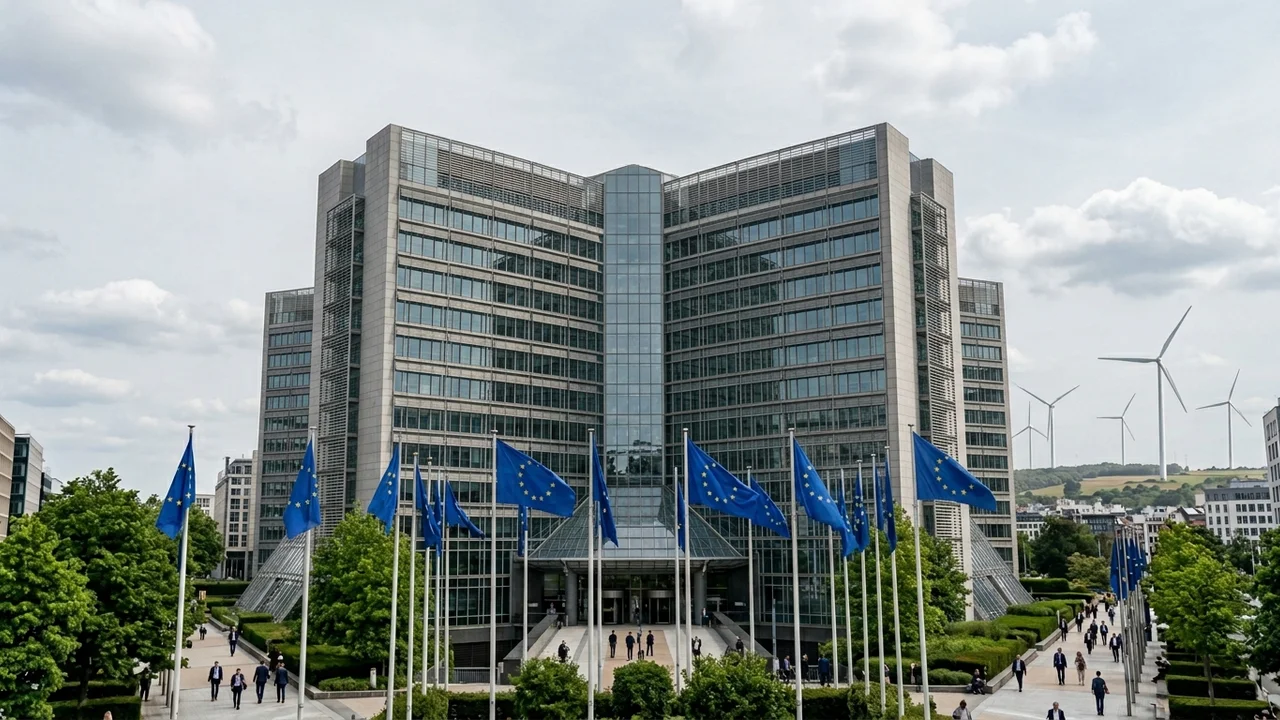
The Fit for 55 package, published on July 14, 2021, is the legislative origin of every CBAM obligation that EU importers face today. In a single day, the European Commission proposed 13 interlocking policy instruments — covering emissions trading, renewable energy, transport, land use, and carbon borders — to cut EU greenhouse gas emissions by at least 55% below 1990 levels by 2030. One of those 13 instruments was CBAM. Understanding how Fit for 55 designed the relationship between carbon pricing and import regulation is essential for any importer, exporter, or compliance officer who wants to understand why CBAM works the way it does, what it is not, and where it is heading next.
Note on terminology: The phrase "carbon border tax" appears in the title of this article because it is the label widely used by journalists, politicians, and search engines to describe CBAM. The article that follows corrects that label. CBAM is not a tax. It is a certificate-based mechanism linked to EU ETS auction prices, and the distinction carries real legal and compliance consequences.
Caption: The Fit for 55 package of July 2021 bundled 13 legislative proposals, with CBAM positioned as the trade-facing complement to ETS reform.
What Is the Fit for 55 Package and How Does It Connect to CBAM?
Fit for 55 is the EU's 2021 legislative package that raised the bloc's 2030 climate target to a 55% net reduction in greenhouse gas emissions below 1990 levels and proposed the full set of laws needed to reach that target, including the first standalone EU proposal for a carbon border adjustment mechanism.
The package takes its name from the 55% target enshrined in the European Climate Law (Regulation (EU) 2021/1119), adopted in June 2021. Fit for 55 translated that target into sector-by-sector legislation. The 13 proposals covered the Emissions Trading System (ETS) revision, a new Social Climate Fund, revised renewable energy and energy efficiency directives, a Carbon Border Adjustment Mechanism, a revision of the Energy Taxation Directive, the ReFuelEU Aviation and FuelEU Maritime regulations, land use and forestry rules (LULUCF), and the CO₂ standards for cars and vans.
CBAM occupied a specific structural role in the package. The revised ETS proposal would tighten the EU carbon market cap, reduce free allowances to industry, and raise domestic carbon prices. Higher ETS prices protect the climate but create a cost gap between EU-based producers and their non-EU competitors. CBAM was designed to close that gap at the border. The Commission's proposal framing was explicit: CBAM and ETS reform are two halves of the same policy, and neither functions as intended without the other.
How Did the Fit for 55 CBAM Proposal Become Regulation (EU) 2023/956?
The Fit for 55 CBAM proposal (COM(2021)564) went through nearly 2 years of legislative process before becoming law. The legislative steps proceeded in this sequence.
The 4 major milestones between proposal and publication are listed below.
- March 15, 2022: The Council of the EU adopted its general approach, accepting the core CBAM architecture but adjusting the proposed free allocation phase-out schedule.
- June 22, 2022: The European Parliament adopted its position by a vote of 450 in favor, 115 against, and 55 abstentions, expanding the list of covered sectors and accelerating the phase-out of free allocation.
- December 13, 2022: Trilogue negotiations between the Commission, Parliament, and Council reached a provisional agreement that settled the final sector list — iron and steel, cement, aluminium, fertilizers, electricity, and hydrogen.
- May 16, 2023: Regulation (EU) 2023/956 was published in the Official Journal of the EU (OJ L 130, pp. 52–104), establishing the full legal basis for CBAM under Article 192(1) TFEU — the EU's environmental policy competence, not its trade policy competence.
The legal basis matters because it determines how CBAM is challenged internationally. A measure adopted under Article 192(1) TFEU is classified as an environmental regulation, not a trade restriction. This classification forms the EU's primary defense against WTO challenges: CBAM is a carbon equalization tool, not a protectionist tariff.
The EU CBAM mechanism that entered its definitive phase on January 1, 2026, is therefore the end product of the Fit for 55 legislative chain. Every obligation that importers face today — authorization, declaration, certificate surrender — traces directly back to the July 2021 proposal.
What Does Fit for 55 Require That Is Different From CBAM Alone?
Fit for 55 imposes obligations across the entire EU economy that go far beyond CBAM. CBAM addresses only the import side of the carbon pricing equation. The other 12 instruments in the package cover the domestic production, energy, transport, and land use sides.
The 6 most consequential Fit for 55 components for industrial operators are listed below.
- Revised EU ETS (Directive 2003/87/EC as amended): The annual cap on EU ETS allowances now declines by approximately 4.3% per year from 2024 onward. Free allocation to industry phases out between 2026 and 2034, with the steepest reduction occurring between 2029 and 2030 when the CBAM factor jumps from 22.5% to 48.5%.
- ETS for Buildings and Road Transport (ETS2): A second carbon market covering fuel distributors for buildings and road vehicles, starting in 2027, with prices capped at €45/tCO₂ until 2030.
- Social Climate Fund: Funded partly by ETS2 revenues to compensate vulnerable households and small businesses for carbon price increases.
- Revised Renewable Energy Directive (RED III): Raises the EU-wide binding renewable energy target to 42.5% by 2030, with an indicative 45% aspiration.
- Energy Efficiency Directive (EED): Requires a 36% reduction in final energy consumption by 2030 versus projected levels.
- LULUCF Regulation: Sets binding carbon removal targets per member state, requiring land use, forestry, and agriculture to absorb 310 million tonnes CO₂e per year by 2030.
CBAM interacts most directly with the revised ETS because the certificate price formula in Article 22(1) of Regulation (EU) 2023/956 is mathematically tied to the ETS auction clearing price. At approximately €70/tCO₂ as of late March 2026, a tonne of blast-furnace steel with embedded emissions of approximately 2.0 tCO₂/t carries a gross CBAM cost of €140/t. The net cost in 2026 is €140 × 2.5% (the current CBAM factor) = €3.50/t — small today, but scaling to approximately €72.75/t net in 2030 as the CBAM factor reaches 48.5%.
Is CBAM a Carbon Tax, a Tariff, or Something Else?
CBAM is none of these. CBAM is a certificate-based mechanism that requires EU importers to surrender electronic certificates corresponding to the embedded CO₂-equivalent emissions in their imports, with certificate prices tied to the EU ETS carbon market auction price. The phrase "carbon border tax" that appears in media coverage and in this article's title is a colloquial shorthand that is factually incorrect in three specific ways.
First, a tax is a one-way financial transfer from the payer to the state. CBAM certificates are purchased at a specific price and surrendered — but importers can buy them back (up to 50% of certificates purchased that year) before the October 31 buyback deadline if they over-purchased. Taxes do not allow repurchase. Second, a tariff is set at a fixed rate per unit of goods and does not vary with the domestic environmental cost. CBAM certificate prices fluctuate daily with EU ETS market prices. Third, a tax or tariff is assessed on the value or quantity of imported goods. CBAM is assessed on the embedded greenhouse gas emissions of those goods — a fundamentally different base that rewards low-carbon production.
The legal term in Regulation (EU) 2023/956, Article 3(10), is "CBAM certificate" — defined as "a certificate in electronic format corresponding to one tonne of CO₂e embedded in goods." The mechanism, not the terminology used by non-specialists, governs compliance obligations and the WTO defense strategy.
This distinction also determines whether a foreign carbon price is deductible. Under Article 9, importers reduce certificate obligations when the exporter has paid a legally mandated carbon price in their home country. Tax payments can generate this deduction. Voluntary carbon offsets and internal corporate carbon prices cannot.
How Does the EU ETS Reform Under Fit for 55 Drive CBAM Costs Over Time?
The EU ETS reform is the direct driver of CBAM cost escalation through 2034. CBAM costs remain low in 2026 because free allocation still covers 97.5% of EU domestic producers' emissions — the CBAM factor is only 2.5%. The cost escalation that businesses need to plan for is structural and pre-scheduled by the ETS Directive.
The table below shows the free allocation phase-out schedule and its direct effect on net CBAM costs for blast-furnace steel at a reference ETS price of €75/tCO₂.
| Year | CBAM Factor | Free Allocation Remaining | Net CBAM Cost (BF-BOF Steel at €75/tCO₂) |
|---|---|---|---|
| 2026 | 2.5% | 97.5% | €3.75/t |
| 2027 | 5% | 95% | €7.50/t |
| 2028 | 10% | 90% | €15.00/t |
| 2029 | 22.5% | 77.5% | €33.75/t |
| 2030 | 48.5% | 51.5% | €72.75/t |
| 2031 | 61% | 39% | €91.50/t |
| 2032 | 73.5% | 26.5% | €110.25/t |
| 2033 | 86% | 14% | €129.00/t |
| 2034 | 100% | 0% | €150.00/t |
Source: Article 10a(1a) of Directive 2003/87/EC as amended; emission factor approximately 2.0 tCO₂/t for BF-BOF steel.
The steepest acceleration occurs in the 2029-to-2030 transition, where the CBAM factor jumps from 22.5% to 48.5% in a single year. Importers whose supply chains include high-carbon production routes — blast-furnace steel, grey hydrogen at approximately 9 to 12 tCO₂/t, or urea fertilizer at approximately 2.5 tCO₂/t — face a step-change in costs at that point. Supply chain decarbonization decisions made in 2026 and 2027, before the cliff arrives, determine the financial exposure in 2030.
The EU ETS annual cap also tightens by approximately 4.3% per year, which places upward pressure on the ETS price over time. Long-term consensus analyst projections from 2024 and 2025 placed the ETS price at approximately €80 to €100/tCO₂ in 2027 and approximately €100 to €150/tCO₂ in 2030. Both of these factors — rising CBAM factor and rising ETS price — compound together, which means net CBAM costs could increase 30-fold or more between 2026 and 2034 for high-emission production routes.
Caption: The CBAM factor increases each year as free ETS allocation declines, with the sharpest jump in the 2029-to-2030 transition period.
What Does Fit for 55 Mean for EU Importers and Non-EU Exporters Right Now?
Fit for 55 creates a converging set of obligations that tighten across the decade. For EU importers and their non-EU supplier networks, the practical consequences in 2026 follow from the definitive phase rules that entered force on January 1, 2026.
EU importers of goods in the 6 CBAM sectors — iron and steel, cement, aluminium, fertilizers, electricity, and hydrogen — bear the primary compliance obligations. Those obligations include maintaining authorized declarant status (the authorization application deadline was March 31, 2026), preparing embedded emissions data for calendar year 2026 imports, and filing the first annual CBAM declaration by September 30, 2027. The CBAM certificate obligations that accompany these steps include purchasing certificates from February 1, 2027 onward and surrendering the correct quantity by the September 30, 2027 deadline.
Non-EU exporters face no direct legal obligations under Regulation (EU) 2023/956. The commercial reality is different. Exporters producing above-default emission intensities face price pressure from EU importers who will pass CBAM costs upstream. Exporters with verified actual emissions below the country-specific defaults under IR 2025/2621 gain a competitive advantage in the EU market. The default value mark-up schedule accelerates this pressure: in 2026 defaults carry a 10% mark-up, rising to 20% in 2027 and 30% from 2028 onward (for steel, cement, aluminium, and hydrogen). Fertilizer defaults carry a 1% mark-up due to agricultural price sensitivity.
Fit for 55 and the Broader Context: What Comes After CBAM's Initial Scope?
The Fit for 55 package established CBAM for 6 sectors, but the legislative process does not end with Regulation (EU) 2023/956. Two proposals published in December 2025 signal the next expansion stage.
Does the Downstream Product Expansion Change the Fit for 55 Framework?
COM(2025)989, published December 17, 2025, proposes adding approximately 180 downstream steel- and aluminium-intensive products — including vehicle parts, machinery components, washing machines, and industrial radiators — to CBAM scope from January 1, 2028. This proposal requires co-legislator approval through the ordinary legislative procedure and is not yet adopted as of April 2026.
The expansion addresses a structural gap in the original Fit for 55 design. Under current rules, a steel billet imported into the EU is subject to CBAM. A steel billet processed into a gear casing in Turkey and imported as a finished component is not. The downstream expansion proposal closes this loophole, though the precise CN code list and de minimis treatment for downstream goods remain under negotiation. The Omnibus simplification amendment adopted in October 2025 changed key CBAM parameters including the de minimis threshold and declaration deadline, but did not alter the scope of Annex I goods — that remains a matter for COM(2025)989.
Is CBAM Compatible With WTO Rules Under the Fit for 55 Framework?
CBAM's WTO compatibility remains legally contested. The EU positions CBAM as an environmental measure justified under GATT Article XX exceptions — specifically Article XX(b) (measures necessary to protect human, animal, or plant life) and Article XX(g) (measures relating to conservation of exhaustible natural resources). This defense relies on the Fit for 55 context: CBAM is inseparable from the ETS reform and the 55% climate target.
Russia filed WTO dispute DS639 in May 2025, challenging CBAM under GATT Articles I, II, and III and the Agreement on Subsidies and Countervailing Measures. As of April 2026, the EU declined consultations and Russia may request panel establishment. India is expected to file a formal challenge but had not done so as of April 2026. The WTO Appellate Body remains non-functional, meaning any panel ruling cannot be appealed and has limited enforceability. A timeline of years applies to any resolution.
Does the EU ETS Reform Risk Undermine the CBAM Mechanism?
The CBAM mechanism's effectiveness depends on the EU ETS price holding at levels that create a meaningful cost signal for non-EU producers. The EU ETS reform debate active in Q1 2026 — with 10 member states calling for ETS review — introduces uncertainty. CBAM certificate prices are calculated from the quarterly average of EU ETS auction clearing prices under Article 22(1a) of Regulation (EU) 2023/956. A structural reduction in ETS prices would reduce CBAM certificate prices proportionally, weakening the competitive equalization the mechanism is designed to deliver. No confirmed ETS reform proposal has been adopted as of April 2026, but compliance officers conducting multi-year financial planning should monitor Market Stability Reserve developments closely.
What Is the Fit for 55 Legislative Timeline at a Glance?
Understanding where CBAM sits in the broader Fit for 55 sequence helps importers contextualize the CBAM legislative timeline from proposal to current obligations. The 5 most significant dates in that chain are listed below.
- July 14, 2021: Commission publishes Fit for 55 package, including COM(2021)564 (the CBAM proposal)
- December 13, 2022: Trilogue agreement reached on CBAM text, including 6 covered sectors and free allocation link
- May 16, 2023: Regulation (EU) 2023/956 published in the Official Journal; enters into force May 17, 2023
- October 1, 2023: Transitional period begins — reporting obligations with no financial liability
- January 1, 2026: Definitive phase begins — financial obligations commence across all 6 sectors simultaneously
Frequently Asked Questions: Fit for 55 and CBAM
What is the relationship between Fit for 55 and CBAM?
Fit for 55 is the EU's 2021 legislative package to cut emissions 55% by 2030. CBAM (the Carbon Border Adjustment Mechanism) was one of the 13 proposals in that package, designed to prevent carbon leakage as the EU ETS raised domestic carbon prices. CBAM became Regulation (EU) 2023/956, published May 16, 2023.
Is CBAM a carbon tax?
CBAM is not a carbon tax. It is a certificate-based mechanism that requires EU importers to purchase and surrender electronic certificates proportional to the embedded CO₂-equivalent emissions in their imports, priced at the EU ETS market rate. Unlike a tax, certificates can be bought back (up to 50% of annual purchases), and the obligation scales with actual embedded emissions rather than the value or weight of goods.
When did Fit for 55 propose CBAM?
The Fit for 55 package was published on July 14, 2021. It included COM(2021)564, the Commission's original CBAM proposal. The proposal took approximately 23 months to complete the legislative process, resulting in Regulation (EU) 2023/956 entering into force on May 17, 2023.
What sectors does CBAM cover under Fit for 55?
CBAM covers 6 sectors as defined in Annex I of Regulation (EU) 2023/956: iron and steel, cement, aluminium, fertilizers, electricity, and hydrogen. These sectors were selected because their production processes are carbon-intensive and their goods are traded across borders in ways that create carbon leakage risk when domestic carbon prices rise.
How do Fit for 55 ETS reforms affect CBAM certificate prices?
CBAM certificate prices track the quarterly average of EU ETS auction clearing prices. As the Fit for 55 ETS reform tightens the annual cap by approximately 4.3% per year, upward pressure on ETS prices compounds with the rising CBAM factor (from 2.5% in 2026 to 100% in 2034), producing a multi-fold increase in net CBAM costs over the decade.