Carbon leakage directly undermines EU climate policy: 6 sectors covering steel, cement, aluminium, fertilizers, electricity, and hydrogen account for the bulk of industrial CO₂ emissions subject to the EU ETS, yet without CBAM those same emissions can be relocated abroad with zero regulatory consequence. The EU Carbon Border Adjustment Mechanism, established by Regulation (EU) 2023/956 and fully operative from January 1, 2026, was designed specifically to close this gap by pricing embedded emissions at the moment of import. Understanding carbon leakage is the foundation for understanding why CBAM exists, how its cost structure works, and why the stakes grow sharply between now and 2034.
Carbon leakage is the displacement of CO₂ emissions from jurisdictions with binding carbon pricing, such as the EU ETS, to jurisdictions where no equivalent carbon cost applies, resulting in no net global emissions reduction despite domestic regulatory effort. The EU's legal basis for CBAM, Article 192(1) TFEU, specifically frames leakage prevention as the mechanism's primary environmental justification. This article explains what carbon leakage is, how it operates in practice across each CBAM sector, and how the EU ETS and CBAM work together to neutralize it.
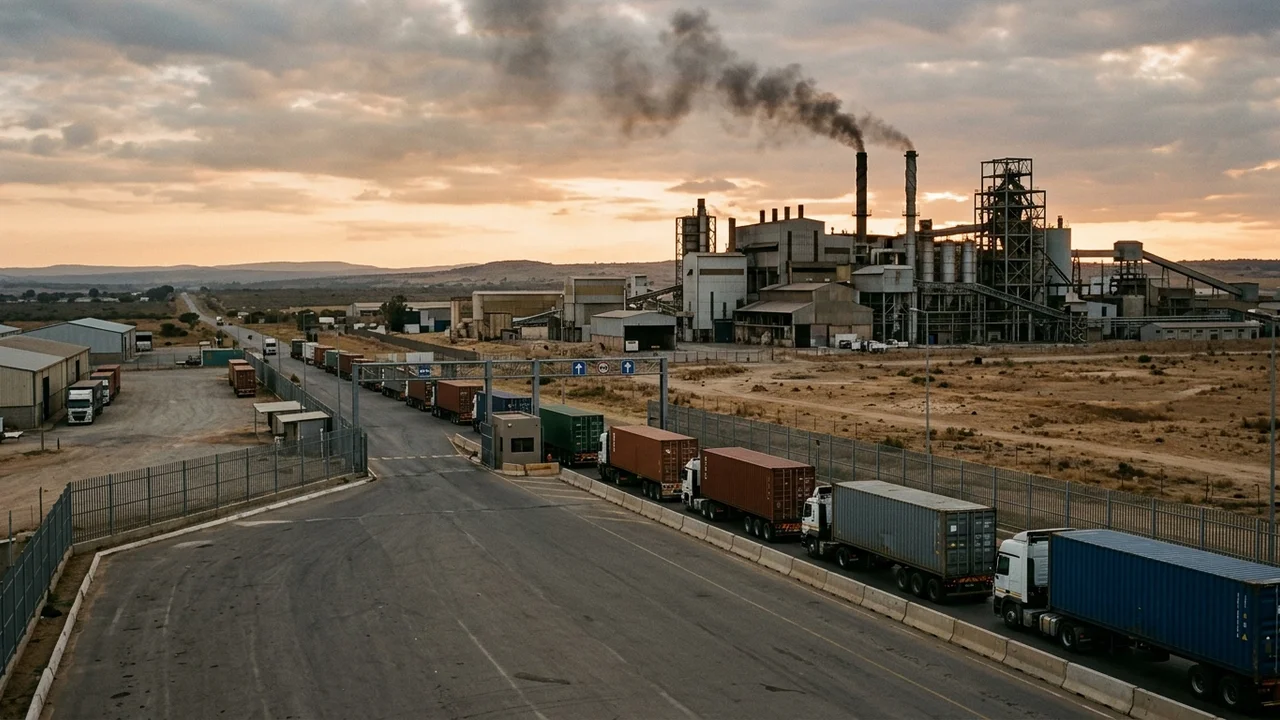
Caption: Carbon leakage occurs when a carbon price differential between the EU and trading partners creates an incentive to relocate production outside the EU ETS.
What Is Carbon Leakage?
Carbon leakage occurs when EU carbon pricing causes production to migrate to countries with weaker or absent climate regulations, increasing global emissions even as EU domestic emissions appear to fall. The EU ETS imposes a mandatory cost on every tonne of CO₂ emitted by covered installations. As of late March 2026, that cost stands at approximately €70 per tonne. A steelmaker operating inside the EU pays this cost on every tonne of CO₂ produced through the blast furnace route, roughly 2.0 tCO₂ per tonne of steel, translating to roughly €140 per tonne of steel in gross carbon costs at current prices.
A competing steel producer in a country with no carbon price pays zero equivalent cost. That asymmetry creates a structural competitive disadvantage for EU producers that grows as the ETS carbon price rises. Carbon leakage is the name for the specific outcome that follows from this asymmetry: production migrates, emissions migrate with it, and global atmospheric CO₂ concentration rises at the same rate it would have without the EU's domestic effort.
The EU Commission's own impact assessments, cited in the preamble to Regulation (EU) 2023/956, estimate that without corrective mechanisms, EU climate policy would drive measurable production relocation in steel, cement, and aluminium. These are not hypothetical losses: the global steel market is highly price-sensitive, and a €140/tonne gross carbon cost at full phase-in represents a decisive competitive disadvantage against producers in countries, such as China, India, and Russia, that operate under no comparable constraint.
What makes carbon leakage particularly problematic from a policy standpoint is that it is a form of regulatory arbitrage with no environmental benefit. The tonne of CO₂ emitted in a Chinese steel mill enters the same atmosphere as the tonne that would have been emitted in a German one. Climate targets expressed as "EU emissions reductions" can be met on paper while global emissions remain unchanged or increase. CBAM's purpose is to make this form of arbitrage economically unattractive.
How Carbon Leakage Operates Across the Six CBAM Sectors
Carbon leakage risk is not uniform across industries. The five factors that determine a sector's leakage exposure are trade intensity with non-EU countries, carbon cost as a share of production cost, availability of low-cost substitutes from unregulated markets, emissions intensity of the production process, and the feasibility of relocating production capacity. The six CBAM sectors were selected precisely because they score high across these dimensions.
The table below shows the carbon leakage exposure profile for each of the six CBAM sectors at the current EU ETS price of approximately €70 per tonne of CO₂.
| Sector | Production route | Emission factor (tCO₂/t) | Gross carbon cost at €70/tCO₂ | Primary leakage source countries |
|---|---|---|---|---|
| Steel (blast furnace, BF-BOF) | Coking coal + iron ore | ~2.0 | ~€140/t | China, Russia, India, Ukraine |
| Steel (electric arc, EAF) | Scrap steel + electricity | ~0.5 | ~€35/t | Turkey, South Korea, Vietnam |
| Cement (Portland) | Limestone calcination | ~0.83 | ~€58/t | Turkey, Egypt, Vietnam, China |
| Primary aluminium | Electrolysis (direct + indirect) | ~1.5 (direct only) | ~€105/t | China, Russia, UAE, Bahrain |
| Urea fertilizer | Natural gas (Haber-Bosch) | ~2.5 | ~€175/t | Russia, Egypt, Qatar, Trinidad |
| Grey hydrogen (SMR) | Steam methane reforming | ~9–12 | ~€630–840/t H₂ | Russia, Ukraine, North Africa |
Gross costs above are before free allocation adjustment. Net CBAM cost in 2026 is gross cost multiplied by the 2.5% CBAM factor, making year-one liabilities small. This changes sharply from 2028 onward.
Steel carries the highest absolute carbon leakage risk of any CBAM sector because it combines a high emission intensity with deep global trade flows and substantial existing capacity in countries with no carbon pricing. Chinese blast furnace steel enters EU markets with roughly €140/tonne in avoided carbon costs relative to an equivalent German producer. The EU imported approximately 11 million tonnes of steel in 2023 from CBAM-covered origins. For a deeper analysis of the steel-specific leakage dynamic, the CBAM steel sector guide covers CN codes, emission factors, and calculation methodology in full.
Fertilizers, specifically urea and ammonia, have the highest emission factor among CBAM goods at approximately 2.5 tCO₂ per tonne of urea. Russian and Egyptian producers using cheap natural gas in regions with no carbon pricing are structurally positioned to undercut EU producers on carbon-cost grounds alone. The leakage risk here is compounded by the sensitivity of European agriculture to nitrogen fertilizer input prices.
Aluminium presents a dual leakage pathway: direct emissions from smelting and indirect emissions from electricity consumption. Chinese primary aluminium production uses a grid that is approximately 60% coal-powered, producing an indirect emission intensity that would attract significant CBAM costs if indirect emissions were priced for aluminium under the current regulation (they are not, under Annex II of Regulation (EU) 2023/956, though this is a recognized gap).
Why EU Free Allocation Alone Could Not Solve Carbon Leakage
Free allocation of EU ETS allowances to domestic industrial producers was the EU's primary carbon leakage protection mechanism before CBAM. Under free allocation, EU installations in sectors deemed at risk of carbon leakage received a portion of their annual allowance requirement at no cost, reducing the net carbon price they actually paid. This sheltered them from the full competitive disadvantage of ETS pricing.
Free allocation carries three structural weaknesses that CBAM addresses directly.
The three limitations of free allocation as a leakage protection tool are listed below.
- It reduces the environmental signal. When EU producers receive free allowances, they do not pay the full carbon cost. The incentive to invest in decarbonization is weakened in proportion to the free allocation received. A mechanism designed to price carbon partially exempts the largest emitters from that price.
- It does not address the import side. Free allocation protects EU producers on their domestic production costs, but it does nothing to equalize the cost of competing imports. A Chinese steel producer selling into the EU still faces zero carbon cost on those sales regardless of how much free allocation a German steelmaker receives.
- It is incompatible with full decarbonization. EU ETS Directive 2003/87/EC, as amended, mandates complete phase-out of free allocation for CBAM sectors by January 1, 2034. Free allocation was always a transitional mechanism, never a permanent solution.
CBAM solves the import side of the problem that free allocation left entirely unaddressed. By requiring EU importers to purchase CBAM certificates proportional to the embedded emissions of their imports, at a price linked to the EU ETS carbon price, CBAM equalizes the carbon cost between domestically produced and imported goods. The EU importer of Chinese steel pays roughly the same carbon cost per tonne of embedded emissions as the German steelmaker producing domestically under the ETS.
The free allocation phase-out and CBAM phase-in are deliberately synchronized. As free allocation declines from 97.5% remaining in 2026 to 0% by 2034, the CBAM factor (the share of embedded emissions that must be covered by certificates) rises from 2.5% to 100% on the same schedule. Net CBAM costs for importers rise from approximately €3.50 per tonne of BF-BOF steel in 2026 to approximately €150 per tonne of BF-BOF steel in 2034, at a constant ETS price of €75/tCO₂.
The Legal Basis: Why Article 192(1) TFEU Matters
The EU grounded CBAM in Article 192(1) TFEU, which covers environmental policy, rather than Article 114 TFEU (internal market harmonization) or trade law instruments. This choice is not incidental. It signals that CBAM is legally an environmental measure designed to prevent carbon leakage, not a trade defense instrument or a customs mechanism.
The preamble to Regulation (EU) 2023/956 explicitly states that the primary purpose of CBAM is to prevent carbon leakage and support the EU's climate objectives under the Paris Agreement and the European Green Deal. This framing is the EU's primary defense against WTO challenges: GATT Article XX(b) and XX(g) provide exceptions for measures necessary to protect human, animal, or plant life and for measures related to conservation of exhaustible natural resources. The environmental basis in EU treaty law reinforces this GATT defense.
From a compliance standpoint, the Article 192(1) basis also means that CBAM is integrated into the broader EU ETS legal architecture rather than operating as a standalone trade measure. CBAM certificate prices track EU ETS auction prices weekly from 2027 onward, creating a single carbon price signal that applies whether a tonne of steel is produced inside or outside the EU.
How CBAM Neutralizes Carbon Leakage in Practice
CBAM neutralizes carbon leakage by eliminating the carbon cost asymmetry between domestically produced and imported goods at the EU border. The mechanism operates through a certificate obligation: an EU importer of CBAM goods must surrender one CBAM certificate per tonne of CO₂e embedded in their imports. CBAM certificates are priced at the weekly average EU ETS auction clearing price, meaning the importer effectively pays the same carbon price as an EU producer would pay under the ETS.
The full neutralization mechanism works in three steps. First, the importer declares the embedded emissions of their imports, either using actual verified data from the production installation or using default values published by the Commission under IR (EU) 2025/2621. Second, the importer purchases CBAM certificates through the Common Central Platform, with sales beginning February 1, 2027. Third, the importer surrenders certificates equal to the embedded emissions of that year's imports by September 30 of the following year, with the first CBAM declaration deadline being September 30, 2027.
Importers who source from countries with their own carbon pricing schemes can apply for a deduction under Article 9 of Regulation (EU) 2023/956. If a South Korean steel producer has paid a carbon price under the Korea Emissions Trading System (K-ETS), the EU importer can deduct the equivalent cost from their CBAM certificate obligation, provided the carbon price was legally binding and effectively paid. This deduction recognizes that double-pricing the same tonne of CO₂ would go beyond the leakage prevention objective and create a trade barrier rather than a level playing field.
For detailed methodology on how embedded emissions are calculated to determine the CBAM certificate obligation, the how embedded emissions are calculated page covers the calculation rules, monitoring plan requirements, and default value fallback structure.
Does CBAM Fully Eliminate Carbon Leakage?
CBAM does not fully eliminate carbon leakage in its current form. Three residual leakage pathways remain open after CBAM's first phase.
The first pathway is the export side. CBAM applies to imports into the EU but provides no rebate to EU producers exporting to non-EU markets. An EU steelmaker selling to Japan competes against Japanese producers who pay no carbon price, while the EU producer has lost its ETS free allocation and receives no border correction at the point of export. This "reverse carbon leakage" or "competitiveness leakage" problem is acknowledged in the Regulation but not resolved. The Temporary Decarbonization Fund proposed in COM(2025)990 addresses the 2026-2027 production period with partial support funded from 25% of CBAM revenues, but this is a transitional measure, not a structural solution.
The second pathway is downstream product avoidance. CBAM covers specific CN codes listed in Annex I, primarily raw and semi-finished goods. A manufacturer that imports finished downstream products, such as automotive components made of steel or machinery containing aluminium, currently avoids CBAM entirely. The Commission's proposal COM(2025)989, filed December 17, 2025, proposes adding approximately 180 downstream product categories from January 2028, pending Parliamentary and Council approval. Until that expansion takes effect, the downstream gap remains a carbon leakage vector.
The third pathway is circumvention. Article 27 of Regulation (EU) 2023/956 prohibits schemes designed to avoid CBAM, including artificial rerouting of goods, minor processing to change origin, and splitting of shipments to stay below the 50-tonne de minimis threshold. The Commission can investigate and extend CBAM to additional goods if circumvention patterns are detected. Enforcement capacity at member state customs authorities varies substantially, creating practical gaps between the legal prohibition and its application.
Caption: CBAM requires EU importers to surrender certificates equal to embedded emissions, closing the carbon cost gap that enables carbon leakage.
How CBAM and EU ETS Work Together Against Carbon Leakage
CBAM and the EU ETS form a single system for addressing carbon leakage, with each instrument handling a different side of the same market. The EU ETS prices domestic production. CBAM prices imports. The free allocation phase-out synchronizes the two so that the cost differential between them narrows to zero by 2034.
Understanding the EU carbon border adjustment mechanism as a whole requires seeing CBAM not as a standalone mechanism but as the import-side complement to an ETS that was designed for domestic installations only. The EU ETS has priced domestic emissions since 2005. Carbon leakage became a recognized problem almost immediately, but the original solution, free allocation, was always designed to be replaced once a border mechanism was technically feasible. CBAM is that replacement.
The connection between EU ETS price levels and CBAM costs is direct and mathematical. CBAM certificate prices are set at the quarterly average of EU ETS auction clearing prices in 2026 and at the weekly average from 2027 onward, under IR (EU) 2025/2548. Every move in the ETS carbon price passes through to CBAM certificate prices at a 1:1 ratio. When ETS prices are high, the leakage protection provided by CBAM is stronger: the import-side carbon cost rises proportionally, maintaining the level playing field. When ETS prices are low, the protection weakens proportionally. This is one reason why ETS price volatility, and the reform pressure from 10 member states that emerged in Q1 2026, directly affects CBAM's effectiveness as a leakage prevention tool.
For a complete analysis of the ETS price history, current levels, and their effect on CBAM certificate costs, the EU ETS and CBAM certificate prices guide covers the full price timeline from 2018 to Q1 2026 and long-term price forecasts through 2035.
Frequently Asked Questions About Carbon Leakage and CBAM
What is carbon leakage in simple terms?
Carbon leakage is the transfer of CO₂ emissions from one country to another as a result of differences in carbon pricing. When the EU charges its industries €70 per tonne of CO₂ and a competing country charges nothing, production moves to the cheaper jurisdiction and global emissions do not fall. CBAM prevents this by charging the carbon cost on imports at the EU border.
Does CBAM apply to all sectors with carbon leakage risk?
CBAM applies to 6 sectors defined in Annex I of Regulation (EU) 2023/956: iron and steel, cement, aluminium, fertilizers, electricity, and hydrogen. These sectors were selected based on their trade intensity, emissions intensity, and assessed leakage risk. The EU Commission reviews the sector list every two years under Article 30. The proposed downstream expansion in COM(2025)989 would add approximately 180 further product categories from January 2028, subject to Parliamentary approval.
Is carbon leakage the same as offshoring?
Carbon leakage is a specific form of offshoring driven by carbon price differentials. General offshoring occurs for many reasons, including labor costs, infrastructure, and market access. Carbon leakage occurs specifically when a carbon price is the marginal deciding factor in the relocation decision. CBAM is designed to neutralize carbon price differentials as an offshoring incentive, not offshoring in general.
Can a country avoid CBAM by reducing its own emissions?
A country whose producers achieve lower actual embedded emissions than the CBAM default values will pay less in CBAM certificate costs, because the obligation is proportional to actual embedded emissions per tonne, not to a flat rate. Additionally, countries with a recognized carbon pricing system can qualify for an Article 9 deduction on the carbon price already paid, reducing the CBAM certificate obligation accordingly. Countries that reduce their production emissions to near zero face near-zero CBAM costs, which is the intended long-term incentive structure of the mechanism.
Is CBAM a carbon tax on imports?
CBAM is not a carbon tax, a tariff, or a customs duty. CBAM is a certificate obligation linked to the EU ETS carbon price. The distinction matters legally: taxes and tariffs are fiscal instruments subject to WTO Schedules and fiscal sovereignty rules. CBAM is an environmental mechanism grounded in Article 192(1) TFEU and defended under GATT Article XX environmental exceptions. The EU Commission and member states are consistent in rejecting the characterization of CBAM as a tax or tariff.
Which country exports the most goods at risk of CBAM carbon leakage?
China is the largest exporter of CBAM-covered goods into the EU by volume, primarily in steel and aluminium. Russia was historically a major supplier of fertilizers, aluminium, and steel, but EU sanctions from 2022 onward have reduced Russian CBAM-relevant trade. India, Turkey, and Ukraine are among the other top five exporters of CBAM-covered goods. For country-specific analysis, the CBAM regulation page covers the regulatory framework that governs how all third-country goods are assessed.