CBAM India exposure crystallized in FY2024–25 when India's CBAM-covered EU exports fell 24.4% as EU importers began shifting procurement away from full-liability suppliers before the definitive phase took effect on January 1, 2026. India now accounts for approximately 6.6% of all CBAM-covered imports into the EU, with steel representing more than 60% of that embedded emissions exposure. The trade shift already underway in 2025 reflects a structural repricing of Indian goods in EU supply chains, and the financial pressure on Indian exporters compounds annually through 2034 as the EU free allocation phase-out accelerates.
This article covers India's CBAM exposure by sector, why the country's domestic carbon pricing scheme does not qualify for an Article 9 deduction, what the cost trajectory looks like between 2026 and 2030, and what Indian exporters must do to avoid default value penalties in the definitive phase.
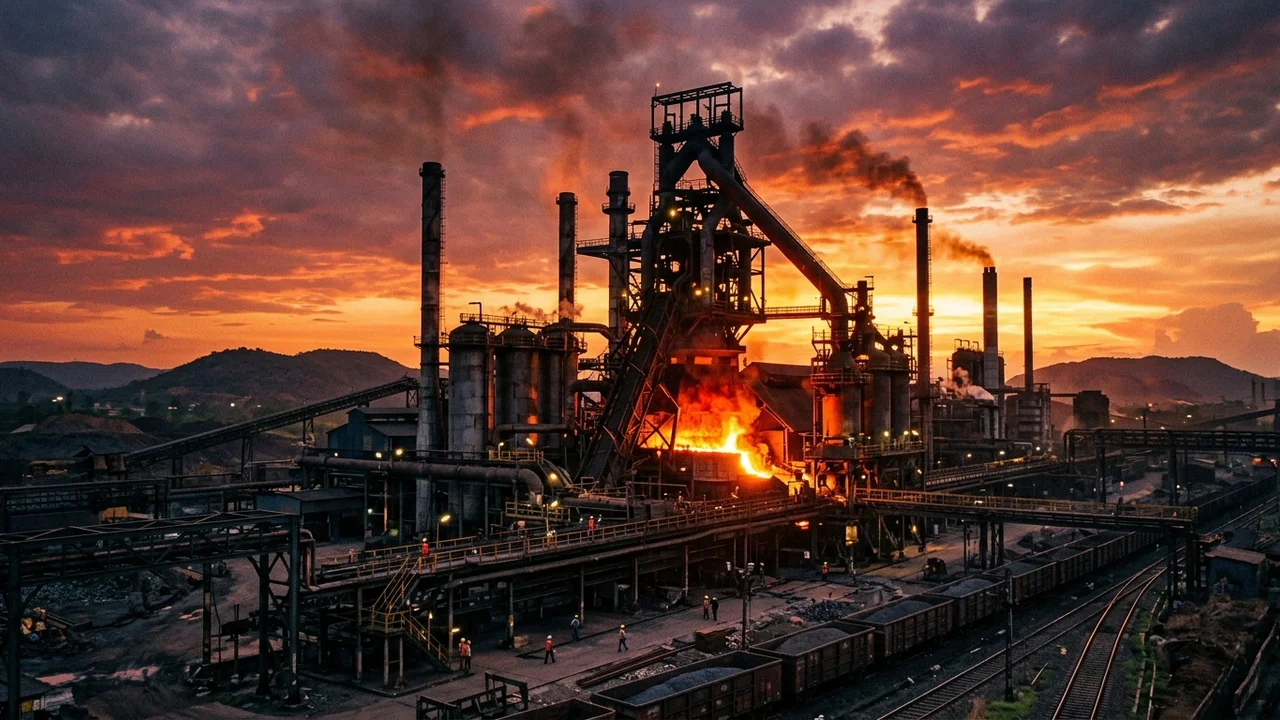
Image brief: Aerial or interior view of a blast furnace steel facility in India. Text overlay: "CBAM India: 24.4% Export Drop in 2025". Commission as branded illustration with cbamguide.com logo.
What Is India's CBAM Exposure and Why Did Exports Fall?
India's CBAM-covered EU exports fell 24.4% in FY2024–25, driven primarily by steel sector contraction as EU buyers anticipated full certificate liability under Regulation (EU) 2023/956. Total CBAM-affected exports from India to the EU are estimated at €3–5 billion per year, with iron and steel products representing the dominant share of that embedded emissions liability. EU importers purchasing Indian steel now face certificate obligations priced at the EU ETS carbon price, currently approximately €70 per tonne of CO₂ equivalent as of late March 2026.
The 24.4% decline occurred before certificates were even required for purchase. That timing signals that the export contraction is a commercial decision by EU buyers, not a compliance failure by Indian exporters. EU importers assess the forward cost of CBAM India exposure and adjust their sourcing toward suppliers in countries where carbon pricing qualifies for an Article 9 deduction, or where lower embedded emissions reduce certificate volume. India currently offers neither advantage.
The scale of that embedded emissions challenge is concentrated in blast furnace steel. India produces the majority of its EU-exported steel via the blast furnace to basic oxygen furnace (BF-BOF) route, which carries an emission factor of approximately 1.8 to 2.1 tonnes of CO₂ per tonne of steel. At the current EU ETS price of €70/tCO₂, that translates to a gross CBAM cost of €126–147 per tonne of exported steel before free allocation adjustment. In 2026 the net cost is minimal at the 2.5% CBAM factor, but by 2030 the same steel carries a net liability of approximately €61–71 per tonne as the CBAM factor reaches 48.5%.
The EU carbon border adjustment mechanism operates through Regulation (EU) 2023/956, as amended by Regulation (EU) 2025/2083. Under this framework, an EU importer purchasing Indian steel must purchase CBAM certificates proportional to the embedded emissions in those goods, priced at the EU ETS auction average. India's steel exporters, including Tata Steel, JSW Steel, and SAIL, face growing commercial pressure to provide verified actual emissions data or accept default values that carry a 10% mark-up in 2026, rising to 30% from 2028 onward.
India's CBAM-Exposed Sectors: Steel Is the Core Liability
India's CBAM exposure concentrates in four sectors covered by Regulation (EU) 2023/956: iron and steel, aluminium, fertilizers, and cement. The following table presents each sector's exposure profile, estimated EU trade value, and indicative CBAM cost at the current ETS price.
| Sector | Estimated EU Trade Value | Primary Route | Emission Factor (tCO₂/t) | Gross CBAM Cost @ €70 | Article 9 Deduction Available |
|---|---|---|---|---|---|
| Iron and steel (BF-BOF) | ~€3.9 billion | Blast furnace | ~1.8–2.1 | €126–147/t | No |
| Aluminium (primary) | Included in €3–5B total | Hall-Héroult | ~1.5 (direct only) | ~€105/t | No |
| Fertilizers (urea) | Secondary share | Haber-Bosch (SMR) | ~2.3–2.6 tCO₂e/t | ~€161–182/t | No |
| Cement | Smaller share | Dry kiln | ~0.83 | ~€58/t | No |
The iron and steel sector accounts for approximately 60% or more of India's total CBAM-embedded emissions exposure to the EU. India is the second-largest exporter of CBAM-covered steel to the EU by volume, behind Turkey, with approximately 4.33 million tonnes exported annually according to 2024 Eurostat data. That volume positions India centrally in the EU carbon border adjustment mechanism debate, as Indian steel faces the full certificate liability without any offsetting carbon price credit.
CBAM steel exposure carries a further complication for Indian producers: the BF-BOF route dominates because India's electricity grid is not yet sufficiently renewable to make electric arc furnace production cost-competitive at scale. That production mix means India's steel sector faces among the highest per-tonne CBAM gross costs of any major exporting country. EU buyers of CBAM steel from India bear the certificate obligation, but the commercial impact flows back to Indian exporters through lower prices negotiated to offset the importer's rising CBAM liability.
Why India Has No Article 9 Deduction
India's carbon pricing situation disqualifies it from any Article 9 deduction under Regulation (EU) 2023/956, meaning EU importers of Indian goods cannot reduce their certificate obligation based on carbon costs already paid in India.
What Is the Article 9 Deduction and Who Qualifies?
The Article 9 deduction allows an EU authorized declarant to reduce their CBAM certificate obligation by the carbon price effectively paid in the country of production, provided that country operates a qualifying carbon pricing scheme. A qualifying scheme must be legally binding, set an effective price per tonne of CO₂e, and operate as an absolute cap or equivalent mechanism. The deduction is calculated as the verified carbon cost already embedded in the goods at point of production.
Does India's Carbon Credit Trading Scheme Qualify?
India's Carbon Credit Trading Scheme (CCTS) does not currently qualify for the Article 9 deduction. Phase 1 of the CCTS covers aluminium and cement sectors only. The steel sector, which represents 60% or more of India's CBAM exposure to the EU, is explicitly excluded from Phase 1 coverage. The scheme operates on an intensity-based target, not an absolute cap, and the carbon credit price targets approximately $10 per tonne, which is far below the €70/tCO₂ EU ETS price. The EU Commission has not recognized the CCTS as a qualifying scheme, and no formal assessment has been initiated as of April 2026.
India's Perform Achieve and Trade (PAT) scheme, which covers energy efficiency improvements across industrial sectors, also does not qualify for Article 9. The PAT scheme rewards efficiency gains with energy saving certificates, but it does not put an explicit price on carbon emissions and does not constitute a carbon pricing scheme under the CBAM definition. Indian exporters and EU importers of Indian goods therefore carry full certificate liability with zero deduction available.
This full liability position distinguishes India from South Korea, where the K-ETS may qualify for partial Article 9 recognition, and from countries like Brazil where a national carbon market is in development. India's diplomatic posture, which has included 29 formal objections at the WTO Trade and Environment Committee and threats to collapse EU-India Free Trade Agreement negotiations over CBAM, has not translated into a domestic carbon pricing mechanism that would reduce the commercial burden on Indian exporters.
How the CBAM Cost Trajectory Escalates for Indian Exporters
The net CBAM cost for Indian steel exporters is low in 2026 but rises sharply by 2030 as the EU free allocation phase-out accelerates.
What Does the Net Cost Look Like Year by Year?
The net CBAM surcharge is calculated as the gross CBAM cost multiplied by the CBAM factor, which reflects the percentage of EU free allocation phased out each year. The five cost scenarios below use a reference ETS price of €75/tCO₂ and the BF-BOF emission factor of 2.0 tCO₂/t for Indian steel.
The net cost schedule for CBAM India BF-BOF steel at €75/tCO₂ reference price is as follows. In 2026, with a 2.5% CBAM factor, the net surcharge per tonne is approximately €3.75. In 2028, with a 10% factor, the surcharge rises to €15 per tonne. In 2030, at 48.5%, the surcharge reaches €72.75 per tonne. In 2032, at 73.5%, the net cost climbs to €110.25 per tonne. At full phase-in in 2034, with a 100% factor, Indian BF-BOF steel exporters face a net CBAM cost of €150 per tonne of steel.
The EU free allocation phase-out schedule from Article 10a(1a) of the EU ETS Directive creates the steepest cost jump between 2029 and 2030, when the CBAM factor increases from 22.5% to 48.5%. Indian steel exporters who plan compliance infrastructure only around 2026 costs will face a sudden and severe cost escalation in that two-year window. Export volumes that survived the transition period at manageable CBAM costs face structural uncompetitiveness by 2030 unless actual verified emissions fall well below the BF-BOF default.
What Must Indian Exporters Do Under CBAM?
Indian exporters operating under CBAM India conditions face three concrete operational obligations, even though the legal compliance obligation falls on the EU importer.
How Does the CBAM Operators Portal Work for Indian Producers?
The CBAM Operators Portal is the EU registry system through which non-EU producers submit actual embedded emissions data to their EU importers. An Indian steel producer that provides verified actual emissions data through the Portal can enable its EU customers to use those verified figures instead of default values. Default values carry a 10% mark-up in 2026 (rising to 30% from 2028), which means that any Indian producer with actual emissions below the default benchmark gains a direct commercial advantage by submitting verified data.
The four steps Indian exporters follow to engage with the CBAM Operators Portal are listed below.
- Register the production installation in the CBAM Operators Portal using the EU Registry system administered by DG TAXUD.
- Appoint an accredited verifier to audit and certify the embedded emissions calculations for each relevant product line, beginning with BF-BOF steel.
- Submit verified actual embedded emissions reports to the Portal, covering direct emissions per tonne of each CN code product category covered under Annex I of Regulation (EU) 2023/956.
- Maintain records for at least 4 years after the relevant declaration year, as required under Article 6(6) of Regulation (EU) 2023/956 as amended.
Failure to provide actual data does not expose the Indian exporter to direct CBAM penalties, since those penalties fall on the EU authorized declarant. The penalty for an authorized declarant who fails to surrender sufficient certificates is €100 per tonne of CO₂e not covered. The commercial consequence for the Indian exporter is loss of EU customers who switch to lower-cost, lower-emission, or data-compliant alternatives.
Is Verified Emissions Data Financially Worth the Effort for Indian Steel?
Verified actual emissions data produces a cost reduction only when actual facility-level emissions fall below the default value for the relevant product and country combination. For Indian BF-BOF steel, the gap between actual facility emissions and the default value determines the financial benefit. Indian producers with actual emissions in the 1.8–2.0 tCO₂/t range versus a default value benchmark of 1.370 tCO₂e/t (the BF-BOF CBAM benchmark from IR 2025/2621) face a more complex calculation, as actual values in this case may exceed the benchmark. Producers operating more carbon-intensive facilities have the clearest incentive to measure and verify: they can confirm whether actual or default values yield lower CBAM liability for their EU customers.
India's WTO Position and the CBAM Compliance Timeline
Has India Filed a Formal WTO Challenge Against CBAM?
India has not yet filed a formal WTO dispute against CBAM India-related provisions as of April 2026, though a formal challenge is expected. India has filed 29 formal objections at the WTO Trade and Environment Committee and has characterized CBAM as a violation of the UNFCCC principle of Common but Differentiated Responsibilities (CBDR). Finance Minister Nirmala Sitharaman has publicly called CBAM "unilateral, arbitrary, and a trade barrier." The EU-India Strategic Agenda signed in September 2025 included a clause on CBAM and CCTS cooperation, but the substance remains unresolved. Russia filed the only formal WTO challenge to date, DS639, on May 12, 2025. India's anticipated formal challenge would likely cite GATT non-discrimination provisions.
What Are the Key CBAM Deadlines Indian Exporters Must Know?
The compliance calendar for CBAM India obligations flows through the EU authorized declarant, but Indian exporters must engage with these milestones to avoid losing EU customers. The critical dates are listed below in chronological order.
- January 1, 2026: Definitive phase of CBAM entered into force under Article 36(2) of Regulation (EU) 2023/956.
- March 31, 2026: Deadline for EU authorized declarants to apply for authorization under Article 17(7a) inserted by Regulation (EU) 2025/2083.
- February 1, 2027: Certificate sales commence. EU importers begin purchasing CBAM certificates priced at the quarterly EU ETS auction average.
- September 30, 2027: First CBAM declaration deadline, covering calendar year 2026 embedded emissions under Article 6 as amended by Regulation (EU) 2025/2083.
- 2028 onward: Default value mark-up rises from 10% to 30% above the calculated default, increasing the financial penalty for Indian exporters who do not provide verified actual data.
How Does CBAM India Compare to Other Major Exporters?
Image brief: Comparative bar or radar chart showing India, Turkey, and China CBAM exposure levels, Article 9 status, and net cost trajectories. Text overlay: "Full Certificate Liability". Commission as branded illustration with cbamguide.com logo.
CBAM India's full certificate liability position is shared by Turkey, which is the most commercially exposed country to CBAM in absolute and relative terms with approximately €19 billion in CBAM-affected exports. Both India and Turkey carry no Article 9 deduction and face the full gross CBAM cost on every tonne of embedded emissions in their EU exports. For a direct comparison of how another major steel exporter navigates CBAM without a qualifying carbon price, see the CBAM Turkey country analysis.
China's position differs from India's because China expanded its national ETS to cover the steel sector in March 2025, creating a potential (though not yet confirmed) Article 9 deduction pathway. However, China's ETS price of approximately $11/tCO₂ is far below the EU ETS level of €70/tCO₂, so the deduction (if eventually recognized) would cover only about 15% of China's CBAM liability. For a full treatment of how China's ETS expansion affects its CBAM exposure, see the CBAM China analysis.
India's structural disadvantage versus China lies not in the scale of the deduction gap, but in the absence of any domestic carbon pricing pathway for the steel sector. The CCTS excludes steel entirely from Phase 1, and no timeline for steel inclusion has been formally announced. Indian steel exporters therefore face full certificate liability indefinitely, while Chinese steel producers operate under at least a nominal carbon price that creates the foundation for an eventual Article 9 application.
Is CBAM India a Trade Barrier Under WTO Rules?
India argues that CBAM constitutes a discriminatory trade barrier that violates GATT non-discrimination principles and the UNFCCC Common but Differentiated Responsibilities framework. The EU defends CBAM under GATT Article XX(b) (necessary to protect human, animal, and plant life) and Article XX(g) (conservation of exhaustible natural resources). WTO compatibility remains legally contested. The BASIC group of countries, which includes Brazil, India, South Africa, and China, has jointly criticized the EU's decision to direct 75% of CBAM revenues into its own budget rather than recycling them back to developing nations to fund decarbonization.
Does the Perform Achieve and Trade Scheme Reduce CBAM Liability?
India's Perform Achieve and Trade (PAT) scheme does not reduce CBAM liability. The PAT scheme rewards industrial energy efficiency improvements with tradable energy saving certificates, but it does not impose an explicit carbon price per tonne of CO₂e. CBAM's Article 9 deduction requires a carbon price that is "effectively paid" in the country of origin, meaning a legally binding per-tonne CO₂ cost. Energy efficiency schemes without a carbon price mechanism do not meet this threshold. Indian exporters whose facilities participate in PAT still carry full CBAM India certificate liability.
Can Indian Exporters Use CBAM Compliance as a Competitive Advantage?
Indian exporters with lower actual embedded emissions than the BF-BOF default can use verified data submission as a competitive differentiator. An Indian producer operating a more efficient BF-BOF facility with actual emissions of 1.7 tCO₂/t faces a lower gross CBAM cost than a competitor operating at 2.1 tCO₂/t, and verified reporting makes that cost advantage transparent to EU importers. Producers investing in decarbonization technology, such as partial DRI-EAF transitions or scrap-rate increases, improve their CBAM India competitive position as the net cost per tonne rises toward 2030. Understanding the full spectrum of CBAM compliance for exporters is the starting point for any Indian producer building a long-term EU market strategy.
The financial case for decarbonization investment strengthens significantly at the 2030 cost level. At a 48.5% CBAM factor and €70/tCO₂, BF-BOF steel faces a net liability of approximately €67.90 per tonne. An Indian producer that transitions a portion of production to DRI-EAF (emission factor ~0.48 tCO₂/t at the CBAM benchmark) reduces that net liability to approximately €16.30 per tonne at the same 2030 parameters. The difference of approximately €51.60 per tonne at 2030 production volumes represents a material financial incentive for technology investment decisions made in 2026 and 2027.
CBAM certificates are the financial instrument through which the EU importer's obligation is discharged. For a full explanation of how CBAM certificates are priced, purchased, and surrendered under Regulation (EU) 2023/956 as amended, including the quarterly holding requirement of at least 50% of cumulative embedded emissions, the authorized declarant authorization process, and the first declaration deadline of September 30, 2027, see the certificates compliance guide.