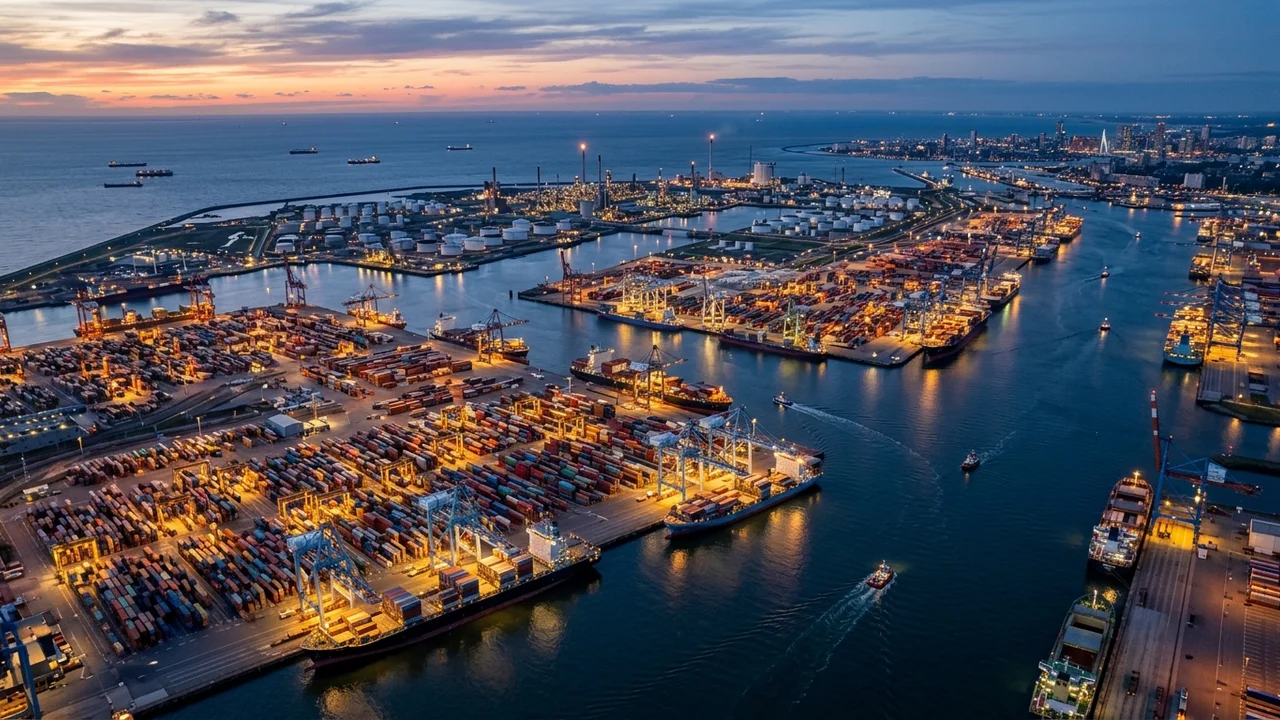
CBAM Netherlands compliance sits at the intersection of EU law, port logistics, and one of the busiest industrial trade corridors in the world, with Rotterdam processing more CBAM-covered goods by volume than any other single EU entry point. The Nederlandse Emissieautoriteit (NEa) serves as the Dutch national competent authority under Regulation (EU) 2023/956, processing authorization applications, managing CBAM registry accounts, and conducting risk-based inspections for every Dutch-established importer. The authorization application deadline of March 31, 2026 has already passed, and Dutch importers who did not file in time face penalties of €300 to €500 per tonne CO₂e for unauthorized importing. This article covers NEa's exact role and contact points, how Rotterdam port flows map onto CBAM obligations, the six-step compliance process for Dutch importers, and the practical cost exposure by sector.
Caption: Rotterdam port cargo flows of steel, aluminium, and fertilizers subject to CBAM certificate obligations under NEa oversight.
What Is the NEa and What Does It Do Under CBAM
The NEa (Nederlandse Emissieautoriteit) is the Dutch national competent authority for CBAM, responsible for receiving authorization applications, granting declarant status, managing CBAM accounts, issuing certificates, and conducting enforcement inspections for all importers established in the Netherlands under Article 11 of Regulation (EU) 2023/956. The NEa operates as an independent regulatory body within the Dutch government structure, reporting to the Ministry of Infrastructure and Water Management. It administers both the EU Emissions Trading System in the Netherlands and CBAM, giving it combined institutional expertise across both carbon pricing regimes.
The NEa's CBAM responsibilities cover six distinct functions. The six functions the NEa performs for Dutch-established importers are listed below.
- Receive and assess authorization applications submitted via the CBAM Registry Authorization Management Module (AMM)
- Conduct the 120-day authorization review (maximum processing time per Article 4(1) of Implementing Regulation 2025/486)
- Open and manage CBAM registry accounts for authorized declarants
- Sell CBAM certificates via the Common Central Platform from February 1, 2027
- Conduct risk-based inspections under Article 15 of Regulation (EU) 2023/956
- Process annual CBAM declarations and certificate surrender submissions due September 30 each year
Dutch importers submit applications through the EU CBAM Registry at cbam.ec.europa.eu, using their EORI credentials via the UUM&DS authentication system. The NEa cannot be bypassed. A Dutch-established company must file with the NEa regardless of where its goods physically enter the EU. Rotterdam-based logistics firms acting as indirect customs representatives must confirm with their principals whether the principal or the representative holds authorization and accepts legal liability, as joint liability rules under Article 5(2a) apply in specific circumstances.
The broader context for understanding the EU CBAM guide framework matters here: the NEa applies the same Regulation (EU) 2023/956 rules as all 27 national competent authorities, but its administrative culture, processing pace, and enforcement focus reflect Dutch regulatory practice, which is historically technology-forward and compliance-oriented.
Rotterdam Port and CBAM: Why the Netherlands Is a Critical Compliance Hub
Rotterdam is the largest port in Europe by throughput, handling approximately 467 million tonnes of cargo in 2024. Rotterdam processes iron ore, steel slabs, aluminium ingots, ammonia, urea, and chemical precursors in volumes that dwarf any other EU entry point. All six CBAM sectors, including iron and steel, cement, aluminium, fertilizers, electricity, and hydrogen, have meaningful Rotterdam exposure.
Steel and aluminium dominate Rotterdam's CBAM cargo mix. Rotterdam receives iron ore and semi-finished steel products, primarily hot-rolled coil, slabs, and wire rod, from origins including Turkey, India, South Korea, and China. These goods carry embedded emissions that range from approximately 0.5 tCO₂ per tonne for electric arc furnace scrap-route steel to approximately 2.0 tCO₂ per tonne for blast furnace and basic oxygen furnace route steel. At the current EU ETS reference price of approximately €70 per tonne of CO₂, the gross CBAM certificate obligation on BF-BOF steel reaches approximately €140 per tonne before the free allocation adjustment.
Fertilizers are Rotterdam's second major CBAM-relevant cargo stream. The port handles ammonia and urea shipments from Russia, Egypt, Algeria, and the Middle East. Urea carries embedded emissions of approximately 2.5 tCO₂e per tonne, generating a gross CBAM cost of approximately €175 per tonne at €70 ETS. Russian fertilizer flows through Rotterdam have declined sharply following EU additional tariffs effective July 2025: €40 to €45 per tonne initially, rising to €315 to €430 per tonne by July 2028, stacked on top of CBAM obligations.
The table below maps the four primary CBAM cargo types moving through Rotterdam against their key compliance parameters.
| Cargo Type | Typical Origin Countries | Emission Factor | Gross CBAM Cost @ €70/tCO₂ | Net Cost in 2026 (2.5% CBAM Factor) |
|---|---|---|---|---|
| Steel (BF-BOF) | Turkey, India, South Korea | ~2.0 tCO₂/t | ~€140/t | ~€3.50/t |
| Steel (EAF scrap) | Turkey, South Korea | ~0.5 tCO₂/t | ~€35/t | ~€0.875/t |
| Primary aluminium | UAE, Bahrain, Russia | ~1.5 tCO₂/t (direct) | ~€105/t | ~€2.63/t |
| Urea fertilizer | Egypt, Russia, Algeria | ~2.5 tCO₂e/t | ~€175/t | ~€4.38/t |
Net 2026 costs reflect the 2.5% CBAM factor (97.5% of EU ETS free allocation remains in 2026). The CBAM factor rises to 48.5% in 2030, increasing these net costs by approximately 19 times.
Rotterdam's position as an import hub creates a compliance concentration challenge that importers and logistics companies established in the Netherlands face at greater scale than those in most other member states. A Dutch commodity trader importing 100,000 tonnes of BF-BOF steel from Turkey in 2026 carries a gross CBAM obligation of approximately €14 million, reduced to approximately €350,000 in net 2026 terms by the CBAM factor. That same trader's net obligation in 2030, at the same ETS price, grows to approximately €6.78 million. The step-change between 2026 and 2030 is the critical planning horizon Dutch importers must model now.
How CBAM for EU Importers Works in Six Steps for Dutch Companies
CBAM for EU importers involves a sequential six-step compliance process, with the NEa as the central point of contact for Dutch-established companies at four of the six steps. The six steps are outlined below.
Step 1: Determine applicability. Check that each imported product's CN code appears in Annex I of Regulation (EU) 2023/956 and that total annual imports across all CBAM sectors exceed 50 tonnes per importer. Electricity and hydrogen carry no de minimis threshold. Goods originating in Iceland, Liechtenstein, Norway, or Switzerland are exempt under Annex III.
Step 2: File for NEa authorization. Applications submitted to the NEa after March 31, 2026 do not benefit from the provisional import provision under Article 17(7a). Importers who filed by March 31, 2026 may continue importing while the NEa completes its 120-day review. Required documents include a valid EORI number, tax identification, 5-year customs and tax compliance history, audited financial statements, and a description of CBAM goods including CN codes, estimated annual tonnage, and countries of origin.
Step 3: Obtain producer emissions data. The importer must collect specific embedded emissions data from each non-EU production installation. Where producers cannot or will not provide data, the importer falls back on default values from Implementing Regulation (EU) 2025/2621, with mark-ups of 10% above the calculated default in 2026, 20% in 2027, and 30% from 2028 onward.
Step 4: Engage an accredited verifier. Actual emissions data requires third-party verification by a verifier accredited under EN ISO/IEC 14065. Verifiers can register in the CBAM Registry from September 1, 2026. Physical site visits to non-EU production installations are mandatory for the first verification period covering calendar year 2026. Verifier fees range from €5,000 to €50,000 per installation.
Step 5: Purchase CBAM certificates. Certificate sales through the NEa-administered Common Central Platform begin February 1, 2027. The 2026 certificate price equals the quarterly average of EU ETS auction closing prices during each quarter of importation. From 2027 onward, the price tracks the weekly average. At the end of each calendar quarter, Dutch authorized declarants must hold certificates equal to at least 50% of cumulative embedded emissions since the start of that calendar year.
Step 6: File the annual declaration. The first annual CBAM declaration, covering calendar year 2026 imports, is due September 30, 2027, under Article 6 as amended by Regulation (EU) 2025/2083. The declaration must state total imported quantities by CN code and origin, total embedded emissions by goods type, the number of certificates surrendered, and any Article 9 deductions for carbon prices paid in exporting countries. Records must be retained until the end of the 4th year following the declaration year.
Dutch importers seeking to understand the how to get CBAM authorized declarant status process should note that the NEa requires the same documentation set as other major NCAs but communicates in Dutch and English, maintaining a bilingual guidance portal updated as the regulation evolves.
What CBAM Means Financially for Dutch Importers in 2026 and Beyond
Dutch importers face two distinct financial exposures under CBAM: the direct certificate cost and the operational compliance cost. The certificate cost in 2026 is deliberately low because 97.5% of EU ETS free allocation remains. A Dutch steel trader importing 50,000 tonnes of BF-BOF steel from India in 2026, at 2.0 tCO₂/t and a €70 ETS price, carries a gross CBAM obligation of €7 million. After the 2.5% CBAM factor, the net certificate cost in 2026 is approximately €175,000. That same importer in 2030, with the CBAM factor at 48.5% and the same ETS price, faces a net certificate cost of approximately €3.395 million.
The free allocation phase-out schedule below shows the trajectory that makes 2028 to 2030 the critical planning window.
| Year | CBAM Factor | Free Allocation Remaining | Net Certificate Cost (BF-BOF steel, €70 ETS, 50,000 t) |
|---|---|---|---|
| 2026 | 2.5% | 97.5% | ~€175,000 |
| 2027 | 5% | 95% | ~€350,000 |
| 2028 | 10% | 90% | ~€700,000 |
| 2029 | 22.5% | 77.5% | ~€1,575,000 |
| 2030 | 48.5% | 51.5% | ~€3,395,000 |
| 2034 | 100% | 0% | ~€7,000,000 |
Caption: Free allocation phase-out schedule showing how net CBAM certificate costs for Dutch importers scale from 2026 through 2034 as the CBAM factor increases annually.
The operational compliance cost adds a second layer. Verification costs of €5,000 to €50,000 per production installation apply each year actual data is used. A Dutch commodity trader sourcing steel from 10 different installations in Turkey, India, and South Korea faces verification costs of €50,000 to €500,000 per year. Internal compliance management, legal advisory, and emissions data collection from producers add a further €20,000 to €100,000 or more annually depending on import complexity.
Importers sourcing from countries with qualifying carbon pricing schemes can claim an Article 9 deduction to reduce certificate obligations. South Korea's K-ETS is the most likely scheme to receive Commission recognition, though even at ~€7/tCO₂ versus €70 CBAM, the deduction covers only approximately 10% of CBAM liability. No deduction is available for goods from Turkey, China at the steel level, India, Russia, Egypt, or most other major Rotterdam cargo origins.
NEa Authorization: Key Details for Dutch Importers
What Is the NEa Authorization Process Timeline?
The NEa authorization review takes a maximum of 120 days from receipt of a complete application, per Article 4(1) of Implementing Regulation 2025/486. The NEa may pause the clock by requesting additional information, a common step when compliance history documentation is incomplete. Importers who applied by March 31, 2026 under the provisional import provision may continue importing during the review period. Those who missed the March 31 deadline and are still importing CBAM goods without authorization face penalties of €300 to €500 per tonne CO₂e under Article 26(2) of Regulation (EU) 2023/956 as amended by Regulation (EU) 2025/2083.
NEa also manages ongoing authorization conditions. If an authorized declarant's financial status changes materially, such as entering insolvency proceedings, the NEa can revoke authorization. Similarly, a criminal conviction for tax fraud, smuggling, or environmental offenses during the authorization period triggers mandatory reassessment.
Do Rotterdam Freight Forwarders Need CBAM Authorization?
Rotterdam freight forwarders acting as indirect customs representatives for CBAM goods are subject to joint liability rules under specific conditions. An indirect representative who completes a customs declaration for CBAM goods on behalf of an importer is not automatically required to hold CBAM authorization independently. The key distinction is whether the representative declares on behalf of the importer (liability stays with the importer) or declares in their own name (liability may shift to the representative). Rotterdam logistics firms handling CBAM cargo should review their agency agreements and declare which party holds authorization in each transaction to avoid enforcement exposure.
What Are the CBAM Sectors Most Relevant to Rotterdam?
Rotterdam's CBAM exposure concentrates in four sectors. Steel (both blast furnace route and electric arc route) represents the largest volume by mass. Aluminium ingots and semi-fabricated aluminium products follow, with primary aluminium from UAE, Bahrain, and Gulf states accounting for a significant share. Fertilizers, principally urea and ammonia, arrive from North Africa and the Middle East. Hydrogen imports via Rotterdam, currently small in volume, carry no de minimis threshold and face CBAM on every kilogram, with grey hydrogen carrying embedded emissions of approximately 9 to 12 tCO₂ per tonne of hydrogen.
The CBAM steel sector guide covers the CN code classification rules that Rotterdam customs agents must apply at the point of declaration for steel products in Chapters 72 and 73.
Is There a De Minimis Exemption for Small Dutch Importers?
The de minimis threshold exempts importers whose total annual CBAM goods imports fall below 50 tonnes across all covered sectors combined, per Article 2(3a) as amended by Regulation (EU) 2025/2083. A Dutch SME importing 40 tonnes of steel sections per year from a non-exempt country pays no CBAM obligation. Electricity and hydrogen are excluded from the de minimis rule regardless of volume. The CBAM de minimis threshold rules explain how to calculate annual mass correctly across mixed-sector import portfolios, including how consignment splitting by third parties to exploit the threshold constitutes anti-circumvention behavior under Article 27.
What Happens if a Dutch Importer Misses the Certificate Surrender Deadline?
An authorized declarant who fails to surrender sufficient CBAM certificates by September 30 faces a penalty of €100 per tonne CO₂e not covered under Article 26(1) as amended. The penalty does not extinguish the obligation: the importer must still purchase and surrender the missing certificates at the prevailing market price, plus pay the €100 penalty on top. At approximately €70 ETS, the total effective cost of non-compliance reaches approximately €170 per tonne CO₂e. The CBAM penalties guide details how the inflation adjustment to the €100 base rate applies and how the enforcement escalation from warning to formal penalty proceeds through the NEa.
Can Dutch Importers Sell Back Excess CBAM Certificates?
Authorized declarants can sell back up to 50% of the CBAM certificates purchased in a given calendar year to the NEa, at the original purchase price, by October 31 of the surrender year. Certificates not surrendered or bought back by November 1 are automatically cancelled under Article 24(1) as amended. The buyback limit of 50% provides a partial hedge against over-purchasing caused by lower-than-expected import volumes or verified emissions below initial estimates. Dutch importers who strategically over-purchase certificates during the year can use this provision to manage working capital, holding no more certificates than their expected annual obligation plus the permitted buyback buffer.
How Do Dutch Importers Handle CBAM Certificates for 2026 Imports?
CBAM certificates for calendar year 2026 imports are purchased through the NEa's Common Central Platform from February 1, 2027. The certificate price for 2026 imports is set at the quarterly average of EU ETS auction closing prices during each quarter of 2026, meaning Dutch importers will know the exact 2026 certificate price before they purchase. This retroactive certainty is a direct result of the Omnibus amendment under Regulation (EU) 2025/2083. The CBAM certificates guide covers the certificate purchase mechanics, including how to calculate the quarterly holding requirement and how to manage certificate vintages across multiple declaration years.