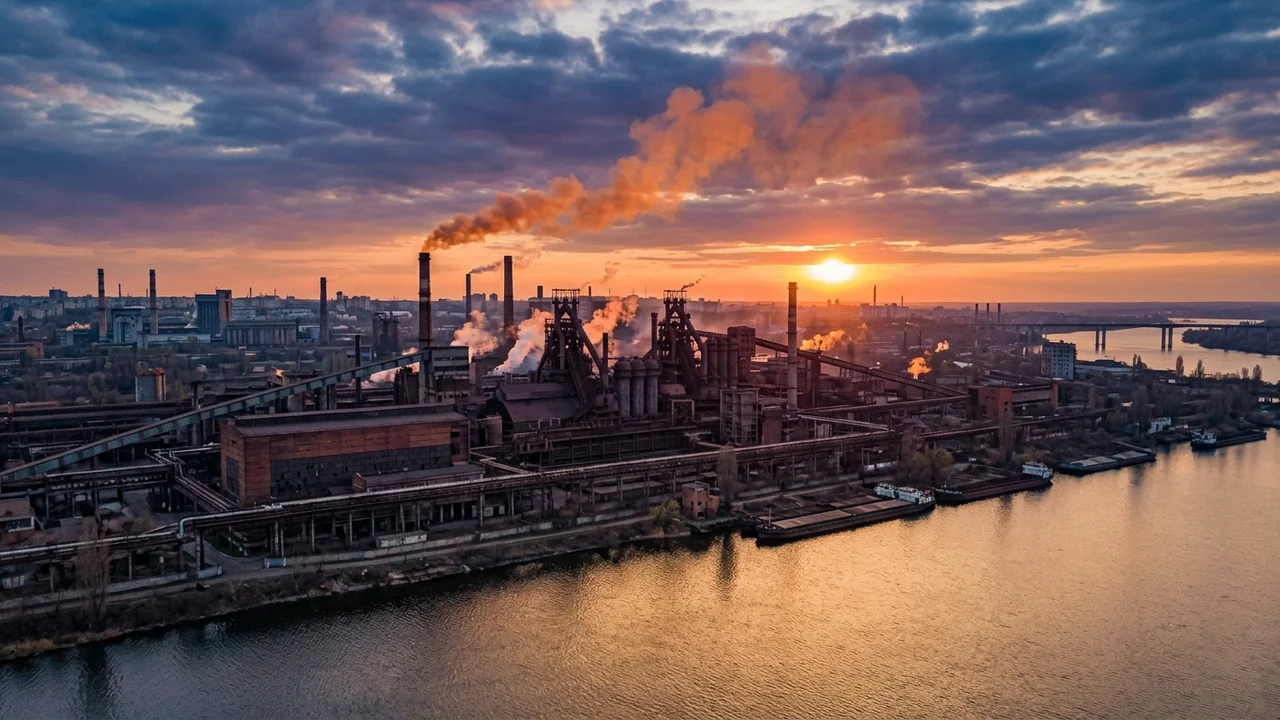
CBAM Ukraine exposure reaches an estimated $4.7 billion in projected export losses between 2026 and 2030, concentrated almost entirely in steel, a sector that war has already reduced to a fraction of its pre-2022 capacity. What makes Ukraine's position unlike that of any other exporting country is a regulatory paradox: as an EU accession candidate, Ukraine may eventually join the EU Emissions Trading System, at which point CBAM would no longer apply to Ukrainian exports at all. The short-term burden of CBAM compliance and the long-term promise of ETS membership pull in opposite directions. This article maps Ukraine's CBAM-exposed sectors, quantifies the financial stakes, and explains why EU accession status changes the strategic calculation entirely.
Caption: Ukraine's blast furnace steel sector accounts for the vast majority of its CBAM-exposed EU exports, with 81% of finished steel exports directed to the EU market.
What Is Ukraine's CBAM Exposure?
Ukraine's CBAM exposure, as of 2026, is concentrated in steel, with the steel sector accounting for approximately 81% of all finished goods Ukraine exports to the EU. The GMK Center, a Kyiv-based metals and mining research institute, published a 2024 study estimating that CBAM-related investment losses for Ukrainian industry could reach $2.7 billion between 2026 and 2030, with export losses reaching $4.7 billion over the same period. These figures reflect the combined effect of CBAM certificate costs falling on EU importers of Ukrainian steel, the resulting price pressure passed upstream to Ukrainian producers, and the structural shift in competitiveness as CBAM costs escalate annually.
Ukraine's pre-war steel industry was built around blast furnace and basic oxygen furnace (BF-BOF) production, the most carbon-intensive route in steelmaking. The BF-BOF route carries an embedded emission factor of approximately 2.0 tonnes of CO2 per tonne of steel, producing a gross CBAM cost of approximately €140 per tonne at the current EU ETS price of approximately €70 per tonne of CO2. The EU carbon border adjustment mechanism under Regulation (EU) 2023/956 prices those embedded emissions through a certificate system linked to the EU ETS, meaning EU importers of Ukrainian steel must purchase EU carbon border adjustment mechanism certificates proportional to the carbon content of their imports.
Ukraine exported approximately 3.40 million tonnes of steel to the EU in 2024, a number significantly below pre-war levels. At full phase-in of CBAM by 2034, with the EU ETS price projected by industry analysts to range between €100 and €150 per tonne of CO2, the gross liability on that volume would reach between €680 million and €1.02 billion per year on steel alone.
Ukraine's CBAM-Exposed Sectors: Trade Volumes and Financial Stakes
The 4 primary CBAM-exposed product categories for Ukraine are listed below.
Ukraine's CBAM-exposed exports by sector, with estimated trade volumes and financial parameters, are presented in the following table.
| Sector | EU Export Volume (2024 est.) | Primary Route | Emission Factor | Gross CBAM Cost @ €70/tCO2 |
|---|---|---|---|---|
| Steel (BF-BOF) | ~3.40 Mt | Blast furnace | ~2.0 tCO2/t | ~€140/t |
| Steel (EAF scrap) | Minor share | Electric arc | ~0.5 tCO2/t | ~€35/t |
| Cement | Severely disrupted | Rotary kiln | ~0.83 tCO2/t | ~€58/t |
| Electricity | Via ENTSO-E interconnector | Coal/gas grid mix | Country default | Grid emission factor |
Cement exports from Ukraine historically represented approximately 13% of EU cement imports from non-EU countries, but physical infrastructure damage following the 2022 Russian invasion has severely reduced export capacity. Steel dominates the CBAM exposure picture by a wide margin.
The net CBAM cost in 2026 is substantially lower than the gross figures above. Because CBAM's free allocation phase-out schedule means only 2.5% of the free allocation reduction applies in 2026, the net cost for BF-BOF steel at €70 per tonne ETS is approximately €3.50 per tonne. This figure scales to approximately €72.75 per tonne net by 2030, when 48.5% of free allocations are phased out, representing a 20-fold increase in 4 years. Ukrainian steelmakers and their EU buyers who treat 2026's minimal cost as the baseline will face a structural shock in the 2029 to 2030 period when free allocation drops most steeply.
How War Has Reshaped Ukraine's CBAM Exposure
Ukraine's CBAM steel exposure is inseparable from the economic consequences of Russia's 2022 invasion. The GMK Center study flagged the risk of closure for 3 out of Ukraine's 7 remaining blast furnaces under combined war damage and CBAM cost pressure, with potential job losses exceeding 13,000 workers in the steel sector. Metinvest and ArcelorMittal Kryvyi Rih, the 2 dominant Ukrainian steel producers, have both operated well below pre-war capacity throughout 2023 and 2024 as energy disruption, supply chain severance, and physical destruction of plant infrastructure reduced output.
The war context matters for CBAM exposure in 3 specific ways.
First, reduced output means the absolute CBAM cost burden on Ukrainian industry is currently lower than pre-war projections indicated. Fewer tonnes exported means fewer CBAM certificates required by EU importers.
Second, reconstruction demand will reverse this trajectory. As Ukraine rebuilds, steel output is expected to recover, and EU-bound exports are likely to increase. The CBAM cost environment will be significantly worse at the point of reconstruction than it was before the war, because the free allocation phase-out will be further advanced.
Third, the infrastructure damage has pushed Ukrainian steel production toward electric arc furnace (EAF) routes in some facilities where blast furnaces are inoperable. EAF steel carries an emission factor of approximately 0.5 tonnes of CO2 per tonne, less than one quarter of the BF-BOF factor, which materially reduces the CBAM cost per tonne for those facilities.
Article 9: Does Ukraine Qualify for a Carbon Price Deduction?
Ukraine does not currently have a qualifying carbon pricing scheme for the purposes of Article 9 deduction under Regulation (EU) 2023/956. Article 9 allows EU importers to deduct a carbon price effectively paid in the country of origin from their CBAM certificate obligation, but only where the originating country operates a carbon pricing mechanism that meets the EU's qualifying criteria: a legally binding cap, effective enforcement, and pricing that applies to the embedded emissions of the exported goods.
Ukraine is developing an emissions trading system as part of its broader EU accession commitments under the Association Agreement and the conditions attached to its EU candidate status granted in June 2022. This ETS is not yet operational as of April 2026. Until it is established and assessed by the European Commission as a qualifying scheme, EU importers of Ukrainian goods cannot apply any Article 9 deduction. The full CBAM certificate cost, at the prevailing EU ETS auction price, applies to the embedded emissions of Ukrainian exports.
The Commission's December 2025 Article 30 review of CBAM considered but did not grant Ukraine a specific CBAM exemption, citing limited aggregate economic impact. Ukrainian industry stakeholders and the Ukrainian government have contested this framing, noting that the aggregate assessment obscures the concentrated exposure of a country whose export structure is dominated by a single CBAM sector.
The EU Accession Complication: Inside the ETS, Not Outside CBAM
Ukraine's status as an EU accession candidate creates a regulatory complication that no other major CBAM-exposed exporting country faces. The complication is this: if Ukraine accedes to the EU and joins the EU ETS, CBAM would no longer apply to Ukrainian exports at all. CBAM exists to prevent carbon leakage when goods move from jurisdictions without carbon pricing into the EU single market. An EU member state, or a country with a linked ETS equivalent to the EU ETS, falls outside CBAM's scope by definition.
The practical timeline creates a genuine strategic dilemma. The EU accession process is projected to take between 7 and 15 years under current conditions, depending on the pace of legal alignment and political agreement across EU member states. In the interim, Ukraine faces a CBAM cost escalation that peaks in severity precisely during the 2028 to 2034 period when free allocations phase out most aggressively. The heaviest financial burden arrives well before any accession scenario could provide relief.
Three implications follow from this dual timeline.
First, Ukrainian steel producers face a window of CBAM exposure that increases annually from 2026, with the sharpest cost increases occurring between 2029 and 2030. Planning investment in decarbonization must account for this peak exposure even if eventual ETS integration provides a long-run escape from CBAM costs.
Second, the development of a Ukrainian domestic ETS, which is required for EU accession alignment, will itself generate compliance costs for Ukrainian steel producers. ETS membership means paying a domestic carbon price on production, not just absorbing the commercial pressure of CBAM on EU buyers. The cost trajectory is upward regardless of the path.
Third, there is a transitional arrangement question that remains unresolved as of April 2026. Whether Ukraine qualifies for transitional provisions or phased arrangements during the accession period that might reduce or defer CBAM costs has not been formally addressed in Commission guidance. The EU has precedent for managing accession-phase regulatory alignment through transitional derogations, but no specific CBAM transitional framework for Ukraine exists in current legislation.
Caption: Ukraine's dual timeline places CBAM's peak financial burden in 2028 to 2030, years before EU accession could provide relief through ETS membership.
How Does Ukraine Compare to Other CBAM-Exposed Steel Exporters?
Ukraine's CBAM position relative to the 6 largest steel exporters to the EU is the contextual border question. Understanding Ukraine's position requires comparing it to countries with different carbon pricing arrangements and different strategic relationships with the EU.
Ukraine vs. Turkey: Similar Exposure, Different Legal Relationship
Turkey faces approximately €6 to €8 billion in annual CBAM-affected exports, with steel the dominant sector alongside cement. Turkey enacted its first Climate Law in July 2025, establishing the legal basis for a pilot ETS, but no qualifying carbon price exists as of 2026. Turkey's Customs Union relationship with the EU generates a separate legal dispute about whether CBAM discriminates against Turkish goods, but this argument has not produced a formal WTO challenge. Ukraine, by contrast, faces CBAM exposure from a position of political alignment with the EU rather than commercial tension.
Ukraine vs. India: Opposing Diplomatic Stances
India, the largest single steel exporter to the EU at approximately 4.33 million tonnes per year valued at €3.9 billion, has adopted a confrontational stance on CBAM, with 29 formal objections filed at the WTO Trade and Environment Committee. Ukraine's position is structurally opposite: the Ukrainian government views CBAM compliance as a necessary condition of EU integration rather than a discriminatory measure to be challenged.
Ukraine vs. South Korea: The Article 9 Difference
South Korea operates the K-ETS (Korea Emissions Trading Scheme), active since 2015, and is the most likely candidate for Article 9 deduction recognition among major steel exporters. At a K-ETS price of approximately $6 to $7 per tonne of CO2, the deduction covers only about 9% of CBAM liability, but the precedent is significant. Ukraine lacks a qualifying scheme and receives no such deduction, placing Ukrainian steel at a cost disadvantage relative to South Korean steel in the EU market as CBAM costs scale.
What Steps Can Ukrainian Exporters Take Now?
Non-EU exporters under CBAM have no direct legal obligation under Regulation (EU) 2023/956. The legal obligation falls on the EU importer. However, Ukrainian steel producers can take 4 practical steps to reduce the commercial pressure CBAM places on their EU buyers.
- Measure and verify actual embedded emissions per production installation to replace punitive default values. The default mark-up for steel is 10% above the calculated default in 2026, rising to 30% from 2028 onward. Where actual emissions are below the default, verified data reduces the CBAM cost per tonne directly.
- Engage EU buyers early on CBAM cost allocation, negotiating whether the certificate cost is absorbed by the importer, shared, or reflected in adjusted contract pricing.
- Monitor the Ukrainian ETS development timeline and the Commission's assessment process for Article 9 qualification, as recognition would enable a partial deduction once an effective carbon price is established.
- Track the accession negotiation timeline and any transitional CBAM provisions that may emerge in future Commission proposals or accession package legislation.
For a full explanation of how the certificate obligation works from the EU importer's side, including how embedded emissions are calculated and declared, see the guide to CBAM for non-EU exporters.
Is Ukraine Exempt from CBAM?
Ukraine is not exempt from CBAM as of 2026. The only countries exempt from CBAM under Regulation (EU) 2023/956 are EEA members (Norway, Iceland, Liechtenstein) and Switzerland, which operates a linked ETS. Ukraine's EU candidate status does not confer a CBAM exemption. The European Commission's December 2025 review explicitly considered and rejected a specific exemption for Ukraine, citing limited aggregate economic impact, a finding that Ukrainian industry stakeholders dispute given Ukraine's concentrated steel export dependency.
Does Ukraine's CBAM Exposure Include Electricity?
Ukraine's electricity grid synchronized with ENTSO-E in March 2022 and Ukraine exports electricity to the EU via interconnectors. Under CBAM Regulation (EU) 2023/956, electricity exports are subject to CBAM based on the embedded CO2 per MWh at the point of generation. Ukraine's grid emission factor reflects a coal and gas heavy generation mix, particularly following damage to nuclear capacity. Ukraine does not qualify for the market coupling exemption under Article 2(7) to (12), which requires full electricity market integration and ETS commitment. Ukraine's electricity exports therefore carry CBAM exposure, though the financial magnitude is smaller than steel given current interconnector volumes.
Will CBAM Apply to Ukraine After EU Accession?
CBAM will not apply to Ukrainian exports to the EU after Ukraine's accession, provided Ukraine has joined the EU ETS as part of accession. EU member states are part of the internal market and the ETS; goods produced within the EU are not subject to CBAM, which applies only to imports from third countries. The practical question is timing: EU accession for Ukraine is projected to take between 7 and 15 years under current conditions, meaning CBAM will apply through the period of steepest cost escalation, 2026 to 2034, before any accession-based relief is possible.
What Are CBAM Certificates and Who Buys Them for Ukrainian Steel?
CBAM certificates are instruments purchased by the authorized EU importer, not by the Ukrainian exporter. The EU importer of Ukrainian steel must register as an authorized CBAM declarant, calculate the embedded emissions of the steel based on verified data or default values, and purchase CBAM certificates equal to those emissions at the quarterly average EU ETS auction price. Certificate sales begin on February 1, 2027, under Regulation (EU) 2025/2083. The first annual CBAM declaration covering calendar year 2026 is due by September 30, 2027. For a detailed explanation of how CBAM certificates work, including the purchase, holding, and surrender cycle, see the certificates guide.
How Does CBAM Affect the CBAM Russia and Ukraine Comparison?
Russia and Ukraine occupy opposite ends of the CBAM geopolitical spectrum. CBAM Russia filed WTO dispute DS639 on May 12, 2025, the only formal CBAM WTO challenge globally, arguing CBAM violates GATT trade discrimination rules and that EU ETS free allocation constitutes a prohibited subsidy. Ukraine views CBAM compliance as a path toward EU integration. The trade volumes differ substantially: Russian CBAM-affected exports to the EU are severely reduced by 2022 sanctions, while Ukraine's steel exports continue and are expected to grow with reconstruction. The strategic postures, legal arguments, and financial trajectories of the two countries under CBAM are entirely distinct.