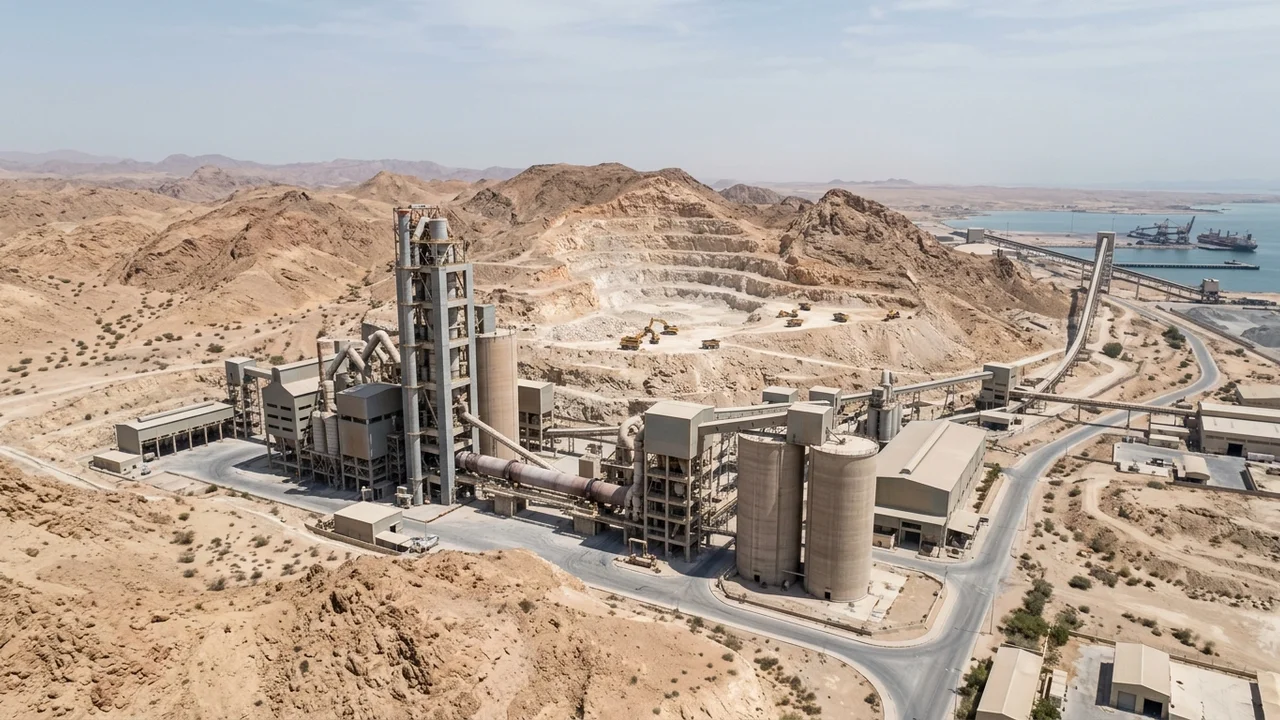
CBAM cement rules, now in full force under Regulation (EU) 2023/956 since January 1, 2026, create the sharpest financial gap in any single product-country combination across all six covered sectors: Turkish Portland cement carries an actual emission intensity of approximately 0.88 tCO₂/t, while the CBAM default value for "other countries" Portland cement stands at 1.584 tCO₂e/t. That gap of roughly 0.70 tCO₂e/t translates directly into avoidable cost for every tonne crossing into the EU without verified emissions data.
Turkey supplies 35–39% of all EU cement imports — approximately 3.3–4.8 million tonnes per year. No other exporting country combines that volume with that default-to-actual gap. The consequence for Turkish producers who do not provide measured, verified data is a CBAM cost that, at the current EU ETS price of approximately €70/tCO₂, can exceed the FOB export price of the cement itself.
This article explains the mechanics of CBAM's impact on non-EU cement exporters, quantifies the default-value penalty for the top supplying countries, details what data exporters must collect and how to submit it, and outlines the four strategic responses available to producers.
Caption: CBAM embedded emissions — actual values versus default values for top EU cement-supplying countries.
What CBAM Means for Non-EU Cement Exporters
CBAM does not impose a direct legal obligation on non-EU cement manufacturers. The financial obligation falls entirely on the EU-based authorized CBAM declarant — the importer of record. The mechanism that connects exporters to CBAM costs is commercial, not legal: EU importers require installation-level embedded emissions data to calculate their certificate obligation accurately. When that data is absent, the importer applies a default value set by the Commission under Implementing Regulation (EU) 2025/2621. Default values are not averages — they carry a mark-up of 10% above the calculated reference default in 2026, rising to 20% in 2027 and 30% from 2028 onward.
The practical chain runs as follows. The importer determines whether to apply actual emissions (if the exporter provides verified data) or defaults (if no data is available). Using defaults increases the importer's certificate obligation and therefore their landed cost for the cement. The importer then passes that extra cost back to the exporter through lower purchase prices, renegotiated contracts, or supplier substitution. Exporters who cannot provide data face a compounding disadvantage as the default mark-up escalates through 2028.
For EU cement importers specifically, CBAM covers both direct and indirect embedded emissions. Cement is not listed in Annex II of Regulation (EU) 2023/956, which means indirect emissions from electricity consumption in the production process are priced alongside direct process and fuel emissions. This two-scope requirement distinguishes cement from steel and aluminium, where only direct emissions carry financial obligation.
The EU carbon border adjustment mechanism establishes that the CBAM certificate price tracks the weekly average EU ETS auction clearing price — currently approximately €70/tCO₂ as of late March 2026, though this is market data that fluctuates daily.
Actual vs Default Emissions: The Gap Across Top Cement Exporters
The financial incentive to provide actual data depends entirely on the gap between what a producer actually emits and what the CBAM default assumes. The table below compares actual and default emission values for the five largest suppliers of cement to the EU, together with the resulting cost differential at the current ETS price.
The 3 columns on the right calculate the cost difference at the 2030 CBAM factor of 48.5% — the year when free allocation reductions create the first major financial reckoning for high-default-gap producers.
| Country | Share of EU Cement Imports | Typical Actual Emissions (tCO₂e/t) | CBAM Default (tCO₂e/t) | Gap (tCO₂e/t) | Cost Difference @ €70 × 48.5% (2030) |
|---|---|---|---|---|---|
| Turkey | 35–39% | ~0.88 | ~1.584 | ~0.70 | ~€24/t |
| Algeria | ~19% | ~0.95–1.05 | ~1.4–1.6 (est.) | ~0.45–0.65 | ~€15–22/t |
| Ukraine | ~13% | ~0.85–0.95 | ~1.3–1.5 (est.) | ~0.40–0.55 | ~€14–19/t |
| Tunisia | ~8% | ~0.90–1.00 | ~1.3–1.5 (est.) | ~0.35–0.55 | ~€12–19/t |
| Egypt | ~4–9% | ~1.00–1.15 | ~1.5–1.7 (est.) | ~0.40–0.60 | ~€14–20/t |
Default values for non-Turkey countries are estimates based on IR 2025/2621 methodology; confirmed values for all countries are published in the CBAM Operators Portal. The 2030 column uses the 48.5% CBAM factor and €70 ETS reference price.
Turkey's gap is the widest of any major cement-exporting country by a substantial margin. At €70/tCO₂ and using defaults throughout, a Turkish cement exporter receives approximately €83/t less in effective revenue compared to a producer who submits verified actual data by 2030. Given that Portland cement typically sells for €60–80/t FOB, this is an existential cost pressure, not a manageable surcharge.
The CBAM cement guide covers the full sector mechanics, including CN code classification, clinker-to-cement ratio calculations, and how blended cements with lower clinker content achieve lower embedded emissions under the measurement framework.
Why Turkey's Cement Sector Faces the Most Acute Exposure
Three structural factors combine to make Turkish cement producers the most commercially exposed non-EU exporters under CBAM cement rules.
First, volume. Turkey's 35–39% share of EU cement imports represents approximately 3.3–4.8 million tonnes annually. No other single country comes close to this concentration in EU cement supply. That volume means the financial stakes of getting the data gap wrong are larger in absolute terms for Turkish producers than for any competitor.
Second, the absence of qualifying carbon pricing. Turkey enacted its Climate Law No. 7552 on July 9, 2025, establishing the legal basis for a Turkish emissions trading scheme. The pilot phase operating in 2026 provides full free allocation — meaning no carbon price is "effectively paid" at the installation level. Article 9 of Regulation (EU) 2023/956 allows EU importers to deduct carbon costs paid in the country of origin from their CBAM certificate obligation. Turkish cement producers currently cannot benefit from this deduction because the Turkish ETS has not reached the level of effective carbon pricing that would qualify. Without an Article 9 deduction, the full CBAM certificate cost falls on every tonne of Turkish cement imported into the EU.
Third, geographic captivity. Turkish cement exporters cannot easily redirect EU-bound volume to alternative markets. Proximity, logistics infrastructure, and supply chain integration with European construction projects concentrate Turkish cement exports toward the EU. Unlike steel producers in India or China, who can pivot to large domestic markets or other export destinations, Turkish cement producers are structurally dependent on EU demand.
The combination of high volume, zero qualifying carbon price, and no viable market diversion means Turkish producers face both the largest absolute CBAM exposure and the smallest set of short-term alternatives. Providing verified actual emissions data is not optional — it is the primary commercial lever available.
What Data Cement Exporters Must Collect and Submit
CBAM cement obligations require exporters to provide installation-level data structured according to Implementing Regulation (EU) 2025/2547, which defines the calculation methodology for all six CBAM sectors. The data falls into four categories.
The 4 required data categories for cement exporters are listed below.
- Installation identification: Full legal name of the production company, physical address, UN/LOCODE of the installation, geographical coordinates, and a designated contact person for CBAM queries.
- Production and process data: Total production volume (tonnes), production route classification (kiln type, preheater stages, suspension preheater vs. shaft kiln), fuel consumption per process step, and electricity consumption data.
- Specific direct and indirect embedded emissions: Tonnes CO₂e per tonne of cement produced, calculated using the calculation-based method (activity data multiplied by emission factors from laboratory analyses) or the mass balance method. For cement specifically, the clinker-to-cement ratio in the final product determines the specific embedded emissions per tonne of finished cement — CEM I (ordinary Portland cement) with 95–100% clinker content carries the highest obligation; CEM III (blast furnace slag cement) with 5–64% clinker content carries substantially lower embedded emissions.
- Precursor data: Where clinker is purchased from a separate upstream installation and used to produce finished cement, the specific embedded emissions of that clinker must also be documented and included.
From January 1, 2026, only the full EU methodology under IR 2025/2547 is accepted. Alternative methods based on third-country national data that were permitted during the 2023–2025 transitional reporting period are no longer valid.
The European Commission's CBAM Operators Portal provides the official Communication Template for data submission. Exporters who upload verified installation data to the portal make it available to all EU buyers simultaneously — one upload serves every importer relationship. Verifier registration for third-country accreditation bodies opens September 1, 2026 under Implementing Regulation (EU) 2025/2083.
The Verification Requirement and Its Timeline
Verified actual data carries a very different commercial value than unverified self-reported data. EU importers can only use exporter-provided actual emissions data when that data has been verified by an accredited third-party verifier under EN ISO/IEC 14065 by a National Accreditation Body with mutual recognition with the European Accreditation body (EA). Turkish, Egyptian, and Algerian accreditation bodies have varying levels of EA mutual recognition — cement producers must confirm their chosen verifier's accreditation status before commissioning a verification.
Physical site visits are mandatory for the first verification period covering 2026 imports. The verifier must physically inspect the kiln operations, review fuel consumption records, examine limestone and clinker input documentation, and sample measurement systems. Verification fees range from approximately €5,000 to €50,000 per installation per reporting period, depending on installation complexity and verifier location.
The decision timeline for cement exporters who have not yet begun the data collection process is compressed. To have verified 2026 data available for EU importers who will complete their first CBAM declaration by September 30, 2027, producers must begin data collection immediately, complete the monitoring plan documentation, and engage a verifier for site visit scheduling within the first half of 2026.
How the Data Gap Translates to Commercial Loss
Understanding the precise cost mechanics helps cement producers build the business case for data collection investment. The gross CBAM cost using defaults at the current ETS price and a Turkish cement example runs as follows.
At €70/tCO₂ and the default of 1.584 tCO₂e/t, gross CBAM cost per tonne using defaults is approximately €111/t. At €70/tCO₂ and actual emissions of 0.88 tCO₂/t, gross CBAM cost per tonne using verified actual data is approximately €62/t. The gross difference is approximately €49/t — but in 2026 this is moderated by the 2.5% CBAM factor (only 2.5% of free allocation has been removed), making the net difference approximately €1.22/t in 2026 alone.
The net cost difference escalates sharply through 2030. At the 48.5% CBAM factor operating in 2030, the same calculation produces a net cost difference of approximately €24/t. Cement FOB prices at that level of cost disadvantage make Turkish cement economically uncompetitive in the EU market against producers who have provided verified data or against European domestic producers whose free allocation is also being phased out but who carry no default mark-up penalty.
What Are the Strategic Options for Non-EU Cement Exporters?
Four strategic responses are available to non-EU cement exporters facing CBAM pressure. The correct choice depends on current emission intensity, production technology, available capital, and EU market dependence.
The 4 strategic options are listed below.
- Measure and submit verified actual data: The most immediately impactful option for producers whose actual emissions are below the CBAM default, particularly Turkish, Ukrainian, and Algerian producers. Upfront verification cost of €5,000–€50,000 per installation generates net savings of €15–€24/t in 2030 per tonne exported to the EU, providing a strong return on investment at any meaningful export volume.
- Invest in production decarbonization: Reduce actual embedded emissions by increasing clinker substitution ratios (blast furnace slag, calcined clay, fly ash), upgrading kiln efficiency, or transitioning to alternative fuels. Longer-term, 3–10 year investment horizon, but creates structural competitive advantage as CBAM costs rise toward full phase-in in 2034.
- Negotiate cost allocation with EU buyers: Where an exporter has limited leverage to change emissions intensity quickly, negotiate CBAM default costs explicitly into pricing arrangements with EU importers. This preserves the commercial relationship while distributing the default penalty across both parties transparently.
- Divert export volume to non-CBAM markets: Redirect EU-bound cement to markets without an equivalent carbon border mechanism. This option is narrowing: the UK CBAM starts January 2027, Canada is developing a comparable scheme, and the window for diversion without facing equivalent mechanisms elsewhere is closing.
Caption: Turkish Portland cement production — kiln emissions data collection is the critical compliance step for CBAM actual-value submissions.
CBAM Cement Exporters: Key Questions Answered
Does CBAM Apply to Cement Clinker as Well as Finished Cement?
CBAM cement rules cover both cement clinker (CN code 2523 10 00) and finished Portland cement (CN codes 2523 21 00 and 2523 29 00), as well as aluminous cement (2523 30 00) and other hydraulic cements (2523 90 00). Cement clinker typically carries higher embedded emissions than finished cement because clinker is the precursor that concentrates the limestone calcination reaction. Clinker's emission intensity runs approximately 0.83–0.87 tCO₂/t, while finished Portland cement carrying 70–95% clinker content has slightly lower specific emissions averaging 0.70–0.83 tCO₂/t. The CBAM filing must reflect the actual clinker content of the imported cement to calculate specific embedded emissions correctly.
Is Turkey Exempt from CBAM Under the EU-Turkey Customs Union?
Turkey is not exempt from CBAM cement requirements. The Turkish government's position is that CBAM is incompatible with the 1995 EU-Turkey Customs Union Agreement, which established preferential trade terms between Turkey and the EU. No formal WTO challenge has been filed by Turkey — the dispute is being pursued through bilateral channels. As of April 2026, no resolution has been reached, and Turkish cement exports face full CBAM obligations. The Turkish pilot ETS (2026) provides no Article 9 deduction because full free allocation is granted, meaning no effective carbon price is paid at the installation level.
Can a Non-EU Cement Producer Upload Data Directly Without Going Through the EU Importer?
Non-EU cement producers can upload their installation-level emissions data directly to the CBAM Operators Portal. The portal allows producers to submit data independently and then authorize specific EU-based CBAM declarants to access it. This means a Turkish or Egyptian cement producer uploads once and the data is available to all EU buyers who are authorized declarants, without needing to transmit separate data packages to each buyer. The verified data uploaded through the portal is the standard format EU importers use to calculate actual-emissions-based certificate obligations.
What Happens if the Verified Actual Emissions Are Higher Than the Default?
Exporters whose verified actual emissions exceed the CBAM default value face the opposite incentive: using defaults is cheaper than using actual data. This scenario is rare for cement producers in countries with relatively modern kiln technology, but it can apply in countries with very old, inefficient kilns where coal combustion and outdated calcination technology pushes actual emissions significantly above regional averages. Producers in this position retain the option to use defaults through their EU importer, but the 10–30% default mark-up erodes this advantage progressively through 2028.
Does CBAM Cement Cover Indirect Emissions from Electricity Use?
CBAM cement rules price both direct emissions (limestone calcination and fuel combustion in the kiln) and indirect emissions (electricity consumed during production). Cement is not listed in Annex II of Regulation (EU) 2023/956, so indirect emissions carry a financial obligation in the definitive phase. For most cement producers, electricity accounts for approximately 5% of total embedded emissions — a smaller component than in aluminium production, but still measurable and required in the data submission. Exporters using a certified green electricity source with documented traceability can claim a lower specific indirect emission factor.
What Is the First CBAM Declaration Deadline for Cement Imports?
The first CBAM declaration deadline, covering calendar year 2026 imports, is September 30, 2027, as amended by Regulation (EU) 2025/2083 (Omnibus). Certificate sales start February 1, 2027. EU importers must hold CBAM certificates equal to at least 50% of their cumulative embedded emissions at each quarterly checkpoint from Q1 2027 onward. Cement exporters whose EU buyers will file the September 2027 declaration need to have verified 2026 data available well before that date to allow importers to substitute actual values for defaults in their calculations.
Supplementary Context: Non-EU Exporters Across All CBAM Sectors
How Does CBAM Affect Non-EU Exporters Beyond Cement?
CBAM cement is one part of the broader six-sector obligation covering iron and steel, aluminium, fertilizers, electricity, and hydrogen. Non-EU exporters across all sectors face the same fundamental commercial pressure: provide verified actual data or accept punitive defaults. The CBAM for non-EU exporters hub covers the full exporter landscape, including the country-by-country carbon pricing status that determines Article 9 deduction eligibility, the de minimis threshold of 50 tonnes annual mass per importer, and the verification framework that applies across sectors.
Is There a Role for EU Cement Importers in Closing the Data Gap?
EU importers of cement are the authorized CBAM declarants with direct legal obligations. Their incentive to close the data gap aligns precisely with the exporter's incentive: actual-data-based declarations carry lower certificate obligations where actual emissions are below defaults. CBAM for importers of cement details the importer-side workflow, including declaration filing timelines, certificate calculation mechanics under Implementing Regulation (EU) 2025/2547, and how clinker-content documentation feeds into the specific embedded emissions calculation.
What Is the CBAM Default Value Framework for Exporters?
Default values are not penalties in the legal sense but function as penalties in the commercial sense. The CBAM default values for exporters page explains how the Commission calculates sector defaults, how the 10–20–30% mark-up schedule escalates over 2026–2028, and what the process is for transitioning from default-based to actual-data-based reporting once a producer completes verification. For cement specifically, the default for "other countries" Portland cement at 1.584 tCO₂e/t was set at the 90th percentile of global emission intensity data — meaning 90% of producers globally should have lower actual emissions than the default, reinforcing the incentive to measure.
What Is the CBAM Turkey Exposure Picture Beyond Cement?
Turkey's cement sector accounts for the highest-visibility gap, but Turkey's total CBAM-affected exports across all sectors are estimated at €19 billion annually, representing approximately 8% of Turkey's total export value. Steel and aluminium add substantial additional exposure beyond cement. The Turkey CBAM country page covers the Customs Union dispute, the Turkish ETS pilot timeline, and sector-by-sector exposure estimates.