CBAM cement obligations carry a distinction no other sector shares: EU importers must account for both direct and indirect embedded emissions, making cement one of only two CBAM sectors (alongside fertilizers) where electricity consumption in production is priced alongside process and fuel emissions. The Portland cement benchmark stands at 0.83 tCO₂e per tonne under Regulation (EU) 2023/956, and the first CBAM declaration covering calendar year 2026 imports is due by September 30, 2027. Understanding exactly which CN codes trigger these obligations, how embedded emissions are calculated across both emission scopes, and what certificate surrender requires is the operational foundation every EU importer of cement needs before the next import shipment clears customs.
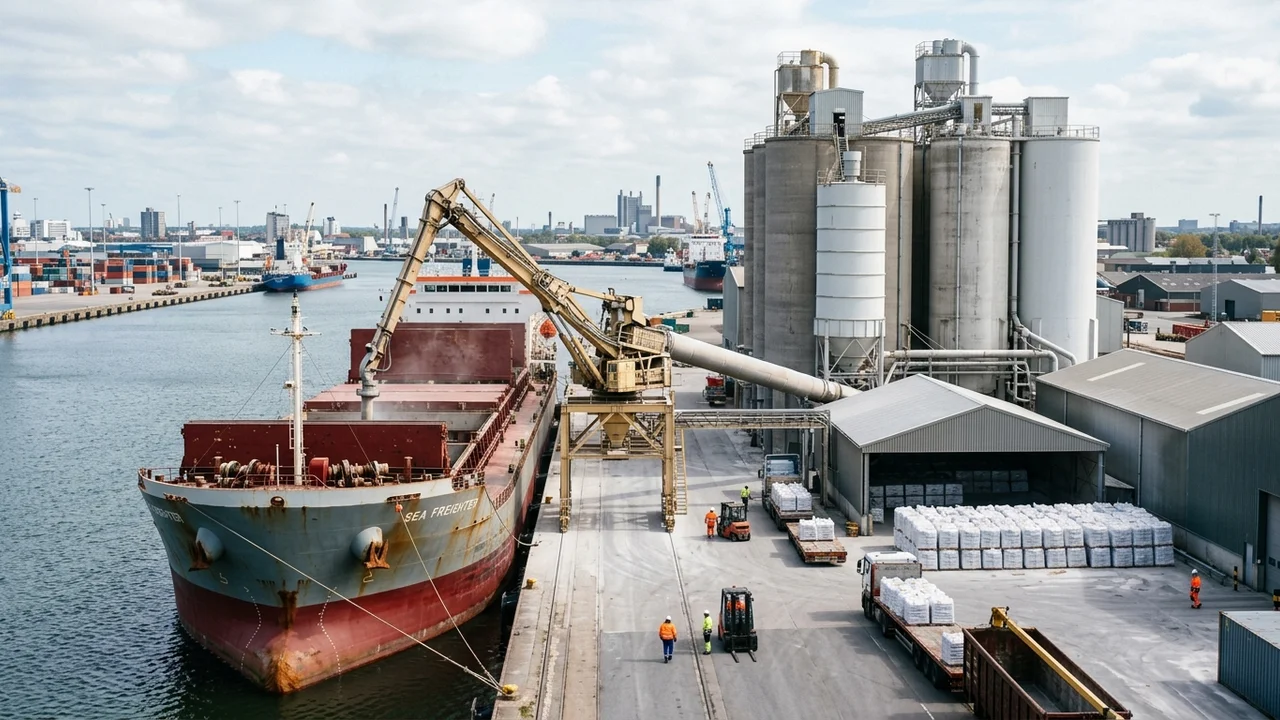
Caption: Cement is unique among CBAM sectors in pricing both direct process emissions and indirect electricity emissions.
Which CN Codes Trigger CBAM for Cement Importers
Four CN codes under Chapter 25 directly trigger CBAM obligations for EU importers of cement. The table below lists each code, the product it covers, and the benchmark embedded emissions value from Implementing Regulation (EU) 2025/2621.
| CN Code | Product | Direct Benchmark (tCO₂/t) | Indirect Emissions Priced |
|---|---|---|---|
| 2523 10 00 | Cement clinker | 0.83 | Yes |
| 2523 21 00 | White Portland cement | 0.81 | Yes |
| 2523 29 00 | Other Portland cement | 0.81 | Yes |
| 2523 30 00 | Aluminous cement | Varies by production route | Yes |
| 2523 90 00 | Other hydraulic cements (slag, supersulfate) | Lower (reduced clinker ratio) | Yes |
Two points demand attention before classifying a shipment. First, cement clinker (2523 10 00) carries the highest embedded emissions of any cement product because it represents the pure output of limestone calcination before any supplementary materials dilute the clinker ratio. Second, articles of cement and concrete (Chapter 68) are not listed in Annex I of Regulation (EU) 2023/956 and fall outside CBAM scope entirely.
The EU carbon border adjustment mechanism requires importers to match the CN code on the customs declaration to an Annex I product before any compliance obligation attaches. An importer who clears 49 tonnes of Portland cement in a full calendar year remains below the 50-tonne annual de minimis threshold under Article 2(3a) as amended by Regulation (EU) 2025/2083 and is exempt. All tonnage above that threshold in any calendar year carries the full obligation chain.
Why Cement Covers Both Direct and Indirect Embedded Emissions
Cement is the only major construction material in the CBAM framework where indirect emissions from electricity consumption are priced alongside direct process and fuel emissions. Steel and aluminium importers pay only on direct emissions. Cement importers pay on both, and understanding why is essential to calculating liability correctly.
The reason lies in EU ETS compensation rules. EU cement producers do not receive state aid compensation for indirect carbon costs (the carbon price embedded in their electricity bills), unlike EU aluminium producers who do receive such compensation under Article 10a(6) of the EU ETS Directive. Including indirect emissions in CBAM for cement creates symmetry between EU domestic producers bearing indirect carbon costs and non-EU producers whose electricity also generates CO₂. Excluding indirect emissions for cement would give non-EU producers a structural cost advantage over EU peers.
The three emission sources a cement importer must account for are listed below.
- Process emissions (calcination): Limestone decomposition (CaCO₃ to CaO plus CO₂) accounts for approximately 60% of total cement carbon footprint. This reaction is chemically unavoidable at kiln temperatures and cannot be reduced through energy efficiency alone.
- Fuel combustion emissions: Burning coal, petcoke, or alternative fuels to heat the kiln to 1,450 degrees Celsius accounts for approximately 35% of total emissions.
- Indirect emissions (electricity): Electricity consumed in grinding, conveying, and auxiliary processes accounts for approximately 5% of total emissions but is legally required in the CBAM calculation.
The CBAM cement guide covers each emission source in full technical detail, including the calculation equations from Implementing Regulation (EU) 2025/2547.
How to Calculate CBAM Cost for Portland Cement Imports
CBAM cost for Portland cement imports depends on three inputs: the verified embedded emissions figure (in tCO₂e per tonne of product), the volume imported, and the EU ETS certificate price at the time of purchase. The EU ETS price as of late March 2026 is approximately €70 per tCO₂, though this figure fluctuates daily and must be confirmed at the time of certificate purchase.
The gross cost calculation for Portland cement at the current benchmark is straightforward. At 0.83 tCO₂e per tonne of product and €70 per tCO₂, the gross CBAM cost is approximately €58.10 per tonne of Portland cement imported. For a typical EU importer bringing in 5,000 tonnes per year, gross exposure reaches approximately €290,500.
Net cost in 2026 is substantially lower because free allocation phase-out is just beginning. The CBAM factor for 2026 is 2.5%, meaning only 2.5% of embedded emissions require certificate coverage this year. The same 5,000-tonne import scenario carries a net 2026 certificate cost of approximately €7,263, rising steeply as free allocation phases out through 2034. Importers who treat 2026 as a low-stakes year risk underestimating the compliance infrastructure needed when the CBAM factor reaches 48.5% in 2030 and 100% in 2034.
The default value penalty for cement is severe. If an EU importer cannot obtain verified emissions data from a Turkish or Egyptian producer, the applicable default for Portland cement from Turkey is approximately 1.584 tCO₂e per tonne under IR 2025/2621, with a 10% mark-up in 2026. At €70/tCO₂, default-based CBAM cost reaches approximately €110 per tonne, which in many cases exceeds the FOB export price of the cement itself. The gap between Turkey's actual emission intensity (approximately 0.88 tCO₂/t) and the default (1.584 tCO₂/t) is approximately 80%, the largest actual-versus-default differential of any product-country combination in CBAM. This creates an overwhelming financial incentive for Turkish producers to measure and verify actual emissions, and for EU importers to require that data contractually.
Caption: Portland cement CBAM cost at €70/tCO₂: approximately €58/t gross at benchmark, versus €110/t if Turkey default values apply.
The 7-Step Compliance Process for EU Cement Importers
EU importers of CBAM cement goods must complete the following steps to meet obligations under the definitive phase. Steps 1 through 4 require action before or at the time of import. Steps 5 through 7 apply annually.
- Confirm CN code applicability. Check every cement product CN code against Annex I of Regulation (EU) 2023/956. Clinker (2523 10 00) and all Portland cement subheadings (2523 21 00, 2523 29 00) are covered. Confirm annual volume exceeds the 50-tonne de minimis threshold.
- Apply for authorized CBAM declarant status. Submit the application via the CBAM Registry Authorization Management Module by March 31, 2026. Requirements include a valid EORI number, 5-year customs compliance history, and a description of the cement goods to be imported including production installations. Processing takes a maximum of 120 days.
- Collect production installation data at import. Record the name, address, and geographic coordinates of the non-EU cement plant for every shipment. This data is mandatory in the annual declaration and cannot be reconstructed retrospectively.
- Request verified embedded emissions data from the producer. For cement, the data package must include specific direct embedded emissions (tCO₂/t), specific indirect embedded emissions (tCO₂/t from electricity), the clinker-to-cement ratio used, and a reference to the monitoring plan at the production installation. For how embedded emissions are calculated, the full calculation methodology from Equation 64 of IR 2025/2547 applies.
- Engage an accredited verifier. Verification of actual embedded emissions data by an EN ISO/IEC 14065-accredited verifier is mandatory for importers using actual values rather than defaults. Verifier registration in the CBAM Registry opens September 1, 2026. Physical site visits to non-EU cement plants are mandatory for the first verification period. Verifier costs range from €5,000 to €50,000 per production installation.
- Purchase CBAM certificates. Certificate sales begin February 1, 2027. From that date, importers must maintain quarterly holdings equal to at least 50% of cumulative embedded emissions since the start of the calendar year. Certificates are priced at the weekly average EU ETS auction closing price.
- Submit the annual declaration and surrender certificates. The first declaration, covering calendar year 2026 imports, is due September 30, 2027. At the time of filing, CBAM certificates equal to net verified embedded emissions are surrendered and cancelled in the registry.
What Happens If You Miss a Compliance Step
Failure to surrender sufficient certificates by the annual declaration deadline triggers a penalty of €100 per tonne of CO₂e not covered under Article 26(1) of Regulation (EU) 2023/956 as amended by Regulation (EU) 2025/2083. Importing cement without authorization at all carries a penalty of €300 to €500 per tonne CO₂e, the 3-to-5 times multiplier reflecting the more serious non-compliance.
Records supporting CBAM declarations must be retained until the end of the 4th year following the declaration year. For the 2026 declaration (due September 30, 2027), records must be kept through the end of 2031. Competent authority inspections are risk-based and require no advance notice. Customs import data feeds automatically into the CBAM Registry, and discrepancies between customs records and CBAM declarations are flagged immediately for review.
How CBAM Cement Compliance Compares to Other Sectors
The dual-emissions scope of CBAM cement is the clearest structural difference between cement and the three largest CBAM sectors by trade volume. The comparison below shows why cement importers face a categorically different calculation challenge.
| Sector | Direct Emissions Priced | Indirect Emissions Priced | Default Mark-up 2026 | Benchmark (tCO₂/t) |
|---|---|---|---|---|
| Cement (Portland) | Yes | Yes | +10% | 0.83 |
| Iron and steel (BF-BOF) | Yes | No | +10% | 1.370 (crude steel) |
| Aluminium (primary) | Yes | No | +10% | ~1.5 (direct only) |
| Fertilizers (urea) | Yes | Yes | +1% | ~2.3–2.6 |
Fertilizers share the dual-emissions scope with cement, but the default mark-up for fertilizers is only 1% versus 10% for cement in 2026, reflecting agricultural price sensitivity. Cement importers therefore face a sharper penalty for relying on defaults than fertilizer importers do. Steel and aluminium importers, by contrast, do not need to obtain or verify electricity consumption data from their non-EU suppliers at all.
For CBAM compliance for importers across all sectors, the authorization and declaration process follows the same steps, but the emissions data package required differs by sector.
Contextual Border: How CBAM Cement Obligations Connect to the Wider Compliance Chain
CBAM cement obligations sit within a broader supply chain compliance responsibility that links the EU importer to non-EU producers and, increasingly, to CBAM cost pass-through decisions in commercial contracts. Understanding where cement compliance ends and related obligations begin prevents gaps in the compliance infrastructure.
Does Turkey's Cement Face a Carbon Price Deduction?
Turkey does not currently operate a carbon pricing scheme that qualifies for an Article 9 deduction under Regulation (EU) 2023/956. Turkey accounts for approximately 35 to 39% of all EU cement imports, approximately 3.3 to 4.8 million tonnes annually, making it the single largest source of CBAM-covered cement. With no qualifying carbon price and a wide actual-versus-default differential, Turkish cement producers face the strongest financial incentive of any cement-exporting country to measure, verify, and disclose actual embedded emissions to their EU buyers.
Egypt, the second-largest cement exporter to the EU at approximately 4 to 9% of EU imports, also has no qualifying carbon price as of April 2026.
Is Cement Clinker Treated Differently from Portland Cement?
Cement clinker (2523 10 00) is treated as a distinct CBAM good from finished Portland cement, and its embedded emissions reflect the full calcination process before clinker substitution dilutes the ratio. An EU importer who imports clinker for blending into cement within the EU must declare the clinker's embedded emissions, not the finished cement's. Importing clinker and then blending it domestically does not reduce the CBAM obligation, because CBAM attaches at the point of import under the CN code declared at customs, not at the point of final use.
Can Blended Cements with Lower Clinker Content Reduce CBAM Cost?
Lower clinker content in blended cements (such as CEM III slag cement) reduces embedded emissions and therefore CBAM certificate requirements. CEM I (ordinary Portland cement) contains 95 to 100% clinker and carries the highest embedded emissions. CEM III contains only 5 to 64% clinker. The calculation under IR 2025/2547 (Equation 64) applies the clinker-to-cement ratio to determine the specific embedded emissions of the imported product. EU importers who switch procurement toward higher-substitution blended cements reduce both their direct carbon footprint and their CBAM certificate costs simultaneously.
Should Non-EU Cement Exporters Be Aware of CBAM?
Non-EU cement producers who export to EU importers bear no legal CBAM obligation themselves, but they face significant commercial pressure from their EU buyers to provide verified emissions data. Producers who cannot supply that data force their EU buyers onto punitive default values, which at 1.584 tCO₂e/t for Turkish Portland cement can make the import commercially unviable. The CBAM cost calculator quantifies exact cost scenarios at different ETS price levels and emissions intensities, supporting procurement decisions.
For non-EU producers seeking to understand their EU buyers' obligations, the exporter perspective is covered in detail on the CBAM cement exporters guide.
Frequently Asked Questions: CBAM for Cement Importers
What is the Portland cement CBAM benchmark?
The Portland cement CBAM benchmark under Implementing Regulation (EU) 2025/2621 is 0.83 tCO₂ per tonne for direct emissions. Indirect emissions from electricity consumption are added separately based on the production installation's electricity use and the applicable grid emission factor.
Does importing small amounts of cement exempt an EU company from CBAM?
An EU importer whose total annual net mass of CBAM goods across all sectors falls at or below 50 tonnes is exempt under the de minimis threshold in Article 2(3a) of Regulation (EU) 2023/956 as amended. The threshold applies per importer per year across all CBAM goods combined, not per product or per shipment.
When do CBAM certificates need to be purchased for 2026 cement imports?
CBAM certificate sales begin February 1, 2027. Certificates covering 2026 imports are purchased from that date. The quarterly holding requirement, which requires holding certificates equal to at least 50% of cumulative embedded emissions at each quarter end, begins once certificate sales open. The annual declaration and certificate surrender deadline for 2026 imports is September 30, 2027.
Can an EU importer use default values instead of verified emissions data for cement?
Yes, but the financial penalty for doing so is severe. Default values for Portland cement from Turkey are approximately 1.584 tCO₂e per tonne, approximately 80% above Turkey's actual average emission intensity of approximately 0.88 tCO₂/t. The default carries a 10% mark-up in 2026 and rises to 30% from 2028. Using defaults also eliminates the need for third-party verification, but the certificate cost difference between actual and default values will in most cases far exceed verification costs.
Are cement articles and concrete products covered by CBAM?
No. Chapter 68 products, including articles of cement, concrete, and artificial stone, are not listed in Annex I of Regulation (EU) 2023/956. Only the cement products under CN codes 2523 10 00, 2523 21 00, 2523 29 00, 2523 30 00, and 2523 90 00 are within CBAM scope.
Is white Portland cement treated differently from ordinary Portland cement under CBAM?
White Portland cement (2523 21 00) and other Portland cement (2523 29 00) are listed as separate CN codes in Annex I and carry the same benchmark direct emissions figure of 0.81 tCO₂/t under IR 2025/2621. The compliance process and certificate surrender obligations are identical. The CN code distinction matters for declaration accuracy, not for the emissions benchmark applied.