Electricity importers face the most technically complex compliance obligations of all six CBAM sectors, and the stakes are significant: under Regulation (EU) 2023/956, effective January 1, 2026, every megawatt-hour of electricity imported across a non-exempt interconnector carries a CBAM obligation, with no de minimis threshold available to reduce exposure. Unlike steel or cement importers, who may use actual verified emissions as a cost-saving strategy, electricity importers almost universally default to country-specific average grid emission factors because the 5-condition actual-value test is nearly impossible to satisfy in practice. Understanding which interconnectors trigger compliance, how default values are calculated, and how to structure your annual declaration determines the total financial exposure your organization carries through 2034.
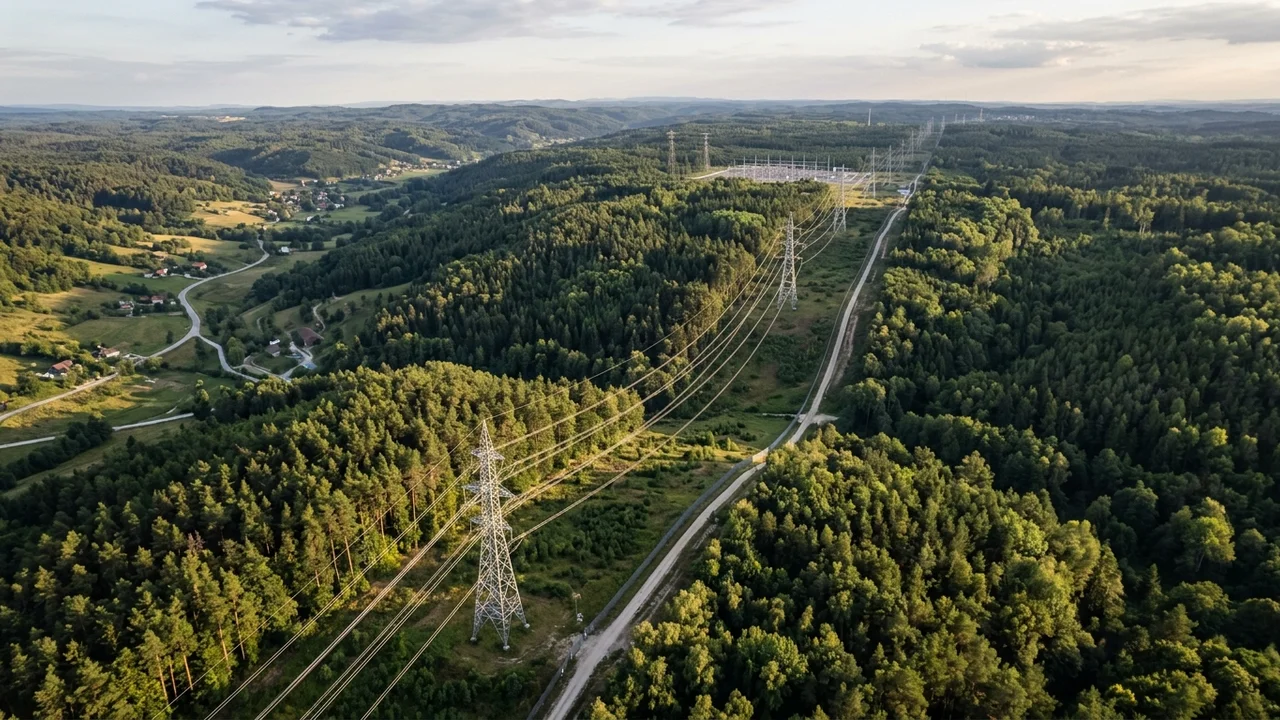
Caption: Physical interconnectors connecting non-exempt third countries to the EU grid are the entry point for CBAM electricity obligations.
What CBAM Means for Electricity Importers
Electricity importers subject to CBAM are EU-established authorized declarants who import electrical energy via physical interconnectors from non-exempt third countries, with the embedded CO₂ per MWh of generation calculated using country-specific grid emission factors published in Implementing Regulation (EU) 2025/2621. This definition has three operative elements: the import must cross a physical interconnector, the origin country must not appear in Annex III of Regulation (EU) 2023/956, and the importer must hold authorized CBAM declarant status before importing.
The breadth of this obligation distinguishes electricity from every other CBAM sector. Quantities are measured in MWh rather than tonnes, and the 50-tonne annual de minimis threshold that exempts small importers of steel, cement, aluminium, fertilizers, and hydrogen does not apply. Article 2(3a), as amended by Regulation (EU) 2025/2083, explicitly excludes electricity and hydrogen from the de minimis exemption. Any volume of electricity imported from a non-exempt country triggers full CBAM compliance requirements. For the full framework covering all sectors and importer obligations, the EU CBAM guide provides the complete regulatory overview.
Which Interconnectors Are Subject to CBAM
Six active interconnectors currently carry electricity from non-exempt third countries into the EU grid, creating live CBAM obligations for importers in France, Belgium, the Netherlands, Greece, Bulgaria, and Spain.
The active interconnectors subject to CBAM obligations are listed below.
- UK to France: IFA (2 GW capacity), IFA2 (1 GW capacity), ElecLink (1 GW capacity)
- UK to Netherlands: BritNed (1 GW capacity)
- UK to Belgium: Nemo Link (1 GW capacity)
- UK to Denmark: Viking Link (1.4 GW capacity, operational from 2024)
- Turkey to Greece and Bulgaria: Multiple 400 kV lines with approximately 0.7 GW total capacity
- Morocco to Spain: Gibraltar AC interconnector with approximately 0.7 GW capacity
- Ukraine: Emergency synchronization with ENTSO-E completed March 2022; ongoing flows subject to CBAM
The UK is the most commercially significant non-exempt electricity-exporting country. The UK's post-Brexit position places it outside the EEA and outside the EU-ETS, and the UK Emissions Trading System operates as a separate, unlinked scheme. UK electricity exports across all interconnectors to France, Belgium, the Netherlands, and Denmark carry CBAM obligations. Whether EU importers of UK electricity can claim an Article 9 carbon price deduction based on UK ETS costs paid by UK generators remains an unresolved grey area as of April 2026, with no Commission guidance issued.
Countries exempt from CBAM for electricity include Norway, Iceland, and Liechtenstein (EEA members participating in the EU ETS), Switzerland (via its linked ETS), and all EU member states as part of the internal market. The Energy Community market coupling exemption under Articles 2(7) to 2(12) of Regulation (EU) 2023/956 was designed for Western Balkans countries, Ukraine, Moldova, and Georgia, requiring full electricity market integration and a binding ETS commitment. No country currently meets both criteria simultaneously as of April 2026.
Caption: Grid carbon intensity by country of origin determines the embedded CO₂ per MWh used in CBAM electricity calculations.
The 5-Condition Actual-Value Test for Electricity
Electricity importers can use actual measured emissions instead of country-specific defaults only when all five conditions of Annex III, point 5 of Regulation (EU) 2023/956 are satisfied simultaneously. Satisfying only four of five conditions is insufficient: all five must apply concurrently for the same import.
The 5 conditions for using actual embedded emissions are listed below.
- A power purchase agreement (PPA) exists with a specific electricity-generating installation
- The installation is directly connected to the EU grid, or no network congestion exists on the relevant interconnector
- The installation emits no more than 550 g CO₂ per kWh at the point of generation
- The electricity has been firmly nominated to allocated interconnection capacity in advance
- Nomination and actual production from that specific installation match within one-hour periods (hourly matching)
Condition 5, the hourly matching requirement, is operationally the most restrictive element. Hourly matching means that for each clock hour during which electricity is imported, the importer must demonstrate that the contracted generator actually produced and delivered that specific MWh into the interconnector during that same hour. Grid balancing, curtailment events, and the physics of alternating current networks make this verification extremely difficult except for dedicated, directly connected installations. In practice, the overwhelming majority of electricity importers use country-specific default values rather than attempting to satisfy all five conditions.
Default Values for Electricity: How They Are Calculated
Country-specific default emission factors for electricity are the standard compliance pathway, not the fallback. Implementing Regulation (EU) 2025/2621 publishes default values representing the weighted average CO₂ intensity of each non-exempt country's electricity generation mix, expressed in tCO₂ per MWh.
The default value calculation approach for electricity differs fundamentally from the mark-up system applied to industrial goods. Steel, cement, aluminium, and hydrogen defaults carry mark-ups of 10% in 2026, 20% in 2027, and 30% from 2028 onward, as specified in IR 2025/2621. Electricity defaults carry no equivalent mark-up because country grid averages are already the primary and intended measurement mechanism, not a punitive fallback. The formula for calculating CBAM obligation under default values is straightforward: MWh imported from Country X × Country X default emission factor (tCO₂/MWh) × CBAM certificate price.
The table below compares the key parameters electricity importers need for their CBAM calculations.
| Parameter | Value | Source |
|---|---|---|
| CN code | 2716 00 00 | Annex I, Regulation (EU) 2023/956 |
| De minimis threshold | None (all volumes subject to CBAM) | Article 2(3a), as amended |
| Emissions scope | Direct generation emissions only (CO₂) | Annex II, post-Omnibus |
| Default value basis | Country-specific grid average tCO₂/MWh | IR 2025/2621 |
| Default mark-up | None (grid average is the standard value) | IR 2025/2621 |
| Actual value conditions | All 5 of Annex III, point 5 must be met simultaneously | Annex III, point 5 |
| Quarterly holding requirement | ≥50% of cumulative embedded emissions | Article 22(2), as amended |
| First declaration deadline | September 30, 2027 (covering 2026 imports) | Article 6, as amended |
| Certificate price basis (2026) | Quarterly average of EU ETS auction prices | Article 22(1a), as amended |
| Certificate price reference (April 2026) | ~€70/tCO₂ (market data, fluctuates daily) | EU ETS market |
The authorization requirement applies to electricity importers identically to all other CBAM sectors. The March 31, 2026 authorization application deadline under Article 17(7a), inserted by Regulation (EU) 2025/2083, applies regardless of sector. Importers who submitted applications by that date may continue importing on a provisional basis while the competent authority processes their file, with a maximum processing time of 120 days from receipt of a complete application. For a complete understanding of all importer obligations under the definitive phase, see the guide to CBAM for EU importers.
How to Calculate Your CBAM Electricity Obligation
Calculating the CBAM obligation for electricity imports is a 4-step process that feeds directly into the annual declaration due September 30, 2027 for calendar year 2026 imports.
The 4 calculation steps for electricity CBAM obligation are listed below.
- Record import volumes by country of origin: For each calendar quarter of 2026, compile total MWh imported per non-exempt country of origin. Use the country of origin of the generating installation, not the country of the interconnector endpoint.
- Apply the country-specific default emission factor: Multiply MWh per country by that country's default emission factor from IR 2025/2621, expressed in tCO₂ per MWh, to obtain total embedded CO₂ in tonnes.
- Apply the CBAM factor: Multiply total embedded CO₂ by the CBAM factor for the relevant year. In 2026, the CBAM factor is 2.5% (with 97.5% of ETS free allocation remaining). This produces the net certificate requirement.
- Determine certificate count and cost: Multiply net certificate requirement by the quarterly average EU ETS auction price for the relevant quarter of importation. For 2026 imports, the certificate price uses quarterly averages under Article 22(1a), not weekly averages. The EU ETS price in late March 2026 was approximately €70 per tCO₂.
An illustrative example: an importer bringing 10,000 MWh from UK generators using a country default of 0.233 tCO₂/MWh accumulates 2,330 tCO₂ embedded emissions. The 2026 CBAM factor of 2.5% produces a net obligation of approximately 58.25 certificates. At €70/tCO₂, the gross financial obligation for that tranche is approximately €4,077 before any Article 9 deduction. Net costs increase significantly from 2029 onward as free allocation phases out, reaching 48.5% coverage reduction by 2030 and full phase-out by January 1, 2034.
What Electricity Importers Must Include in Their CBAM Declaration
The annual CBAM declaration, submitted via the EU CBAM Registry to the national competent authority by September 30, 2027, must contain specific information for electricity imports. Electricity declarations differ from industrial goods declarations in one critical respect: verification by an accredited third-party verifier is required only when using actual values. Importers using country-specific default values do not require third-party verification, because the Commission has already established the accuracy of the published grid average factors through its own methodology.
The declaration must include, for each non-exempt country of origin, the total MWh imported, the default emission factor applied (or the verified actual emission factor if actual values are used), the resulting total embedded CO₂ in tonnes, the number of CBAM certificates to be surrendered after applying the CBAM factor, and any Article 9 deductions claimed based on carbon prices effectively paid by generators in the country of origin. The record-keeping period runs to the end of the fourth year following the declaration year, meaning 2026 import records must be retained until the end of 2031 under Article 6(6), as amended.
Supplementary Topics for Electricity Importers
Does the CBAM Electricity Sector Use the Same Default Mark-Up as Other Sectors?
No. The CBAM electricity sector guide explains this distinction in full: electricity defaults from IR 2025/2621 are grid-average emission factors, not values derived from the industrial benchmark mark-up schedule that applies to steel, cement, aluminium, and hydrogen. The 10%/20%/30% mark-up schedule in IR 2025/2621 applies to industrial goods only. Electricity importers using country defaults receive the unadjusted grid average, making default compliance structurally more straightforward for electricity than for most other sectors. For detailed figures on the grid emission factors used in CBAM calculations, the CBAM electricity default values page provides country-specific data and the methodology behind each factor.
Can Electricity Importers Claim an Article 9 Deduction?
Electricity importers can claim an Article 9 deduction if the generators in the exporting country effectively paid a legally binding carbon price for the specific embedded emissions of the exported electricity. The deduction reduces the number of CBAM certificates to surrender proportionally. The Commission must have formally recognized the carbon pricing scheme for the deduction to apply, and the published list of qualifying schemes is expected from 2027 onward. UK generators operating under the UK ETS present the most commercially significant open question: whether UK ETS costs paid by generators qualify as an effectively paid carbon price for Article 9 purposes remains unresolved as of April 2026. Voluntary carbon offsetting schemes and internal corporate carbon prices categorically do not qualify. For the full methodology behind embedded emission calculations, see how embedded emissions are calculated.
Is There a De Minimis Exemption for Small Electricity Importers?
No de minimis exemption exists for electricity importers. Article 2(3a) of Regulation (EU) 2023/956, as amended by Regulation (EU) 2025/2083, sets the 50-tonne annual mass threshold exclusively for importers of steel, cement, aluminium, fertilizers, and certain other goods. Electricity and hydrogen are explicitly excluded. Every MWh imported from a non-exempt country requires full CBAM compliance regardless of total import volume. This makes electricity one of the two sectors with no threshold relief, alongside hydrogen. Importers who previously relied on the pre-Omnibus monetary threshold of €150 per consignment should note that this threshold no longer exists under any CBAM framework. The current de minimis rules for all sectors are covered in the CBAM de minimis threshold guide.
Are Default Values Always Financially Worse Than Actual Values for Electricity?
Not necessarily in 2026, and this is a critical planning consideration. For industrial goods, default values are deliberately set above typical actual emission intensities and carry the 10% mark-up in 2026, creating a financial incentive to measure and verify. For electricity, the default is the country grid average, which reflects a mix of generation sources. An importer sourcing electricity exclusively from a gas-fired plant in a country with a coal-heavy grid average may find that the country default understates the actual emissions of their specific supply. Conversely, an importer sourcing from a wind or nuclear generator in the same country benefits from the grid average obscuring the low actual emissions. The CBAM default values guide covers how defaults are set across all sectors and how importers can assess their actual versus default exposure.
How Does the Quarterly Holding Requirement Apply to Electricity Imports?
The quarterly holding requirement under Article 22(2), as amended by Regulation (EU) 2025/2083, applies to electricity importers from 2027 onward. At the end of each calendar quarter, the authorized declarant must hold CBAM certificates in their registry account equal to at least 50% of the cumulative embedded emissions from all CBAM imports since the start of that calendar year, adjusted for the applicable CBAM factor. Certificates become available for purchase from February 1, 2027. For 2026 imports, the quarterly holding requirement does not apply because certificates cannot be purchased until 2027, and the first declaration covering 2026 is due September 30, 2027. The national competent authority sends a formal notice if the 50% threshold is not met at any quarter-end.
What Records Must Electricity Importers Retain?
Electricity importers must retain all records supporting the annual CBAM declaration until the end of the fourth year following the declaration year, per Article 6(6) as amended. Records include customs and import documentation showing MWh volumes and interconnector crossing data, the default emission factor version from IR 2025/2621 used for each country and declaration year, CBAM certificate purchase confirmations, Article 9 deduction calculations and supporting evidence if any deduction is claimed, and all correspondence with national competent authorities regarding the declaration or authorization. Physical inspection by competent authorities requires no advance notice, and inspectors may request any document within the retention period.