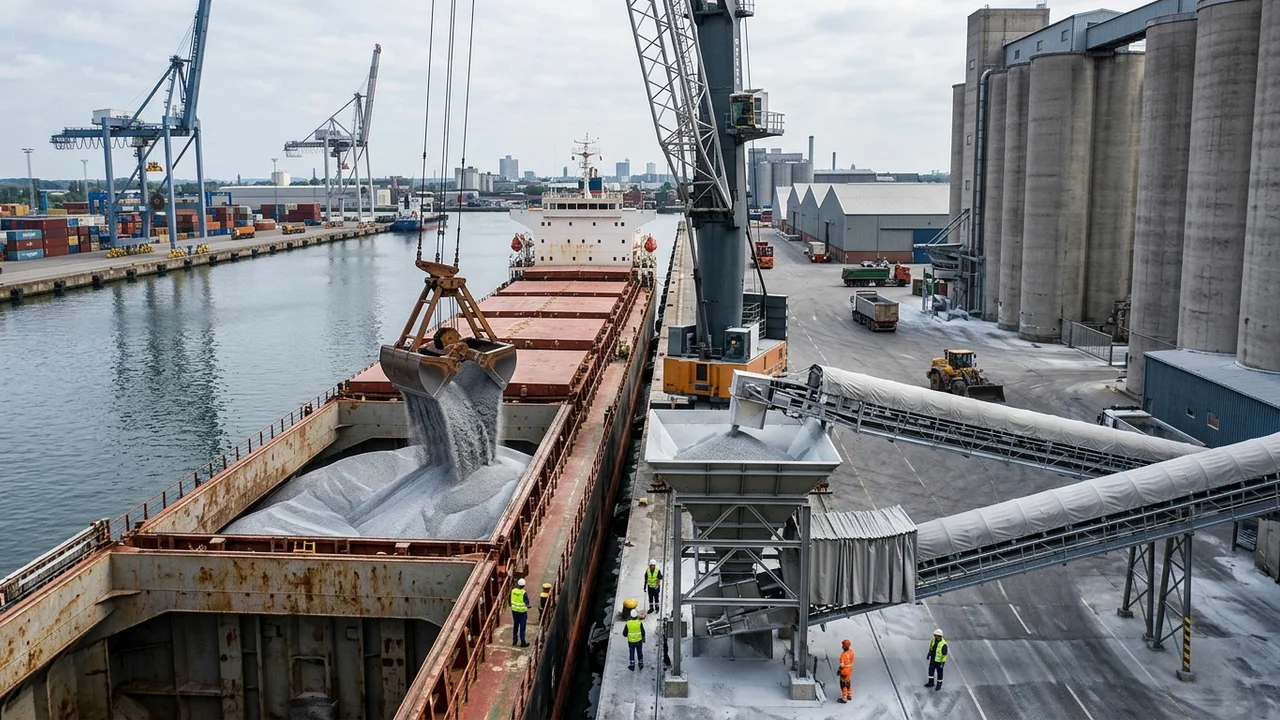
Fertilizer importers face a higher CBAM compliance burden than most other sectors because urea carries an embedded emission factor of approximately 2.5 tCO₂e per tonne, and the obligation covers both direct CO₂ from natural gas reforming and direct N₂O from nitric acid production. Under the EU CBAM guide framework established by Regulation (EU) 2023/956, the definitive phase began on January 1, 2026, requiring every EU importer above the 50-tonne annual de minimis threshold to hold authorized declarant status before importing. This guide covers the 10 compliance steps specific to nitrogen fertilizers, including urea (CN 3102 10), anhydrous ammonia (CN 2814 10 00), ammonium nitrate (CN 3102 30), and UAN solutions (CN 3102 80).
Caption: Haber-Bosch ammonia synthesis is the production origin of all CBAM-covered nitrogen fertilizers, including urea, AN, and UAN.
What Makes Fertilizers a Distinct CBAM Sector
Fertilizers are one of two CBAM sectors where both direct and indirect emissions are priced, alongside cement, because EU fertilizer producers do not receive EU ETS compensation for electricity consumption in production. The fertilizer sector also covers N₂O, a greenhouse gas with a global warming potential of 265 times CO₂ per the IPCC AR5 methodology, arising from nitric acid production in the ammonium nitrate and UAN production chains.
Fertilizer compliance is distinctive in two further respects. First, the default value mark-up for fertilizers is only 1% above the calculated country-specific average (under Implementing Regulation (EU) 2025/2621), compared to 10% in 2026 rising to 30% from 2028 for all other CBAM sectors. The Commission explicitly cited agricultural price sensitivity and food security in justifying this lower mark-up. Second, urea and ammonia rank among the highest-volume nitrogen compounds traded globally, meaning importers often handle dozens of production installations across multiple origin countries, each requiring separate embedded emissions data.
The calculation methodology for fertilizers follows Equation 65 of Implementing Regulation (EU) 2025/2547, which allocates embedded emissions proportionally to the exact nitrogen content (in kilograms per tonne) of the final product. Importers who source urea from Egypt, Algeria, or Trinidad and Tobago will encounter different default values for each origin, requiring installation-level tracking from the point of customs entry.
CBAM Emission Factors for Key Fertilizer Products
The four emission factors below represent the production-stage CO₂e intensity used to calculate certificate obligations. N₂O from soil application of fertilizers is outside CBAM scope; only production-stage N₂O is counted.
The emission factors for the four principal covered products are listed below.
- Anhydrous ammonia (CN 2814 10 00): approximately 1.6–2.0 tCO₂e per tonne
- Urea at 46% N content (CN 3102 10): approximately 2.3–2.6 tCO₂e per tonne
- Ammonium nitrate (CN 3102 30): approximately 1.5–2.0 tCO₂e per tonne
- UAN solutions at 30% N (CN 3102 80): approximately 1.0–1.5 tCO₂e per tonne
At the current EU ETS price of approximately €70 per tCO₂ (late March 2026 market reference, subject to daily fluctuation), gross CBAM cost for urea reaches approximately €175 per tonne. Net cost in 2026 remains low because the CBAM factor is only 2.5%, reflecting the 97.5% of free allocation that remains in the EU ETS. A 10,000-tonne urea import at 2.5 tCO₂/t generates 25,000 tCO₂ gross, requiring certificate coverage for 625 tCO₂ (2.5%), costing approximately €43,750 at €70/tCO₂. That net obligation rises sharply: the CBAM factor reaches 48.5% by 2030, making early compliance infrastructure investments directly relevant to the financial planning horizon.
The 10-Step CBAM Compliance Process for Fertilizer Importers
Fertilizer importers follow the same 10-step process described for CBAM for EU importers generally, with three steps that carry sector-specific complexity: emission factor selection (Step 5), verifier engagement for ammonia precursors (Step 6), and the Article 9 deduction calculation for origin countries with partial carbon pricing (Step 8).
The complete 10-step process for fertilizer importers is outlined below.
- Verify CN code coverage. Check each product against Annex I of Regulation (EU) 2023/956. Covered CN codes for fertilizers include 2808 (nitric acid), 2814 (ammonia), 2834 (potassium nitrate), 3102 10 through 3102 80, and 3105 (mixed N-P-K fertilizers, except 3105 60 00 which contains no nitrogen). Phosphorus-potassium-only fertilizers under CN 3105 60 00 are not covered.
- Check the 50-tonne de minimis threshold. If your total annual net mass of all CBAM goods across all sectors is 50 tonnes or less, you are exempt under Article 2(3a) as amended by Regulation (EU) 2025/2083. Calculate this across your entire CBAM import portfolio, not per product.
- Confirm origin country exemptions. Goods originating in Iceland, Liechtenstein, Norway, or Switzerland are exempt under Annex III. All other origins, including Russia, Egypt, Algeria, Ukraine, and Trinidad and Tobago, are subject to CBAM obligations.
- Apply for authorized CBAM declarant status. File via the Authorization Management Module of the CBAM Registry before March 31, 2026 (Article 17(7a), inserted by Regulation (EU) 2025/2083) to continue importing provisionally while the application is processed. The competent authority has 120 days from a complete application to issue a decision per IR 2025/486.
- Collect embedded emissions data from producers. For fertilizers, this means direct CO₂ from natural gas reforming, CO₂ incorporated in urea synthesis, N₂O from nitric acid units (for AN and UAN), and indirect electricity emissions. Producers who cannot supply verified data trigger the use of IR 2025/2621 default values, subject to the 1% mark-up for fertilizers.
- Engage an accredited verifier. Verification is required for actual values only; using defaults requires no verification. Verifiers must register in the CBAM Registry from September 1, 2026, and must conduct a physical site visit to the production installation for the first verification period. With the declaration deadline of September 30, 2027, importers sourcing from multiple countries face a tight 13-month window to complete site visits globally. Verifier fees range from €5,000 to €50,000 per installation.
- Purchase CBAM certificates. Certificate sales begin February 1, 2027 via the national competent authority. The price for 2026 imports is the quarterly average EU ETS auction clearing price for each quarter of importation (Article 22(1a)). No secondary market exists; certificates can only be purchased from and sold back to the national competent authority.
- Apply Article 9 deductions for carbon prices paid in origin countries. Russia and Egypt currently have no qualifying carbon pricing schemes. South Korea (K-ETS) is under Commission assessment and may qualify. The deduction reduces certificates proportionally to the foreign carbon price effectively paid, meaning free allocations or government rebates received by the producer reduce the deductible amount.
- Submit the annual CBAM declaration. The first declaration covers calendar year 2026 and is due September 30, 2027 (Article 6 as amended). The declaration reports total tonnage by CN code and country of origin, specific embedded emissions per type, certificates to surrender, and any Article 9 deductions claimed with supporting documentation.
- Retain all records for 4 years. Keep customs declarations, producer emissions data, monitoring plan documentation, verification reports, and certificate purchase and surrender confirmations until the end of the 4th year after the declaration year.
CBAM Certificate Cost Reference for Fertilizer Importers
The table below shows gross CBAM certificate costs for the three most traded nitrogen fertilizer products at reference ETS price points. All figures represent gross cost before the free allocation CBAM factor adjustment.
| Product | Emission Factor (tCO₂e/t) | Gross Cost @ €50/tCO₂ | Gross Cost @ €70/tCO₂ | Gross Cost @ €100/tCO₂ |
|---|---|---|---|---|
| Urea (46% N) | ~2.5 | €125/t | €175/t | €250/t |
| Ammonium nitrate | ~1.75 (midpoint) | €87.50/t | €122.50/t | €175/t |
| Anhydrous ammonia | ~1.8 (midpoint) | €90/t | €126/t | €180/t |
| UAN solution (30% N) | ~1.25 (midpoint) | €62.50/t | €87.50/t | €125/t |
Net costs in 2026 are 2.5% of the gross figures shown. An importer sourcing 20,000 tonnes of urea at €175/t gross faces a net certificate obligation of approximately €87,500 for the full year 2026, rising to approximately €850,750 by 2030 as the CBAM factor reaches 48.5%.
Caption: Urea carries the highest gross CBAM cost of all nitrogen fertilizer products at approximately €175 per tonne at the current €70 ETS reference price.
How the Fertilizers Sector Fits Within CBAM Compliance
The CBAM fertilizers sector guide covers the full regulatory classification, CN code detail, and production chemistry in depth. The compliance steps above represent the importer-facing obligations; the structural context of how fertilizers interact with EU carbon pricing policy belongs to the sector framework.
Russia and Belarus historically supplied approximately 34% of EU nitrogen fertilizer imports. Post-July 2025, Russian exports to the EU declined by approximately two-thirds following the additional EU tariffs of €40–45 per tonne (rising to €315–430 per tonne by July 2028). Egypt now represents approximately 41% of EU urea imports, Algeria approximately 17%, with the remainder distributed among domestic EU producers and other non-EU origins. CBAM certificates apply to all non-exempt origins regardless of tariff status.
Does the CBAM De Minimis Exemption Apply to Fertilizer Imports?
The 50-tonne annual de minimis threshold applies to fertilizers. Importers whose total net mass of all CBAM goods across all sectors is 50 tonnes or less per year are exempt from CBAM obligations under Article 2(3a) of Regulation (EU) 2023/956 as amended. Small agricultural traders importing limited volumes for domestic distribution qualify for this exemption. The threshold is calculated across an importer's entire CBAM portfolio, not per product category, so an importer handling 40 tonnes of urea and 30 tonnes of steel in the same year exceeds the combined 50-tonne threshold and loses the exemption entirely.
Does CBAM Cover N₂O from Fertilizer Application in the Field?
N₂O from soil application of fertilizers is not covered by CBAM. Only production-stage N₂O is within the CBAM scope, specifically N₂O generated during nitric acid production in the manufacturing of ammonium nitrate and UAN solutions. This production-stage N₂O carries a global warming potential of 265 per IPCC AR5 methodology, making it a material contributor to the embedded emission factor for AN and UAN products. Importers sourcing urea (which contains no nitric acid production step) from Egypt or Algeria face CO₂-only obligations, not N₂O obligations.
Can Fertilizer Importers Use Default Values Instead of Verified Actual Data?
Fertilizer importers can use default values from IR 2025/2621 without third-party verification. Default values carry a mark-up of only 1% above the country-specific calculated average for fertilizers, compared to 10% in 2026 rising to 30% from 2028 for all other CBAM sectors. This low mark-up reflects the Commission's food security policy judgment. The practical result is that the financial incentive to invest in actual emissions measurement and third-party verification is lower for fertilizers than for steel or cement importers. Importers should compare the cost of verification against the potential savings from actual emissions data before committing to either approach.
Are Fertilizer Importers Required to Verify Ammonia Separately from Urea?
Ammonia (CN 2814 10 00) is classified as a standalone CBAM good and carries its own embedded emission obligation when imported directly. When ammonia is imported as a precursor and processed into urea or AN inside the EU, the embedded emissions from that ammonia production are incorporated into the finished fertilizer's calculation. Importers who bring ammonia into the EU for on-site processing must declare it separately from their finished fertilizer import obligations. The calculation method under Equation 65 of IR 2025/2547 allocates upstream ammonia emissions proportionally to nitrogen content in the final product.
Is There a Carbon Price Deduction Available for Egyptian or Algerian Urea?
Egypt and Algeria currently have no qualifying carbon pricing schemes recognized by the European Commission for the purposes of an Article 9 deduction. South Korea operates the K-ETS and is under Commission assessment for potential recognition. Until the Commission publishes its recognized schemes list (expected from 2027), EU importers sourcing from Egypt, Algeria, Russia, or Trinidad and Tobago cannot claim any Article 9 deduction and must surrender the full certificate volume calculated from embedded emissions.
For detail on how the Article 9 mechanism is calculated and which schemes are under assessment, see how embedded emissions are calculated and the Commission's pending recognition list.
What Happens If a Fertilizer Importer Misses the March 2026 Authorization Deadline?
Importing CBAM goods without authorization after the definitive phase began on January 1, 2026 exposes an importer to penalties of €300–500 per tonne CO₂e under Article 26(2) of Regulation (EU) 2023/956. This is 3 to 5 times the standard penalty of €100 per tonne CO₂e that applies to authorized declarants who fail to surrender sufficient certificates. Importers who applied by March 31, 2026 may continue importing provisionally while their authorization application is processed. Those who missed this deadline face an immediate compliance gap. The competent authority has 120 days from a complete application to issue a decision, meaning applications submitted in April 2026 may resolve by August 2026 at the earliest.
Do CBAM Obligations Apply to Mixed N-P-K Fertilizers?
Mixed mineral fertilizers containing nitrogen are covered under CN 3105, except CN 3105 60 00 (phosphorus-potassium fertilizers with no nitrogen content). For covered N-P-K blends, embedded emissions are calculated proportionally to nitrogen content using Equation 65 of IR 2025/2547. Importers must identify the nitrogen fraction (in kg/t) of each blended product and apply the relevant emission factors to that nitrogen content. Phosphorus and potassium components carry no CBAM obligation.
What Is the Buyback Rule for Fertilizer Importers Who Over-Purchase Certificates?
Fertilizer importers who purchase more CBAM certificates than their verified emissions require can sell back up to 50% of the certificates purchased in that calendar year at the original purchase price, with a buyback deadline of October 31 of the surrender year (Article 23 as amended by Regulation (EU) 2025/2083). Certificates not surrendered or sold back by November 1 are cancelled. This provision allows importers to over-purchase as a hedge against mid-year volume uncertainty, knowing that up to half of over-purchased certificates can be recovered at cost.
For more on how the buyback calculation interacts with the de minimis threshold, see CBAM de minimis threshold and CBAM default values.
Importers concerned about the financial impact of CBAM on their supply chain can also review the CBAM impact on fertilizer exporters to understand how their non-EU suppliers are managing the data and emissions verification requirements that feed directly into the importer's declaration.