CBAM steel obligations became legally binding for EU importers on January 1, 2026, covering more than 40 CN codes across Chapters 72 and 73 of the Combined Nomenclature. The EU carbon border adjustment mechanism requires every authorized declarant importing steel to calculate embedded emissions, engage an accredited verifier, purchase CBAM certificates, and file an annual declaration by September 30, 2027 for the 2026 import year. This guide covers exactly which CN codes apply, how the three production-route benchmarks translate into certificate costs at the current EU ETS price of approximately €70 per tonne CO₂e, and the full 11-step compliance process an EU importer must execute.
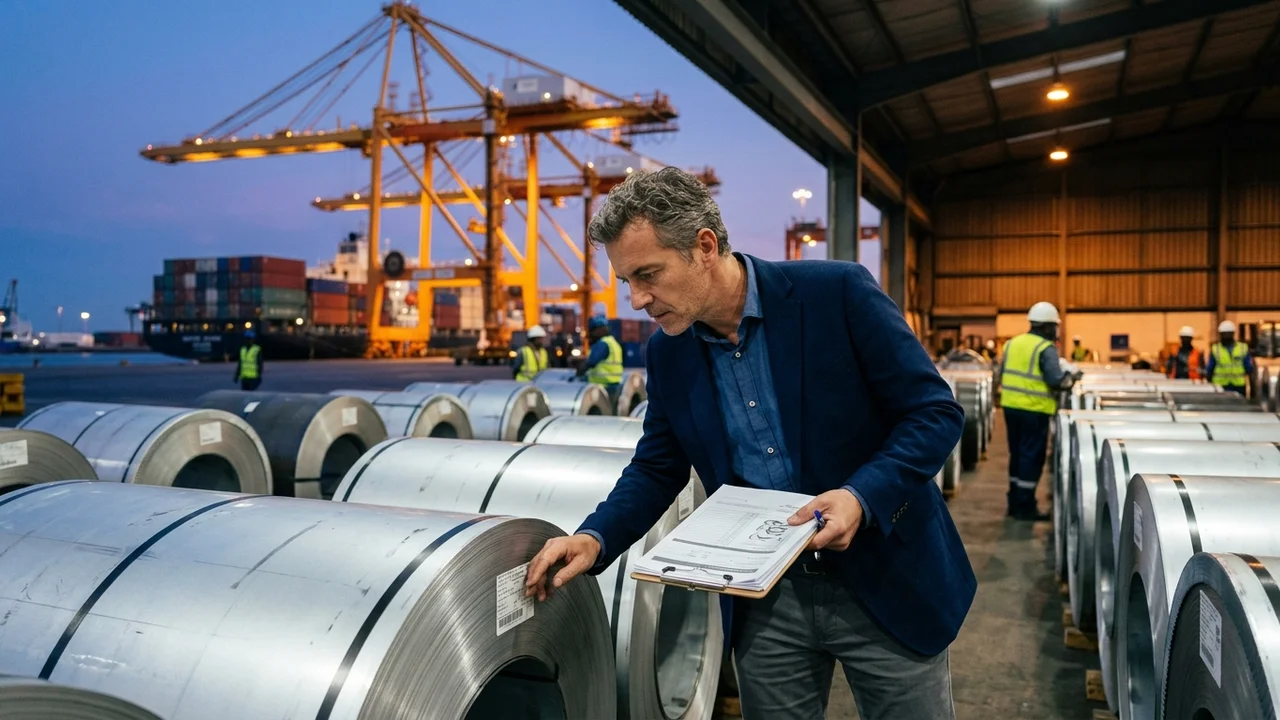
Caption: CBAM steel covers both primary and secondary production routes, with BF-BOF carrying the highest embedded emissions benchmark of 1.370 tCO₂e per tonne of crude steel.
Which Steel CN Codes Fall Under CBAM Scope
CBAM steel scope covers 40-plus CN codes, with the BF-BOF production route carrying the highest embedded emissions. The regulation draws from two chapters: Chapter 72 (iron and steel) and Chapter 73 (articles of iron or steel). Ferrous waste and scrap (7204) is explicitly excluded because secondary scrap input is zero-rated for embedded emissions purposes under Regulation (EU) 2023/956.
The table below lists the primary CN code ranges in scope, together with the official benchmark values from Implementing Regulation (EU) 2025/2621 and estimated gross CBAM costs at an EU ETS price of €70 per tonne CO₂e.
| CN Code Range | Product Description | Production Route | Official Benchmark (tCO₂e/t) | Gross CBAM Cost @ €70/tCO₂ |
|---|---|---|---|---|
| 7201 | Pig iron and spiegeleisen | BF-BOF precursor | 1.370 | ~€95.90/t |
| 7206–7207 | Steel ingots and semi-finished products | BF-BOF / EAF | 1.370 / 0.072 | ~€95.90 / ~€5.04/t |
| 7208–7212 | Flat-rolled products, non-alloy steel | BF-BOF / EAF | 1.370 / 0.072 | ~€95.90 / ~€5.04/t |
| 7213–7217 | Bars, rods, wire, non-alloy steel | BF-BOF / EAF | 1.370 / 0.072 | ~€95.90 / ~€5.04/t |
| 7218–7229 | Stainless steel semi-finished and finished | BF-BOF / DRI-EAF | 1.370 / 0.481 | ~€95.90 / ~€33.67/t |
| 7301–7302 | Sheet piling, railway material | BF-BOF | 1.370 | ~€95.90/t |
| 7303–7307 | Tubes, pipes, and fittings | BF-BOF / EAF | 1.370 / 0.072 | ~€95.90 / ~€5.04/t |
| 7308–7311 | Structures, reservoirs, containers | BF-BOF | 1.370 | ~€95.90/t |
| 7318, 7326 | Fasteners and other articles (selected) | BF-BOF / EAF | 1.370 / 0.072 | ~€95.90 / ~€5.04/t |
Gross costs are before applying the CBAM factor. In 2026, the CBAM factor is 2.5% (97.5% of EU ETS free allocation remains), so net certificate costs in 2026 are 2.5% of the gross figure above. A BF-BOF net cost at €70 ETS price is approximately €2.40 per tonne in 2026.
Route classification rule: When more than 50% of crude steel mass originates from scrap, the Scrap-EAF benchmark of 0.072 tCO₂e per tonne applies. When more than 50% originates from DRI, the DRI-EAF benchmark of 0.481 tCO₂e per tonne applies. All other cases default to the BF-BOF benchmark of 1.370 tCO₂e per tonne.
The CBAM steel guide provides a complete sector breakdown including country-of-origin exposure, default values for China, India, and Turkey, and the circumvention risk profile for Vietnamese processing routes.
How Embedded Emissions Are Calculated for Steel
Embedded emissions for CBAM steel are direct emissions only: electricity consumption at the steel mill is excluded because steel is listed in Annex II of Regulation (EU) 2023/956. This is a critical compliance distinction. An EU importer sourcing hot-rolled coil from a Chinese BF-BOF facility must obtain the specific direct CO₂ emissions per tonne of crude steel produced at that installation, not total lifecycle emissions.
The calculation method follows Implementing Regulation (EU) 2025/2547. Specific embedded emissions are expressed in tonnes CO₂e per tonne of goods. For downstream steel products (cold-rolled coil at 7209, coated products at 7210), embedded emissions from the precursor hot-rolled coil (7208) carry through via mass-balance allocation. An EU importer of cold-rolled strip must therefore trace embedded emissions back to the upstream casting and rolling stages at the original production installation.
Three data sources are available to EU importers, in order of financial preference:
- Verified actual data: The non-EU producer measures and verifies its specific embedded emissions using a monitoring plan. An accredited verifier must issue a site-visit verification report before the September 30, 2027 declaration deadline.
- Commission default values (IR 2025/2621): Country-specific and product-specific values with a mark-up of 10% above the calculated default in 2026, rising to 20% in 2027 and 30% from 2028. The China steel slab default is 3.167 tCO₂e per tonne, substantially above the BF-BOF benchmark of 1.370.
- Own calculation using Commission templates: Available where monitoring data exists but third-party verification is not yet complete.
For more detail on how embedded emissions are calculated for each production route, see how embedded emissions are calculated.
The 11-Step CBAM Compliance Process for Steel Importers
EU importers of CBAM steel goods follow an 11-step compliance process spanning authorization, data collection, verification, certificate purchase, and annual declaration. The steps below are ordered chronologically for an importer beginning compliance in 2026.
Step 1: Confirm CBAM Applies to Your Steel Imports
Three conditions must be checked simultaneously before any other compliance work begins. First, verify that your steel product's CN code appears in Annex I of Regulation (EU) 2023/956. Second, calculate total annual net mass of all CBAM goods across all six sectors. If total net mass is below 50 tonnes per year (the de minimis threshold under Article 2(3a), as amended by Regulation (EU) 2025/2083), CBAM does not apply. Third, confirm the country of origin is not Iceland, Liechtenstein, Norway, or Switzerland, as those countries are exempt under Annex III.
Step 2: Apply for Authorized CBAM Declarant Status
The authorization application deadline is March 31, 2026. Importers who applied by that date may continue importing provisionally while the application is processed. Applications are filed via the Authorization Management Module of the EU CBAM Registry (cbam.ec.europa.eu) with the competent authority of the member state of establishment. Required documents include a valid EORI number, tax identification number, 5-year customs compliance history, and a description of the CBAM steel goods to be imported including CN codes and production installation details. Processing takes a maximum of 120 days from a complete application.
Importing CBAM steel without authorization carries a penalty of €300 to €500 per tonne CO₂e (3 to 5 times the standard rate) under Article 26(2) of the regulation.
Step 3: Access the CBAM Registry
After authorization, the national competent authority creates a CBAM account within the EU CBAM Registry operated by DG TAXUD. Authentication uses the UUM&DS system. The account holds certificate purchase records, import transaction records drawn from customs data, and the annual declaration module. Certificate purchases are possible from February 1, 2027.
Step 4: Classify All Steel Import Shipments
For each import shipment of CBAM steel goods, record the CN code, net mass in tonnes, country of origin per EU customs origin rules (not country of shipment), and the name, address, and geographical coordinates of the production installation. Production route (BF-BOF, DRI-EAF, or Scrap-EAF) must also be recorded. This data forms the basis of the annual declaration and cannot be reconstructed retrospectively from customs records alone.
Step 5: Obtain Embedded Emissions Data from Steel Producers
Obtaining verified embedded emissions data from non-EU steel mills is the operationally most demanding step in CBAM steel compliance. The EU importer must collect specific direct embedded emissions per tonne of goods, the production route classification, and a reference to the monitoring plan at the production installation. The Commission operates a CBAM Operators Portal where non-EU installation operators can upload and share emissions data directly with their EU customers.
If the steel producer refuses to provide data or lacks the monitoring infrastructure, the importer falls back to default values from IR 2025/2621. For steel, the default mark-up rises from 10% in 2026 to 30% from 2028, making defaults increasingly expensive over time.
Step 6: Engage an Accredited Verifier
Third-party verification by an accredited verifier is required for all actual embedded emissions data submitted in an annual declaration. Verifiers must be accredited under EN ISO/IEC 14065 by an EA-recognized national accreditation body and registered in the CBAM Registry, which opens for verifier registration on September 1, 2026. For 2026 import data, a physical site visit to the non-EU steel production installation is mandatory. Fees range from €5,000 to €50,000 per installation depending on size and complexity. Importers with steel supply chains spanning India, Turkey, or South Korea should contract verifiers in April 2026 to secure scheduling capacity before the September 30, 2027 declaration deadline.
Step 7: Purchase CBAM Certificates
Certificate sales open on February 1, 2027 via each national competent authority. For 2026 imports, the certificate price is the quarterly average of EU ETS auction closing prices during each quarter of importation (Article 22(1a), as amended). The current EU ETS price is approximately €70 per tonne CO₂e (Q1 2026 range: €66 to €90). Certificates cannot be traded on a secondary market. The quarterly holding requirement from 2027 onward requires the authorized declarant to hold CBAM certificates covering at least 50% of cumulative embedded emissions of all CBAM goods imported since the start of each calendar year.
Step 8: Assess Article 9 Carbon Price Deductions
If the non-EU steel producer has effectively paid a legally binding carbon price in the country of origin for the specific embedded emissions of the exported goods, the importer can apply an Article 9 deduction to reduce the number of certificates to surrender. South Korea's K-ETS is under Commission assessment for qualification as of April 2026. Turkey and India have no qualifying carbon pricing schemes. China's ETS covers electricity generation only and does not extend to the steel sector in 2026.
Step 9: Submit the Annual CBAM Declaration
The first annual declaration covers calendar year 2026 imports and is due by September 30, 2027. The declaration must specify total quantity of CBAM steel goods imported by CN code and country of origin, total specific embedded emissions by goods type and country of origin, total CBAM certificates to surrender, any Article 9 deductions claimed with supporting documentation, and verification report references. At the moment of filing, CBAM certificates equal to net verified embedded emissions are surrendered and cancelled.
Step 10: Exercise the Buyback Option if Needed
EU importers who purchased more certificates than required may sell back up to 50% of certificates purchased in that calendar year at the original purchase price. The buyback deadline is October 31 of the surrender year. Certificates not surrendered or bought back by November 1 are cancelled without compensation.
Step 11: Maintain Records for Audit Readiness
All CBAM compliance records must be retained until the end of the 4th year following the declaration year, approximately 4 to 5 years from the date of import. Records include customs declarations for all CBAM steel goods, embedded emissions monitoring data from producers, verification reports, certificate purchase and surrender confirmations, Article 9 deduction calculations, and communications with producers and verifiers.
Key Deadlines for CBAM Steel Importers in 2026 and 2027
The deadline sequence below applies to EU importers covering 2026 steel import volumes. Missing the authorization deadline is the most critical risk: importers without authorization face the unauthorized penalty rate of €300 to €500 per tonne CO₂e rather than the standard €100 per tonne CO₂e for authorized declarants who fail to surrender sufficient certificates.
The 6 key deadlines for 2026 CBAM steel compliance are listed below.
- March 31, 2026: Authorization application deadline for provisional importing during the definitive phase (Article 17(7a), Regulation (EU) 2025/2083)
- September 1, 2026: Verifier registration opens in the CBAM Registry; begin contracting verifiers immediately if not already done
- December 31, 2026: End of the first calendar year for which a declaration is required; all 2026 import data must be collected by this date
- February 1, 2027: Certificate sales begin via national competent authorities
- September 30, 2027: First annual CBAM declaration due, covering all 2026 CBAM steel imports
- October 31, 2027: Buyback deadline for excess 2026 certificates
Caption: The authorization deadline of March 31, 2026 is the most time-critical step; importers without authorization face the €300–500 per tonne CO₂e penalty rate.
What Does CBAM Mean for Steel Importers Beyond 2026
The financial impact of CBAM steel compliance grows sharply after 2026 as the EU ETS free allocation phase-out accelerates. In 2026, the CBAM factor is 2.5%, meaning the net certificate cost is 2.5% of the gross embedded emissions liability. By 2030, the CBAM factor reaches 48.5%, and by 2034, free allocation is fully eliminated. At a consensus forecast ETS price of €126 per tonne CO₂e in 2030, a BF-BOF steel importer faces a gross CBAM cost of approximately €172.62 per tonne (1.370 tCO₂e × €126) before the CBAM factor. Net cost in 2030: approximately €83.72 per tonne.
EU importers sourcing from India, Turkey, Vietnam, and China face the highest exposure. Turkey exports approximately 2.59 million tonnes of steel to the EU annually with no qualifying carbon pricing scheme. India exports approximately 4.33 million tonnes annually, also without a qualifying scheme as of April 2026. Importers buying from South Korea (approximately 3.38 million tonnes annually) may benefit from an Article 9 deduction once the K-ETS receives Commission recognition.
CBAM compliance for importers at scale integrates into supply chain contracts, supplier selection, and capital planning. The CBAM compliance for importers hub covers the full obligation structure including authorization, certificate purchasing, quarterly holding, and record-keeping obligations applicable to all six CBAM sectors.
How Does CBAM Affect Steel Importers Compared to Steel Exporters?
CBAM obligations fall entirely on the EU importer, not on the non-EU exporter. The EU importer holds the legal obligation to obtain authorization, collect embedded emissions data, purchase certificates, and surrender them at declaration. The non-EU steel exporter has no legal obligation under Regulation (EU) 2023/956. Exporters provide emissions data voluntarily to reduce their EU customers' CBAM costs. The steel exporter perspective explains what non-EU steel producers can do to support their EU buyers and reduce overall CBAM liability.
Is Scrap-Based Steel (EAF) Exempt from CBAM?
Scrap-based steel (Scrap-EAF route) is not exempt from CBAM, but its benchmark of 0.072 tCO₂e per tonne of crude steel makes it 19 times less expensive than BF-BOF steel under CBAM. At €70 per tonne CO₂e, the gross certificate cost for Scrap-EAF steel is approximately €5.04 per tonne compared to €95.90 per tonne for BF-BOF. The zero-rating applies to the recycled scrap input itself, not to the final steel product.
Can EU Steel Importers Use Default Values Instead of Verified Data?
EU importers can use default values from IR 2025/2621 without requiring third-party verification. Using defaults removes the cost and complexity of engaging an accredited verifier. The trade-off is financial: the China steel slab default of 3.167 tCO₂e per tonne is 2.31 times higher than the BF-BOF benchmark of 1.370. At €70 per tonne CO₂e, this default generates a gross certificate cost of approximately €221.69 per tonne versus €95.90 for a producer with verified actual emissions at the benchmark level. The mark-up on defaults rises from 10% in 2026 to 30% from 2028, making actual measurement increasingly valuable.
What Happens If an EU Steel Importer Misses the Declaration Deadline?
Failure to surrender sufficient CBAM certificates by September 30, 2027 triggers a penalty of €100 per tonne CO₂e not covered (Article 26(1), as amended by Regulation (EU) 2025/2083). This penalty applies to authorized declarants. Importers without authorization face €300 to €500 per tonne CO₂e. Penalties are inflation-adjusted from the base year. The competent authority also issues a notice requiring the shortfall to be remedied, but the penalty accrues from the deadline regardless of remedy.
Does CBAM Apply to Steel Imported via Third Countries?
CBAM applies based on the country of origin under EU customs origin rules, not the country from which the goods were exported. Steel produced in China and shipped via Turkey is attributed to China for CBAM purposes. This is significant for circumvention risk: Vietnamese processing of Chinese hot-rolled coil is flagged as high risk in the regulation's anti-circumvention provisions (Article 27), and the Commission actively monitors import patterns for origin manipulation.
Where Can EU Steel Importers Calculate Their CBAM Costs?
EU importers can estimate their CBAM certificate costs using the CBAM cost calculator, which applies the current EU ETS price, the applicable benchmark or default value, and the CBAM factor for the relevant compliance year. The calculator covers all three steel production routes (BF-BOF at 1.370, DRI-EAF at 0.481, and Scrap-EAF at 0.072) and outputs both gross and net cost per tonne. For certificate purchase mechanics and registry procedures, see CBAM certificates.