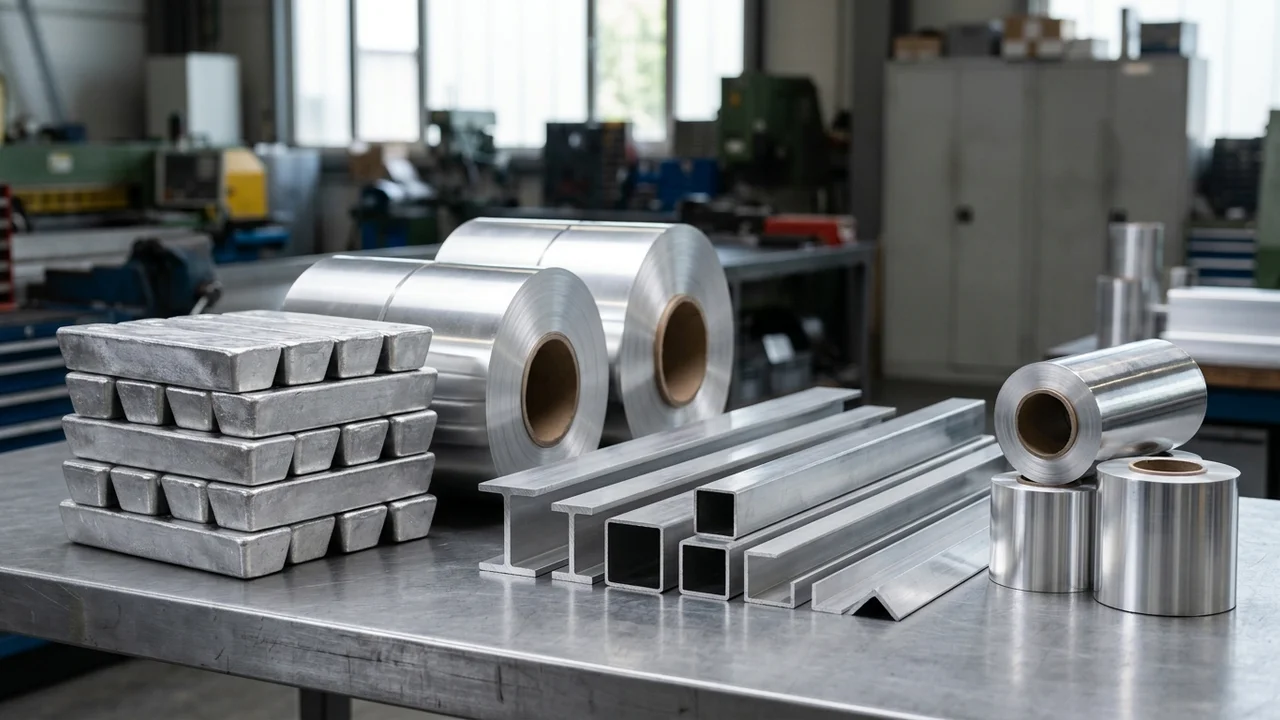
CBAM aluminium CN codes span 11 headings within Chapter 76 of the Combined Nomenclature, covering every major wrought and semi-finished aluminium product that EU importers must account for under Regulation (EU) 2023/956 as of January 1, 2026. Understanding which codes fall inside scope and which are excluded determines whether an import triggers a certificate obligation or bypasses it entirely. This article lists every covered and excluded heading, explains the direct-emissions-only scope that applies uniquely to aluminium, and identifies the compliance thresholds that govern quarterly reporting.
Caption: The 11 CBAM-covered headings within Chapter 76 range from unwrought primary aluminium through foil, tubes, and structural parts.
What Are the CBAM Aluminium CN Codes?
CBAM aluminium CN codes are the Combined Nomenclature tariff classifications listed in Annex I of Regulation (EU) 2023/956 that define which aluminium goods trigger certificate obligations when imported into the EU. All 11 covered headings fall within Chapter 76 (aluminium and articles thereof). Two headings are explicitly excluded: 7602 (waste and scrap) and 7615 (table, kitchen, and household articles).
The distinction matters because the de minimis threshold of 50 tonnes annual mass per importer applies across all covered aluminium imports. Importers whose combined annual volume across all Chapter 76 covered codes falls below 50 tonnes owe no CBAM obligation for that calendar year. Electricity and hydrogen have no equivalent threshold, making aluminium's de minimis provision particularly valuable for low-volume traders.
For a complete overview of how the certificate mechanism functions, the EU CBAM guide explains the authorization, declaration, and surrender workflow that applies to all covered sectors.
Chapter 76 CBAM CN Code Table: All Covered and Excluded Headings
The 11 covered CN headings and 2 excluded headings within Chapter 76 are listed below. EU importers must classify each shipment at the 4- or 8-digit subheading level to determine the exact embedded emissions calculation method specified in Implementing Regulation (EU) 2025/2547.
| CN Heading | Description | CBAM Status | Notes |
|---|---|---|---|
| 7601 | Unwrought aluminium | Covered | 7601 10 (not alloyed); 7601 20 (alloys) — highest trade volume |
| 7602 | Aluminium waste and scrap | Excluded | Zero-rated secondary material; no embedded emissions assigned |
| 7603 | Aluminium powders and flakes | Covered | Includes atomized and lamellar powders |
| 7604 | Aluminium bars, rods, and profiles | Covered | Extruded and drawn products |
| 7605 | Aluminium wire | Covered | All diameters; bare or coated |
| 7606 | Aluminium plates, sheets, and strip >0.2 mm | Covered | Flat-rolled products above foil thickness threshold |
| 7607 | Aluminium foil ≤0.2 mm | Covered | Packaging and industrial foil; backed or not backed |
| 7608 | Aluminium tubes and pipes | Covered | Seamless and welded; all alloys |
| 7609 | Fittings for aluminium tubes and pipes | Covered | Couplings, elbows, sleeves |
| 7610 | Aluminium structures and parts | Covered | Bridges, towers, prefabricated buildings |
| 7611–7614 | Reservoirs, stranded wire, netting, expanded metal | Not listed in Annex I | Outside CBAM scope in current Annex I |
| 7615 | Table, kitchen, and household articles | Excluded | Explicitly excluded from Annex I |
| 7616 | Other articles of aluminium | Covered | Residual category; includes selected manufactured articles |
The CBAM aluminium sector guide covers the emission factors, default values, and country-level exposure that apply to these 11 headings in full.
Emissions Scope for Chapter 76: Direct Only, with PFCs
CBAM prices direct emissions only for all Chapter 76 goods. Aluminium is listed in Annex II of Regulation (EU) 2023/956, which restricts the obligation to direct process emissions rather than the full life-cycle footprint. This creates a significant scope asymmetry: a Chinese smelter powered by coal-fired electricity emitting approximately 12 tCO₂ per tonne total faces CBAM pricing on only the roughly 1.5 tCO₂/t from direct anode combustion and perfluorocarbon (PFC) events.
Two greenhouse gases beyond CO₂ are included for aluminium: CF₄ (tetrafluoromethane, GWP 6,630) and C₂F₆ (hexafluoroethane, GWP 11,100). These PFC emissions arise during "anode effect" events in the Hall-Héroult electrolytic smelting process when alumina (Al₂O₃) feed concentration drops below operating thresholds. Legacy smelters in Russia, China, and Gulf Cooperation Council countries still produce measurable PFC emissions that importers must account for in their embedded emissions calculation.
The direct-only scope produces a gross CBAM cost of approximately €105 per tonne for primary aluminium at the current EU ETS price of approximately €70/tCO₂ (Q1 2026 range: €66–90). Net cost in 2026 equals gross cost multiplied by the 2.5% CBAM factor, because 97.5% of EU ETS free allocation remains in place for 2026. The net cost is therefore approximately €2.63 per tonne in 2026, rising sharply through the phase-out schedule: the CBAM factor reaches 48.5% in 2030, producing a net cost of approximately €50.93 per tonne at the same ETS reference price.
Importers below the 50-tonne annual threshold are exempt for that year. For importers approaching the threshold across multiple Chapter 76 codes, understanding aggregation rules is covered under the CBAM de minimis threshold page.
Caption: PFC gases from anode effect events at Hall-Héroult smelters are included in CBAM embedded emissions alongside direct CO₂ from carbon anode consumption.
Using CBAM Aluminium CN Codes in Practice
How Do Default Values Apply to Chapter 76 Products?
Default embedded emissions values for Chapter 76 goods are set by Implementing Regulation (EU) 2025/2621. The default mark-up schedule for aluminium applies a +10% premium above the calculated default in 2026, rising to +20% in 2027 and +30% from 2028 onward. Importers relying on defaults rather than verified actual data therefore face costs that grow more punitive each year.
The 4 most common practical questions importers ask about CBAM Chapter 76 codes are listed below.
- Which 8-digit subheadings within 7601 require separate declarations? The two primary subheadings are 7601 10 00 (aluminium, not alloyed) and 7601 20 (aluminium alloys). Each subheading carries its own default embedded emissions value because alloy composition affects energy consumption at the smelting stage.
- Does 7616 cover all residual aluminium articles? Heading 7616 is a residual category that covers manufactured articles not captured by the more specific headings (7603–7615). Castings, forgings, and machined parts commonly fall here. Each 8-digit subheading within 7616 must be checked against the Annex I list to confirm inclusion.
- Are aluminium-clad products under 7606 fully in scope? Heading 7606 covers plates, sheets, and strip exceeding 0.2 mm thickness regardless of surface treatment or cladding, provided the base material is aluminium. Products where aluminium serves only as a thin cladding on a steel substrate may require separate classification.
- Does 7609 (tube fittings) generate its own CBAM declaration or follow the tube declaration? Heading 7609 is listed independently in Annex I and requires a separate embedded emissions calculation. The precursor embedded emissions from the aluminium used to produce the fittings carry through under the precursor rules in IR 2025/2547.
Is Secondary Aluminium (Recycled Scrap) Subject to CBAM?
Secondary aluminium produced entirely from post-consumer or pre-consumer scrap carries zero embedded emissions under CBAM. Scrap inputs are zero-rated because the carbon cost of primary production was already allocated at the point of first manufacture. Secondary aluminium smelting uses approximately 0.05–0.1 tCO₂/t from the energy required for re-melting, but this figure relates to the smelter's direct process energy, not a scrap precursor emission.
Exporters supplying scrap-based aluminium products under headings 7604, 7605, 7606, 7607, or 7616 can document verified actual emissions that are substantially below default values, producing a near-zero CBAM liability. The financial advantage of demonstrating actual scrap-based emissions grows with the rising CBAM factor from 2027 onward.
Does the CBAM Chapter 76 List Change Over Time?
The current Annex I list is established under Regulation (EU) 2023/956 and the Omnibus amendment Regulation (EU) 2025/2083. European Commission proposal COM(2025)989 proposes expanding CBAM scope to approximately 180 downstream manufactured goods from January 1, 2028, pending European Parliament and Council approval. This proposal targets finished goods containing CBAM-covered materials, including aluminium components in automotive parts, machinery, and construction products. No Chapter 76 headings are proposed for removal; the expansion targets downstream Chapters 84, 85, 87, and 94.
Are Norway and Iceland Aluminium Exports Exempt from CBAM?
Norway and Iceland aluminium exports to the EU are fully exempt from CBAM obligations. Both countries are European Economic Area (EEA) members and participate in the EU Emissions Trading System. Their aluminium producers (including Norsk Hydro in Norway) benefit from this exemption regardless of the carbon intensity of individual facilities. Norway exported approximately €4.4 billion of aluminium to the EU in 2024 and is the largest single aluminium supplier to the EU market, making the EEA exemption a structurally significant advantage over non-exempt competitors in China, Turkey, the UAE, and Bahrain.
Switzerland also benefits from an exemption due to its ETS linkage agreement with the EU. China, Turkey, the UAE, and Bahrain do not operate equivalent linked carbon pricing schemes and therefore receive no Article 9 deduction against their CBAM certificate obligations.
What Tools Exist for Looking Up CBAM Aluminium CN Codes?
The CBAM CN code lookup tool allows importers to search by 4-digit heading or 8-digit subheading to confirm whether a specific product falls within Annex I scope, retrieve the applicable default embedded emissions value, and identify whether the good is classified as an Annex II product (direct emissions only) or a non-Annex II product (direct and indirect). For Chapter 76, all covered headings return Annex II status, confirming the direct-emissions-only pricing rule.
Importers managing multiple Chapter 76 lines across suppliers in different countries can access supplier-level verified actual values through the CBAM Registry once verifier registration opens on September 1, 2026. Until verified data is submitted and accepted, CBAM default values apply automatically, with the 2026 +10% mark-up already embedded in the published defaults for Chapter 76 goods.
EU importers with active aluminium supply chains should review their full Chapter 76 import portfolio alongside their authorization status, as the authorization application deadline of March 31, 2026 has passed. Importers who missed that deadline can still apply but face restrictions on the certificates they are permitted to hold. Full guidance on authorization procedures, quarterly holding requirements (minimum 50% of cumulative embedded emissions), and the first CBAM declaration deadline of September 30, 2027 is available through the CBAM compliance for aluminium importers page.
Non-EU aluminium exporters evaluating the cost impact of CBAM on their EU-bound shipments, including the Article 9 deduction mechanics for countries with qualifying carbon pricing, can find the full exporter perspective in the CBAM impact on aluminium exporters guide.