CBAM PFC emissions from aluminium smelting rank among the most potent greenhouse gas charges in the entire EU carbon border mechanism, with the 2 perfluorocarbon gases covered — CF₄ and C₂F₆ — carrying global warming potentials of 6,630 and 11,100 respectively. For importers of primary aluminium products, understanding how these emissions are measured, converted to CO₂ equivalents, and reported under Regulation (EU) 2023/956 determines the size of the CBAM certificate obligation filed by September 30, 2027. This article explains the technical calculation method, the trigger conditions for PFC release, and what the numbers mean in financial terms for 2026 declarations.
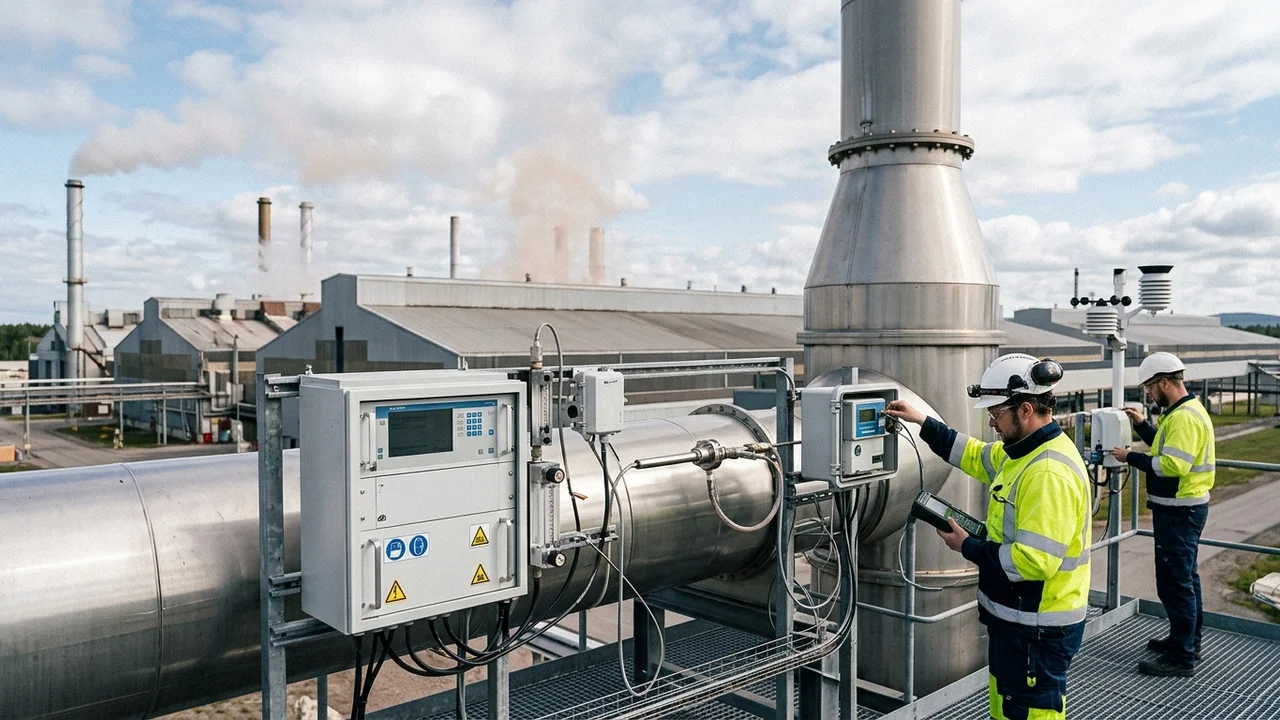
Caption: The Hall-Héroult electrolysis process is the sole commercial production route for primary aluminium and the direct source of both CO₂ and PFC emissions under CBAM.
What Are Perfluorocarbons in Aluminium Smelting?
Perfluorocarbons in aluminium production are two fully fluorinated carbon compounds — tetrafluoromethane (CF₄) and hexafluoroethane (C₂F₆) — released during anode effect events in the Hall-Héroult electrolysis process when alumina (Al₂O₃) feed concentration drops too low. Both gases are covered by CBAM under Regulation (EU) 2023/956 as part of the direct embedded emissions scope for aluminium goods listed in CN codes 7601 through 7616.
Under the EU CBAM framework, aluminium is classified as an Annex II good, meaning only direct emissions are priced. Perfluorocarbons are direct process emissions from the smelting cell itself, so both CF₄ and C₂F₆ fall squarely within the CBAM calculation boundary. The full mechanism for understanding which emissions are covered and how they relate to embedded carbon obligations is set out in our EU CBAM guide.
The anode effect occurs when the aluminium fluoride bath composition in the electrolytic cell becomes starved of alumina. Under these conditions, the carbon anode reacts with the fluoride bath rather than with dissolved alumina, producing CF₄ and smaller quantities of C₂F₆. Modern smelters use real-time monitoring and automated alumina feeding to reduce anode effect frequency, but legacy facilities in China, Russia, and GCC member states still generate significant volumes of these gases.
Why PFC Global Warming Potentials Matter for CBAM Calculations
Two global warming potential values govern PFC emissions accounting for aluminium CBAM purposes: CF₄ at GWP = 6,630 and C₂F₆ at GWP = 11,100. These values, drawn from the IPCC Fifth Assessment Report methodology adopted in the CBAM implementing regulations, determine the CO₂ equivalent (CO₂e) mass used to calculate certificate obligations.
The practical consequence is significant. One kilogram of CF₄ released at a smelter counts as 6.63 tonnes of CO₂e in the CBAM declaration. One kilogram of C₂F₆ counts as 11.1 tonnes of CO₂e. Even a modest reduction in anode effect frequency at a large facility translates to measurable reductions in CBAM certificate costs, which are priced at the EU ETS quarterly average auction clearing price (approximately €70/tCO₂e as of late March 2026 — a figure that fluctuates daily and should be confirmed against current market data before financial planning).
The full direct emission factor for primary aluminium combines both the CO₂ from carbon anode consumption and the CO₂e contribution from PFCs. The resulting range for CBAM purposes sits at approximately 1.5 to 2.1 tCO₂e per tonne of primary aluminium, depending on facility technology, anode quality, and anode effect control performance. This is the figure that drives the CBAM aluminium sector guide cost calculations for importers.
| Gas | Chemical formula | GWP (IPCC AR5) | Typical emission rate (kg/t Al) | CO₂e contribution (tCO₂e/t Al) |
|---|---|---|---|---|
| Tetrafluoromethane | CF₄ | 6,630 | 0.03–0.3 | 0.20–1.99 |
| Hexafluoroethane | C₂F₆ | 11,100 | 0.003–0.06 | 0.03–0.67 |
| Carbon dioxide (anode) | CO₂ | 1 | 1.4–1.7 | 1.40–1.70 |
| Total direct (primary Al) | ~1.5–2.1 tCO₂e/t |
Emission rate ranges reflect variation between modern low-anode-effect facilities and older legacy smelters. Source: Implementing Regulation (EU) 2025/2621 benchmark methodology.
How PFC Emissions Are Calculated for CBAM Declarations
The calculation method for CBAM PFC emissions follows a two-step process. The first step measures or estimates the anode effect minute per cell-day (AEM/CD) metric at the facility. The second step converts this operational metric into tonnes of CF₄ and C₂F₆ using established emission factors, then applies the GWP conversion to arrive at tCO₂e.
The CBAM implementing regulation IR 2025/2547 specifies the approved methodology for converting anode effect data into PFC mass emissions. Importers who do not have access to facility-level monitoring data from their non-EU supplier fall back on default values published under Implementing Regulation (EU) 2025/2621, which carry a 10% mark-up above the calculated default in 2026, rising to 20% in 2027 and 30% from 2028 onward. This mark-up schedule makes it progressively more expensive for importers to rely on defaults rather than verified actual data.
The 3 steps used to determine PFC-inclusive embedded emissions for a CBAM declaration are listed below.
- Obtain the facility's annual CF₄ and C₂F₆ mass emission figures from the accredited verifier's report (actual method) or apply the country-specific default value from IR 2025/2621 (default method).
- Multiply CF₄ mass (in tonnes) by 6,630 and C₂F₆ mass (in tonnes) by 11,100 to convert each gas to tCO₂e.
- Sum CO₂ from anode consumption and the two PFC CO₂e figures to produce the total direct embedded emissions per tonne of aluminium produced at that installation.
The total figure then feeds into the embedded emissions calculation for the specific good imported. The full methodology for converting facility emissions into per-product embedded figures is covered in our guide on how embedded emissions are calculated.
The Anode Effect: Frequency, Duration, and CBAM Financial Impact
Anode effect frequency is measured in anode effect minutes per cell-day (AEM/CD). A modern, well-controlled smelter achieves fewer than 0.15 AEM/CD. Older or less well-managed facilities can reach 1.0 AEM/CD or higher. This difference has a direct and proportional effect on the CO₂e figure reported in the CBAM declaration.
At a facility producing 500,000 tonnes of primary aluminium per year, the difference between 0.15 AEM/CD and 1.0 AEM/CD can amount to a reduction of approximately 0.5 tCO₂e per tonne of aluminium — equivalent to 250,000 tCO₂e annually. At the current ETS price of approximately €70/tCO₂e, this represents a gross CBAM cost differential of approximately €17.5 million per year at full phase-in. In 2026, with the CBAM factor at 2.5% of gross obligation, the net differential is approximately €437,500 — still material, and growing annually as free allocation phases out through 2034.
The financial incentive for non-EU smelters to invest in anode effect reduction technology is therefore directly created by CBAM. The certificate cost is not the only driver: verifier reporting costs, authorization complexity, and reputational positioning with EU buyers also respond to facility-level emissions performance.
Caption: Certificate cost differential between high and low anode effect frequency smelters, calculated at EU ETS reference price across CBAM phase-in years 2026 to 2034.
Contextual Border: What PFC Emissions Mean for Indirect Aluminium Imports
PFC emissions are direct process emissions — they arise at the point of primary aluminium smelting. This means their embedded emissions content carries forward into all downstream aluminium goods covered by CBAM: aluminium bars and rods (7604), wire (7605), plates and sheets (7606), foil (7607), tubes and pipes (7608), structures (7610), and other articles (7616). An importer of aluminium foil (CN code 7607) sourced from a high-PFC smelter carries the full PFC-inclusive embedded emission factor from that upstream production step.
Secondary aluminium produced from recycled scrap operates under a zero-rated embedded emissions rule for the scrap input itself. The re-melting energy for secondary aluminium typically produces 0.05 to 0.1 tCO₂/t, with no PFC contribution because the Hall-Héroult electrolysis process is not used. Importers of secondary aluminium products therefore face significantly lower CBAM obligations than importers of primary aluminium equivalents.
Are PFCs Included in the CBAM Default Values for Aluminium?
Yes. The CBAM default values published in Implementing Regulation (EU) 2025/2621 for aluminium goods include the PFC contribution based on country-level production statistics. The default value for a given country reflects the weighted average of that country's aluminium production mix, including the typical anode effect frequency for facilities in that country. Countries with predominantly older smelter technology and higher anode effect rates carry higher default values, even before the 10% mark-up is applied in 2026.
Do CBAM Indirect Emissions Rules Affect PFC Reporting?
No. CBAM indirect emissions rules — which govern whether electricity consumption is priced — do not affect PFC reporting. Aluminium is listed in Annex II of Regulation (EU) 2023/956, meaning only direct emissions are priced under CBAM. PFCs are direct process emissions from the electrolysis cell, not an indirect emission from electricity generation. They are included in the direct scope regardless of where the electricity powering the smelter originates. The distinction between direct and indirect emissions for aluminium — and why the electricity-intensive nature of the sector creates what the Commission's own Recital 67 describes as a coverage gap — is addressed in our article on CBAM aluminium indirect emissions.
Which CN Codes Carry PFC-Inclusive Embedded Emissions?
All primary aluminium CN codes under Chapter 76 that are covered by CBAM carry PFC-inclusive embedded emissions from the upstream Hall-Héroult process. The 8 CBAM-covered CN codes where PFC contribution applies to importers of primary-sourced goods are listed below.
- 7601: Unwrought aluminium (primary source; highest PFC exposure per tonne of product)
- 7603: Aluminium powders and flakes
- 7604: Bars, rods, and profiles
- 7605: Wire
- 7606: Plates, sheets, and strip (thickness greater than 0.2 mm)
- 7607: Foil (thickness 0.2 mm or less)
- 7608: Tubes and pipes
- 7616: Other articles of aluminium
For the complete list of CN codes covered under the aluminium sector, including exclusions for waste and scrap (7602) and household articles (7615), see the CBAM aluminium CN codes reference.
Should Importers Use Actual or Default PFC Values?
Importers of primary aluminium products benefit from using actual verified PFC emissions data when their supplier's facility operates below the country default value. The default values include the 10% mark-up in 2026, meaning any facility performing better than the country average generates cost savings by measuring and reporting actual emissions. For suppliers in countries with legacy smelter infrastructure where actual PFC emissions are high, using default values may in some cases produce a lower 2026 obligation due to the interaction between the CBAM factor (2.5%) and the free allocation structure — but this reverses from 2027 onward as the mark-up rises to 20%.
The financial decision between actual values and defaults depends on three variables: the facility's actual anode effect frequency, the applicable country default value, and the 2026 CBAM factor. Importers planning for 2027 and beyond should model both scenarios using the phase-out schedule. Reference figures for aluminium default values are available in the CBAM default values guide.
Is There a Penalty for Incorrect PFC Reporting?
Yes. Authorized declarants who surrender insufficient CBAM certificates — including cases where PFC emissions are understated — face a penalty of €100 per tonne of CO₂e not covered, under Article 26(1) of Regulation (EU) 2023/956 as amended by Regulation (EU) 2025/2083. Importers who operate without authorization face penalties of €300 to €500 per tonne of CO₂e. The high GWP values of CF₄ (6,630) and C₂F₆ (11,100) mean that even small absolute quantities of PFC emissions, if omitted, translate to large tCO₂e shortfalls and correspondingly large penalties. Verified reporting from accredited verifiers operating from September 1, 2026 is the primary protection against this risk. For full guidance on the CBAM obligation chain for importers, see CBAM compliance for aluminium importers.