Green hydrogen classified under CN code 2804 10 00 carries an embedded emission factor of approximately zero tCO₂ per tonne when certified as an RFNBO, compared to the 9–12 tCO₂/t generated by grey hydrogen through steam methane reforming. At the current EU ETS price of approximately €70/tCO₂ (Q1 2026 range: €66–90), that difference translates to a gross CBAM cost gap of up to €840 per tonne of hydrogen imported. RFNBO certification under Delegated Regulation (EU) 2023/1184 is the single mechanism that closes this gap completely, reducing the certificate obligation of a green hydrogen importer to zero. This article explains how that certification works, what the CBAM calculation requires, and how the financial trajectory through 2034 changes the economics for every party in the green hydrogen supply chain.
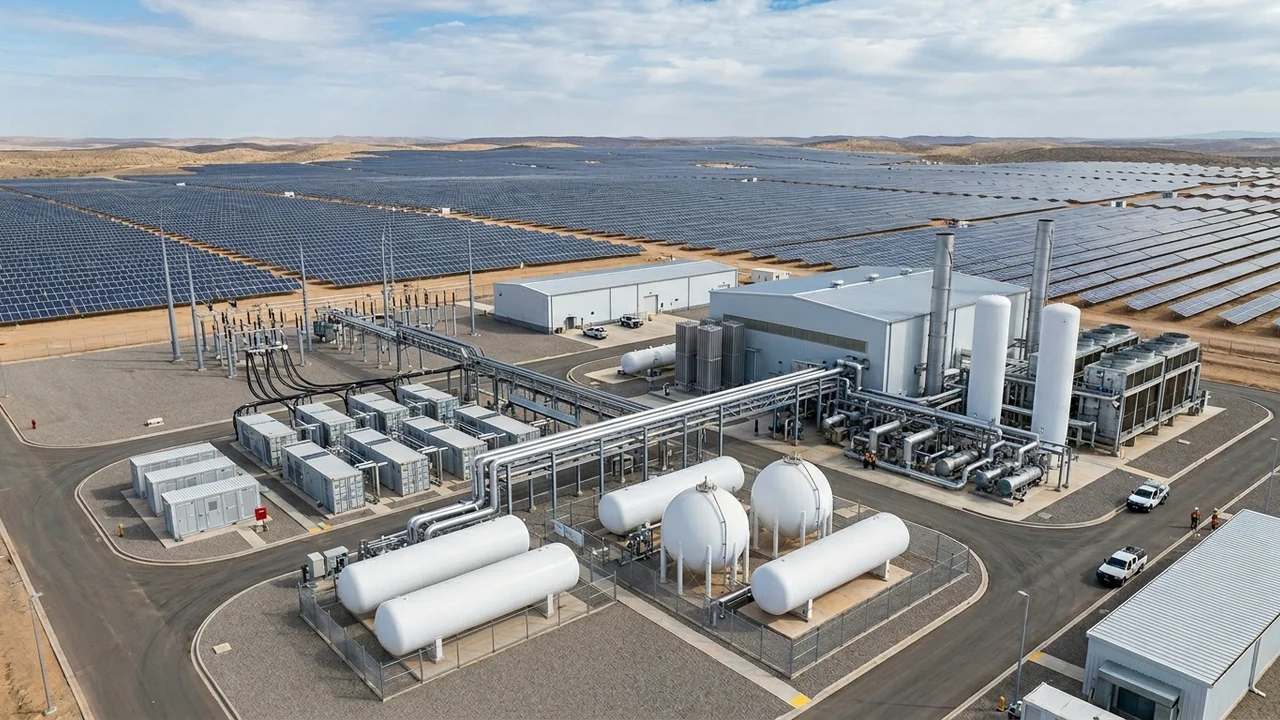
Caption: RFNBO-certified electrolysis plants must meet additionality, temporal correlation, and geographical correlation criteria under EU Delegated Regulation 2023/1184.
What CBAM Means for Hydrogen Importers in 2026
CBAM is a certificate-based mechanism established by Regulation (EU) 2023/956, as amended by Regulation (EU) 2025/2083, that requires EU importers of carbon-intensive goods to purchase certificates proportional to the embedded CO₂ emissions of their imports, priced at the EU ETS carbon price. Hydrogen entered the definitive phase on January 1, 2026.
Hydrogen is listed in Annex II of Regulation (EU) 2023/956, meaning only direct emissions are priced under CBAM — indirect emissions from electricity consumed during electrolysis are excluded from the calculation, provided that electricity qualifies under the RFNBO rules. This is the regulatory gateway that makes green hydrogen uniquely positioned among CBAM-covered goods. For a thorough grounding in the broader framework, the EU CBAM guide covers the complete certificate lifecycle and declarant obligations.
The de minimis threshold of 50 tonnes annual mass that exempts small importers from most CBAM sectors does not apply to hydrogen. Hydrogen importers of any volume face the full obligation from the first tonne imported, making the production route — and its certified emissions — commercially decisive from day one.
How RFNBO Certification Eliminates the Certificate Obligation
RFNBO certification permits a green hydrogen importer to declare an embedded emission factor of zero for the electricity consumed in electrolysis. Zero embedded emissions mean zero certificates to purchase. Zero certificates mean zero financial obligation to the CBAM registry administered by DG TAXUD.
The certification framework is established in Delegated Regulation (EU) 2023/1184 under the Renewable Energy Directive. Three criteria must be simultaneously satisfied for electricity used in hydrogen electrolysis to receive a zero-emission accounting treatment. The three criteria are listed below.
- Additionality: The renewable electricity used must come from generating installations that became operational no more than 36 months before the electrolyser or that were specifically commissioned to supply it. Electricity from existing grid renewable contracts does not qualify without this constraint.
- Temporal correlation: The renewable electricity must be matched to the electrolyser's consumption on a monthly basis from 2026 through 2029, then on an hourly basis from January 1, 2030 onward. Monthly matching in the early years eases the operational burden, but exporters planning capacity must account for the 2030 transition.
- Geographical correlation: The renewable electricity source and the electrolyser must be located in the same or an electrically connected bidding zone, preventing exporters from claiming distant renewables as the source for their hydrogen output.
When all three criteria are met, the embedded emissions attributable to the electricity consumed in electrolysis are calculated as zero. The CBAM declaration for that hydrogen then reflects only any residual direct emissions from the electrolysis process itself, which for well-operated alkaline or PEM electrolysers approaches zero tCO₂/t H₂. The full methodology for calculating what enters a CBAM declaration is explained in the guide on how embedded emissions are calculated.
The Financial Case: Green vs. Grey Hydrogen CBAM Costs
The cost differential between green hydrogen and grey hydrogen under CBAM is not a marginal consideration — it is structurally transformative. The table below compares gross CBAM costs across production types at the current EU ETS reference price of approximately €70/tCO₂.
| Production Type | Emission Factor (tCO₂/t H₂) | Gross CBAM Cost @ €70/tCO₂ | Gross CBAM Cost @ €126/tCO₂ (2030 forecast) |
|---|---|---|---|
| Grey (SMR, no CCS) | ~10–12 | €700–840/t H₂ | €1,260–1,512/t H₂ |
| Blue (SMR + CCS) | ~0.5–1.0 | €35–70/t H₂ | €63–126/t H₂ |
| Turquoise (methane pyrolysis) | ~0–1 | €0–70/t H₂ | €0–126/t H₂ |
| Pink (nuclear electrolysis) | ~0–0.5 | €0–35/t H₂ | €0–63/t H₂ |
| Green (RFNBO-certified) | ~0 | €0/t H₂ | €0/t H₂ |
The 2026 net cost is softened by the CBAM factor: only 2.5% of free allocation has been phased out in 2026, meaning the net obligation for grey hydrogen at €70/tCO₂ and a 10.4 tCO₂/t transitional default is approximately €18.20/t in 2026. That figure reaches €378/t net by 2030 when the CBAM factor rises to 48.5%. Green hydrogen exporters certified as RFNBO face zero at every point in this trajectory.
The transitional default value for hydrogen set in Implementing Regulation (EU) 2025/2621 carries a 10% mark-up above the calculated default in 2026, rising to 20% in 2027 and 30% from 2028 onward. Grey hydrogen importers relying on default values face increasing penalties for not providing verified actual emissions data, while green hydrogen importers with RFNBO certification declare zero and carry no default exposure at all.
Caption: Net CBAM cost per tonne of hydrogen rises steeply from 2029 as the free allocation phase-out accelerates toward full elimination in 2034.
What the CBAM Declaration Requires for Green Hydrogen
An authorized CBAM declarant importing RFNBO-certified green hydrogen must include specific documentation in the annual declaration due by September 30, 2027 for calendar year 2026. The declaration covers 4 required data elements for green hydrogen with zero-emission certification.
- CN code and product description: 2804 10 00 (hydrogen, pure) with notation that the production route is electrolysis using renewable electricity.
- Verified embedded emissions: A figure at or near zero tCO₂/t H₂, supported by third-party verification from an accredited verifier. Verifier registration opens September 1, 2026.
- RFNBO certification documentation: Evidence of compliance with Delegated Regulation (EU) 2023/1184, including proof of additionality, temporal matching records, and geographical correlation evidence.
- Carbon price paid in country of origin: If any carbon pricing applies in the exporting country, an Article 9 deduction application may reduce the obligation further — though for certified green hydrogen at zero emissions, no certificates are due regardless.
Authorized CBAM declarants must be registered before March 31, 2026 to legally import during the definitive phase. The certificate buying obligation begins February 1, 2027 — at which point, green hydrogen importers with RFNBO documentation simply purchase zero certificates and face no financial liability under the mechanism.
How Green Hydrogen Fits in the Broader CBAM Hydrogen Sector
The hydrogen sector under CBAM covers a single CN code, 2804 10 00, and carries no de minimis exemption. It also serves a precursor role: hydrogen is an input into ammonia production (CN code 2814), which feeds the nitrogen fertilizer chain covered under Chapter 31. An importer bringing in RFNBO-certified green hydrogen for use in green ammonia production carries those zero embedded emissions through to the ammonia and, where applicable, to the fertilizer products downstream.
For the full context of how CBAM obligations differ across hydrogen production types, the CBAM hydrogen sector guide covers CN code 2804 10 00 in detail, including the default value structure and precursor flow.
Frequently Asked Questions on Green Hydrogen and CBAM
What is the CBAM certificate obligation for RFNBO-certified green hydrogen?
The CBAM certificate obligation for RFNBO-certified green hydrogen is zero. Delegated Regulation (EU) 2023/1184 permits a zero emission factor for electricity consumed in compliant electrolysis, and hydrogen produced with zero embedded emissions requires no certificates under Regulation (EU) 2023/956.
Does the de minimis threshold apply to green hydrogen imports?
No. The 50-tonne annual mass de minimis threshold established under Article 2(3a) of Regulation (EU) 2023/956, as amended by Regulation (EU) 2025/2083, explicitly excludes electricity and hydrogen. Green hydrogen importers face the full CBAM obligation from the first tonne regardless of import volume, though certified green hydrogen carries a zero-emission declaration.
Does RFNBO certification automatically satisfy the CBAM embedded emissions declaration?
RFNBO certification under Delegated Regulation (EU) 2023/1184 establishes the basis for a zero-emission factor, but the CBAM declaration still requires third-party verification of embedded emissions by an accredited verifier. Certification and verification are complementary, not interchangeable. Verifier accreditation registration opens September 1, 2026.
Is blue hydrogen treated the same as green hydrogen under CBAM?
No. Blue hydrogen (steam methane reforming with carbon capture and storage) carries embedded emissions of approximately 0.5–1.0 tCO₂/t H₂, generating a gross CBAM cost of €35–70/t at €70/tCO₂. Blue hydrogen does not qualify for the RFNBO zero-emission accounting treatment. It carries a meaningful but far lower CBAM obligation than grey hydrogen.
Can green hydrogen from Morocco or Chile qualify for zero CBAM certificates?
Green hydrogen from third-country producers qualifies for zero-emission accounting when the RFNBO criteria of Delegated Regulation (EU) 2023/1184 are met, regardless of country of origin. Morocco, Chile, Saudi Arabia, and Australia are among the countries developing green hydrogen projects targeting the EU market. The additionality, temporal correlation, and geographical correlation criteria apply equally to all producing countries.
How does decarbonizing hydrogen production reduce CBAM exposure?
Decarbonizing hydrogen production by shifting from steam methane reforming to renewable-powered electrolysis eliminates the 9–12 tCO₂/t direct emissions that drive the CBAM cost. At the 2030 consensus ETS forecast of €126/tCO₂ and a 48.5% CBAM factor, grey hydrogen importers face net costs of approximately €378/t — a burden that certified green hydrogen producers avoid entirely. The strategic pathway for exporters pursuing this transition is detailed in the guide on decarbonizing for CBAM.
Is the grey hydrogen CBAM cost recoverable through Article 9?
Article 9 of Regulation (EU) 2023/956 allows EU importers to deduct carbon costs already paid in the country of origin from the CBAM certificate obligation. Grey hydrogen importers benefit from Article 9 only if the exporting country operates a qualifying carbon pricing scheme that applies to hydrogen production. As of April 2026, no major grey hydrogen exporting country operates such a scheme. The mechanics of this deduction are covered in the guide on CBAM Article 9 deduction.
Should importers currently using grey hydrogen switch suppliers to avoid CBAM?
Importers using grey hydrogen face a CBAM obligation that rises from approximately €18/t net in 2026 to approximately €378/t net in 2030 at consensus price projections. Suppliers certified as RFNBO producers carry zero CBAM obligation at every stage. The financial case for switching grows each year as free allocation disappears. Dedicated guidance for EU importers managing this transition is available in the CBAM compliance for hydrogen importers resource.
How does the grey hydrogen CBAM cost compare to green hydrogen costs?
Grey hydrogen imported into the EU at the current ETS price of approximately €70/tCO₂ generates a gross CBAM cost of €700–840/t H₂, while RFNBO-certified green hydrogen generates €0/t H₂. The difference between grey hydrogen and green hydrogen on CBAM cost is examined in the grey hydrogen and CBAM guide, which covers default values and the SMR emission calculation in detail.