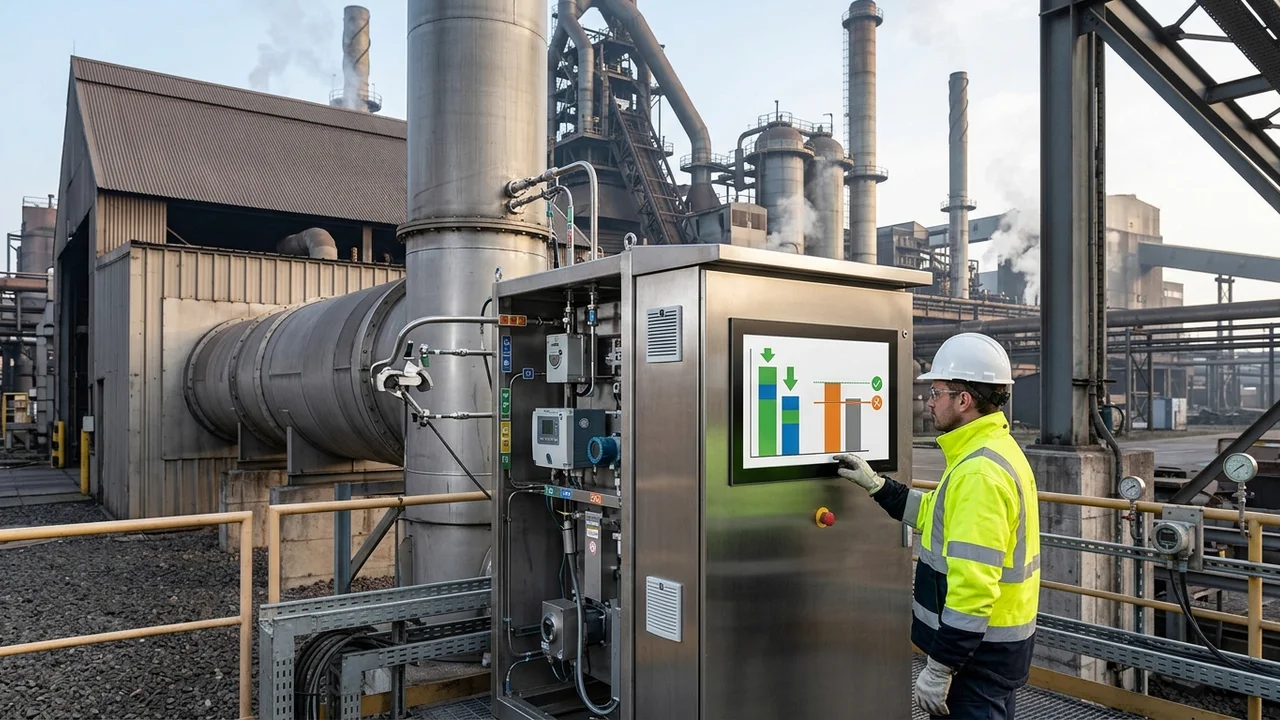
CBAM benchmark values for steel are set by Implementing Regulation (EU) 2025/2621, adopted by the CBAM Committee in December 2025, and these values determine the emissions threshold against which actual production data is measured for every tonne of steel imported into the EU from January 1, 2026. Three production-route benchmarks apply: 1.370 tCO₂e per tonne for blast furnace steel, 0.481 tCO₂e per tonne for gas-based direct reduced iron, and 0.072 tCO₂e per tonne for scrap-based electric arc furnace steel.
Understanding these benchmark values is the first step for any EU importer or non-EU steel exporter calculating their CBAM obligation accurately. The benchmark itself does not determine the final cost, but it defines whether a producer's actual verified emissions fall below or above the official threshold, and that gap drives the financial outcome.
Caption: The three official steel benchmarks from IR 2025/2621 reflect the EU's recognition that blast furnace, DRI, and scrap-EAF routes have fundamentally different carbon profiles.
For a broader foundation, the EU CBAM guide explains the certificate mechanism and the regulatory framework that makes these benchmarks legally binding.
What Are the Official CBAM Steel Benchmark Values for 2026?
The official CBAM steel benchmark values from IR 2025/2621 are 1.370 tCO₂e/t for BF-BOF, 0.481 tCO₂e/t for DRI-EAF, and 0.072 tCO₂e/t for scrap-EAF. These figures represent the production-route-specific emissions thresholds established under Regulation (EU) 2023/956, as implemented for the definitive phase.
The three values below are the authoritative reference for CBAM compliance in the steel sector, as published in IR 2025/2621. The table defines the threshold against which each producer's verified emissions are compared.
| Production Route | CBAM Benchmark (tCO₂e/t crude steel) | Typical Actual Emission Range |
|---|---|---|
| BF-BOF (Blast Furnace, Basic Oxygen Furnace) | 1.370 | 2.0–2.5 tCO₂/t |
| DRI-EAF (Direct Reduced Iron, Electric Arc Furnace) | 0.481 | 0.4–0.6 tCO₂/t |
| Scrap-EAF (Electric Arc Furnace, scrap-based) | 0.072 | 0.3–0.5 tCO₂/t |
The benchmark for BF-BOF steel (1.370 tCO₂e/t) sits well below the typical actual emission range of 2.0–2.5 tCO₂/t. This gap means BF-BOF producers cannot use the benchmark as a shortcut to reduce their declared liability. CBAM obligations are calculated on verified actual emissions, with the benchmark serving as the default only when no verified data exists and the importer opts for calculated default values under IR 2025/2621.
How Are Steel Producers Classified Into the Three Routes?
Route classification follows a mass-balance rule established in IR 2025/2621. The classification criteria below apply to crude steel output and determine which benchmark applies.
The three classification rules for production-route assignment are as follows:
- BF-BOF: More than 50% of crude steel mass originates from blast furnace pig iron.
- DRI-EAF: More than 50% of crude steel mass originates from direct reduced iron produced from iron ore.
- Scrap-EAF: More than 50% of crude steel mass originates from recycled scrap.
A facility using a blended charge, for example a mix of 40% pig iron and 60% scrap, classifies as Scrap-EAF under this threshold rule. Classification matters because the difference in benchmark values between BF-BOF (1.370) and Scrap-EAF (0.072) is approximately 19-fold. An importer who misclassifies a scrap-heavy steel producer as BF-BOF may significantly overstate the CBAM obligation and purchase excess certificates.
Importers sourcing steel from producers that operate both blast furnace and electric arc facilities within the same complex must request route-level production data, not plant-level aggregates, to apply the correct benchmark to each product stream.
What Are Default Values for Steel and How Do They Relate to Benchmarks?
Default values and benchmark values serve two distinct functions in CBAM, and conflating them is a common compliance error. The benchmark is the reference emissions intensity established for each production route. The default value is the country-specific or product-specific figure applied when an importer cannot submit verified actual emissions data.
For Chinese steel slab, IR 2025/2621 publishes a default value of 3.167 tCO₂e per tonne. This figure is substantially higher than the BF-BOF benchmark of 1.370 tCO₂e/t and higher than the typical actual emission range for Chinese BF-BOF producers. The gap creates a strong financial incentive for Chinese steel exporters to commission verified emissions reports rather than allow EU importers to fall back on the default.
The default value mark-up schedule intensifies this incentive over time. The mark-up structure from IR 2025/2621 is listed below:
- 2026: +10% above the calculated default for steel, cement, aluminium, and hydrogen
- 2027: +20% above the calculated default for the same sectors
- 2028 onward: +30% above the calculated default for the same sectors
At a +30% mark-up from 2028, a Chinese steel producer whose actual emissions are 2.2 tCO₂/t would face a default-derived CBAM obligation significantly higher than their verified figure. The cost of commissioning a verification report becomes straightforwardly recoverable against the certificate savings.
The CBAM steel sector guide covers the full range of CN codes under Chapters 72 and 73, along with precursor rules that determine how embedded emissions flow from hot-rolled coil to downstream products.
CBAM Benchmark Values and Certificate Cost at Current ETS Prices
CBAM certificate prices track the EU ETS auction price. The EU ETS price as of late March 2026 is approximately €70 per tonne CO₂ (within the Q1 2026 range of €66–90/tCO₂). The gross certificate cost per tonne of steel imported without verified data depends on which default or actual emission figure applies.
The gross costs below are calculated at €70/tCO₂ for reference, using actual emission factors rather than benchmarks, because CBAM obligations are assessed against verified actual emissions, not against benchmarks.
| Steel Type | Emission Factor Used | Gross CBAM Cost @ €70/tCO₂ |
|---|---|---|
| BF-BOF (actual ~2.0 tCO₂/t) | 2.0 tCO₂/t | €140/t gross |
| DRI-EAF (actual ~0.5 tCO₂/t) | 0.5 tCO₂/t | €35/t gross |
| Scrap-EAF (actual ~0.5 tCO₂/t) | 0.5 tCO₂/t | €35/t gross |
| Chinese slab (default, no verified data) | 3.167 tCO₂/t | €221.69/t gross |
The net CBAM cost in 2026 is a fraction of the gross figure because 97.5% of EU ETS free allocation remains intact. In 2026, only 2.5% of embedded emissions generate a real certificate obligation (the CBAM factor). At €140/t gross for BF-BOF steel, the net 2026 cost is approximately €3.50/t. This changes rapidly: by 2030, the CBAM factor reaches 48.5%, raising net costs for BF-BOF steel to approximately €67.90/t at the same ETS price.
Caption: Net CBAM cost per tonne for BF-BOF steel increases more than 19 times between 2026 and 2030 as free allocation phases out, even at a constant ETS price.
For importers managing budgets now, the CBAM default values page provides a full breakdown of country-specific defaults across all six sectors.
How CBAM Benchmark Values Apply to the Definitive Phase
What Is the Contextual Border Between Benchmark and Verification?
CBAM steel benchmarks from IR 2025/2621 function as the anchor point for the verification system, not as a substitute for it. An importer submitting a CBAM declaration by September 30, 2027 for calendar year 2026 must report the actual verified embedded emissions of all steel imported above the 50-tonne annual de minimis threshold. The benchmark value for the relevant production route serves as the reference when calculating default-based obligations for importers who have not collected verified data.
Do CBAM Benchmarks Affect All Steel CN Codes?
CBAM benchmarks from IR 2025/2621 apply to steel goods covered under Chapters 72 and 73 of the Combined Nomenclature. The primary CN codes subject to CBAM include 7201 (pig iron), 7206–7207 (ingots and semi-finished products), 7208–7212 (flat-rolled products), 7213–7217 (bars, rods, and wire), and 7218–7229 (stainless steel products). Ferrous waste and scrap under CN code 7204 are excluded, as scrap carries zero embedded emissions under CBAM methodology.
The route-specific benchmarks connect to the precursor chain. Hot-rolled coil (CN 7208) is the primary precursor for cold-rolled strip (CN 7209) and coated products (CN 7210), and the embedded emissions of the precursor carry through via mass-balance allocation into the downstream product's CBAM declaration.
Are CBAM Benchmark Values the Same as ETS Benchmark Values?
CBAM benchmarks and EU ETS benchmarks are separate instruments with different legal origins and purposes. EU ETS benchmarks determine the volume of free allowances allocated to EU domestic producers under the ETS Directive. CBAM benchmarks from IR 2025/2621 determine the default emission intensity applied to imported goods when actual verified data is unavailable. The two figures are not identical in value. Using the ETS free allocation benchmark as a proxy for the CBAM benchmark creates a declaratory error.
The relationship between the two systems is structural rather than numerical: as EU ETS free allocation for domestic steel producers phases out between 2026 and 2034, CBAM costs for importers scale up in parallel, ensuring competitive equivalence between domestic production and imports. For a full view of production-route compliance mechanics, see the guides on BF-BOF steel and CBAM and EAF scrap steel and CBAM.
Is There a CBAM Benchmark Advantage for Low-Carbon Steel Producers?
Producers whose verified actual emissions fall below the relevant benchmark do not receive a financial benefit in the form of a rebate or a credit. The benchmark does not create a payment to low-emission producers. The financial advantage is asymmetric: a scrap-EAF producer with actual emissions of 0.072 tCO₂/t or lower pays near-zero CBAM costs, while a BF-BOF producer at 2.2 tCO₂/t pays on the full 2.2 tCO₂/t of actual verified emissions. This asymmetry reflects the policy intent to price actual carbon intensity rather than reward outperformance relative to a benchmark.
Importers sourcing from a verified low-carbon producer can present that advantage as a procurement argument. The CBAM steel calculation guide provides the step-by-step method for deriving the embedded emissions figure that feeds into the CBAM declaration.
What Is the Penalty for Incorrect Use of CBAM Benchmark Values?
An authorized CBAM declarant who submits an incorrect declaration, whether by misclassifying a production route or applying a default where verified data was available, faces a penalty of €100 per tonne CO₂e not covered by surrendered certificates, under Article 26(1) of Regulation (EU) 2023/956 as amended by Regulation (EU) 2025/2083. An importer who operates without CBAM authorization and imports steel above the 50-tonne de minimis threshold faces a penalty of €300–500 per tonne CO₂e, which is 3–5 times the standard rate.
Compliance for EU importers purchasing from multiple steel sources, including BF-BOF suppliers in India and scrap-EAF producers in Turkey, requires a supplier-level tracking system rather than a product-category average. The CBAM compliance for steel importers page outlines the authorization, record-keeping, and declaration obligations in full.