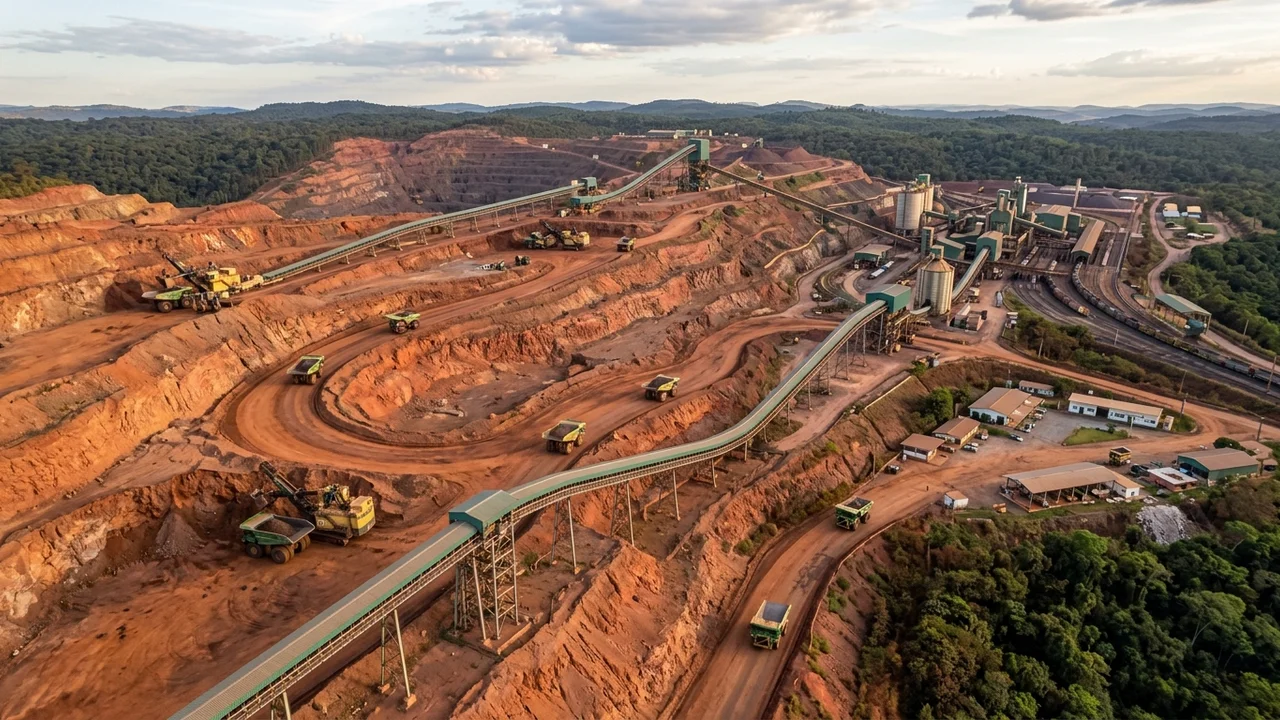
Brazil's CBAM exposure concentrates in 2 primary sectors, steel and fertilizers, with combined annual exports to the EU valued at approximately €1–2 billion under Regulation (EU) 2023/956. The decisive question for Brazilian producers is not whether CBAM applies, but whether Brazil's new carbon market creates the right conditions to claim an Article 9 deduction and lower the certificate cost paid by EU importers. Brazil enacted legislation establishing the Sistema Brasileiro de Comércio de Emissões (SBCE) in December 2024, placing it ahead of most developing economies in the Article 9 race. This article analyzes Brazil's CBAM position, the SBCE's qualification prospects, and the concrete steps Brazilian steel and fertilizer exporters take to protect EU market access through 2030 and beyond.
Caption: Brazilian steelmakers CSN, Gerdau, and Usiminas export to EU markets that are now subject to CBAM certificate obligations starting in full from February 2027.
What Is CBAM and Why Does It Apply to Brazil?
CBAM is a certificate-based mechanism, established by Regulation (EU) 2023/956, that requires EU importers of carbon-intensive goods to purchase certificates proportional to the embedded CO₂ emissions of their imports, priced at the EU Emissions Trading System (ETS) carbon price. The definitive phase began January 1, 2026. Brazil's steel and iron products fall under Chapters 72 and 73 of the EU's Combined Nomenclature, and nitrogen fertilizers including urea (CN 3102 10) fall under Chapter 31. All exports of these goods to the EU now carry a financial obligation on the EU importer.
Brazilian producers hold no direct legal obligation under CBAM. The obligation falls on the EU-based authorized CBAM declarant. That commercial reality creates a mechanism through which the cost reaches Brazilian exporters indirectly: EU importers either pass the CBAM certificate cost back through lower purchase prices, or they shift orders to suppliers who can reduce the net certificate cost through verified actual emissions data or qualifying carbon price deductions. Understanding the full EU CBAM mechanism is the starting point for Brazilian exporters assessing their exposure and options.
The EU ETS price currently stands at approximately €70/tCO₂ (late March 2026, Q1 2026 range: €66–90). Brazil's primary CBAM-exposed sector, blast furnace and basic oxygen furnace (BF-BOF) steel, carries an emission factor of approximately 2.0 tCO₂ per tonne of steel, producing a gross CBAM cost of approximately €140 per tonne at the current price. Net costs in 2026 are modest because the CBAM factor is only 2.5% (97.5% of EU free allocation remains). By 2030, when the CBAM factor reaches 48.5%, that gross €140/t translates to approximately €67.90/t net, creating a structural cost pressure that Brazilian producers cannot ignore.
Brazil's CBAM-Exposed Sectors: Steel and Fertilizers
Brazil's CBAM exposure divides into 2 sectors with distinct emission profiles, market structures, and Article 9 implications.
Steel: BF-BOF Dominance and Its Implications
Brazilian steel exports to the EU originate primarily from 3 major producers: CSN (Companhia Siderúrgica Nacional), Gerdau, and Usiminas. Brazil's production mix includes both BF-BOF and electric arc furnace (EAF) routes. The distinction carries direct financial consequence under CBAM, as the table below shows.
Brazil Steel CBAM Cost Reference at €70/tCO₂:
| Production Route | Emission Factor | Gross CBAM Cost | Net Cost 2026 (2.5%) | Net Cost 2030 (48.5%) |
|---|---|---|---|---|
| BF-BOF | ~2.0 tCO₂/t | €140/t | €3.50/t | €67.90/t |
| EAF (scrap-based) | ~0.5 tCO₂/t | €35/t | €0.88/t | €16.98/t |
| DRI-EAF | ~0.9–1.4 tCO₂/t | €63–98/t | €1.58–2.45/t | €30.56–47.53/t |
Brazil's electricity grid provides a structural advantage for EAF-route producers. The national grid draws significantly from hydroelectric generation, giving Brazilian EAF steelmakers one of the cleanest electricity profiles of any major steel-exporting nation. This translates to lower actual indirect emissions per tonne, relevant for the default value comparison even though indirect emissions are not financially priced for steel under CBAM (Annex II classification).
For BF-BOF producers, the critical question is whether their actual measured emissions fall below the CBAM default values for their production category. BF-BOF actual emissions in Brazil range from approximately 2.0 to 2.5 tCO₂/t. The CBAM benchmark value for BF-BOF from IR 2025/2621 is 1.370 tCO₂e/t of crude steel. Brazilian producers with actual values above this benchmark face the full default mark-up: 10% in 2026, rising to 30% from 2028 onward. This makes CBAM steel obligations and verified data submission commercially essential for BF-BOF operators exporting to the EU.
Fertilizers: N₂O Emissions Add Complexity
Brazil exports nitrogen fertilizers to the EU, with urea (CN 3102 10) and ammonium nitrate products representing the bulk of CBAM-covered volumes. The fertilizer sector under CBAM prices both direct CO₂ emissions and N₂O emissions from nitric acid production, using a global warming potential of 265 for N₂O (IPCC AR5). Urea carries an emission factor of approximately 2.3–2.6 tCO₂e per tonne, producing a gross CBAM cost of approximately €175/t at €70/tCO₂.
The fertilizer sector under CBAM benefits from a lower default value mark-up than other sectors: only 1% above the calculated default in 2026 and subsequent years, compared to 10–30% for steel. This reflects agricultural price sensitivity. Brazilian fertilizer exporters therefore face lower penalty for using default values, but the Article 9 deduction opportunity still applies if the SBCE qualifies and carbon prices paid under it can be documented.
How Brazil's SBCE Works and Why It Matters for Article 9
Brazil's SBCE creates a potential Article 9 deduction pathway, but the pathway contains 3 qualification hurdles that exporters and EU importers must understand before counting on the deduction.
What the SBCE Is
The Sistema Brasileiro de Comércio de Emissões (SBCE) was established by Brazilian federal legislation enacted in December 2024. The SBCE is a mandatory emissions trading system covering major industrial emitters. As of April 2026, the SBCE is in its initial implementation phase, with operational details including cap levels, allocation methodologies, and registry infrastructure still being finalized by the Brazilian Ministry of Environment and Climate Change. The legislation establishes the legal framework; full market operationalization is expected to proceed through 2026 and into 2027.
The SBCE covers the same sectors most relevant to CBAM: steel, cement, aluminium, and chemical industries including fertilizer production. This sectoral alignment creates the structural basis for an Article 9 deduction claim, provided the system meets the EU Commission's qualifying criteria.
Article 9 Qualification Criteria
Article 9 of Regulation (EU) 2023/956 permits EU importers to deduct from their CBAM certificate obligation any carbon price effectively paid in the country of origin. Three criteria determine whether a carbon pricing scheme qualifies for this deduction. The criteria apply cumulatively: all 3 must be satisfied, and partial satisfaction produces no deduction.
The 3 qualifying criteria for Article 9 deduction recognition are listed below.
- Legally binding and effectively enforced: The scheme must be established by legislation, not voluntary or industry-driven. Carbon credits must be retired in a verifiable registry, and penalties for non-compliance must be real and enforced.
- No free allocation neutralizing the carbon price: The carbon price effectively paid is the gross price minus any free allocation received. Where all emissions receive free allowances, the effectively paid price is zero and no deduction arises.
- Not rebated at export: The scheme must not refund the carbon cost when goods are exported to the EU. Export rebate schemes are explicitly excluded.
The SBCE's December 2024 legislation satisfies criterion 1 in principle, providing the legal basis. Criteria 2 and 3 depend on implementation details, particularly the allocation methodology adopted for the initial trading phases. The EU Commission conducts its own formal assessment before recognizing any third-country scheme for Article 9 purposes. This assessment has not yet been completed for the SBCE as of April 2026.
The Article 9 Deduction Calculation
The financial value of an Article 9 deduction depends on the carbon price effectively paid under the SBCE relative to the EU ETS price. The deduction is proportional: for every €1/tCO₂ paid under the Brazilian scheme, €1/tCO₂ is deducted from the CBAM certificate price across all embedded tCO₂ in the exported goods.
A concrete example illustrates the scale. A Brazilian BF-BOF steel producer paying R$200/tCO₂ under the SBCE (approximately €35/tCO₂ at current rates) and exporting to an EU importer at €70/tCO₂ CBAM price would generate an Article 9 deduction of €35 per tCO₂. With embedded emissions of 2.0 tCO₂/t of steel, the deduction equals €70/t of steel. The net CBAM certificate obligation falls from €140/t to €70/t gross. Applying the 2030 CBAM factor of 48.5%, the net cost reduces from approximately €67.90/t to approximately €33.95/t, saving approximately €33.95/t in certificate costs. The Article 9 deduction represents the single most commercially powerful tool available to Brazilian exporters with a qualifying carbon price.
What Brazilian Exporters Must Do Now
Brazilian steel and fertilizer exporters take 4 concrete actions to protect their EU market position before the first CBAM declaration deadline of September 30, 2027 (covering calendar year 2026).
The 4 priority actions for Brazilian exporters are listed below.
-
Register on the CBAM Operators Portal: The European Commission provides a dedicated portal for non-EU installation operators. Uploading verified installation-level emissions data makes it available to all EU buyers simultaneously, avoiding the need to provide the same data to each customer separately. The portal accepts data in the official Communication Template format defined by IR 2025/2547.
-
Commission a verified actual emissions calculation: A third-party verifier, accredited under EN ISO/IEC 14065 by an EA-recognized National Accreditation Body, must physically visit the production installation and verify the calculation methodology. Verifier fees range from €5,000 to €50,000 per installation per reporting period. Actual emissions below the CBAM default benchmark reduce the certificate cost, often by multiples of the verification cost.
-
Document SBCE carbon price payments: Once the SBCE becomes operational, exporters paying under the scheme must collect and retain documentation: carbon price invoices, registry retirement records, and legal certificates confirming no export rebate was applied. This documentation supports the EU importer's Article 9 deduction claim. Without it, no deduction is possible even if the SBCE qualifies in principle.
-
Engage EU buyers proactively: EU importers face their first CBAM authorization deadline of March 31, 2026. They require actual emissions data from non-EU producers to calculate accurate certificate obligations. Brazilian exporters who provide this data proactively are commercially preferred over those who leave importers to rely on punitive default values.
Caption: The Article 9 deduction process connects the SBCE carbon price paid by Brazilian producers to the EU importer's certificate obligation calculation, reducing the net cost when the Brazilian scheme qualifies.
How Does Brazil Compare to Other Exporters on Article 9 Readiness?
Brazil's SBCE positions it ahead of several major competing exporters but behind South Korea's established K-ETS system. The comparison table below shows the Article 9 status of the 5 largest CBAM-relevant exporting nations as of April 2026.
| Country | Carbon Pricing Scheme | Article 9 Status | SBCE/ETS Operational? |
|---|---|---|---|
| South Korea | K-ETS (since 2015, Phase 4 from 2026) | Likely yes — Commission assessment pending | Yes |
| Brazil | SBCE (legislation December 2024) | Potential — implementation in progress | Partial |
| South Africa | Carbon Tax (since June 2019) | Potentially qualifies — Commission assessment pending | Yes |
| India | CCTS Phase 1 (aluminium, cement only) | Not currently; steel excluded | Partial |
| Turkey | Climate Law No. 7552 (July 2025); pilot ETS full free allocation | Not currently; zero effectively paid | No |
South Korea's K-ETS is the most likely first country to receive Article 9 recognition from the EU Commission. Brazil's SBCE, once fully operational, stands as the second-strongest candidate among major steel and fertilizer exporters. Turkey's pilot ETS provides no effective carbon price in 2026 because full free allocation means zero cost is effectively paid.
Does Brazil's Cleaner Grid Help Under CBAM?
Brazil's electricity generation mix provides a structural carbon advantage in sectors where indirect emissions are priced, but the benefit under CBAM is more limited than many exporters assume.
For steel (BF-BOF and EAF), indirect emissions from electricity consumption are not priced under CBAM. Steel falls under Annex II of Regulation (EU) 2023/956, meaning only direct combustion and process emissions carry certificate obligations. Brazil's hydroelectric-dominated grid does not reduce the CBAM certificate cost for steel exporters.
For fertilizers, indirect emissions are priced under CBAM (fertilizers are not listed in Annex II). Brazilian fertilizer producers using grid electricity in the Haber-Bosch ammonia synthesis process can potentially report lower indirect emissions than producers in countries with coal-heavy grids. This provides a limited CBAM cost reduction in the fertilizer sector, subject to verification under IR 2025/2547 methodology.
The grid advantage is most commercially relevant for aluminum, though Brazilian aluminum exports to the EU are smaller in value than steel. Primary aluminium under CBAM is also Annex II (direct emissions only), so the hydroelectric benefit again does not reduce the financial CBAM obligation for aluminium exports. The grid advantage for Brazilian producers is real but narrower in CBAM scope than a simple carbon intensity comparison suggests.
What Is the Timeline for Brazil's CBAM Costs?
Brazil faces 4 distinct phases of CBAM cost pressure through 2034, each with a different decision priority.
The CBAM timeline for Brazilian exporters runs as follows.
- 2026 (now): CBAM financial obligation applies from January 1, but the CBAM factor is only 2.5%, making net costs minimal. No certificate purchases are required yet (sales begin February 1, 2027). Priority: register on the Operators Portal, commission first verified emissions calculation, begin documenting SBCE participation where applicable.
- 2027: Certificate purchases begin. The first CBAM declaration covering calendar year 2026 is due September 30, 2027. EU importers must hold certificates equal to at least 50% of cumulative embedded emissions each quarter. Brazilian exporters who have provided verified data by early 2027 protect their EU buyers from default value penalties.
- 2028–2030: CBAM costs accelerate sharply. The CBAM factor jumps from 10% (2028) to 48.5% (2030). Net BF-BOF steel costs rise from approximately €14/t (2028) to approximately €67.90/t (2030) at current ETS prices. An operational SBCE with recognized Article 9 status could cut this cost by 25–50% depending on the Brazilian carbon price level.
- 2031–2034: Free allocation phases out entirely by January 1, 2034. Full certificate cost applies. At a consensus forecast ETS price of approximately €126/tCO₂, BF-BOF steel faces a gross CBAM cost of approximately €252/t. Brazilian producers who have not decarbonized or secured Article 9 deductions face an existential cost burden in this period.
An exporter decarbonization strategy that addresses all four phases now, rather than responding reactively as costs escalate, is the approach that protects EU market share through the 2030s. Exporters relying only on the 2026 "lull" to delay preparation are making a planning error that compounds in cost terms by 2030.
CBAM Brazil: Frequently Asked Questions
Does Brazil have to pay CBAM directly?
Brazilian exporters pay no CBAM certificates directly. The obligation falls on EU-based authorized CBAM declarants (importers) under Regulation (EU) 2023/956. The commercial impact reaches Brazilian producers through lower purchase prices negotiated by EU buyers who factor CBAM certificate costs into procurement, or through loss of EU market share to competitors who offer lower effective CBAM costs.
Can Brazilian exporters claim an Article 9 deduction right now?
Not as of April 2026. The SBCE was enacted in December 2024 but is not yet fully operational. The EU Commission has not completed its formal assessment of whether the SBCE meets Article 9 qualification criteria. Once the SBCE is fully operational and the Commission completes its recognition process, Brazilian exporters who paid carbon prices under the scheme can support their EU buyers in claiming the deduction. The earliest realistic timeline for a functioning deduction is 2027–2028.
Which Brazilian sectors face the highest CBAM costs?
BF-BOF steel producers, including CSN, Usiminas, and portions of Gerdau's output, face the highest per-tonne CBAM costs at approximately €140/t gross at €70/tCO₂. Urea fertilizer exporters face approximately €175/t gross at the same price. EAF scrap-based steelmakers face a much lower gross cost of approximately €35/t due to the lower emission factor of approximately 0.5 tCO₂/t for scrap-based routes.
What happens if Brazilian exporters use CBAM default values?
EU importers who cannot obtain verified actual emissions data from their Brazilian suppliers use CBAM default values from Implementing Regulation (EU) 2025/2621. Default values carry a mark-up of 10% above the calculated default in 2026, rising to 30% from 2028. For BF-BOF steel, this default mark-up increases the certificate cost above what verified actual data would require for producers whose actual emissions are below the default benchmark. The mark-up functions as a financial penalty for non-transparency that grows over time.
Is Brazil exempt from CBAM like Norway or Switzerland?
Brazil is not exempt from CBAM. Exemptions apply only to countries with ETS systems linked to or equivalent to the EU ETS under Article 2(7) of Regulation (EU) 2023/956. These exemptions currently cover Iceland, Norway, Liechtenstein (EEA members), and Switzerland (linked ETS). Brazil does not qualify for an exemption; the SBCE is not linked to the EU ETS. Brazil's position is the Article 9 partial deduction pathway, not exemption.
What is the penalty for non-compliance by EU importers of Brazilian goods?
EU importers who fail to surrender sufficient CBAM certificates face a penalty of €100 per tonne CO₂e not covered, under Article 26(1) of Regulation (EU) 2023/956 as amended by Regulation (EU) 2025/2083. EU importers who operate without authorization face a higher penalty of €300–500 per tonne CO₂e (3–5 times the standard rate). These penalties are imposed on the EU importer, not on the Brazilian exporter, but they make EU importers extremely sensitive to accurate emissions data from their non-EU suppliers.
Non-EU exporters across all sectors assess their CBAM exposure using the same framework. The non-EU exporters compliance hub covers authorization timelines, data submission requirements, and strategic options applicable to producers in all 6 CBAM sectors.
Default values and their mark-up schedule determine certificate costs when verified data is unavailable. The CBAM default values reference covers the current benchmark values by sector and country for 2026 through 2028.