Egypt directs 46% of its highly carbon-intensive fertilizer output to the EU, making it one of the most CBAM-exposed fertilizer exporters in the Mediterranean region. Egyptian producers OCI and ElSewedy face a compliance environment that compounds two simultaneous pressures: the certificate-based obligations of Regulation (EU) 2023/956, effective January 1, 2026, and the vacuum left by EU additional tariffs on Russian nitrogen fertilizers that took effect in July 2025. Understanding exactly how CBAM calculates costs for Egyptian urea and ammonia, which default values apply, and how the free allocation phase-out accelerates financial exposure through 2030 is the operative question for any Egyptian exporter trading with EU buyers.
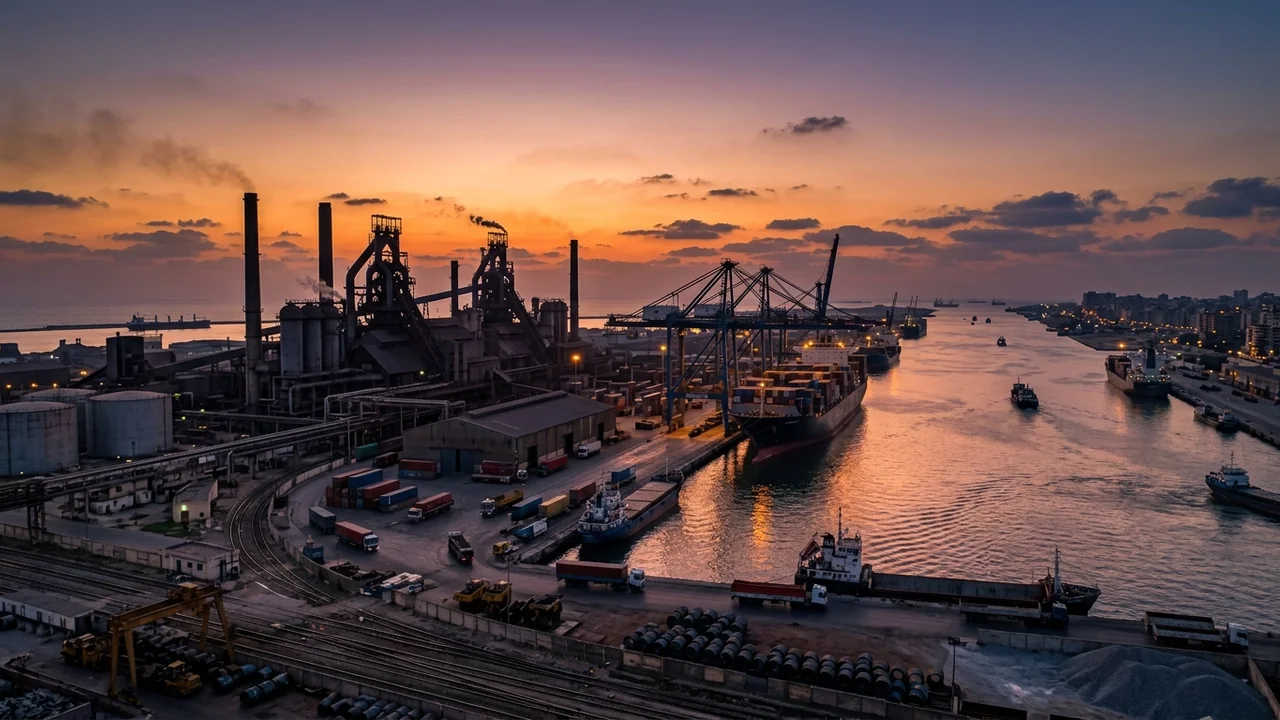
Caption: Egypt's nitrogen fertilizer plants operate on natural gas via the Haber-Bosch process, generating embedded CO₂ and N₂O emissions that fall within CBAM's pricing scope.
What Is Egypt's CBAM Exposure?
Egypt's CBAM exposure is concentrated in nitrogen fertilizers, specifically urea (CN 3102 10) and ammonia (CN 2814 10 00), with cement as a secondary sector, because Egypt holds the position of the second-largest cement exporter to the EU and a top-three global fertilizer supplier after Russia's market displacement. The country operates no carbon pricing scheme as of April 2026, which means EU importers of Egyptian goods cannot apply the Article 9 carbon price deduction and must cover the full certificate cost at the prevailing EU ETS price.
Egypt's CBAM-affected export profile spans three sectors, ranked by current financial exposure. Fertilizers represent the largest immediate risk because urea carries an embedded emission factor of approximately 2.5 tCO₂e per tonne. Cement, accounting for 4 to 9 percent of EU cement imports annually, faces process emissions that cannot be eliminated through energy efficiency alone. Steel, while a smaller share of Egyptian exports to the EU, rounds out the exposure picture for producers using blast furnace routes.
The 46% fertilizer share is not merely a statistical coincidence. Russia and Belarus historically supplied 34% of EU nitrogen fertilizer imports, and the EU's additional tariffs, escalating from €40 to 45 per tonne in July 2025 to €315 to 430 per tonne by July 2028, have accelerated Egyptian producers' market penetration. Egypt now fills a gap that CBAM simultaneously makes more expensive to sustain. This is the structural tension Egyptian exporters face: growing EU market demand on one side, rising certificate costs on the other.
How CBAM Calculates Costs for Egyptian Fertilizer Exporters
CBAM calculates Egyptian fertilizer costs using two inputs: the embedded emissions per tonne of product and the EU ETS certificate price at the time of surrender. The gross cost formula is straightforward. For each tonne of urea exported to the EU, the EU importer owes certificates proportional to 2.5 tCO₂e, priced at the prevailing ETS auction average.
The table below shows gross CBAM cost per tonne of Egyptian urea at three ETS price reference points, before applying the free allocation CBAM factor that reduces net cost during the 2026 to 2034 phase-out period.
| ETS Price | Emission Factor (urea) | Gross CBAM Cost/t | Net Cost 2026 (2.5% factor) | Net Cost 2030 (48.5% factor) |
|---|---|---|---|---|
| €50/tCO₂ | 2.5 tCO₂e/t | €125/t | €3.13/t | €60.63/t |
| €70/tCO₂ | 2.5 tCO₂e/t | €175/t | €4.38/t | €84.88/t |
| €100/tCO₂ | 2.5 tCO₂e/t | €250/t | €6.25/t | €121.25/t |
At the current EU ETS price of approximately €70 per tonne CO₂ as of late March 2026, the net CBAM cost for Egyptian urea is €4.38 per tonne in 2026. This figure is commercially manageable for most producers. The obligation that demands attention is the 2030 projection of €84.88 per tonne net, representing a 20-fold increase driven entirely by the free allocation phase-out schedule rather than any change in production carbon intensity.
Ammonia exports face a comparable calculation. The transitional default for anhydrous ammonia (CN 2814 10 00) is 2.68 tCO₂e per tonne, placing gross CBAM cost at approximately €187.60 per tonne at a €70 ETS price. At the 2.5% CBAM factor in 2026, the net obligation is approximately €4.69 per tonne. Reaching the 48.5% factor in 2030 produces a net cost of approximately €91/t, a figure that compresses margins on a product where FOB prices from Egypt have averaged €280 to 350 per tonne in recent periods.
The EU CBAM certificate-based mechanism links every certificate price to the EU ETS weekly auction average from 2027 onward, and to the quarterly auction average through 2026. Egyptian exporters have no mechanism to influence that price. Their only instrument is the embedded emissions rate they report, which is where the default value question becomes commercially decisive.
Default Values and the Egyptian Fertilizer Data Gap
Default values determine CBAM cost when the EU importer cannot provide verified actual embedded emissions from the producing installation. For Egyptian fertilizer exporters specifically, the default value penalty is smaller in proportional terms than for cement or steel, but the absolute cost gap still warrants attention.
Implementing Regulation (EU) 2025/2621 sets the default value mark-up for fertilizers at 1% above the calculated benchmark default in 2026, rising to 1% in 2027 and maintaining 1% from 2028 onward. This is the narrowest mark-up of any CBAM sector, reflecting the EU Commission's recognition of agricultural price sensitivity and food security concerns. By comparison, steel and cement face mark-ups of 10% in 2026, rising to 30% from 2028 onward.
The financial incentive to measure actual data rather than rely on CBAM default values is therefore structurally lower for Egyptian fertilizer producers than for Turkish cement exporters. At €70 ETS and 48.5% factor in 2030, the cost difference between actual emissions (estimated at 1.8 to 2.2 tCO₂e/t for efficient Egyptian plants) and the default (approximately 2.5 tCO₂e/t) is approximately €10 to 19 per tonne. That is a meaningful saving per 100,000 tonnes shipped, but it is not the existential differential that Turkish cement faces.
For ammonia exports, the situation shifts. The estimated default for Egyptian ammonia stands at approximately 3.5 tCO₂e/t against a typical actual of 1.8 to 2.2 tCO₂e/t. This gap of 1.3 to 1.7 tCO₂e/t, multiplied by €70 ETS and a 48.5% 2030 factor, produces a cost difference of approximately €44 to 58 per tonne. Producers operating highly efficient Haber-Bosch plants with low methane consumption have a strong financial case for engaging an accredited verifier, registering in the CBAM Operators Portal, and sharing verified data with EU buyers.
The data requirements for fertilizer installations include production volume, natural gas consumption per tonne of ammonia, N₂O emission data from nitric acid plants (where applicable), and electricity consumption for indirect emission calculation. Both direct and indirect emissions are priced for fertilizers under CBAM, because fertilizers are not listed in Annex II of Regulation (EU) 2023/956. Egyptian producers must account for plant electricity consumption in addition to the dominant CO₂ emissions from steam methane reforming.
Caption: The 1% fertilizer mark-up on default values is stable through 2028, but the free allocation phase-out between 2026 and 2030 drives net CBAM costs upward by a factor of nearly 20 for Egyptian urea exporters.
Egypt's Cement Sector: CBAM's Secondary Exposure
Egypt's cement export exposure to the EU carries a higher per-tonne cost than fertilizers, because Portland cement carries a default embedded emission value of approximately 1.584 tCO₂e per tonne and a default mark-up of 10% in 2026, rising to 30% from 2028 onward.
Egyptian Portland cement actual emissions run approximately 0.83 to 0.90 tCO₂/t from kiln processes, reflecting a gap relative to the 1.584 default. At €70 ETS and the 48.5% factor in 2030, the cost of using defaults versus actual data is approximately €24 per tonne. On a product selling at €50 to 70 per tonne FOB, that differential is commercially significant. Egyptian cement producers shipping to the EU market hold a stronger financial incentive to invest in verification than their fertilizer counterparts.
The fertilizer sector under CBAM and the cement sector share one critical compliance characteristic: both price indirect emissions. Egyptian cement kilns' electricity consumption feeds into the total embedded emissions calculation, alongside the unavoidable limestone calcination reaction (CaCO₃ → CaO + CO₂) that accounts for approximately 60% of cement's carbon footprint. Efficiency investments in cement reduce the fuel combustion portion but cannot eliminate process CO₂ from calcination without clinker substitution or carbon capture.
Egypt holds a 4 to 9% share of EU cement imports and competes primarily against Turkey, which supplies 35 to 39% of EU cement import volume. Turkey's CBAM exposure is considerably larger by volume, and the Turkish government enacted Climate Law No. 7552 in July 2025 specifically to establish a pilot ETS as a defensive response to CBAM. Egypt has requested an exemption from the EU Commission but has not established carbon pricing as of April 2026, leaving its exporters without Article 9 deduction eligibility.
How Egypt Compares to Other Fertilizer Exporters
Egypt's position among non-EU exporter obligations under CBAM is defined by three attributes: high fertilizer market share, no qualifying carbon price, and a relatively favorable default mark-up rate in the fertilizer sector.
The comparison below shows the four largest nitrogen fertilizer exporters to the EU and their CBAM positions as of April 2026.
| Exporter Country | EU Market Share (approx.) | Carbon Price | Article 9 Deduction | Default Mark-up 2026 |
|---|---|---|---|---|
| Egypt | ~41% post-Russia displacement | None | Not eligible | +1% |
| Algeria | ~17% | None | Not eligible | +1% |
| Russia | Severely reduced (EU additional tariffs) | None effective | Not eligible | +1% (where applicable) |
| EU domestic (Yara, OCI EU operations) | Remainder | EU ETS | N/A (internal) | N/A |
Egypt's 41% share of post-displacement EU urea imports is the headline competitive position. Algeria holds approximately 17%. Domestic EU production (Yara, OCI's EU-based plants) covers the remaining supply, protected by CBAM from the cost disadvantage that previously existed when Russian fertilizers entered without carbon pricing.
Both Egypt and Algeria face identical Article 9 deduction eligibility: none. Neither country operates a qualifying carbon pricing scheme that would allow EU importers to deduct an equivalent carbon cost. The full CBAM certificate obligation applies to every tonne imported from either country. This symmetry means Egypt's competitive position relative to Algeria is not affected by carbon pricing considerations but is driven purely by logistics, production cost, and product quality.
The strategic contrast with Morocco is instructive. Morocco's OCP Group is investing $7 billion in a green ammonia platform, targeting EU market access with near-zero embedded emissions. Green ammonia produced via renewable electrolysis carries an emission factor approaching zero, eliminating CBAM exposure entirely. Egypt's continued reliance on natural gas-based Haber-Bosch production positions its fertilizers as a medium-term supply solution that faces structurally increasing costs through 2034, absent decarbonization investment.
What Happens to CBAM Costs Through 2030: The Phase-Out Trajectory
The free allocation phase-out is the primary driver of Egyptian exporters' escalating compliance costs, not the EU ETS price level or any change in Egyptian production methods. The 2026 net cost of approximately €4.38 per tonne for urea rises to approximately €84.88 per tonne by 2030 because the CBAM factor increases from 2.5% to 48.5% over four years.
The steepest acceleration occurs between 2029 and 2030, when free allocation remaining drops from 77.5% to 51.5%, an 11-percentage-point change that translates to roughly a doubling of the net CBAM obligation in a single year. Egyptian exporters planning commercial agreements with EU buyers in the 2027 to 2029 window need to build in contractual mechanisms for CBAM cost adjustment, since the financial environment changes materially year-over-year.
Certificate purchase obligations formally begin February 1, 2027, and the first annual CBAM declaration covering calendar year 2026 is due September 30, 2027. Egyptian producers currently need to focus on two preparatory actions above all others: establishing a monitoring plan at the production installation that captures natural gas consumption, N₂O data where applicable, and electricity usage; and registering in the CBAM Operators Portal to enable verified data sharing with EU importers.
Compliance Steps for Egyptian Exporters
Egyptian nitrogen fertilizer and cement producers can reduce their CBAM cost exposure through four sequential actions. The four actions are listed in order of lead time, from the shortest implementation cycle to the longest.
- Register production installations in the CBAM Operators Portal and upload installation identification data (legal name, UN/LOCODE, geographic coordinates, contact person).
- Establish a monitoring plan covering all energy inputs (natural gas, electricity), production outputs (tonnes of ammonia, urea, or cement clinker), and emission calculation methodology per Implementing Regulation (EU) 2025/2547.
- Engage an accredited third-party verifier (accredited under EN ISO/IEC 14065 by an EA-recognized National Accreditation Body) for a physical site visit before the first 2026 import data is transmitted.
- Share verified specific embedded emissions with EU buyer's authorized CBAM declarant before or during the declaration preparation period leading to the September 30, 2027 deadline.
Verifier fees for a fertilizer installation typically range from €5,000 to €50,000 per verification period, depending on plant complexity and geographic access costs. For an Egyptian ammonia producer shipping 500,000 tonnes per year to the EU, the potential saving from providing verified actual data versus accepting defaults reaches approximately €22 to 29 million per year by 2030 (at a 1.3 tCO₂e/t gap, €70 ETS, 48.5% factor). The verification investment cost is an order of magnitude smaller than the accumulated cost of defaulting.
Does Egypt Qualify for Any CBAM Relief or Exemptions?
Egypt does not currently qualify for any CBAM exemptions or deductions. Three categories of potential relief are analyzed below, each of which Egypt fails to meet as of April 2026.
The first category is geographic exemption. Countries exempted from CBAM include EEA members (Iceland, Norway, Liechtenstein) and Switzerland, whose ETS is linked to the EU ETS. Egypt is not a candidate for EEA membership and has no ETS linkage agreement.
The second category is the Article 9 carbon price deduction. This deduction applies when the country of production has a legally binding, effectively enforced carbon pricing scheme, and the EU importer can document the carbon price actually paid per tonne CO₂e at the installation level. Egypt has no qualifying scheme. The government has announced a domestic carbon tax in development, but no operational scheme exists that would qualify under the criteria of Article 9 of Regulation (EU) 2023/956.
The third category is the de minimis threshold. Imports below 50 tonnes of annual mass per EU importer are exempt from CBAM obligations. This threshold exempts approximately 90% of EU importing companies by count, but those exempted companies represent only 1% of total CBAM-affected import volume. An EU fertilizer importer purchasing 500,000 tonnes per year from Egypt sits far above the de minimis level and owes the full certificate obligation.
Strategic Context: Egypt's Long-Term CBAM Position
Egypt's CBAM trajectory from 2026 to 2034 follows a path from low immediate cost to structurally significant competitive pressure. The current €4.38 per tonne net cost for urea is not the strategic planning problem. The €121.25 per tonne at full phase-in and €100 ETS is the scenario that determines whether Egyptian natural gas-based fertilizer production retains EU market competitiveness.
What Is the Article 9 Deduction and Can Egypt Ever Qualify?
The Article 9 carbon price deduction allows EU importers to subtract, from their CBAM certificate obligation, the carbon price effectively paid in the country of production per tonne of embedded CO₂e. Egypt currently has no qualifying carbon pricing scheme, and no formal timeline for establishing one has been confirmed as of April 2026. The article 9 deduction requires a legally binding scheme with effective enforcement, not a voluntary or announced-but-unimplemented mechanism.
If Egypt were to establish a qualifying carbon pricing scheme at, say, $10 per tonne CO₂ (approximately €9.20), the deduction at the 48.5% factor in 2030 would reduce the net CBAM obligation for urea by approximately €11.15 per tonne (2.5 tCO₂e/t × €9.20/t × 48.5%). That represents approximately 13% of the projected net obligation at €70 ETS. The benefit grows as free allocation phases out. The incentive for Egyptian policymakers to develop a qualifying scheme is real but requires political will to prioritize.
Does CBAM Affect Egyptian Exports to Non-EU Markets?
CBAM does not apply to Egyptian exports directed at non-EU markets, such as Brazil, India, or Southeast Asia. The financial obligation falls on the EU importer, not the Egyptian producer. Egyptian exporters shipping to non-EU destinations face no CBAM-related certificate cost. This creates a diversion-capable margin for Egyptian exporters: reallocating EU-bound volumes to non-CBAM markets reduces exposure.
The practical constraint is that the EU market offers premium pricing and long-term supply relationships that non-EU markets currently do not replicate at equivalent scale. The CBAM cost transferred to EU buyers as a lower purchase price to maintain competitiveness is the more likely commercial outcome for the 2026 to 2028 period, when net costs remain below €20 per tonne. Beyond 2028, the cost becomes large enough to trigger active supply chain reconfiguration.
Is Egyptian Cement More or Less Exposed Than Egyptian Fertilizer?
Egyptian cement faces a higher per-tonne default value penalty than Egyptian fertilizer, because the default mark-up for cement is 10% in 2026 and 30% from 2028, versus the 1% flat rate for fertilizers. At equal ETS prices and equal volume, an Egyptian cement producer accepting defaults absorbs a larger incremental cost than a fertilizer producer accepting defaults. The actual-versus-default gap for Egyptian ammonia (approximately 1.3 to 1.7 tCO₂e/t) is narrower in mark-up terms but wider in absolute emission intensity terms than the cement gap.
For an Egyptian exporter with resources to invest in only one verification program, the priority decision depends on shipped volume and margin structure. A producer shipping 200,000 tonnes of ammonia annually to the EU and 100,000 tonnes of cement clinker annually benefits more from verifying the ammonia installation first, given the larger absolute emission gap. Exporters with a predominantly cement-focused EU book benefit from the higher proportional default penalty reduction that cement verification delivers post-2028.
How Does CBAM Interact with an Exporter Decarbonization Strategy?
Verified data provision and decarbonization are two separate instruments that produce compounding benefits. Providing verified actual emissions today avoids the default mark-up. Investing in an exporter decarbonization strategy that reduces actual embedded emissions below the current benchmark reduces the base CBAM cost and improves competitiveness against EU domestic producers, whose ETS costs are priced into their production but who face no additional border adjustment.
Egyptian producers investing in electrolytic hydrogen-based ammonia production (green ammonia) eliminate CBAM exposure on the production side entirely, because an emission factor approaching zero means near-zero certificates required. The OCP Group in Morocco is the regional benchmark: a $7 billion green ammonia platform targeting near-zero embedded emissions and EU market access that is structurally immune to CBAM escalation. Egypt's gas-rich production infrastructure makes the transition to green ammonia economically challenging in the short term but strategically rational over a 10-year horizon as CBAM costs compound.
How Does the Cement Sector Exposure Compare to Other Countries?
Turkey, not Egypt, carries the dominant cement sector exposure to CBAM, with a 35 to 39% EU market share and a default versus actual gap of approximately 80% by emission intensity. Egypt's 4 to 9% share positions it as a secondary supplier whose CBAM compliance posture influences competitiveness primarily at the margin. Turkish producers facing €83 per tonne default-based CBAM cost in some scenarios have already driven accelerated verifier engagement in the Turkish cement sector. Egyptian producers shipping smaller volumes to the EU face less acute pressure but benefit from the same data provision infrastructure that the broader industry is building.