Indonesia's CBAM exposure targets two primary sectors, aluminium and steel, at a moment when the country's industrial capacity is expanding faster than its carbon pricing framework can accommodate. Regulation (EU) 2023/956 entered its definitive phase on January 1, 2026, meaning Indonesian exporters shipping covered goods to EU buyers now face real financial consequences flowing directly from their carbon intensity. The question for Indonesian producers is not whether CBAM applies, but how large the cost will become and whether the 2023 domestic carbon market can eventually support an Article 9 deduction.
This article analyzes Indonesia's specific exposure under the EU CBAM framework, covering the sectors affected, the domestic carbon pricing context, the Article 9 eligibility question, and the practical compliance steps Indonesian manufacturers must take to protect their EU market position.
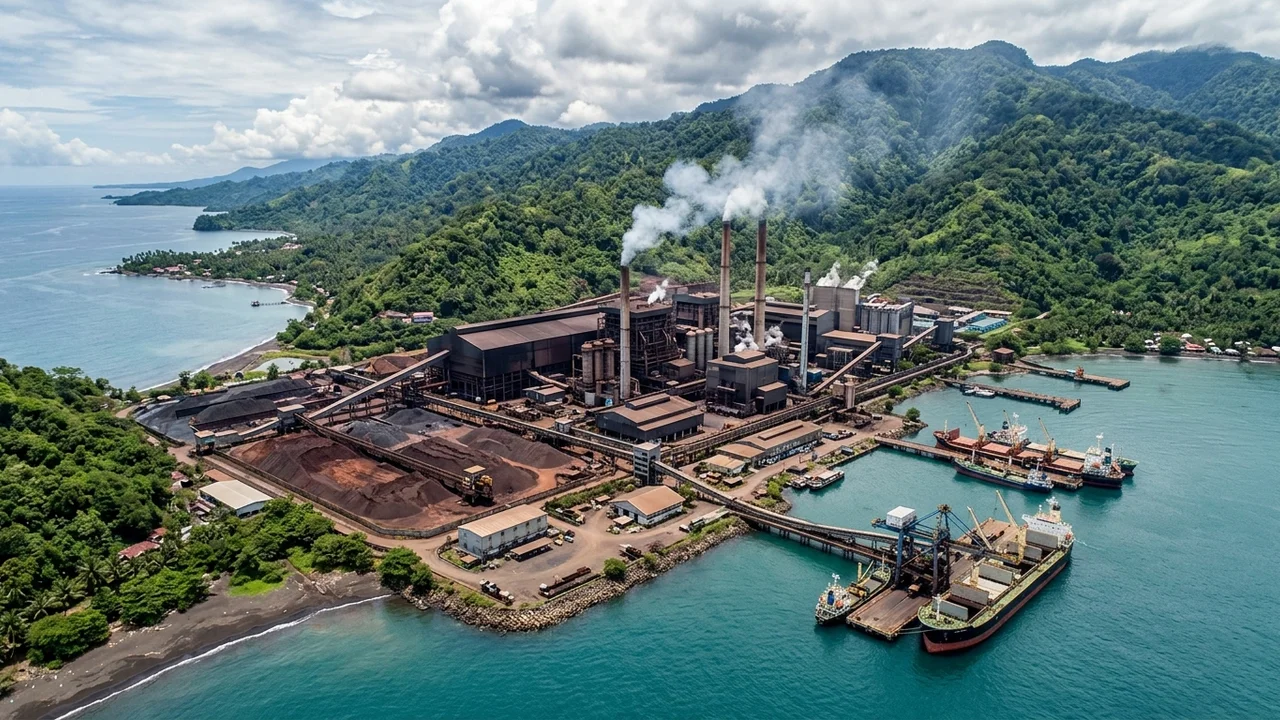
Caption: Primary aluminium production in Indonesia relies on coal-intensive grid power, driving direct emission factors relevant to CBAM certificate calculations.
What CBAM Sectors Apply to Indonesian Exports?
Two sectors represent Indonesia's primary CBAM exposure: aluminium and steel, both listed in Annex I of Regulation (EU) 2023/956. Aluminium accounts for the larger share of Indonesia's EU-directed trade in CBAM-covered goods, while steel exports are growing as domestic capacity expands under Indonesia's industrial development programs.
The 6 CBAM sectors covered by the regulation are iron and steel, cement, aluminium, fertilizers, electricity, and hydrogen. Of these, only iron/steel and aluminium apply materially to Indonesia's current EU export profile. Indonesia does not export significant volumes of cement, fertilizers, or electricity to the EU, and commercial hydrogen trade remains negligible globally as of 2026.
For aluminium, CBAM prices direct emissions only. Aluminium is listed in Annex II of the regulation, meaning only CO₂ and perfluorocarbons (specifically CF₄ with a global warming potential of 6,630 and C₂F₆ with a GWP of 11,100) from the production process itself attract certificate obligations. The indirect emissions from Indonesia's coal-intensive electricity grid, which represent the dominant share of total aluminium lifecycle emissions at approximately 12 to 16 tCO₂/t total when electricity is included, do not generate CBAM liability under the current definitive phase rules.
For steel, CBAM also covers direct emissions only. The blast furnace to basic oxygen furnace route (BF-BOF), which remains Indonesia's primary production method, carries an emission factor of approximately 2.0 tCO₂ per tonne. The steel sector CBAM obligations include CN codes across Chapters 72 and 73, covering semi-finished products, flat-rolled products, structural sections, and a range of downstream steel articles.
How Does Indonesia's 2023 Carbon Market Affect CBAM?
Indonesia launched its carbon trading market in 2023, initially covering coal-fired power plants in a voluntary phase. This makes Indonesia one of a small number of developing economies with an active domestic carbon pricing instrument, but the scheme's current design limits its relevance for CBAM purposes.
The mechanism operates under Indonesia's National Determined Contribution framework and targets the electricity sector. Industrial sectors including steel and aluminium manufacturing are not covered as of April 2026. This sectoral gap is the central obstacle to any Article 9 deduction claim.
The Article 9 eligibility criteria require all of the following:
- A legally binding carbon pricing scheme in the country of origin
- Coverage of the specific production installation and goods being exported
- An effectively paid carbon price (gross price minus any free allocations or rebates received by the producer)
- Documentation verifiable against EU standards and capable of being certified by an accredited third-party verifier
Indonesia's 2023 scheme satisfies the first criterion partially, since the voluntary phase lacks the binding enforcement that CBAM Article 9 requires. The scheme fails the second criterion entirely for steel and aluminium exports because those industries fall outside its current scope. No Article 9 deduction is available to Indonesian exporters under the current carbon market design. The deduction can become available only if Indonesia expands its carbon pricing to industrial sectors and transitions from voluntary to mandatory compliance, a development that remains on the policy agenda but has not been implemented as of 2026.
What Is the Financial Cost of CBAM for Indonesian Exporters?
The net CBAM cost for Indonesian exporters in 2026 is low in absolute terms, because 97.5% of EU ETS free allocation remains in place. The financial obligation accelerates sharply from 2028 onward and reaches full force by January 1, 2034 when free allocation is eliminated entirely.
The table below shows the gross CBAM certificate obligation per tonne, and the net effective surcharge after applying the free allocation factor, at the current EU ETS reference price of approximately €70 per tCO₂.
| Product | Emission Factor (tCO₂/t) | Gross Cost @ €70 | Net Cost 2026 (2.5% factor) | Net Cost 2030 (48.5% factor) | Net Cost 2034 (100% factor) |
|---|---|---|---|---|---|
| Steel BF-BOF | ~2.0 | €140/t | €3.50/t | €67.90/t | €140/t |
| Primary aluminium (direct only) | ~1.5 | €105/t | €2.63/t | €50.93/t | €105/t |
| Steel EAF (scrap-based) | ~0.5 | €35/t | €0.88/t | €16.98/t | €35/t |
The 2026 numbers appear manageable. The 2030 numbers represent a structural cost shift. A BF-BOF steel producer exporting to the EU pays €3.50 per tonne net in 2026 and €67.90 per tonne net in 2030. For a producer operating on margins of €30 to €50 per tonne, the 2030 exposure is commercially threatening without either decarbonization investment or a qualifying domestic carbon price.
Indonesian aluminium producers face a similar trajectory. Primary aluminium direct emissions of approximately 1.5 tCO₂/t generate a 2030 net cost of €50.93/t. This calculation uses direct emissions only. The indirect electricity-related emissions, which dominate total aluminium carbon intensity on Indonesia's coal-heavy grid, do not generate CBAM certificate obligations under current rules. This indirect emissions gap represents an administrative advantage for Indonesian aluminium exporters relative to what the total carbon footprint of their production would otherwise imply.
How does the default value question interact with these cost calculations? Exporters who cannot provide verified actual emission data face default values set by Implementing Regulation (EU) 2025/2621, marked up by 10% above the benchmark default in 2026, rising to 20% in 2027 and 30% from 2028 onward. If Indonesia's actual BF-BOF steel emissions are below the default, providing verified data reduces the certificate obligation. The verification cost runs between €5,000 and €50,000 per production installation per period, depending on facility complexity.
The aluminium sector under CBAM covers CN codes in Chapter 76, including unwrought aluminium (7601), bars and rods (7604), wire (7605), plates and sheets (7606), and structures (7610). Indonesian producers exporting any of these product categories to EU importers trigger CBAM obligations at the importer level from January 1, 2026.
How Does CBAM Create Compliance Obligations for Indonesian Exporters?
Indonesian manufacturers carry no direct legal obligation under CBAM. The authorized CBAM declarant, meaning the EU importer of record, holds the formal obligation to register, measure, and surrender certificates. This legal architecture does not eliminate the commercial pressure on Indonesian exporters, because it determines how EU buyers price and negotiate supply contracts.
The compliance chain works as follows. First, the EU importer must obtain authorization from the competent authority in their member state by March 31, 2026. Second, from February 1, 2027, authorized declarants begin purchasing CBAM certificates priced at the quarterly average of EU ETS auction clearing prices. Third, by September 30, 2027, the first annual CBAM declaration covering calendar year 2026 must be submitted, with certificates surrendered proportional to embedded emissions of that year's imports.
The data obligations Indonesian exporters face in practice include:
- Production route identification (BF-BOF, EAF, or DRI-EAF for steel; Hall-Héroult for aluminium)
- Specific direct embedded emissions per tonne, calculated using the EU methodology under IR 2025/2547
- Physical address, UN/LOCODE, and geographical coordinates of the production installation
- A monitoring plan describing how emissions are measured at the facility
- Third-party verification by an accredited verifier with a mandatory physical site visit for the 2026 reporting period
Exporters who provide this verified data to their EU buyers directly through the CBAM Operators Portal gain a competitive advantage. EU importers pay certificate costs based on declared actual emissions rather than default values. The default mark-up rises to 30% from 2028, meaning Indonesian producers who cannot verify their emissions become 30% more expensive on a per-tonne CBAM cost basis than their actual performance might justify.
The penalty for EU importers who fail to surrender sufficient certificates is €100 per tonne CO₂e under Article 26(1) of Regulation (EU) 2023/956 as amended. Importing without authorization carries a penalty of €300 to €500 per tonne CO₂e, or 3 to 5 times the standard rate. These penalties create strong incentive for EU buyers to demand accurate data from their Indonesian suppliers or to seek suppliers who already have verified data available.
What Is Indonesia's Strategic Position Under CBAM?
Indonesia occupies a middle position among CBAM-affected developing economies: more advanced than many peer economies in having launched a carbon market, but not yet positioned to claim the Article 9 deduction that a mature, industry-covering scheme would enable. This gap defines the strategic agenda for Indonesian policymakers and industrial producers over the next five to seven years.
The 2023 carbon market's voluntary phase is a foundation, not a solution. Transitioning to mandatory compliance, expanding sectoral coverage to steel and aluminium manufacturing, and setting a carbon price that the Commission would recognize as "effectively paid" for Article 9 purposes all represent multi-year policy steps. The precedent from South Korea's K-ETS, which has operated since 2015 and is the scheme closest to achieving Article 9 recognition, illustrates the timeline involved: a decade of operation at legally binding compliance levels before bilateral recognition becomes credible.
Indonesia's government has expressed vocal objections to CBAM in WTO forums without filing a formal dispute as of April 2026. The WTO Trade and Environment Committee has received Indonesia's concerns as part of the broader developing-country coalition opposing CBAM. No formal WTO docket equivalent to Russia's DS639 (filed May 12, 2025) exists for Indonesia. The strategic implication is that Indonesia is applying diplomatic pressure while simultaneously developing its domestic carbon market, positioning itself for a future bilateral recognition negotiation rather than a confrontational legal challenge.
Does CBAM's De Minimis Threshold Affect Indonesian Exporters?
The 50-tonne annual mass threshold exempts EU importers who purchase less than 50 tonnes per year from a single product category from CBAM obligations. Indonesian exporters shipping small volumes to EU buyers near or below this threshold may find their EU customers exempt from certificate requirements entirely.
The practical scale of this exemption is limited for industrial-volume trade. The 50-tonne threshold exempts approximately 90% of EU importing companies by count, but those companies represent only approximately 1% of total CBAM-affected import volume. Large EU steel and aluminium buyers, which account for the overwhelming majority of import tonnage, operate well above 50 tonnes annually and face full compliance obligations.
Indonesian exporters focused on niche or specialty product lines at low volumes gain practical relief from the de minimis rule. Producers supplying volume buyers, including construction material distributors, automotive component manufacturers, and industrial equipment suppliers in the EU, do not.
Can Indonesian Exporters Use the CBAM Operators Portal?
The CBAM Operators Portal, operated by DG TAXUD under the European Commission, accepts direct data uploads from non-EU production installations. Indonesian producers can register their facility, upload verified emissions data, and share that data selectively with specific EU buyer accounts. One verified data upload serves all EU importer relationships simultaneously, reducing the per-relationship reporting burden.
The portal supports the Communication Template issued under IR 2025/2547, which maps facility-level energy flows, production activity data, and emission calculations to the CBAM declaration fields that EU importers must complete. Indonesian producers who complete this template with verified data eliminate the default value risk from their EU customers' compliance calculations.
Verifiers who conduct the physical site assessment at Indonesian facilities must be accredited under EN ISO/IEC 14065 by an EA-recognized National Accreditation Body. Indonesian accreditation bodies with mutual recognition agreements under the EA framework can certify local verifiers for this purpose, meaning the verification process does not necessarily require European verifiers to travel to Indonesia for each assessment.
How Should Indonesian Steel and Aluminium Producers Plan for CBAM?
The planning priority for Indonesian exporters differs by production route and timeline. Three planning horizons apply: the immediate compliance window (2026 to 2027), the escalating cost window (2028 to 2030), and the full-exposure window (2031 to 2034).
Understanding the obligations that apply to non-EU exporter obligations under CBAM starts with recognizing that the financial pressure arrives through EU buyer behavior, not through direct legal enforcement against the Indonesian producer. EU importers facing growing certificate costs negotiate harder on purchase prices, switch to lower-carbon suppliers, or absorb CBAM costs in ways that compress their willingness to pay.
The Article 9 carbon price deduction represents the most strategically significant long-term tool for Indonesian exporters. Achieving eligibility requires Indonesia to expand its 2023 carbon market to cover industrial steel and aluminium production at binding compliance levels. The economic incentive is clear: at 2030 CBAM cost levels, a qualifying carbon price of even €10 per tonne CO₂e, if recognized under Article 9, would reduce the certificate obligation by approximately €10 per tonne of embedded emissions, multiplied by the 48.5% CBAM factor, generating savings of approximately €4.85 per tonne net in 2030. That figure rises to €10 per tonne net in 2034 at 100% factor.
Producers who cannot wait for the policy solution have two immediate options. First, measuring and verifying actual emissions replaces the default value with actual performance data, eliminating the 10 to 30% default mark-up and potentially reducing the gross CBAM obligation if actual emissions fall below the benchmark default. Second, investing in lower-carbon production technology, including scrap-based EAF steelmaking with its emission factor of approximately 0.5 tCO₂/t versus 2.0 tCO₂/t for BF-BOF, reduces CBAM exposure structurally rather than administratively.
Indonesian aluminium producers who use renewable energy contracts for their smelting operations can reduce direct emissions from carbon anode consumption and PFC generation, even though the indirect electricity emissions remain outside CBAM scope. The emission factor reduction translates directly into lower certificate obligations for EU-bound volumes.
How Do Indonesian Exporters Compare to Other CBAM-Affected Developing Economies?
Indonesian producers face CBAM on terms that are less severe than Turkey's or India's but more exposed than Brazil's or South Africa's. Turkey faces CBAM-affected exports worth approximately €19 billion annually with no qualifying carbon price and near-total geographic captivity to the EU market. India's steel exporters face €3.9 billion in annual EU exposure with BF-BOF emission factors of 1.8 to 2.1 tCO₂/t. Indonesia's total CBAM-affected EU trade volume is smaller, and the indirect emissions gap in aluminium (where CBAM only prices direct emissions) provides a structural understatement of total carbon cost that benefits Indonesian producers relative to full-cost pricing alternatives.
The key differentiation is that Indonesia's 2023 carbon market, even in its limited form, represents more domestic policy momentum than Turkey's situation before its Climate Law of July 2025, or the United States, which has no federal carbon pricing mechanism. This trajectory matters because the Article 9 deduction path requires years of policy development, and Indonesia is further along that path than many peer exporters with comparable industrial profiles.
Is Indonesia at Risk of CBAM Circumvention Enforcement?
CBAM anti-circumvention provisions apply to product processing and reclassification schemes designed to avoid certificate obligations. Indonesia faces a specific risk related to Vietnamese processing corridors, where Chinese steel is processed in Vietnam and re-exported as Vietnamese-origin product. Anti-circumvention enforcement under Article 27 of Regulation (EU) 2023/956 targets these routes, and Indonesia's own processing industry can face scrutiny where import inputs and re-export outputs suggest reclassification to reduce declared embedded emissions.
Genuine Indonesian production, with documented domestic origin and verifiable production data, is not subject to circumvention enforcement. The risk applies specifically to processing operations that transform imported semi-finished goods without genuine value-added production activity. Indonesian producers who maintain complete production documentation, including input material sourcing records and emission calculations for the full production chain, are not exposed to circumvention penalties.
What Are the CBAM Default Values Relevant to Indonesia?
CBAM CBAM default values for steel and aluminium are set per IR 2025/2621 and are specific to production route and country of origin in some cases. For Indonesia, the general "other countries" defaults apply in the absence of country-specific benchmarks. The BF-BOF default benchmark is 1.370 tCO₂e per tonne of crude steel. Actual Indonesian BF-BOF producers typically emit in the range of 2.0 to 2.5 tCO₂/t, meaning actual emissions exceed the benchmark default.
This creates a directionally unusual situation: Indonesian BF-BOF producers whose actual emissions exceed the benchmark default face higher certificate obligations under actual-value reporting than under default-value reporting in the early years. The 10% mark-up on defaults in 2026 modifies this only slightly. Producers should calculate their specific emission intensity before deciding whether to provide actual verified data or accept the default, using the following test: if actual emissions per tonne multiplied by 1.10 (the 2026 mark-up factor on the benchmark) exceeds actual emissions, defaults may be financially preferable in 2026.
The mark-up rises to 30% from 2028. At that point, Indonesian producers with actual emissions at or below approximately 1.78 tCO₂/t (1.370 × 1.30) benefit from providing actual data. Producers above that threshold still face higher costs under actuals, but the growing EU importer preference for supply chains with verified data creates commercial pressure to engage verification regardless of the pure arithmetic.
What Is an Exporter Decarbonization Strategy for Indonesian Producers?
An exporter decarbonization strategy for Indonesian steel and aluminium producers involves four parallel tracks pursued simultaneously rather than sequentially. The four tracks are emissions measurement and verification, production technology investment, carbon market engagement, and EU buyer relationship management.
Emissions measurement and verification produces the data needed for CBAM Operators Portal submission, enables the default value comparison calculation, and creates the baseline against which future emissions reductions can be measured and credited. Technology investment in scrap-based EAF steelmaking or renewable energy procurement for aluminium smelting reduces the CBAM obligation structurally. Carbon market engagement means participating in Indonesia's 2023 scheme as it expands to industrial sectors, building the compliance history that Article 9 recognition will eventually require. EU buyer relationship management converts CBAM data provision into a commercial differentiator: verified, low-emission Indonesian exporters retain EU contracts that higher-carbon competitors lose.
The sequencing that maximizes value: begin emissions measurement immediately, since the 2026 declaration period data must be verifiable for the September 30, 2027 first declaration deadline. Technology investment follows the measurement baseline, targeting the largest emission sources first. Carbon market participation can proceed in parallel with whatever Indonesian policy expansion timeline permits.
Caption: BF-BOF steel production in Indonesia carries approximately 2.0 tCO₂ per tonne of direct emissions, driving growing CBAM certificate obligations for EU-bound export volumes through 2034.
Frequently Asked Questions: CBAM Indonesia
Does CBAM apply to Indonesian aluminium exports to the EU? CBAM applies to Indonesian aluminium exports beginning January 1, 2026. The obligation falls on the EU importer, not the Indonesian producer. Direct emissions from the production process, including CO₂ and perfluorocarbons from the Hall-Héroult electrolysis route, attract certificate requirements. Indirect emissions from Indonesia's coal-heavy electricity grid are not currently priced under CBAM for aluminium, since aluminium is listed in Annex II of Regulation (EU) 2023/956.
Does Indonesia's 2023 carbon market qualify for the Article 9 deduction? No, Indonesia's 2023 carbon market does not currently qualify for the Article 9 deduction. The scheme covers coal-fired power plants only and began in a voluntary phase. Steel and aluminium manufacturing are outside the scheme's scope. Article 9 eligibility requires a legally binding, effectively enforced carbon pricing scheme that covers the specific production installation and product category being exported to the EU.
What is the net CBAM cost per tonne for Indonesian BF-BOF steel in 2026? At an EU ETS price of approximately €70 per tCO₂ and the 2.5% CBAM factor applicable in 2026, the net CBAM certificate cost for Indonesian BF-BOF steel is approximately €3.50 per tonne. This rises to approximately €67.90 per tonne net in 2030 when the CBAM factor reaches 48.5%, and to €140 per tonne net in 2034 at the 100% factor.
Does the 50-tonne de minimis threshold protect Indonesian exporters? The 50-tonne de minimis threshold exempts EU importers, not the Indonesian exporter directly. If an EU buyer purchases less than 50 tonnes per year of CBAM-covered goods from all sources combined within a product category, that buyer is exempt from CBAM obligations. For volume industrial trade, EU buyers typically exceed this threshold and face full compliance requirements regardless of the origin country of their purchases.
When must Indonesian exporters provide emissions data to their EU buyers? The first formal CBAM declaration covering imports made in calendar year 2026 must be submitted by September 30, 2027. EU importers need verified emissions data from their Indonesian suppliers to complete this declaration without defaulting to default values. Indonesian producers should target completing emissions measurement, verification, and Operators Portal registration by mid-2026 to give EU buyers time to incorporate the data into their declaration planning.