Japan's CBAM exposure centers on approximately €1–2 billion in annual steel and aluminium exports to the EU, produced by two of the world's most carbon-efficient steelmakers, Nippon Steel and JFE Steel. The central question for Japanese exporters in 2026 is whether the GX-ETS carbon pricing scheme launched in April 2026 will qualify for an Article 9 deduction under Regulation (EU) 2023/956, a determination that reduces the certificate obligation carried by EU importers of Japanese goods. This article examines the GX-ETS structure, Japan's steel emission profile, the Article 9 eligibility criteria, and the compliance actions Japanese producers take now to protect their EU market position through the 2030 free-allocation cliff.
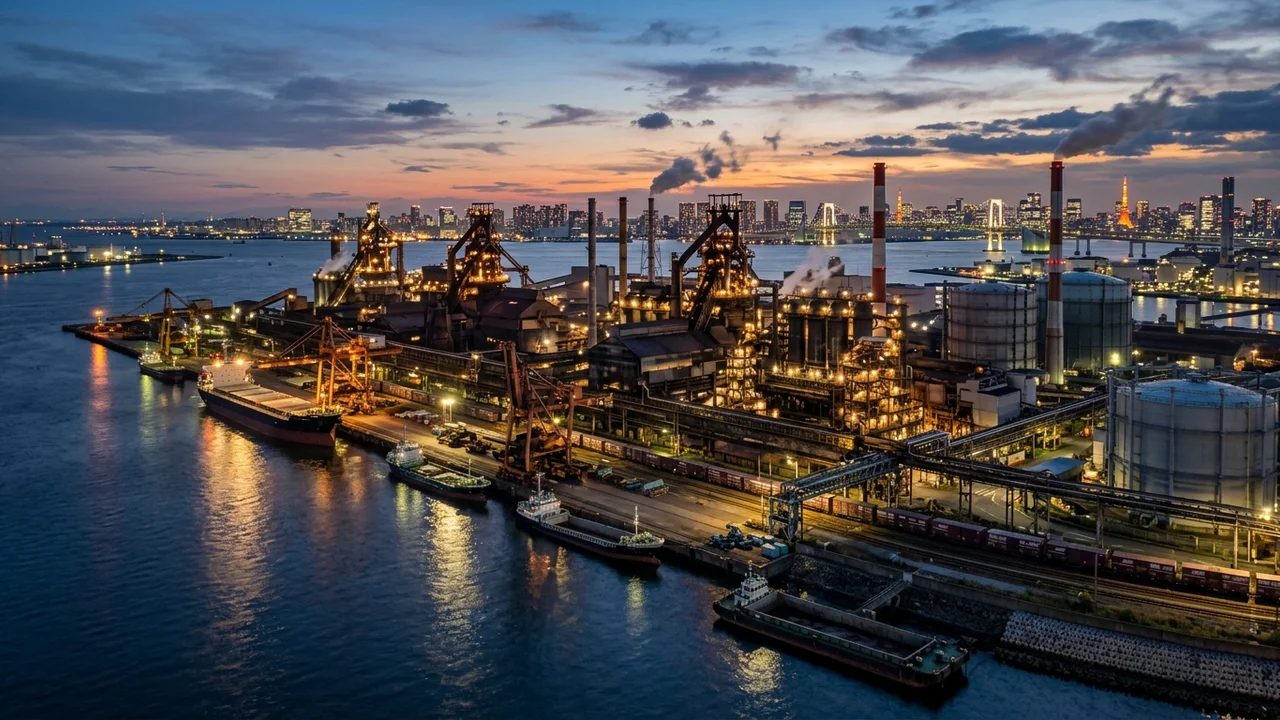
Caption: Blast furnace and basic oxygen furnace infrastructure at a Japanese integrated steelworks. Direct emissions from BF-BOF production are priced under CBAM from January 1, 2026.
What Is Japan's Position Under EU CBAM?
Japan's position under the EU Carbon Border Adjustment Mechanism is that of a moderate-exposure, high-efficiency exporter whose primary vulnerability is the immature status of its GX-ETS carbon pricing scheme rather than its emission intensity. Japanese steelmakers operate among the lowest-carbon BF-BOF facilities globally, yet that efficiency provides limited protection while the GX-ETS has not secured Article 9 recognition from the European Commission.
The EU CBAM is a certificate-based mechanism, not a tax or tariff, established by Regulation (EU) 2023/956 and effective in its definitive phase from January 1, 2026. It requires EU importers of carbon-intensive goods from six sectors (iron and steel, cement, aluminium, fertilizers, electricity, and hydrogen) to purchase certificates proportional to the embedded CO₂ emissions of those imports, priced at the EU ETS carbon price of approximately €70/tCO₂ as of late March 2026.
Japan's exposure is concentrated in two sectors. The steel sector, led by Nippon Steel and JFE Steel, accounts for the dominant share of CBAM-covered exports. Aluminium exports add a secondary exposure. Neither cement, fertilizers, nor hydrogen represents material Japanese export volumes to the EU. This sector concentration means that the BF-BOF benchmark and the Article 9 question are the two decisive factors shaping Japan's CBAM compliance calculus.
How Does the GX-ETS Work and What Does It Cover?
The GX-ETS (Green Transformation Emissions Trading System) became mandatory from April 2026, having operated on a voluntary basis since its launch in 2023 under Japan's GX Promotion Act. The mandatory phase covers large industrial emitters across power generation, steel, cement, paper, and chemicals, targeting facilities that emit above a defined threshold measured in tCO₂ per year.
The scheme structure differs from the EU ETS in three important respects. First, the GX-ETS operates with significant free allocation in its early mandatory phase, meaning the "effectively paid" carbon price relevant to Article 9 is lower than the headline permit price. Second, the current effective carbon price under the GX-ETS combined with Japan's pre-existing carbon tax of JPY 289/t (approximately $2/tCO₂) remains very low. Third, the GX-ETS uses a benchmark-based allocation system rather than a hard absolute cap, which bears on Article 9 qualification criteria under the CBAM regulation.
For Article 9 purposes, the critical metric is not the statutory carbon price but the amount effectively paid per tonne of CO₂e after subtracting free allocation and any refunds or rebates. At the GX-ETS's current development stage, Japanese producers likely pay an effective carbon price well below €5/tCO₂, compared to the CBAM certificate price of approximately €70/tCO₂.
What Is Japan's Steel Emission Profile Under CBAM?
Japanese steel producers using the BF-BOF route carry embedded emission intensities generally in the range of 1.8–2.1 tCO₂/t of crude steel, which compares favorably against the global BF-BOF average. The CBAM BF-BOF benchmark established under Implementing Regulation (EU) 2025/2621 sits at 1.370 tCO₂e/t of crude steel.
The three production routes and their benchmarks are listed below.
| Production Route | CBAM Benchmark (tCO₂e/t crude steel) | Typical Japanese Range |
|---|---|---|
| BF-BOF (Blast Furnace — Basic Oxygen Furnace) | 1.370 | 1.8–2.1 tCO₂/t (actual) |
| DRI-EAF (Direct Reduced Iron — Electric Arc Furnace) | 0.481 | Limited use in Japan |
| Scrap-EAF (Electric Arc Furnace — scrap-based) | 0.072 | Moderate use (secondary producers) |
Japanese producers whose actual emissions exceed the 1.370 BF-BOF benchmark face a gross CBAM cost calculated on their actual specific embedded emissions, not the benchmark. At approximately €70/tCO₂ and an emission factor of 2.0 tCO₂/t, the gross cost reaches €140/t before applying the CBAM factor.
The key financial reality in 2026 is that the net obligation is small because 97.5% of EU ETS free allocation remains in place. Under the CBAM cost formula, a BF-BOF producer at 2.0 tCO₂/t and €70/tCO₂ faces a gross cost of €140/t multiplied by the 2.5% CBAM factor, producing a net obligation of approximately €3.50/t in 2026. That net cost rises to approximately €67.90/t in 2030 when the CBAM factor reaches 48.5%, representing a 20-fold increase that makes advance data preparation commercially essential.
The steel sector under CBAM is the largest covered sector by trade volume, and Japanese producers competing against Indian and Turkish BF-BOF steel benefit from their relative efficiency advantage in terms of verified actual data. However, that advantage only materializes if producers provide verified actual emission data rather than allowing EU importers to default to the IR 2025/2621 default values, which carry a 10% mark-up above the calculated default in 2026, rising to 30% from 2028 onward.
Does Japan Qualify for the Article 9 Carbon Price Deduction?
The Article 9 deduction is the mechanism under Regulation (EU) 2023/956 that allows EU importers to reduce their CBAM certificate obligation by the amount of carbon price effectively paid in the country of origin. Japan's GX-ETS is not yet recognized for this deduction as of April 2026.
The Commission's assessment of third-country carbon pricing schemes examines four qualifying criteria for Article 9 recognition. These criteria are applied to each scheme seeking deduction eligibility.
The four criteria applied in the Article 9 assessment process are listed below:
- The carbon pricing scheme must be legally binding and effectively enforced across the sectors claiming the deduction.
- The scheme must price the same GHGs as CBAM (CO₂ for steel, plus PFCs for aluminium).
- The carbon price must be "effectively paid" — meaning the gross permit cost minus any free allocation received, rebates, or state compensation constitutes a real financial cost to the producer.
- The scheme must cover the production installations from which the exported goods originate.
The GX-ETS clears criterion 1 as of its mandatory phase from April 2026. It covers steel sector installations and the relevant GHGs under criterion 2. However, criterion 3 presents the most significant barrier: given the substantial free allocation in the early mandatory GX-ETS phase and the low effective carbon price of approximately $2/tCO₂ when combined with the carbon tax, the "effectively paid" amount is unlikely to produce a material Article 9 deduction even if the scheme is formally recognized. The value of any deduction scales directly with the carbon price actually paid, and at $2/tCO₂ versus a CBAM certificate price of approximately €70/tCO₂, the deduction would represent less than 3% of gross CBAM liability.
South Korea's K-ETS, operating since 2015 and in Phase 4 as of 2026, offers a comparison point. The Commission considers K-ETS the strongest candidate for Article 9 recognition among non-EU CBAM-affected economies. Even with K-ETS recognition, the effective deduction at approximately $6–7/tCO₂ covers only around 9% of gross CBAM liability at €70/tCO₂. Japan's GX-ETS, at an earlier maturity stage, produces a smaller effective deduction and faces a longer assessment timeline.
What Are the CBAM Compliance Steps for Japanese Exporters?
Japanese exporters face four practical compliance actions that protect their position with EU buyers and reduce the risk of default values being applied. The obligation falls legally on the EU importer, but the commercial mechanism transfers the cost impact upstream to the exporter when verified data is not available.
The compliance preparation steps for Japanese production installations are outlined below:
- Register with the CBAM Operators Portal. The European Commission operates a dedicated portal for non-EU installation operators to upload facility-level emission data. A single upload makes verified data available to all EU-based authorized CBAM declarants purchasing from that installation.
- Commission a monitoring plan. A document defining system boundaries, emission sources, measurement instruments, and calculation methodology must be in place under Implementing Regulation (EU) 2025/2547. The monitoring plan forms the basis for the verification audit.
- Engage an accredited verifier. Verifiers must hold accreditation under EN ISO/IEC 14065 from a National Accreditation Body with EA mutual recognition. The first verification requires a physical site visit to the production installation. Verifier fees range from €5,000 to €50,000 per installation per reporting period.
- Calculate specific embedded emissions using the EU methodology. From 2026 onward, only the full EU calculation methodology under IR 2025/2547 is accepted. The transitional "alternative methods" based on third-country data are no longer valid.
Japanese producers who complete these steps replace default values with verified actuals, which matters financially from 2027 onward as certificate purchase begins on February 1, 2027, and grows in significance as the free allocation phases out toward 2034.
How Does Japan's CBAM Exposure Compare to Other Asian Exporters?
Japan's position sits between South Korea and China in the CBAM-readiness spectrum. South Korea's K-ETS is the most mature carbon pricing scheme among non-EU Asian steel exporters, making it the best-positioned country for Article 9 recognition. Japan's GX-ETS is newer and less financially binding but represents a genuine mandatory system as of April 2026. China's national ETS covered the electricity sector only as of early 2025, with steel sector inclusion progressing but the scheme remaining intensity-based rather than operating under an absolute cap.
The non-EU exporter obligations under CBAM share a common structure: no direct legal obligation, but commercial pressure from EU buyers who face certificate costs tied to the embedded emissions of what they import. Japanese steelmakers carry a structural efficiency advantage over Chinese BF-BOF producers because Japanese actual emission intensities are typically lower, but the advantage is captured only through verified data submission.
The annual CBAM-affected export value from Japan to the EU of approximately €1–2 billion is modest relative to China's €15+ billion or India's €4–5 billion exposure. This lower exposure reduces the urgency of bilateral diplomatic engagement, though Japan's government monitors the GX-ETS recognition question carefully given the broader precedent it sets for Japanese industry.
Contextual Border: How Will the GX-ETS Evolve Relative to CBAM Through 2030?
The GX-ETS trajectory through 2030 determines whether Article 9 recognition becomes financially material for Japanese exporters. Japan's GX Promotion Act envisions a progressive tightening of the GX-ETS, with the government targeting a carbon price increase that brings the effective rate closer to levels that produce meaningful Article 9 deductions. The policy timeline aligns poorly with the CBAM free-allocation cliff.
The free allocation phase-out accelerates sharply between 2029 and 2030, when the CBAM factor jumps from 22.5% to 48.5%. A Japanese BF-BOF producer at 2.0 tCO₂/t and €70/tCO₂ faces a net cost increase from approximately €31.50/t in 2029 to approximately €67.90/t in 2030. If the GX-ETS produces an effective carbon price of €20/tCO₂ by 2030 and Article 9 is recognized, the deduction covers 2.0 × €20 = €40 of gross liability per tonne, reducing the net obligation significantly. The commercial value of GX-ETS recognition therefore grows substantially as the 2030 threshold approaches.
Does the GX-ETS Carbon Tax Qualify Separately Under Article 9?
Japan's carbon tax of JPY 289/t (approximately $2/tCO₂) is a separate instrument from the GX-ETS. Article 9 of Regulation (EU) 2023/956 allows deductions for carbon prices paid through either an ETS or a carbon tax, provided the scheme meets the qualifying criteria. The Japanese carbon tax is legally binding and effectively enforced, but its level of approximately $2/tCO₂ produces a deduction of approximately €3.65/t gross for BF-BOF steel at 2.0 tCO₂/t, before the CBAM factor adjustment. In 2026, this deduction is worth approximately €0.09/t net at the 2.5% CBAM factor. The carbon tax deduction is real but currently immaterial in financial terms. Its value scales with the CBAM factor as free allocation phases out, reaching approximately €1.77/t net in 2030 at the 48.5% factor.
Should Japanese Exporters Use CBAM Default Values or Actual Data?
Actual verified data produces lower costs in the majority of cases. This guidance applies particularly from 2027 onward when certificate purchase begins and the default mark-up (10% in 2026, rising to 30% from 2028) compounds the financial gap between defaults and actuals. Japanese BF-BOF producers with actual emission intensities of 1.8–2.1 tCO₂/t benefit from verified actuals versus defaults that carry the mark-up above the calculated benchmark, provided verification costs are recovered through the cost differential. The CBAM default values carry increasing penalties as the mark-up schedule rises, making the verification investment commercially justifiable for any installation exporting above the 50-tonne annual mass de minimis threshold.
What Is the Article 9 Deduction Eligibility Process?
The Article 9 deduction eligibility process requires the EU importer to document the carbon price paid by the exporter and submit this documentation as part of the CBAM declaration filed by September 30, 2027, covering calendar year 2026. The Article 9 carbon price deduction mechanism operates at the level of the authorized CBAM declarant, not the exporter directly. Japanese exporters support Article 9 claims by providing documentation of GX-ETS permit costs paid, including the effective amount after free allocation, verified against the scheme's registry records. Until the Commission formally recognizes the GX-ETS, no deduction is applied regardless of the documentation quality.
What CBAM Steel Benchmarks Apply to Japanese Products?
The CBAM steel benchmarks under IR 2025/2621 determine the default emission level against which actual verified data is compared. For Japanese BF-BOF producers, the applicable BF-BOF benchmark values are 1.370 tCO₂e/t of crude steel for the blast furnace route. Japanese producers whose verified actuals exceed this benchmark are assessed on their actual emissions, not the benchmark. Producers whose verified actuals fall below 1.370 tCO₂e/t are assessed on actual emissions, benefiting from their efficiency. The benchmark does not cap CBAM liability; it is used in the calculation methodology defined in Annex III of the regulation.
How Do Japanese Exporters Build a Long-Term Decarbonization Strategy?
Decarbonization investment at Japanese steelworks combines hydrogen-DRI demonstration projects, electric arc furnace capacity expansion, and carbon capture development. Nippon Steel and JFE Steel have announced hydrogen-based steelmaking roadmaps targeting significant emission reductions by 2030. The CBAM creates a financial reinforcement for these investments because lower actual emissions translate directly to lower CBAM certificate costs as free allocation phases out. An exporter decarbonization strategy that aligns capital investment timelines with the CBAM free-allocation schedule produces the greatest commercial advantage: emission reductions achieved before the 2029–2030 cliff reduce exposure at the point of maximum financial impact.
Caption: GX-ETS permit documentation and CBAM certificate cost trajectory comparison. Article 9 recognition requires proof of effectively paid carbon price per tonne CO₂e.
Frequently Asked Questions
Does Japan's GX-ETS qualify for the CBAM Article 9 deduction?
The GX-ETS has not yet received Article 9 recognition from the European Commission as of April 2026. The scheme became mandatory in April 2026 but operates with substantial free allocation, producing an effective carbon price of approximately $2/tCO₂ when combined with Japan's carbon tax. Even if recognized, the deduction covers less than 3% of gross CBAM liability at the current effective price versus approximately €70/tCO₂ CBAM certificate cost.
Which Japanese companies are most affected by CBAM?
Nippon Steel and JFE Steel are the primary Japanese producers affected by CBAM through their EU-directed steel exports. Both operate BF-BOF production routes subject to CBAM direct emissions pricing. Both companies have established monitoring and verification programs aligned with the EU methodology requirements under IR 2025/2547.
What is Japan's annual CBAM-affected export value to the EU?
Japan's CBAM-affected exports to the EU are estimated at approximately €1–2 billion per year, concentrated in steel and aluminium. This figure is substantially lower than the exposure of China (€15+ billion), Turkey (€6–8 billion), or India (€3–5 billion), reflecting Japan's more diversified export markets and the fact that the EU is not the primary destination for Japanese steel.
What is the net CBAM cost for Japanese BF-BOF steel in 2026?
A Japanese BF-BOF producer at 2.0 tCO₂/t of crude steel and the current EU ETS price of approximately €70/tCO₂ faces a gross CBAM cost of €140/t. The net cost in 2026 applies the 2.5% CBAM factor (reflecting 97.5% free allocation remaining), producing approximately €3.50/t net. The same producer faces approximately €67.90/t net in 2030 when the CBAM factor reaches 48.5%.
When must the first CBAM declaration covering Japanese exports be filed?
The first CBAM declaration covering calendar year 2026 imports must be filed by September 30, 2027, under Article 6 of Regulation (EU) 2023/956 as amended by Regulation (EU) 2025/2083. Certificate purchase for this declaration opens on February 1, 2027.