Morocco's CBAM exposure under Regulation (EU) 2023/956 concentrates in two sectors, cement and phosphate-based fertilizers, yet the country simultaneously holds a structural green hydrogen advantage that no other African exporter can match. Where Turkey or Egypt face CBAM primarily as a cost burden, Morocco faces it as a dual signal: a near-term compliance challenge in carbon-intensive industries and a medium-term commercial opening for clean energy exports. Understanding both dimensions is essential for Moroccan manufacturers, trading companies, and policy planners who need to act before 2030 cost pressures escalate sharply.
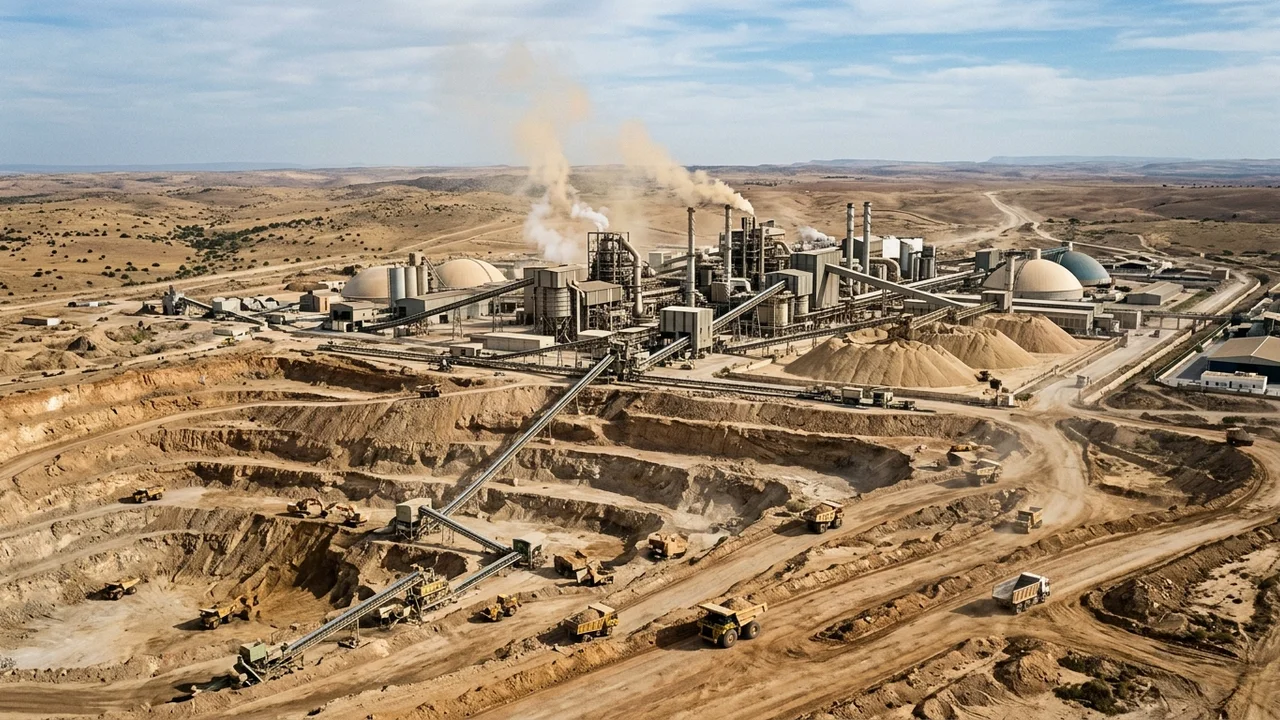
Caption: Portland cement production generates approximately 0.83 tCO₂ per tonne through limestone calcination and kiln combustion, making it one of CBAM's most exposed product categories.
What Is CBAM and How Does It Apply to Moroccan Exporters?
CBAM is a certificate-based mechanism under EU law that requires EU importers of carbon-intensive goods to purchase certificates equal in price to the embedded CO₂ emissions of those imports, calculated at the EU ETS carbon price. It is not a tariff, not a carbon tax, and not a border levy on trade value. The financial obligation falls on the EU importer, not on the Moroccan manufacturer, but the commercial consequence flows directly upstream to the exporter through pricing pressure.
The mechanism entered its definitive phase on January 1, 2026. Moroccan exporters in covered sectors, including cement producers shipping Portland clinker and fertilizer producers exporting ammonia-derived products under OCP Group's platform, now supply EU buyers who carry growing certificate obligations. The EU ETS carbon price stands at approximately €70 per tonne CO₂ as of late March 2026, a number that drives the per-tonne CBAM cost for every Moroccan shipment.
Moroccan exporters who want to understand the full scope of obligations their EU customers face can read the complete guide to the EU CBAM mechanism, including the certificate purchase timeline, authorization deadlines, and surrender rules.
The de minimis threshold exempts EU importers whose total annual CBAM-covered imports remain below 50 tonnes. For Morocco's cement trade, this threshold matters: smaller-volume construction material importers in Spain or Portugal may fall below 50 tonnes per year and owe no certificates at all. Larger import contracts above that threshold trigger the full obligation chain regardless of origin country.
How Does CBAM Affect Morocco's Cement Exports?
Morocco's cement exports to the EU fall directly under CBAM because Portland cement (CN code 2523 29 00) and cement clinker (CN code 2523 10 00) are listed in Annex I of Regulation (EU) 2023/956. Cement is one of the most carbon-intensive CBAM goods per tonne because the limestone calcination reaction (CaCO₃ → CaO + CO₂) is chemically unavoidable and accounts for approximately 60% of total cement carbon emissions. Fuel combustion in the rotary kiln contributes a further 35%, and electricity consumption makes up the remaining 5%.
For Portland cement, the CBAM emission benchmark is 0.83 tCO₂ per tonne for direct emissions. Cement is not listed in Annex II of the regulation, which means both direct and indirect embedded emissions are priced. At the current EU ETS price of approximately €70 per tonne CO₂, the gross CBAM cost for Portland cement reaches approximately €58 per tonne before the free allocation adjustment.
The net cost in 2026 is much lower because free allocation has only been reduced by 2.5% (the CBAM factor for 2026). A Moroccan cement producer whose EU buyer imports 10,000 tonnes in 2026 would generate a gross CBAM obligation of approximately €580,000, but the net obligation after free allocation adjustment amounts to just €14,500 in 2026. That figure rises to €281,300 by 2030 when the CBAM factor reaches 48.5%, and to €580,000 by 2034 when free allocation is fully eliminated.
The table below shows this cost trajectory for Moroccan Portland cement exports at different CBAM phases, using the benchmark emission factor and an EU ETS price of €70 per tonne CO₂:
| Year | CBAM Factor | Net Cost per Tonne (€) | Net Cost per 10,000 t Shipment (€) |
|---|---|---|---|
| 2026 | 2.5% | €1.45 | €14,500 |
| 2027 | 5% | €2.90 | €29,000 |
| 2028 | 10% | €5.81 | €58,100 |
| 2029 | 22.5% | €13.07 | €130,700 |
| 2030 | 48.5% | €28.13 | €281,300 |
| 2034 | 100% | €58.10 | €581,000 |
Gross cost = 0.83 tCO₂/t × €70/tCO₂ = €58.10/t. Net = gross × CBAM factor. Morocco has no qualifying carbon pricing scheme, so no Article 9 deduction applies.
The 2030 figure matters most for strategic planning. Moroccan cement reaching €28 per tonne in net CBAM cost competes against Turkish cement, which faces similar net costs but starts from a larger default-value problem. Turkey's cement default value under CBAM stands at approximately 1.584 tCO₂e per tonne, roughly 80% above actual Turkish kiln emissions of around 0.88 tCO₂/t. Moroccan producers with lower actual emissions who invest in verified data reporting can undercut competitors still using defaults.
The cement sector under CBAM carries specific obligations around clinker ratio disclosure, indirect emissions calculation, and monitoring plan requirements that every cement exporter's EU customer must meet from September 2027 when the first declaration is due.
What Fertilizer Exports Does Morocco Send to the EU Under CBAM?
Morocco's fertilizer exposure under CBAM arises primarily from OCP Group's phosphate-based production platform. OCP Group is the world's largest phosphate rock and phosphoric acid exporter, and its fertilizer portfolio includes diammonium phosphate (DAP) and monoammonium phosphate (MAP), which contain nitrogen and therefore fall under CBAM's fertilizer scope (Chapter 31 of Annex I).
Mixed mineral fertilizers containing nitrogen, such as those classified under CN code 3105, are covered when they contain two or more of nitrogen, phosphorus, and potassium as plant nutrients. Phosphorus-only or potassium-only fertilizers (CN code 3105 60 00) are excluded. The practical implication is that OCP's high-nitrogen products shipped to EU agricultural markets carry embedded emission obligations, while pure phosphate products do not.
Fertilizers carry both direct and indirect embedded emissions under CBAM, because they are not listed in Annex II. The nitrogen component in OCP's mixed fertilizers derives from ammonia synthesis via the Haber-Bosch process, which produces approximately 1.6 to 2.4 tCO₂ per tonne of ammonia from natural gas feedstock. OCP's own green ammonia investment program aims to shift this feedstock to renewable hydrogen by the late 2020s, a transition that would dramatically reduce the embedded emission intensity of its nitrogenous products.
Morocco has no qualifying carbon pricing scheme as of April 2026, so the Article 9 deduction mechanism under CBAM is not available to reduce EU importer obligations on Moroccan fertilizer shipments. The full certificate cost applies. Moroccan exporters competing in the fertilizer sector under CBAM face particular cost pressure relative to producers from countries with qualifying carbon pricing, though none of Morocco's primary fertilizer competitors (Egypt, Russia) currently qualify for Article 9 either.
What Is the Green Hydrogen Strategic Opportunity for Morocco?
Morocco's CBAM opportunity, not merely its exposure, comes from its renewable energy position. The country has a 23 GW renewable energy target by 2030, high capacity factors for solar photovoltaic and wind generation in its Atlantic coastal and Saharan zones, and existing transmission interconnection with Spain via the Gibraltar AC link rated at approximately 0.7 GW capacity.
Green hydrogen certified as an RFNBO (Renewable Fuel of Non-Biological Origin) under Delegated Regulation (EU) 2023/1184 carries an emission factor of effectively zero for the electricity consumed in electrolysis. Under CBAM, hydrogen (CN code 2804 10 00) is a covered sector with no de minimis exemption. Grey hydrogen produced from steam methane reforming carries approximately 10 to 12 tCO₂ per tonne of H₂, generating a gross CBAM cost of €700 to €840 per tonne at current ETS prices. Green hydrogen certified under RFNBO standards carries zero CBAM cost.
This cost differential is the commercial logic behind Morocco's green hydrogen position. A Moroccan green hydrogen exporter supplying EU buyers faces €0 in CBAM certificate obligations per tonne. A grey hydrogen exporter from any country faces €700 to €840 per tonne gross (with net costs rising from €19.50 per tonne H₂ in 2026 to €378 per tonne H₂ in 2030 as the CBAM factor escalates). The gap between grey and green hydrogen's CBAM cost grows every year through 2034.
OCP Group has announced a $7 billion green ammonia platform currently at pre-final investment decision stage. Green ammonia produced via RFNBO-certified hydrogen, when used as the nitrogen source for fertilizer products, would dramatically reduce the embedded emissions of OCP's EU-bound fertilizer exports. The compounded benefit is twofold: lower CBAM certificate obligations for EU importers of OCP fertilizers, and eligibility to market products as "green fertilizers" to EU agricultural buyers who face their own decarbonization targets.
The SoutH2 pipeline corridor, which targets hydrogen transport from North Africa to southern Europe via existing and new infrastructure, includes Morocco as a source node. If pipeline infrastructure becomes viable by the late 2030s, Morocco's green hydrogen could flow directly to EU member states. Until then, ammonia remains the most commercially viable carrier because existing port infrastructure, shipping routes, and chemical handling capacity already exist.
Caption: Morocco's Atlantic coastline and southern desert zones support utility-scale wind and solar installations that form the generation base for RFNBO-compliant green hydrogen electrolysis.
What Does CBAM Mean for Morocco's Trade Strategy Through 2030?
CBAM creates three concrete decision points for Moroccan exporters and the institutions that support them.
The first concerns verified emissions data. Morocco has no carbon pricing scheme, which eliminates the Article 9 deduction option. The remaining tool for reducing EU importer costs is verified actual emissions data submitted through the CBAM Operators Portal. If Moroccan cement kilns run at lower actual emission intensities than the default values applied to non-specific countries, providing verified data reduces the EU importer's certificate cost, which in turn preserves the Moroccan exporter's price competitiveness.
The second concerns timing. The first CBAM declaration is due September 30, 2027, covering calendar year 2026 imports. EU importers of Moroccan cement and fertilizers must submit declarations with specific embedded emissions for every shipment made in 2026. Moroccan producers who have not set up data collection systems, engaged accredited verifiers, and registered on the CBAM Operators Portal before their EU buyers request data will force those buyers to use default values. Default values carry a 10% mark-up in 2026, rising to 30% from 2028 onward.
The third concerns the competitive horizon. By 2030, the net cement CBAM cost for unverified Moroccan exports using defaults at 1.584 tCO₂e per tonne and a 48.5% CBAM factor reaches approximately €53.85 per tonne at €70/tCO₂. For a Moroccan kiln with actual emissions of 0.78 tCO₂ per tonne using verified data, the net cost falls to approximately €26.63 per tonne. That €27 per tonne difference in 2030 is the cost of failing to invest in emissions monitoring, on a product that may sell for €60 to €80 FOB.
Moroccan exporters should read the full framework for non-EU exporter obligations to understand what their EU customers are required to collect, report, and surrender from January 2026 onward.
How Should Moroccan Exporters Respond to CBAM?
Moroccan exporters have four actionable responses to CBAM, each with a different cost, timeline, and benefit profile. The four options are listed below by implementation horizon.
-
Establish emissions monitoring and engage an accredited verifier (0 to 18 months): Collect production-level activity data for fuel consumption, electricity use, and raw material inputs at each installation. Engage an EN ISO/IEC 14065-accredited verifier for a physical site visit and emissions report. Upload verified data to the CBAM Operators Portal. Cost: €5,000 to €50,000 per installation per verification period. Benefit: avoids the 10% to 30% default mark-up and preserves EU customer relationships.
-
Lobby for a qualifying carbon pricing scheme (2 to 5 years): A domestic Moroccan carbon pricing mechanism that meets CBAM's Article 9 criteria would allow EU importers to deduct the carbon price paid by Moroccan producers from their certificate obligations. At €70 per tonne CO₂, even a modest €15 per tonne Moroccan carbon price would generate a meaningful deduction for high-volume importers. Morocco's existing Green Economy Roadmap provides a policy platform.
-
Accelerate green hydrogen and green ammonia investment (3 to 10 years): OCP Group's $7 billion green ammonia platform and Morocco's IRESEN renewable hydrogen program align with the RFNBO certification pathway that eliminates CBAM costs on certified hydrogen and derived fertilizer products entirely. This is the highest-investment, highest-reward option.
-
Expand market share at competitors' expense (ongoing): As Turkish and Egyptian cement and fertilizer exporters face larger default-value penalties because of higher-carbon production routes, Moroccan producers with lower actual emission intensities and verified data gain a price advantage in EU procurement. Pursuing EU market share growth from 2026 to 2030 exploits the window while competitors absorb transition costs.
For exporters ready to move beyond basic compliance toward a long-term positioning plan, the complete exporter decarbonization strategy framework covers all four response options in detail, including investment thresholds and timeline benchmarks.
Supplementary Questions on CBAM and Morocco
Does Morocco Have a Carbon Price That Qualifies for the Article 9 Deduction?
Morocco does not have a qualifying carbon pricing scheme as of April 2026. The Article 9 deduction under CBAM allows EU importers to reduce their certificate purchase obligations when a carbon price has been effectively paid by the producer in the country of origin, but only under a scheme that meets the Commission's qualifying criteria. Morocco's voluntary carbon credit and offset mechanisms in the energy and forestry sectors do not qualify. Voluntary carbon offsets and internal corporate carbon prices are explicitly excluded under CBAM's deduction rules. A mandatory, legally binding carbon pricing scheme covering CBAM-relevant sectors would be required to trigger the deduction.
Is Morocco Exempt from CBAM on Electricity Exports?
Morocco is not exempt from CBAM on electricity exports. The Gibraltar AC link between Morocco and Spain carries approximately 0.7 GW of interconnection capacity, and electricity exports via this interconnector are subject to CBAM under CN code 2716 00 00. Exempt status applies only to EEA countries (Norway, Iceland, Liechtenstein) and Switzerland, all of which participate in or are linked to the EU ETS. Morocco's electricity exports to Spain carry embedded emission obligations calculated using Morocco's average grid emission factor unless the strict criteria for source-specific actual values are met. As Morocco scales its renewable energy capacity toward its 23 GW target by 2030, the average grid emission factor will decrease, reducing the CBAM cost on future electricity exports.
What Is the RFNBO Certification Requirement for Moroccan Green Hydrogen?
RFNBO certification for Moroccan green hydrogen requires compliance with Delegated Regulation (EU) 2023/1184, which sets three core criteria: additionality (new renewable capacity dedicated to hydrogen production), temporal correlation (generation and electrolysis matched on a monthly basis moving toward hourly matching from 2030), and geographical correlation (the renewable generator and electrolyser must be in the same or adjacent bidding zone). Morocco and Spain share a common interconnection, which raises the question of geographical zone compliance for hydrogen produced in Morocco using Moroccan renewable electricity and exported to the EU. Commission guidance on cross-border RFNBO supply chains remains under development as of April 2026. Moroccan green hydrogen producers planning export contracts should track this guidance closely, as the certification outcome directly determines whether the hydrogen reaches EU buyers with zero CBAM cost or a residual embedded emission charge.
Can Moroccan Cement Producers Use Default Values Instead of Measured Emissions?
Moroccan cement producers can rely on default values through their EU buyers' declarations, but this becomes increasingly costly. Default values for non-specific-country Portland cement under CBAM stand at approximately 1.584 tCO₂e per tonne, roughly double the benchmark emission factor of 0.83 tCO₂/t. Using defaults means EU importers purchase certificates based on the higher default figure rather than actual kiln emissions. The financial difference compounds through the free allocation phase-out: at 48.5% CBAM factor in 2030 and €70 per tonne CO₂, the extra cost of using defaults instead of actual data reaches approximately €37 per tonne. Moroccan kilns operating at actual emission intensities below 1.0 tCO₂/t have a strong financial incentive to measure, verify, and report from 2026 onward.
Does the Article 9 Carbon Price Deduction Benefit Apply to OCP Fertilizer Exports?
The Article 9 carbon price deduction does not currently apply to OCP Group's fertilizer exports from Morocco, because Morocco has no qualifying carbon pricing scheme. Under Article 9 of Regulation (EU) 2023/956, the deduction is calculated as the carbon price effectively paid per tonne CO₂e in the country of production, after subtracting any free allocation or compensatory state aid received. For this deduction to reduce the certificate burden on EU importers of OCP fertilizers, a Moroccan national carbon mechanism meeting Commission criteria would need to be operational and recognized. OCP's internal shadow carbon pricing initiatives are not eligible under the regulation's explicit exclusion of voluntary and internal pricing arrangements.
Is Green Hydrogen From Morocco a Competitive Advantage Against Grey Hydrogen Imports?
Green hydrogen from Morocco is a competitive advantage against grey hydrogen imports specifically because of CBAM's zero-cost outcome for RFNBO-certified hydrogen. Grey hydrogen produced via steam methane reforming carries approximately 10 to 12 tCO₂ per tonne of H₂, generating a gross CBAM cost of €700 to €840 per tonne at current ETS prices. By 2030, the net CBAM cost on grey hydrogen reaches approximately €378 per tonne H₂ after applying the 48.5% CBAM factor. RFNBO-certified Moroccan green hydrogen carries no CBAM certificate cost at all. Whether this advantage translates into commercial viability depends on green hydrogen's production cost relative to grey hydrogen plus its CBAM surcharge, a calculation that becomes more favorable for green hydrogen every year through 2034 as the CBAM factor rises. Exploring the full landscape of green hydrogen and CBAM shows how certification, temporal correlation, and additionality requirements interact with Morocco's specific renewable resource profile.