CBAM South Korea holds the strongest Article 9 deduction position of any major exporter: the K-ETS is the only large-scale national carbon pricing scheme currently assessed as qualifying under Regulation (EU) 2023/956. South Korea exports approximately €3.6 billion in steel to EU buyers annually (3.38 Mt in 2024), placing it third among all non-EU steel exporters to the EU. The key question for every South Korean steelmaker shipping to Europe is not simply what CBAM costs, but how much of that cost a verified K-ETS payment reduces.
Four questions define the South Korea CBAM compliance picture: how the K-ETS qualifies under Article 9 of Regulation (EU) 2023/956, how the deduction calculation works in practice, why the offset is partial rather than full, and what South Korean exporters and their EU importers must do to claim it.
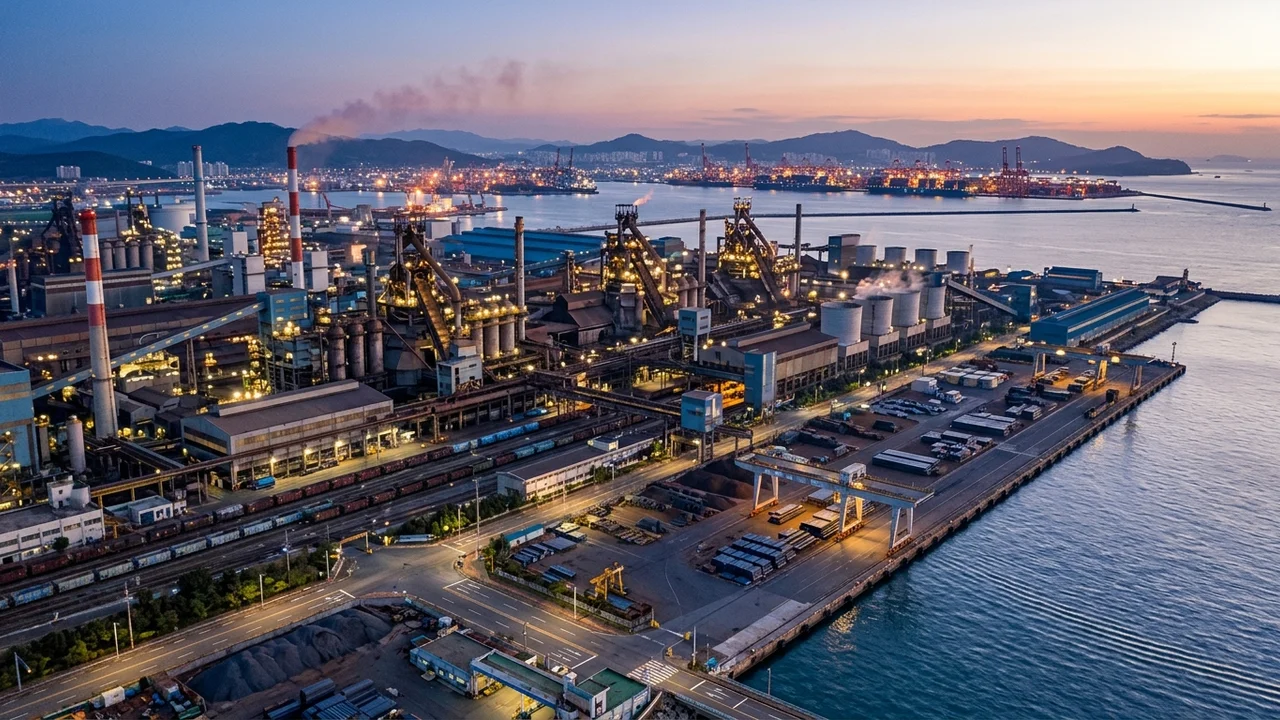
Caption: South Korea's K-ETS coverage and CBAM Article 9 deduction pathway for steel exporters shipping to the EU.
What Is CBAM and Why It Affects South Korean Exporters
CBAM is a certificate-based mechanism, not a tax, established under the EU carbon border adjustment mechanism (Regulation (EU) 2023/956, definitive phase from January 1, 2026) that requires EU importers of carbon-intensive goods to purchase CBAM certificates proportional to the embedded CO2 emissions of their imports. The certificate price tracks the EU ETS auction price, which stood at approximately €70 per tonne CO2 in late March 2026.
South Korea faces CBAM exposure primarily through steel, the dominant CBAM sector in its EU trade profile. POSCO, Hyundai Steel, and Dongkuk Steel are the three principal South Korean steel exporters to Europe and together represent the bulk of the 3.38 Mt annual shipment volume. These shipments fall under CN codes in Chapters 72 and 73 of Annex I to Regulation (EU) 2023/956, covering flat-rolled products, semi-finished forms, and structural articles.
The legal obligation rests with the EU importer, not the South Korean producer. EU importers purchasing South Korean steel must register as authorized declarants, hold CBAM certificates equal to at least 50% of their cumulative embedded emissions each quarter (the quarterly holding requirement post-Omnibus amendment), and surrender certificates by the first declaration deadline of September 30, 2027, covering calendar year 2026. The EU importer's financial exposure determines the commercial pressure passed upstream to the South Korean exporter through price negotiation.
How South Korea's K-ETS Works and Why It Qualifies
South Korea launched the K-ETS (Korea Emissions Trading Scheme) in 2015, making it one of the longest-running mandatory carbon markets in Asia. Phase 4 of the K-ETS commenced in 2026 and covers approximately 70% of South Korea's national greenhouse gas emissions across five sectors: power generation, industry, buildings, transport, and waste.
Three criteria determine whether a third-country carbon pricing scheme qualifies for the Article 9 CBAM deduction. The criteria are listed below.
- The scheme must be legally binding in the country of origin and effectively enforced, not voluntary or advisory.
- The scheme must cover the same emissions as those priced under CBAM for the relevant goods, meaning direct CO2 emissions from the production process.
- The carbon cost must not be rebated or offset at the point of export, so that the price actually reaches and remains with the producer.
The K-ETS satisfies all three criteria in a way that no other major exporting nation's scheme currently does at the same level of maturity and coverage. China's national ETS, expanded to steel and cement in March 2025, is intensity-based rather than cap-based and its steel sector coverage remains immature for Article 9 purposes. India's Carbon Credit Trading Scheme excludes the steel sector entirely in its Phase 1. Turkey's pilot ETS (authorized under Climate Law No. 7552 of July 2025) operates with full free allocation in 2026, meaning no carbon cost is effectively paid. Japan's GX-ETS became mandatory in April 2026 but is still in transition and not yet at the maturity threshold for Commission recognition. The K-ETS, by contrast, has been in legally binding operation for over a decade.
The Commission assessment of K-ETS qualification was pending as of April 2026. Recognition is not retroactive. South Korean exporters and their EU import partners must track the formal Commission decision and prepare verified documentation of K-ETS payments before any deduction can be claimed.
How the Article 9 Deduction Is Calculated for South Korean Steel
The Article 9 deduction reduces the number of CBAM certificates an EU importer must surrender by an amount proportional to the carbon cost already paid under the qualifying third-country scheme. The deduction is not a full exemption and does not eliminate the CBAM obligation. It reduces it.
The calculation for CBAM steel imported from South Korea works as follows. Using South Korean BF-BOF (blast furnace, basic oxygen furnace) steel as the reference case:
- Embedded emissions (BF-BOF): approximately 2.0 tCO2 per tonne of steel
- CBAM certificate price (EU ETS reference, late March 2026): approximately €70 per tCO2
- Gross CBAM cost before deduction: 2.0 × €70 = €140 per tonne
- K-ETS price: approximately $6.50 per tCO2 (approximately €6.00 per tCO2)
- Article 9 deduction amount: 2.0 × €6.00 = €12.00 per tonne
- Net CBAM obligation after Article 9 deduction: 2.0 × (€70 - €6.00) = €128.00 per tonne gross
That gross obligation is then multiplied by the CBAM factor, which reflects how much of EU ETS free allocation has been phased out. In 2026, the CBAM factor is 2.5% (97.5% of free allocation remains). In 2030, the CBAM factor rises to 48.5%.
The effective net cost per tonne of South Korean BF-BOF steel at these two time points is shown in the table below.
| Year | CBAM Factor | Gross Net Obligation (after Article 9) | Effective Net Cost per Tonne | Article 9 Saving vs. No Deduction |
|---|---|---|---|---|
| 2026 | 2.5% | €128.00 × 2.5% | €3.20/t | €0.30/t |
| 2028 | 10% | €128.00 × 10% | €12.80/t | €1.20/t |
| 2030 | 48.5% | €128.00 × 48.5% | €62.08/t | €5.82/t |
| 2034 | 100% | €128.00 × 100% | €128.00/t | €12.00/t |
The deduction's absolute value in euros per tonne grows as the CBAM factor increases. By 2030, the Article 9 deduction saves a South Korean steel exporter's EU importer approximately €5.82 per tonne compared to a country with no qualifying carbon price. By 2034 at full phase-in, the saving reaches approximately €12.00 per tonne, assuming K-ETS prices remain around current levels. If the K-ETS price rises toward the EU ETS level over time, the deduction value grows proportionally.
Why the K-ETS Deduction Is Partial, Not Full
The K-ETS price covers only approximately 9% of the EU ETS price at current levels. South Korea's K-ETS traded at approximately $6 to $7 per tCO2 (roughly €5.50 to €6.40) in 2026. The EU ETS price stood at approximately €70 per tCO2 in the same period. The ratio means the K-ETS deduction offsets only a fraction of the CBAM certificate obligation.
This partial offset reflects a fundamental structural difference in carbon market design. The K-ETS operates with a more gradual cap reduction trajectory and covers a wider share of the economy at a lower price. The EU ETS, under its revised cap reduction of approximately 4.3% per year from 2024 under Directive 2003/87/EC as amended, applies a stricter structural scarcity that sustains a higher price.
South Korean producers with EU import relationships face three practical implications from this partial deduction:
- Approximately 91% of the CBAM certificate cost remains payable by the EU importer after the K-ETS deduction at current price levels, requiring negotiated cost-sharing arrangements with Korean suppliers.
- Verified actual emissions below the CBAM default value produce a second layer of cost reduction, independent of the K-ETS deduction.
- As the K-ETS Phase 4 tightens its cap post-2026, the K-ETS price may rise, gradually narrowing the price differential with the EU ETS and increasing the deduction's proportional value.
Caption: The K-ETS price gap versus the EU ETS determines the partial nature of the Article 9 deduction for South Korean steel exporters.
What South Korean Exporters Must Do to Claim the Deduction
The Article 9 deduction is not automatic. EU importers claim the deduction at the time of CBAM declaration, and the claim requires verified documentation supplied by the South Korean exporter. The deduction claim process involves four actions.
- The South Korean producer must obtain and retain official K-ETS compliance records demonstrating the tonnes of CO2 covered and the price effectively paid per tonne for the production period corresponding to the exported goods.
- The EU importer's authorized accredited verifier must confirm that the K-ETS payments documented are consistent with the embedded emissions reported in the CBAM declaration for those specific goods.
- The documentation must confirm that the K-ETS cost was not subsequently rebated, reimbursed, or offset by any other government mechanism at or after the point of export.
- Records must be retained for the period required under Article 6(6) as amended by Regulation (EU) 2025/2083: through the end of the 4th year following the declaration year.
Exporters who fail to provide this documentation in time cause their EU importer to lose the Article 9 deduction. The commercial consequence falls on the importer through higher certificate obligations, and this creates a direct contractual incentive for EU importers to require verified K-ETS documentation as a condition of purchase.
South Korea's CBAM Exposure Compared to Other Major Exporters
South Korea's position under CBAM differs fundamentally from the other large steel-exporting nations because of the K-ETS. The comparison table below covers the six largest steel exporters to the EU and their Article 9 deduction status.
| Country | Annual EU Steel Exports (approx.) | Carbon Pricing Scheme | Article 9 Deduction Status | Net Position |
|---|---|---|---|---|
| India | €3.9B / 4.33 Mt | CCTS Phase 1 (steel excluded) | Not currently eligible | Full CBAM obligation |
| South Korea | €3.6B / 3.38 Mt | K-ETS Phase 4 (2015, covers industry) | Likely eligible — assessment pending | Partial deduction applies |
| China | €3.5B basic + large articles volume | National ETS (intensity-based; steel maturity uncertain) | Not currently eligible | Full CBAM obligation |
| Turkey | €3.5B / 2.59 Mt | Pilot ETS (full free allocation in 2026; no effective price) | Not eligible in 2026 | Full CBAM obligation |
| UK | €3.2B / 3.08 Mt | UK ETS (separate from EU ETS; unresolved) | Under review; no determination | Full obligation pending review |
| Ukraine | Disrupted by war / 3.40 Mt | No ETS in force (development for EU accession) | Not eligible | Full CBAM obligation |
South Korea's advantage is structural. The K-ETS has operated continuously since 2015, has legally binding compliance rules, and its coverage of the industrial sector means South Korean steel producers already pay a domestic carbon price on the emissions that CBAM targets. No other major steel exporter to the EU holds an equivalent position as of April 2026.
The Contextual Border: CBAM Article 9 Across All Third-Country Carbon Schemes
The Article 9 deduction mechanism extends beyond South Korea in principle, even if South Korea is the only major exporter currently positioned to use it. Understanding the qualification criteria clarifies both South Korea's current advantage and the conditions under which other countries could eventually challenge it.
CBAM Article 9 sets out that the deduction applies only when a carbon price has been "effectively paid" in the country of origin. This phrase carries significant legal weight. "Effectively paid" excludes schemes where free allocation covers the majority of an installation's obligations, schemes with nominal prices that are administratively waived, and schemes where export rebates neutralize the domestic cost. Turkey's 2026 ETS pilot fails on the free allocation criterion. China's ETS extension to steel faces scrutiny on the intensity-based design and effective enforcement questions. Japan's GX-ETS is progressing but has not yet reached the threshold the Commission uses for formal recognition.
The practical effect is that South Korea holds a temporary competitive advantage in CBAM compliance cost among major steel exporters. This advantage persists as long as other large exporters remain unrecognized under Article 9 and as long as the K-ETS maintains its legally binding, effectively enforced status.
How Does CBAM Compare for South Korea vs China?
CBAM South Korea and CBAM China represent contrasting positions under the same regulation. China faces full CBAM certificate obligations on its steel exports to the EU because the Chinese national ETS expansion to steel (March 2025) does not yet satisfy the Article 9 criteria for Commission recognition: it is intensity-based, its per-tonne price is approximately $11 (approximately €10), and its Article 9 eligibility is uncertain pending an absolute cap transition. South Korean exporters operating under the K-ETS can claim a verified deduction once formal Commission recognition is granted, reducing their EU importer's net certificate obligation by approximately €12 per tonne at current K-ETS prices. China's ETS price, even if it eventually qualifies, would provide a comparable proportional deduction only if it achieves binding absolute-cap status.
Does the K-ETS Deduction Apply to South Korean Aluminium Exports?
The K-ETS deduction applies to any CBAM-covered good for which the exporter can demonstrate that the K-ETS covered the embedded direct emissions. South Korea exports aluminium to EU buyers in addition to steel, and those aluminium exports fall under CN codes in Chapter 76. If the K-ETS covers the direct emissions from South Korean aluminium production, the Article 9 deduction applies to aluminium in the same way it applies to steel, with the importer providing verified documentation of K-ETS payments corresponding to the reported embedded emissions. South Korea's aluminium production volume entering EU trade is significantly smaller than its steel volume, making steel the dominant compliance focus.
Is South Korea Exempt from CBAM?
South Korea is not exempt from CBAM. Exemptions under Regulation (EU) 2023/956 apply only to countries in the European Economic Area (Norway, Iceland, Liechtenstein) and Switzerland, which participates in the linked EU ETS. South Korea's K-ETS is a separate national scheme and does not constitute ETS linkage. The correct characterization is that South Korean steel exports are subject to full CBAM obligations, but EU importers of qualifying South Korean goods can apply an Article 9 deduction that reduces the number of CBAM certificates required, proportional to the K-ETS price paid. The CBAM obligation remains; only its magnitude is reduced.
Can South Korean Exporters Use Default Values Instead of Actual Emissions?
South Korean exporters can allow their EU importers to use CBAM default emission values rather than actual verified emissions data. Default values from Implementing Regulation (EU) 2025/2621 carry a mark-up of 10% above the calculated default in 2026, rising to 20% in 2027 and 30% from 2028 onward. For most South Korean steel producers, actual emissions from modern BF-BOF or EAF operations are likely to fall below punitive default levels. Providing verified actual emissions data serves the exporter's commercial interest because it reduces the importer's CBAM certificate cost, which the importer in turn negotiates back into the purchase price. The combination of actual emissions data and Article 9 K-ETS deduction together represents the minimum achievable CBAM obligation for CBAM for non-EU exporters from South Korea.
What Is the South Korean Government's Position on CBAM?
South Korea has not filed a WTO challenge against CBAM as of April 2026. The government's response has focused on bilateral engagement with the EU Commission to secure formal recognition of the K-ETS as a qualifying scheme under CBAM Article 9 deduction for importers. This cooperative posture distinguishes South Korea from India (which has filed 29 formal WTO objections) and Russia (which filed WTO DS639 in May 2025, the only formal dispute against CBAM to date). South Korea's strategic calculation is that formal K-ETS recognition delivers a more durable commercial advantage than confrontational legal challenges.
Frequently Asked Questions
Does South Korea's K-ETS fully offset CBAM costs?
No. The K-ETS Article 9 deduction is partial. The K-ETS price (approximately €6 per tCO2) covers approximately 9% of the EU ETS price (approximately €70 per tCO2). For BF-BOF steel with 2.0 tCO2 per tonne embedded emissions, the deduction reduces the gross CBAM obligation from €140 to €128 per tonne. The remaining obligation is then multiplied by the annual CBAM factor.
Is the Article 9 deduction automatic for South Korean steel?
No. The deduction requires formal Commission recognition of the K-ETS as a qualifying scheme (assessment pending as of April 2026), plus verified documentation from the South Korean exporter showing actual K-ETS payments on the specific production covered by the CBAM declaration. EU importers must file the deduction claim with supporting evidence at the time of their annual declaration.
When does CBAM become financially significant for South Korean steel?
The net CBAM cost for South Korean BF-BOF steel is approximately €3.20 per tonne in 2026 (after the Article 9 deduction and the 2.5% CBAM factor). This rises to approximately €62 per tonne in 2030 as the CBAM factor reaches 48.5%, representing the major financial exposure window. The 2026 obligation is small; the 2028 to 2030 period carries the material commercial impact.