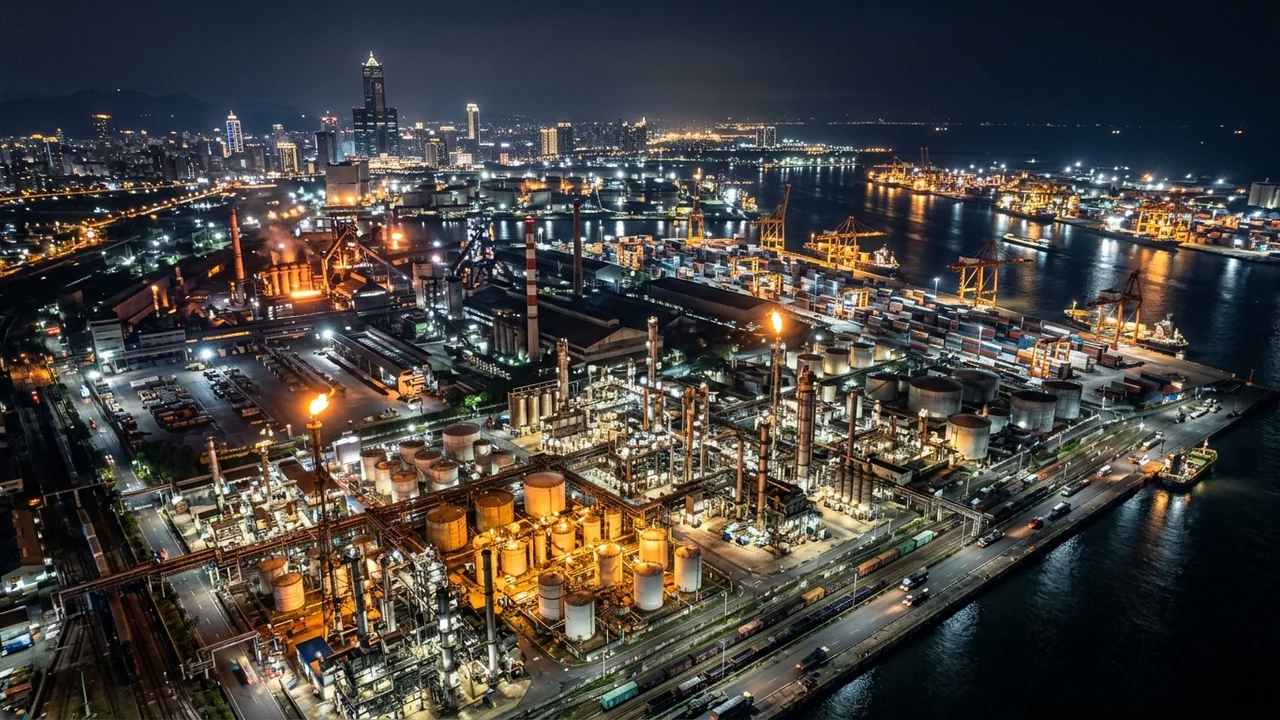
Taiwan's CBAM exposure concentrates in a single sector: steel, where China Steel Corporation accounts for the majority of EU-bound shipments and now faces a certificate-based pricing mechanism that assigns a gross cost of approximately €140 per tonne for blast furnace steel at the current EU ETS price of €70 per tonne CO₂. The definitive phase of the EU Carbon Border Adjustment Mechanism started January 1, 2026, and it interacts with Taiwan's own carbon fee in ways that determine whether EU importers of Taiwanese steel can claim an Article 9 deduction. Understanding that interaction is the central practical question for any Taiwanese producer shipping to Europe in 2026 and beyond.
Caption: Taiwan's steel sector relies on a mix of blast furnace and electric arc production, each carrying distinct embedded emission profiles under CBAM Regulation (EU) 2023/956.
What Is CBAM and How Does It Apply to Taiwan?
The EU Carbon Border Adjustment Mechanism is a certificate-based regulatory system established by Regulation (EU) 2023/956 that requires EU importers of carbon-intensive goods to purchase certificates proportional to the embedded CO₂ emissions of their imports, priced at the EU ETS carbon price, to prevent carbon leakage. It is not a carbon tax, a tariff, or a border duty. CBAM is a certificate mechanism that tracks the EU Emissions Trading System price directly.
Taiwan is not a large exporter to the EU by global standards, but its steel shipments fall squarely inside the six sectors covered by Annex I of the regulation, including iron and steel, cement, aluminium, fertilizers, electricity, and hydrogen. For Taiwan, steel represents the primary CBAM exposure sector, with China Steel Corporation (CSC) as the dominant producer and the most relevant installation for compliance planning purposes.
EU importers of Taiwanese steel must register as authorized CBAM declarants by March 31, 2026, under Article 17(7a) as amended by Regulation (EU) 2025/2083. The first CBAM declaration, covering calendar year 2026, is due September 30, 2027. Certificate purchases begin February 1, 2027. Importers who fail to meet these deadlines face a penalty of €100 per tonne CO₂e not covered, with unauthorized importers facing €300 to €500 per tonne CO₂e.
The full scope of the EU CBAM mechanism, including the authorization workflow, quarterly holding requirements, and surrender obligations, governs all six sectors uniformly. Taiwan's situation differs from peers such as South Korea or Japan only in the specifics of its domestic carbon pricing scheme and its volume of EU-bound exports.
Taiwan's Carbon Fee: What It Covers and What It Costs
Taiwan launched its carbon fee system in 2024, with the first reporting obligations applying to installations above designated thresholds. The fee rate is approximately NT$300 per tonne CO₂ (roughly $9.50 USD per tonne CO₂), which converts to approximately €8.70 per tonne CO₂ at current exchange rates.
The carbon fee covers direct emissions from large industrial installations, including steel producers above the applicable threshold. China Steel Corporation's Kaohsiung integrated steel works falls within scope. The fee is collected by Taiwan's Environmental Protection Administration and applies to domestic production, not to export transactions directly.
Two facts determine how the Taiwan carbon fee interacts with CBAM. First, the fee is a relatively new scheme, introduced in 2024, which means its qualification history is short. Second, the fee rate of approximately NT$300 per tonne CO₂ (approximately €8.70) is substantially below the current EU ETS price of approximately €70 per tonne CO₂. The price gap matters enormously for Article 9 deduction calculations.
Article 9 Eligibility: Does Taiwan's Carbon Fee Qualify?
Article 9 of Regulation (EU) 2023/956 permits EU importers to deduct from their CBAM certificate obligation a value equal to the carbon price effectively paid in the country of origin for the embedded emissions of imported goods. Three conditions determine Article 9 eligibility for Taiwan's carbon fee.
The 3 conditions for Article 9 recognition are as follows:
- The carbon pricing scheme must be legally binding and effectively enforced in the country of origin, not merely voluntary or nominal.
- The price must be an effective price paid per tonne CO₂e, after subtracting any free allocations, rebates, government compensation, or other indirect benefits that reduce the net cost to the producer.
- The Commission must complete a formal assessment confirming the scheme meets the criteria of Article 9 and the implementing regulations, particularly Implementing Regulation (EU) 2025/2547.
Taiwan's carbon fee meets the first condition: it is established under law and collected by a government authority. The second condition requires verification of what steel producers actually pay after accounting for any preferential treatment, exemptions, or allowances under the Taiwanese scheme. The third condition, formal Commission assessment, is not yet complete as of April 2026. Taiwan is not included in any list of pre-approved qualifying carbon pricing schemes published by the Commission for 2026.
The practical result for 2026 is that EU importers of Taiwanese steel cannot yet apply an Article 9 deduction. They carry the full CBAM certificate obligation, priced at approximately €70 per tonne CO₂ against the embedded emissions of each shipment. This is the same position as Turkey, India, and the United States. South Korea, where the K-ETS has operated since 2015 and is further advanced in the Commission's bilateral assessment process, represents the contrast case closest in structure to Taiwan.
Even if Taiwan's carbon fee eventually qualifies, the Article 9 deduction at a price of approximately €8.70 per tonne covers only about 12% of the CBAM certificate cost at €70 per tonne EU ETS pricing. The partial deduction has limited financial impact in 2026, when the net CBAM cost is already minimal due to the 2.5% CBAM factor, but grows in relevance after 2028 as free allocation phases out sharply.
CBAM Cost Calculations for Taiwanese Steel
The financial exposure of Taiwanese steel exports to CBAM is determined by the production route, the embedded emission factor, and the year of export. The table below sets out the key parameters using the CBAM benchmark values from Implementing Regulation (EU) 2025/2621 and the net cost formula applied to different years.
| Production Route | Emission Factor (tCO₂/t) | Gross Cost @ €70/tCO₂ | Net 2026 (2.5% factor) | Net 2030 (48.5% factor) | Net 2034 (100% factor) |
|---|---|---|---|---|---|
| BF-BOF (blast furnace) | ~2.0 | €140/t | ~€3.50/t | ~€67.90/t | ~€140/t |
| EAF scrap | ~0.5 | €35/t | ~€0.88/t | ~€16.98/t | ~€35/t |
| DRI-EAF (gas-based) | ~0.9–1.4 | €63–98/t | ~€1.58–2.45/t | ~€30.56–47.53/t | ~€63–98/t |
The 2026 net cost of approximately €3.50 per tonne for blast furnace steel is commercially negligible for most Taiwanese producers. The 2030 net cost of approximately €67.90 per tonne is a different matter entirely. At current typical steel FOB export prices, a cost addition of that magnitude affects competitiveness materially.
Taiwan's steel industry uses a mix of production routes. China Steel Corporation operates integrated blast furnace facilities at Kaohsiung, producing BF-BOF steel with emission intensities broadly consistent with international benchmarks. Electric arc furnace producers, including Tung Ho Steel, operate on the scrap-EAF route, where embedded emissions run approximately 0.3 to 0.5 tonnes CO₂ per tonne of steel, carrying significantly lower CBAM exposure.
For detailed mechanics of how the steel sector under CBAM calculates embedded emissions, assigns default values for non-reporting installations, and processes precursor data from upstream pig iron and DRI inputs, the sector guide covers the full CN code scope and the mark-up schedule that applies to defaults.
Default Values and the Data Reporting Incentive
Taiwanese steel producers who do not provide verified actual emissions data to their EU customers are classified under CBAM default values for their production route and country. Default values are calculated under Implementing Regulation (EU) 2025/2621 and carry a mark-up above the base benchmark: 10% above calculated default in 2026, rising to 20% in 2027, and 30% from 2028 onward.
The data provision decision is a commercial calculation. The 4 steps that determine whether verified data is financially worthwhile for a Taiwanese steel producer are listed below:
- Establish the actual specific embedded emissions (tCO₂e per tonne) from the production installation using the full EU methodology defined in IR 2025/2547.
- Compare the actual figure against the applicable CBAM default value for the relevant production route.
- Multiply the gap between default and actual by the EU ETS price and the applicable CBAM factor for each planning year.
- Compare the resulting cost saving against the upfront and recurring cost of hiring an accredited verifier (typically €5,000 to €50,000 per installation per reporting period, depending on installation complexity and verifier location).
For BF-BOF producers with actual emissions below the default benchmark, the incentive calculation produces a clear positive net present value from 2027 onward. For EAF scrap producers, whose actual emissions are typically already well below the default, the incentive exists but is smaller in absolute terms per tonne.
The Commission's CBAM Operators Portal allows non-EU installation operators to upload verified emissions data directly and share it with multiple EU buyers simultaneously. One verification effort serves all EU customer relationships, making the upfront cost more efficient for producers with multiple EU importers.
What Changes for Taiwanese Exporters in 2026
January 1, 2026 marks the start of the definitive phase under Article 36(2) of Regulation (EU) 2023/956. Four changes took effect on that date that directly affect non-EU exporter obligations, including those of Taiwanese steel producers.
The practical obligations on Taiwanese producers in 2026 are concentrated in data and documentation. CBAM imposes no direct legal obligation on the non-EU exporter. The obligation falls on the EU importer. However, commercial pressure from EU buyers creates a de facto obligation to cooperate. EU importers who cannot obtain verified emissions data from their Taiwanese suppliers face two options: use punitive default values, which increases their certificate cost and reduces their willingness to pay the exporter full price, or switch to a competing supplier who can provide verified data.
Understanding the full scope of non-EU exporter obligations under CBAM, including what data must be provided, in what format, and via which communication channel, is the first practical step for any Taiwanese producer whose EU customers have raised CBAM data requests.
The timeline for Taiwanese producers in 2026 includes the following milestones: EU importers must apply for authorized declarant status by March 31, 2026. Verifier registration for third-country accredited bodies opens September 1, 2026. EU importers begin purchasing CBAM certificates February 1, 2027. The first CBAM declaration covering 2026 calendar year shipments is due September 30, 2027.
How Taiwan Compares to Other Key Steel Exporters
Contextual comparison clarifies Taiwan's relative position among the major exporters supplying EU steel markets. The table below uses data from the exporter matrix and country analysis knowledge base.
| Country | Carbon Pricing | Article 9 Status | 2026 CBAM Net Cost (BF-BOF) | Primary Risk Factor |
|---|---|---|---|---|
| Taiwan | Carbon fee (NT$300/tCO₂, ~€8.70) | Not yet assessed | ~€3.50/t | Short scheme history; assessment pending |
| South Korea | K-ETS (~$6–7/tCO₂) | Assessment pending, likely recognized | ~€3.18/t (post-deduction if approved) | Low — most favorable position |
| Japan | GX-ETS (mandatory April 2026, ~$2/tCO₂) | Not yet mature | ~€3.50/t | Immature ETS; partial credit only |
| India | CCTS pilot (steel excluded) | No | ~€3.50/t | Steel sector excluded from domestic scheme |
| Turkey | None (pilot ETS, full free allocation) | No | ~€3.50/t | Highest absolute EU steel exposure |
Taiwan's position is structurally similar to Japan's: a domestic carbon pricing mechanism exists, the scheme is relatively new or immature, and Commission recognition under Article 9 has not yet been granted. In both cases, the deduction value if recognized would be small, approximately €8.70 per tonne for Taiwan against a CBAM price of €70 per tonne, covering roughly 12% of the gross certificate cost.
Taiwan's CBAM Exposure in the Broader Trade Context
Taiwan's total CBAM-affected exports to the EU are moderate in global comparison. The primary sector is steel, with secondary exposure in aluminium profiles and related articles of steel classified under CN Chapters 72 and 73. The broader aluminium sector exposure for Taiwan, including profiles, bars, and structural products, follows the same certificate-based logic but at lower embedded emission factors for secondary aluminium routes.
Taiwan does not export electricity or hydrogen to the EU. Cement and fertilizer exports to Europe are negligible. The concentration of CBAM exposure in steel and, to a lesser degree, aluminium means that Taiwan's compliance planning is more focused than that of countries such as India, which faces exposure across steel, aluminium, cement, and fertilizers simultaneously.
The government of Taiwan has expressed concerns about CBAM in multilateral trade forums but has not filed a formal WTO dispute. Taiwan's status as a non-UN member state constrains its formal trade dispute options through standard WTO channels. Bilateral engagement with the European Commission on the carbon fee assessment process represents the most practical available route.
Caption: Net CBAM costs for Taiwanese BF-BOF steel remain low in 2026 due to the 2.5% CBAM factor but rise steeply toward 2030 as free allocation phases out under the ETS Directive amendment.
How Should Taiwanese Producers Plan for CBAM?
Taiwanese steel producers who export to the EU face a planning horizon that extends from the commercially negligible 2026 net cost through a steep ramp between 2028 and 2030, when the CBAM factor rises from 10% to 48.5%. The 2026 net cost of approximately €3.50 per tonne for BF-BOF steel is the starting point for a trajectory that reaches approximately €67.90 per tonne net in 2030 and €140 per tonne net in 2034.
Three strategic responses are available to Taiwanese producers. Implement verified emissions measurement now, before the 2027 declaration filing, to avoid default mark-ups and position for Article 9 deduction if the carbon fee receives Commission recognition. Engage proactively with EU buyers by providing installation identification data, production route documentation, and a monitoring plan summary that allows the EU importer to prepare an accurate CBAM declaration rather than defaulting to punitive benchmark values. Develop an exporter decarbonization strategy that reduces actual embedded emissions from the current baseline, since actual reductions below the production route benchmark lower both the gross CBAM cost and the relative disadvantage against lower-carbon competitors such as EAF scrap producers.
Does Taiwan's Carbon Fee Reduce CBAM Certificate Costs?
Taiwan's carbon fee reduces CBAM certificate costs only if the Commission formally recognizes it as a qualifying carbon pricing scheme under Article 9 of Regulation (EU) 2023/956. Recognition has not yet been granted as of April 2026. If and when recognition is granted, the deduction equals the carbon fee rate effectively paid, approximately NT$300 per tonne CO₂ (approximately €8.70), subtracted from the CBAM certificate price of approximately €70 per tonne CO₂. The resulting partial deduction covers roughly 12% of the gross certificate obligation, with the EU importer remaining responsible for the remaining 88%.
Is CBAM a Tax on Taiwanese Steel Exports?
CBAM is not a tax on Taiwanese steel exports. CBAM is a certificate-based mechanism under Regulation (EU) 2023/956 that requires EU importers, not Taiwanese exporters, to purchase certificates proportional to the embedded CO₂ in goods they import. The obligation falls on the EU-side importer. Commercially, importers negotiate the resulting cost with their suppliers, meaning Taiwanese exporters experience CBAM indirectly through pricing pressure rather than a direct regulatory obligation.
What Is the Article 9 Deduction for Taiwan in 2026?
The Article 9 deduction for Taiwan is zero in 2026 because the Commission has not yet completed its assessment of Taiwan's carbon fee as a qualifying scheme. The deduction applies only in years where recognition has been granted and where the EU importer can document the carbon price effectively paid at the Taiwanese production installation. Voluntary carbon offsets, internal carbon prices, and shadow pricing are explicitly excluded from the Article 9 calculation.
Do Small Taiwanese Steel Exporters Face CBAM?
Small Taiwanese steel exporters are subject to the 50-tonne annual mass de minimis threshold introduced by Regulation (EU) 2025/2083. EU importers whose total annual CBAM-covered imports from all origins fall below 50 tonnes are exempt from authorization and declaration requirements. This threshold exempts approximately 90% of EU importing companies by count but only approximately 1% of total embedded emissions by volume. Taiwanese producers shipping to large EU buyers are almost certainly above the threshold on the importer side, which means the threshold does not protect those exporter relationships.
Will Taiwan's ETS Replace the Carbon Fee for CBAM Purposes?
Taiwan has announced plans to transition from the current carbon fee to a full emissions trading scheme (ETS) targeted for introduction by end 2026. An ETS, if designed with a binding cap, verified allocation, and effective enforcement, is structurally more likely to qualify under Article 9 than a carbon fee system at a single fixed rate. The transition from fee to cap-and-trade is not automatic evidence of qualification: the Commission evaluates whether the effective price paid per tonne CO₂e and the legal enforceability of the scheme meet the criteria of Article 9 and IR 2025/2547. Producers should not assume that an ETS launch automatically generates an Article 9 deduction.
Understanding CBAM Default Values for Steel
EU importers who cannot obtain verified actual emissions data from their Taiwanese steel suppliers are assigned CBAM default values for steel based on the production route and a mark-up schedule that increases over time. The BF-BOF benchmark from IR 2025/2621 is 1.370 tCO₂e per tonne of crude steel. The default value applied in practice incorporates a 10% mark-up in 2026, rising to 20% in 2027 and 30% from 2028 onward. Producers whose actual emissions are below the benchmark benefit most from investing in verified data collection, since each tonne of gap between default and actual translates directly to a lower certificate obligation for the EU importer and a stronger commercial position for the exporter.
Article 9 Carbon Price Deduction Mechanics
The Article 9 carbon price deduction operates at the level of the specific production installation, not at the national policy level. This means that even if Taiwan's carbon fee is eventually recognized as a qualifying scheme, individual Taiwanese steel producers must document the carbon fee actually paid at their specific installation, net of any free allowances, exemptions, or compensations received under the Taiwanese system. Producers who received full or partial exemptions from the carbon fee cannot claim the full published fee rate as their Article 9 deduction basis. The Commission's implementing regulations require the EU importer to hold this documentation and present it to the national competent authority upon request.
Taiwan and the Aluminium Sector Under CBAM
Taiwan's secondary exposure to CBAM occurs in aluminium sector products, particularly aluminium profiles and structural articles classified under CN Chapter 76. Under CBAM, only direct emissions are priced for aluminium (an Annex II good), meaning the electricity consumption of smelting and re-melting is excluded from the certificate calculation. Taiwanese aluminium processors using recycled scrap carry very low embedded direct emissions, typically 0.05 to 0.10 tCO₂ per tonne, resulting in a correspondingly small gross CBAM cost. The aluminium exposure is secondary to steel for Taiwan but may grow if downstream product expansion under COM(2025)989 broadens the covered CN codes from 2028 onward.