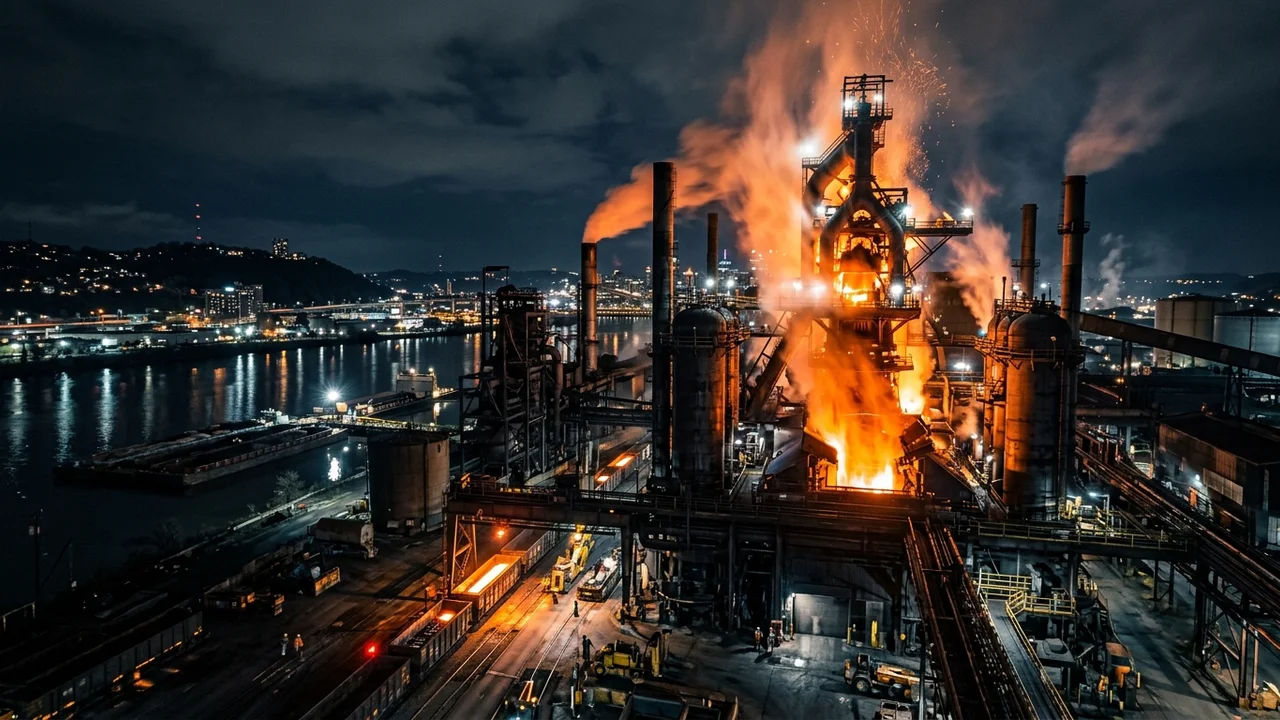
US exporters shipping steel, aluminium, and chemicals to the EU carry 100% of their CBAM certificate obligation with no offset available, because the United States has no federal carbon pricing scheme that qualifies under Article 9 of Regulation (EU) 2023/956. While net costs in 2026 remain low due to the 2.5% CBAM factor still in effect, the free allocation phase-out accelerates sharply from 2028 onward, reaching 48.5% by 2030 and 100% by 2034. US exporters and their EU customers who treat 2026 as a preview of long-term costs are making a serious planning error. This article explains the current CBAM exposure for US-origin goods, the Article 9 gap, the political context, and the four actions US exporters can take before costs become structural.
Caption: US exporters face full CBAM costs with no federal carbon price deduction available under Article 9.
What Is CBAM and Why Does It Apply to US Exports?
CBAM (Carbon Border Adjustment Mechanism) is a certificate-based regulatory system established by Regulation (EU) 2023/956 that requires EU importers of carbon-intensive goods to purchase certificates proportional to the embedded CO₂ emissions of their imports, priced at the EU ETS carbon price, in order to prevent carbon leakage from the EU Emissions Trading System. The definitive phase of CBAM began January 1, 2026. CBAM is not a tariff, not a carbon tax, and not a customs duty. It is a certificate obligation that falls on EU importers, but its costs transmit commercially to non-EU exporters through price negotiations and supplier switching.
The United States is the world's largest economy and a significant exporter of steel and aluminium products to the EU. For the purposes of the EU CBAM guide, the US position is categorically distinct: unlike South Korea, which operates the K-ETS and may qualify for an Article 9 deduction, and unlike Switzerland, which is exempt through its linked ETS, the US has no federal mechanism that qualifies for any deduction against CBAM liability. State-level programs, including California's cap-and-trade system (~$30/tCO₂) and the Regional Greenhouse Gas Initiative covering Northeast power generators, do not qualify under Article 9 because they are subnational and do not apply to steel or aluminium production facilities.
Which US Exports Are Subject to CBAM?
Three product categories from the United States fall within CBAM's Annex I scope: steel and steel articles under Chapters 72 and 73, aluminium and aluminium articles under Chapter 76, and selected chemicals including ammonia and hydrogen under Chapters 28 and 31. The table below summarizes the current CBAM cost exposure for US-origin goods at the EU ETS price of approximately €70/tCO₂ as of late March 2026.
The five covered product groups and their gross CBAM cost at current ETS levels are outlined in the following table.
| US Export Product | CN Chapter | Emission Factor (tCO₂/t) | Gross CBAM Cost @ €70/tCO₂ | Net Cost 2026 (2.5% factor) | Net Cost 2030 (48.5% factor) |
|---|---|---|---|---|---|
| Steel (blast furnace, BF-BOF) | 72, 73 | ~2.0 | ~€140/t | ~€3.50/t | ~€67.90/t |
| Steel (electric arc, EAF scrap) | 72, 73 | ~0.5 | ~€35/t | ~€0.88/t | ~€16.98/t |
| Primary aluminium | 76 | ~1.5 | ~€105/t | ~€2.63/t | ~€50.93/t |
| Urea / nitrogen fertilizers | 28, 31 | ~2.5 | ~€175/t | ~€4.38/t | ~€84.88/t |
| Grey hydrogen (SMR process) | 28 | ~9–12 | ~€630–840/t | ~€15.75–21/t | ~€305.55–407.40/t |
The 2026 net costs are low because 97.5% of EU ETS free allocation remains in place this year. The net cost formula is: gross CBAM cost multiplied by the CBAM factor for that year. At 2.5%, a US BF-BOF steel exporter whose EU customer pays ~€140/t gross faces a real net obligation of only ~€3.50/t. The same product costs ~€67.90/t net in 2030, a 20-fold increase driven entirely by the free allocation schedule, not by any change in ETS price.
The CBAM steel sector guide contains full CN code lists, benchmark emission factors, and calculation mechanics for US-origin steel products entering the EU.
Why US Exporters Cannot Use the Article 9 Deduction
Article 9 of Regulation (EU) 2023/956 allows EU importers to deduct a carbon price "effectively paid" in the country of origin when calculating their CBAM certificate obligation. This deduction requires that the carbon price is legally binding, effectively enforced, and applied to the specific production installation that manufactured the exported goods.
The United States fails all three qualifying conditions at the federal level. No federal carbon pricing mechanism exists. The Clean Competition Act and the Foreign Pollution Fee Act (FPFA) were introduced in the 119th Congress but neither has been enacted. California's cap-and-trade program operates at the state level and applies to electricity generators and large industrial facilities, but does not constitute a federal scheme applicable to all US steel and aluminium producers. The RGGI covers only power sector emitters in Northeast states and is similarly subnational.
US exporters whose EU customers would otherwise benefit from an Article 9 deduction currently receive zero offset against their CBAM certificate obligation. The deduction for non-EU exporters without a qualifying carbon price reads as follows from the CBAM Article 9 deduction page: the deductible amount is zero when no effective carbon price exists in the country of production.
For comparison, the four countries whose Article 9 status contrasts directly with the US position are listed below.
- South Korea (K-ETS active since 2015, covering ~70% of national emissions, pending Commission recognition)
- Switzerland (linked ETS, fully exempt from CBAM, zero certificate obligation)
- United Kingdom (UK ETS active but not exempt; Article 9 recognition unresolved as of April 2026)
- Japan (GX-ETS mandatory from April 2026 but not yet mature enough for Commission recognition)
The US sits in a category distinct from all four: it has no federal mechanism of any type to assess for Article 9, regardless of maturity or current price level. For more information on how other non-EU countries are positioned, the CBAM for non-EU exporters overview covers the full exporter framework.
What the US Government Has Done About CBAM
The US government has not filed a formal WTO challenge against CBAM. The only formal WTO challenge filed globally is DS639, brought by Russia on May 12, 2025. India has filed 29 formal objections at the WTO Trade and Environment Committee, and the US has made bilateral representations to the European Commission through diplomatic channels, but no formal dispute proceeding has been initiated.
The US political position on CBAM has been split along partisan lines. The Biden administration supported CBAM as consistent with US climate goals and IRA climate investments. The argument advanced by the Biden-era US Trade Representative was that the Inflation Reduction Act's clean energy subsidies serve an equivalent decarbonization function. The European Commission formally rejected this equivalency argument: IRA subsidies reduce emissions domestically but do not constitute a carbon price "effectively paid" at the production installation level as required under Article 9.
The Trump-era and current Republican position opposes CBAM as a trade barrier, with several legislators co-sponsoring the FPFA as a potential retaliatory or parallel mechanism. Global Arrangement on Steel and Aluminium (GASA) negotiations between the EU and US remained ongoing as of April 2026, with CBAM interaction as one element of the broader bilateral steel and aluminium trade framework.
US exporters cannot rely on any near-term diplomatic resolution to reduce their CBAM exposure. The WTO route is uncertain and slow, bilaterals have produced no binding outcomes, and no federal carbon pricing legislation is currently advancing through Congress. The exposure is structural and growing.
How CBAM Costs Pass Through the Supply Chain
Non-EU manufacturers have no direct legal obligation under CBAM. The legal obligation falls entirely on the EU-based authorized declarant who imports the goods. However, this legal structure does not protect US exporters from commercial consequences. EU importers who purchase US-origin steel, aluminium, or fertilizers face a CBAM certificate obligation calculated on the embedded emissions of those goods. Three commercial outcomes follow directly.
The three mechanisms through which CBAM costs reach US exporters are described below.
- Price renegotiation: EU importers reduce the price they offer US exporters to account for their certificate obligation. The US producer absorbs part or all of the CBAM cost as a lower FOB or CIF price.
- Supplier switching: EU importers shift sourcing to suppliers in lower-carbon-intensity countries or exempt countries (EEA, Switzerland). US exporters lose market share without any price negotiation occurring.
- Default value penalty: If US exporters cannot provide verified actual emissions data for their production installations, EU importers fall back to punitive CBAM default values. These default values carry a 10% mark-up above the calculated benchmark in 2026, rising to 20% in 2027 and 30% from 2028 onward, per Implementing Regulation (EU) 2025/2621.
The default value mark-up is a compounding problem for US exporters who have not historically tracked production-level emissions data. A US BF-BOF steel producer operating at, say, 1.9 tCO₂/t actual emissions would pay CBAM on a default that could be 10–30% above the CBAM benchmark of 1.370 tCO₂/t. The incentive to provide verified actual data increases every year as the mark-up rises and as the CBAM factor increases.
How Significant Is US Steel and Aluminium Export Exposure?
US direct exports of CBAM-covered goods to the EU are limited relative to countries such as India, Turkey, and China, partly because the EU-US Section 232 tariff agreement and reciprocal trade dynamics have shaped bilateral steel and aluminium flows. The de minimis threshold of 50 tonnes annual mass exempts small importers entirely. However, the Bipartisan Policy Center noted in 2025 that high CBAM default values for US steel "underscore the need for US emissions data," arguing that US steelmakers operating modern electric arc furnace (EAF scrap) facilities would benefit financially from demonstrating actual verified emissions against defaults.
US EAF scrap-based steelmakers are among the world's lowest-carbon steel producers, with emission factors of approximately 0.5 tCO₂/t, compared to the BF-BOF default range of 2.0–2.5 tCO₂/t. If a US mini-mill can demonstrate verified emissions of 0.5 tCO₂/t while the applicable default value exceeds 1.0 tCO₂/t, the financial benefit of actual-data verification is immediate and grows every year as the CBAM factor rises.
Caption: US mini-mill EAF producers operate at emission factors well below CBAM defaults, creating a strong case for verified actual-data reporting.
What US Exporters Should Do Before the 2030 Cost Cliff
The 2026 net CBAM costs are manageable. The 2030 net costs are not. The gap between the 2.5% CBAM factor today and the 48.5% factor in 2030 is a structural price signal that US exporters and their EU customers need to plan for now. The following section covers practical responses.
How Does Default Value Reporting Work for US Exporters?
Default values apply automatically when an EU importer cannot provide verified production-level emissions data from the exporting installation. The importer uses a commission-published default table from Implementing Regulation (EU) 2025/2621. These values are set above industry benchmarks by design, to incentivize actual data submission.
US producers who provide a third-party-verified emissions declaration to their EU customer allow the importer to use actual values instead of defaults. The verification must be conducted by an accredited verifier registered with the CBAM registry (verifier registration opened September 1, 2026). The reporting period covers the calendar year 2026, with the first CBAM declaration due September 30, 2027.
US exporters who want to help EU customers avoid default-value penalties can engage a verifier now. The CBAM default values page explains how default values are calculated by sector and production route.
Is the US ETS Trajectory Likely to Change Before 2030?
No federal carbon pricing legislation is currently advancing in the US Congress as of April 2026. The FPFA and Clean Competition Act remain introduced but unenacted. State-level programs are expanding — California's cap-and-trade coverage and the RGGI have added participants over time — but subnational programs do not qualify for Article 9 deduction.
The probability of a federal carbon pricing scheme being enacted, implemented, and recognized by the European Commission as qualifying under Article 9 within the 2026–2030 window is very low. US exporters should not build their CBAM compliance strategy around a federal carbon price emerging in time to reduce 2030 obligations.
Does the Global Arrangement on Steel and Aluminium Affect CBAM?
The GASA negotiations between the EU and US address bilateral steel and aluminium trade, including sustainability standards, but GASA is a separate track from CBAM. Even a concluded GASA agreement does not automatically exempt US steel and aluminium from CBAM certificate obligations unless it includes an explicit mutual recognition clause for carbon pricing or an ETS linkage provision. No such provision exists in any public GASA negotiating text as of April 2026.
US exporters monitoring GASA progress should treat any CBAM-GASA connection as aspirational rather than operative. Commercial CBAM planning should proceed on the assumption that no GASA outcome reduces certificate obligations before 2030.
Can US Exporters Reduce Their EU Customers' CBAM Liability Without a Carbon Price?
Yes. Three mechanisms allow US exporters to help reduce EU importer certificate obligations without a qualifying federal carbon price being in place. These options are detailed in the CBAM exporter strategy guide.
The three available mechanisms for US exporters without a qualifying carbon price are listed below.
- Submit verified actual emissions data (replaces punitive default values with real production-level figures)
- Shift to lower-carbon production routes (EAF scrap production at ~0.5 tCO₂/t versus BF-BOF at ~2.0 tCO₂/t significantly reduces the certificate burden)
- Qualify individual installations under planned state programs (this does not create an Article 9 deduction but reduces actual emissions, lowering the certificate calculation base)
None of these options produces an Article 9 deduction. All three reduce the gross CBAM cost calculated on embedded emissions, which is the number that gets multiplied by the CBAM factor to determine net obligation.
Is the WTO a Viable Route for US Exporters?
WTO challenges to CBAM are slow, uncertain, and currently limited to state-filed disputes, not individual company claims. Russia's DS639 was filed in May 2025 and remains at the consultations stage. The non-functional WTO Appellate Body means that any eventual panel ruling cannot be appealed or enforced in a binding way. US companies have no standing to file a WTO dispute directly. Any US WTO challenge would require the US Trade Representative to file, and no formal filing has occurred.
US exporters who want to understand the broader WTO context for CBAM can read the WTO and CBAM analysis. Diplomatic engagement at the bilateral level through the GASA framework is a parallel track but, as noted above, has not produced CBAM relief.
How Does the US Compare to China Under CBAM?
The US and China share the absence of a qualifying federal carbon price for Article 9 purposes, but their CBAM exposure profiles differ. China's national ETS, expanded in March 2025 to cover steel, cement, and aluminium, introduces a pricing mechanism (~$11/tCO₂) that may eventually qualify for a partial Article 9 deduction, though the intensity-based structure of the Chinese system creates legal uncertainty. The US has no equivalent mechanism under active development at the federal level.
China also exports approximately €12.5 billion in steel articles to the EU annually, making its gross CBAM exposure significantly larger than the US in absolute volume terms. The CBAM China analysis covers the China position in detail, including the default value differential that gives US EAF producers a relative competitive advantage over Chinese BF-BOF producers.
The comparison between the US and other key non-EU exporters on four critical dimensions is presented below.
| Country | Federal Carbon Price | Article 9 Deduction | WTO Challenge Filed | Primary CBAM Sector |
|---|---|---|---|---|
| United States | None | No | No | Steel, aluminium |
| China | ETS (intensity-based, ~$11/tCO₂) | Uncertain | No | Steel, aluminium |
| South Korea | K-ETS (~$6–7/tCO₂) | Pending recognition | No | Steel |
| Russia | None effective | No | Yes (DS639) | Steel, fertilizers |
| India | CCTS pilot only | No | No (formal) | Steel, fertilizers |