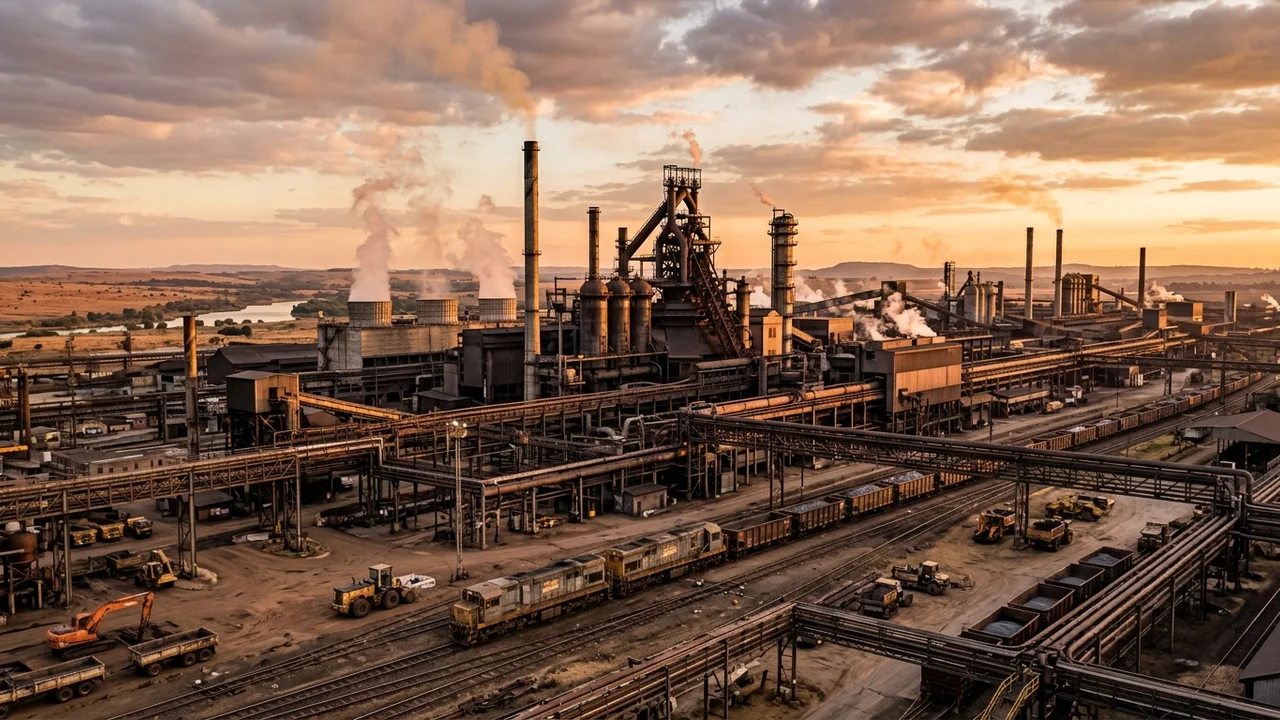
South Africa faces a direct CBAM cost exposure of approximately €0.5–1 billion per year across its steel, aluminium, and fertilizer exports to the EU, making it the most CBAM-affected economy on the African continent in absolute terms. Three factors define South Africa's position: an existing carbon tax that may partially offset CBAM costs under Article 9, an active diplomatic opposition coordinated through the BASIC group (Brazil, India, South Africa, and China), and a competitive steel sector that exports primarily through ArcelorMittal SA into markets where CBAM certificate costs will grow steeply through 2034. Understanding how South Africa's carbon pricing framework interacts with the EU's certificate-based mechanism determines whether South African exporters face a competitive disadvantage or a partial exemption that narrows the gap.
Caption: South African steel exports to the EU face growing CBAM certificate obligations as the free allocation phase-out accelerates toward 2030.
How Does CBAM Apply to South African Exports?
CBAM applies to South African steel, aluminium, and fertilizer exports through the EU importer's obligation to purchase CBAM certificates proportional to the embedded CO₂ in each shipment, priced at the quarterly average EU ETS auction clearing price. Under Regulation (EU) 2023/956 as amended by Regulation (EU) 2025/2083, the definitive phase began on January 1, 2026. South African manufacturers hold no direct legal obligation under this framework. The obligation rests with the EU importer, who acts as the authorized CBAM declarant.
The practical commercial effect, however, transfers cost pressure upstream. EU importers who cannot demonstrate verified actual embedded emissions for South African goods must use CBAM default values under Implementing Regulation (EU) 2025/2621, which carry a 10% mark-up above the calculated default in 2026, rising to 20% in 2027 and 30% from 2028 onward. South African producers who provide verified actual emissions data through an accredited verifier avoid this mark-up and reduce the certificate cost passed back through pricing negotiations.
For more on the broader regulatory framework governing these obligations, the EU CBAM mechanism establishes the certificate-based structure that replaced the transitional reporting phase from January 1, 2026.
The first CBAM declaration covering calendar year 2026 is due September 30, 2027. Certificate sales begin February 1, 2027. For the 2026 compliance year, the net CBAM surcharge remains small because 97.5% of free allocation in the EU ETS remains intact, producing a CBAM factor of just 2.5%. At an EU ETS price of approximately €70/tCO₂, a tonne of South African BF-BOF steel carries a gross CBAM cost of approximately €140 but a net obligation of only €3.50 in 2026. The calculation changes dramatically by 2030, when the CBAM factor reaches 48.5% and the net cost rises to approximately €67.90 per tonne of BF-BOF steel.
What Sectors Are Affected in South Africa?
Three CBAM sectors carry material export exposure for South Africa: steel, aluminium, and fertilizers. The table below summarizes each sector's key parameters.
| Sector | Primary Exporter | Emission Factor | Gross CBAM Cost @ €70 | Net Cost 2026 (2.5%) | Net Cost 2030 (48.5%) |
|---|---|---|---|---|---|
| Steel (BF-BOF) | ArcelorMittal SA | ~2.0 tCO₂/t | ~€140/t | ~€3.50/t | ~€67.90/t |
| Aluminium (primary) | Hillside (BHP) | ~1.5 tCO₂/t | ~€105/t | ~€2.63/t | ~€50.93/t |
| Fertilizers (urea) | Sasol / AECI | ~2.5 tCO₂/t | ~€175/t | ~€4.38/t | ~€84.88/t |
South Africa's steel sector is dominated by BF-BOF production at ArcelorMittal South Africa's facilities in Newcastle and Vanderbijlpark. BF-BOF steel carries the highest emission intensity of all production routes, at approximately 2.0 tCO₂ per tonne, compared to 0.5 tCO₂/t for electric arc furnace scrap-based steel. Aluminium exports originate primarily from the Hillside smelter in Richards Bay, operated by South32, which is one of the largest single-site aluminium smelters in the world. The aluminium sector faces an important CBAM structural point: under Annex II of Regulation (EU) 2023/956, only direct emissions are priced for aluminium, not the indirect emissions from electricity consumption. This matters for South African aluminium producers because Eskom's coal-heavy grid produces high indirect emission intensities, but those indirect emissions carry no CBAM financial obligation in the definitive phase.
Fertilizer exports, particularly urea from Sasol and AECI, carry the highest per-tonne CBAM cost of any South African product class, at approximately €175/t gross at €70/tCO₂. Fertilizers include both direct and indirect embedded emissions under CBAM, and the urea emission factor of approximately 2.5 tCO₂e/t is compounded by N₂O from nitric acid production where applicable.
For full compliance obligations covering the steel sector under CBAM, detailed production route classifications and CN code assignments govern how South African steelmakers' embedded emissions are calculated and reported.
Does South Africa's Carbon Tax Qualify for Article 9 Deduction?
South Africa's carbon tax represents the strongest case for Article 9 eligibility of any African country under CBAM, though formal Commission recognition remains pending as of April 2026. The Carbon Tax Act (Act 15 of 2019) entered into force on June 1, 2019, making South Africa one of the earliest emerging economies to legislate a mandatory carbon price covering industrial sectors. The current tax rate is approximately R159 per tonne of CO₂ equivalent, which translates to roughly €8–9/tCO₂ at current exchange rates, after accounting for the basic tax-free allowance of 60% that applies to most industrial facilities.
The Article 9 deduction under Regulation (EU) 2023/956 allows EU importers to subtract the carbon price effectively paid in the country of production from the CBAM certificate obligation, provided the EU Commission formally recognizes the third-country carbon pricing scheme as qualifying. Recognition requires the scheme to be legally binding, effectively enforced, and applied without refund at a quantifiable rate per tonne of CO₂e. South Africa's carbon tax satisfies the first two conditions. The uncertainty centers on the effective price paid after the 60% basic tax-free allowance, which significantly reduces the net cost faced by industrial producers.
At an effective rate of approximately €3.20–3.60/tCO₂ after the allowance (based on R159 gross minus 60% relief), the Article 9 deduction would reduce CBAM certificate costs by approximately €6.40–7.20 per tonne of BF-BOF steel. In 2026, with the CBAM factor at 2.5%, this deduction saves approximately €0.16–0.18/t, a negligible amount. By 2030, with the CBAM factor at 48.5%, the same deduction saves approximately €3.10–3.49/t on every tonne of steel exported. The deduction grows in absolute value as CBAM costs scale, reaching approximately €6.40–7.20/t by 2034 when free allocation is fully phased out.
The South African government has engaged directly with the EU Commission on Article 9 recognition, positioning the carbon tax as a credible instrument for deduction eligibility. The Article 9 carbon price deduction framework sets out the exact documentation requirements exporters must provide to support their EU buyer's deduction claim, including carbon tax invoices, legal basis citations, and evidence that free allocations were accounted for.
What Is the BASIC Group and Why Does South Africa Oppose CBAM Diplomatically?
South Africa's diplomatic opposition to CBAM operates through the BASIC group, a coalition formed in 2009 that coordinates climate negotiating positions among Brazil, India, South Africa, and China. The BASIC countries have collectively challenged CBAM on two grounds: that it violates the principle of Common but Differentiated Responsibilities (CBDR) established under the UNFCCC, and that the EU retains 75% of CBAM revenues for its own budget rather than returning them to developing nations to fund decarbonization.
The revenue argument is specific and quantifiable. Under Article 30 of Regulation (EU) 2023/956 and the EU Own Resources Decision, 75% of CBAM revenues flow to the EU budget as Own Resources, servicing NextGenerationEU recovery debt and funding the Social Climate Fund. The remaining 25% goes to member states for administrative enforcement costs. BASIC countries argue that this allocation is inequitable because CBAM effectively taxes the industrial development of emerging economies while directing the proceeds to EU fiscal priorities rather than supporting the low-carbon transition in the affected exporting nations.
South Africa's position adds a development dimension to this argument. The country's basic industries, including steel and aluminium, provide direct employment for tens of thousands of workers in communities with limited alternative economic opportunities, particularly in KwaZulu-Natal (steel) and Richards Bay (aluminium). CBAM cost pressures that reduce the competitiveness of these exports carry social consequences beyond the financial impact on individual producers.
As of April 2026, South Africa is considering whether to file a formal WTO complaint, following Russia's filing of WTO DS639 in May 2025, the first formal CBAM challenge globally. South Africa has not yet filed but has raised objections through the WTO Trade and Environment Committee alongside India and other BASIC nations. The WTO dispute pathway faces significant uncertainty because the WTO Appellate Body remains non-functional, limiting the enforceability of any ruling against CBAM.
CBAM South Africa: Key Compliance Questions
What Does the Free Allocation Phase-Out Mean for South African Steel Exporters?
The free allocation phase-out is the single most important long-term financial variable for South African steel exporters under CBAM. Net CBAM costs scale directly with the CBAM factor, which represents the proportion of free allocation phased out in any given year. The steepest increase occurs between 2029 and 2030, when the factor jumps from 22.5% to 48.5%. South African BF-BOF steel facing a net cost of approximately €6.83/t in 2028 will face approximately €67.90/t in 2030 at unchanged ETS prices. Planning that treats 2026 net costs as representative of future exposure is a structural error.
The five-year compliance planning horizon that South African exporters and their EU buyers should use runs from 2026 to 2030. Over that window, the net CBAM cost per tonne of BF-BOF steel increases by a factor of approximately 19 at constant ETS prices. Producers who have not invested in verified actual emissions data, monitoring infrastructure, or production route modifications face compounding disadvantages. EU buyers under cost pressure will prioritize suppliers with lower certified emission intensities or suppliers in countries where Article 9 deductions reduce net certificate costs.
Does South Africa Have to Provide Emissions Data to EU Buyers?
South African producers face no direct legal obligation under CBAM to provide emissions data, but the commercial consequences of withholding data are severe. EU buyers using CBAM default values for South African goods pay a 10% mark-up above the calculated default in 2026, rising to 30% from 2028. For BF-BOF steel, defaults are already set substantially above actual emission intensities for efficient South African operations, meaning the default mark-up amplifies an already conservative baseline.
The practical steps for a South African producer seeking to provide verified data are four in number. First, establish a monitoring plan covering all direct emission sources linked to production, including embedded emissions from precursor goods such as iron ore and coke inputs. Second, calculate specific direct embedded emissions using the calculation-based method under Implementing Regulation (EU) 2025/2547. Third, engage an accredited verifier (accredited under EN ISO/IEC 14065 by an EA-recognized National Accreditation Body) for a mandatory physical site visit and verification report. Fourth, upload verified data to the EU CBAM Operators Portal for sharing with EU buyer accounts.
Non-EU exporters who provide verified actual data access the CBAM default values reference point as a baseline against which their actual performance is measured, creating a direct financial incentive for every producer whose actual emissions fall below the default.
Are South African Exporters Classified as Non-EU Exporters Under CBAM?
South African producers are classified as non-EU exporters under CBAM, and the compliance obligation chain places all legal responsibility on the EU importer. This classification is shared by all exporters from countries that are not EU member states, EEA participants (Norway, Iceland, Liechtenstein), or countries with linked ETS systems (Switzerland). The non-EU exporters compliance framework describes how this legal structure creates commercial leverage for EU buyers in pricing negotiations.
South Africa does not benefit from any of the CBAM exemptions that apply to EEA countries or Switzerland. South Africa is also not on any development-specific exemption list. The December 2025 EU Commission Article 30 review explicitly considered CBAM exemptions for developing countries but declined to establish them, citing the availability of transition finance mechanisms and the phase-in schedule as adequate adjustment time. BASIC group arguments about CBDR obligations were acknowledged but not adopted as legal grounds for exemption.
Is a Decarbonization Strategy the Best Response for South African Producers?
Decarbonization represents the highest-value long-term response for South African producers facing CBAM, because it reduces both the CBAM certificate obligation and the underlying production cost structure as carbon pricing spreads globally. For South African steel specifically, the transition pathway from BF-BOF to direct reduced iron using green hydrogen (DRI-EAF with H-DRI) would reduce emission intensity from approximately 2.0 tCO₂/t to approximately 0.0–0.1 tCO₂/t for the hydrogen-DRI variant. At 2030 CBAM cost levels, this represents a cost saving of approximately €67/t against a BF-BOF baseline.
The challenge for South African producers is that the hydrogen-DRI transition requires both green hydrogen supply infrastructure and capital investment in new furnace capacity at a scale that is unlikely to materialize within the 2026–2030 window. Incremental steps, including increasing scrap rates in existing EAF operations, reducing coal consumption per tonne of steel, and implementing energy efficiency measures, produce measurable emission intensity reductions that are verifiable under CBAM methodology and reduce certificate costs accordingly.
A comprehensive decarbonization strategy for exporters covers the investment decision framework between verified actual data submission, production route optimization, and market diversion strategies that South African producers are currently evaluating.
Does the BASIC Group Opposition Have Any Practical Effect on South African Exporters?
The BASIC group opposition has no direct effect on South African exporters' CBAM obligations in 2026. Regulation (EU) 2023/956 is in force, and EU importers of South African goods carry active legal obligations from January 1, 2026. Diplomatic opposition at the WTO or UNFCCC level does not suspend compliance requirements while proceedings are pending. Russia's WTO DS639 filing in May 2025 is the only formal legal challenge to CBAM globally, and WTO dispute timelines typically run three to five years before any finding, assuming the Appellate Body remains non-functional and panel procedures are available.
The practical value of BASIC group coordination for South African exporters is indirect. Sustained multilateral pressure on the EU may accelerate negotiations on bilateral carbon pricing recognition under Article 9, increase the share of CBAM revenues directed toward developing-country climate finance, or produce WTO panel findings that require CBAM structural modifications. None of these outcomes is guaranteed or imminent. The CBAM impact on developing countries analysis covers the wider equity arguments that BASIC group members including South Africa are advancing in multilateral forums alongside their compliance planning at the producer level.
Caption: BASIC group coordination on CBAM opposition combines WTO procedural challenges with arguments about CBDR and the EU's revenue allocation under Article 30.
Are There Boolean Answers on South Africa's CBAM Status?
Does South Africa qualify for any CBAM exemption? No. South Africa is classified as a third country with no ETS linkage to the EU, no EEA membership, and no bilateral agreement granting exemption. South African exports are subject to full CBAM obligations from January 1, 2026.
Has South Africa's carbon tax been formally recognized for Article 9 deduction? No, as of April 2026. The EU Commission's assessment of South Africa's Carbon Tax Act is pending. Recognition would allow EU importers of South African goods to deduct the effective carbon price paid from their CBAM certificate obligation, potentially reducing costs by €3–7/t depending on year and CBAM factor.