Vietnam's steel sector exported 3.18 million tonnes of steel products to the EU in 2024, placing the country among the top ten non-EU steel suppliers to the bloc and directly in the scope of CBAM compliance scrutiny. That volume brings a specific complication: the EU Commission identifies Vietnamese steel processing as one of two active circumvention patterns under continuous monitoring in 2026, alongside Turkish reprocessing of Russian aluminium ingots. Understanding how CBAM applies to Vietnam requires separating two distinct issues: the direct compliance obligations that fall on EU importers of Vietnamese steel, and the circumvention risk that shapes how those importers and their Vietnamese suppliers are treated by enforcement authorities.
This article covers Vietnam's ETS launch in August 2025, the circumvention monitoring framework under Article 27, the financial exposure of Vietnamese BF-BOF and downstream steel producers at the current EU ETS price of approximately €70 per tonne CO₂, and the compliance steps that reduce risk for both EU importers and their Vietnamese counterparts.
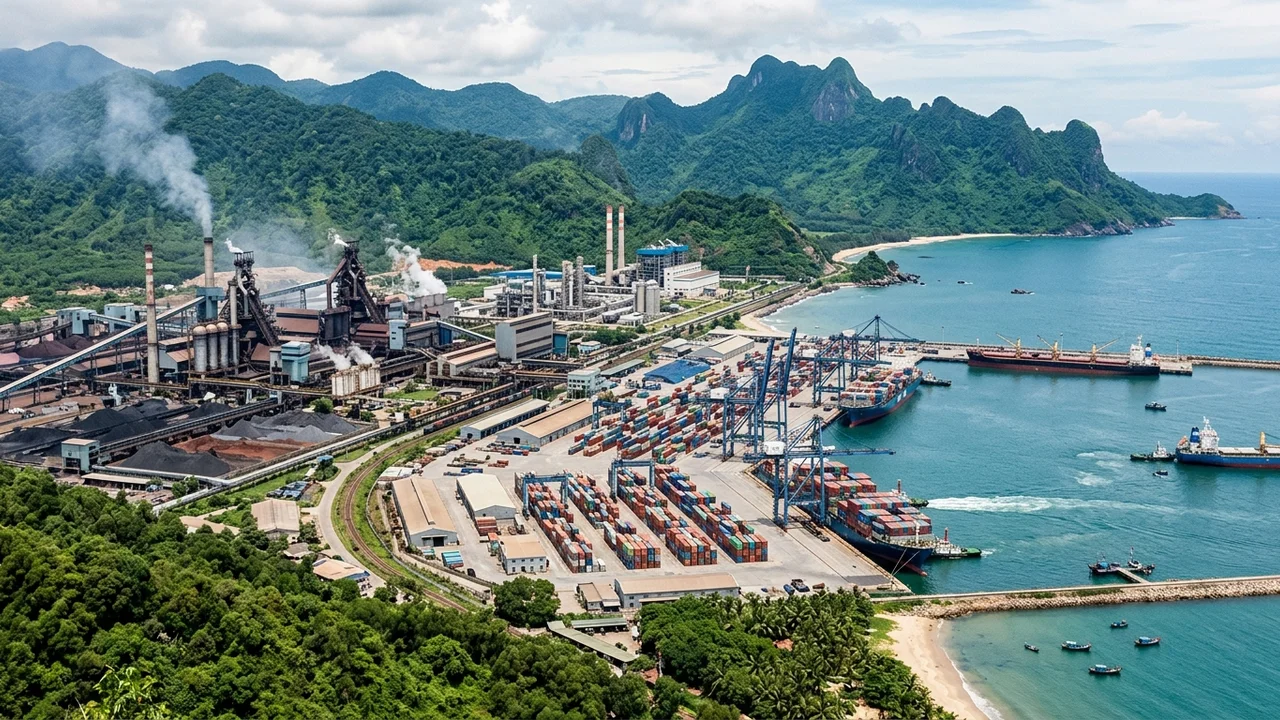
Caption: Steel processing facilities in Vietnam face CBAM scrutiny because Chinese-origin slabs processed domestically can trigger origin-reclassification and anti-circumvention review.
What Is Vietnam's CBAM Exposure in 2026?
Vietnam's CBAM exposure concentrates in steel, specifically in downstream processing operations where Chinese-origin hot-rolled coil and slab are transformed into finished steel products before export to the EU. This processing pattern triggers Article 27 anti-circumvention provisions under Regulation (EU) 2023/956 and is subject to active Commission monitoring as of April 2026.
Vietnam does not export cement, aluminium, or fertilizers to the EU at commercially significant volumes. Steel and aluminium profiles represent the two CBAM-relevant product categories, with steel dominating by volume. The embedded emissions of Vietnamese-produced steel depend entirely on the production route: blast furnace-basic oxygen furnace (BF-BOF) production carries approximately 2.0 tCO₂ per tonne, while electric arc furnace (EAF) scrap-based production carries approximately 0.5 tCO₂ per tonne. At the current EU ETS price of approximately €70 per tonne CO₂, BF-BOF steel generates a gross CBAM obligation of approximately €140 per tonne before the free allocation adjustment factor is applied.
To understand how the certificate-based mechanism works at the regulatory level, the EU CBAM article on this site covers the full authorization and declaration workflow, including how embedded emissions are calculated and reported under Regulation (EU) 2023/956.
The net cost in 2026 remains low because only 2.5% of free allocation has been phased out this year. A Vietnamese BF-BOF steel producer whose EU importer uses actual verified emissions data faces a net CBAM cost of approximately €3.50 per tonne at €70 per tonne CO₂ in 2026. That figure rises to approximately €72.75 per tonne net by 2030, when the free allocation phase-out reaches 48.5%. Vietnamese producers and their EU customers who treat the 2026 cost as representative of long-term exposure are misjudging the 2029–2030 cost acceleration by a factor of approximately 20.
How Does the 2025 Vietnamese ETS Affect CBAM Compliance?
Vietnam's Emissions Trading Scheme expanded in August 2025 to cover thermal power generation, steel production, and cement manufacturing, representing a significant structural development for CBAM compliance. Steel production is now a covered sector under the Vietnamese ETS, which means Vietnamese steelmakers are subject to domestic carbon pricing for the first time.
The expansion creates a potential pathway toward an Article 9 deduction under Regulation (EU) 2023/956. Article 9 allows the EU importer to deduct a carbon price "effectively paid" in the country of origin from the CBAM certificate obligation, reducing the net financial burden on the import transaction. The practical value of this deduction depends on two conditions: first, the Vietnamese ETS must be assessed by the EU Commission as a qualifying carbon pricing scheme; second, the carbon price actually paid by Vietnamese steel producers must be documented and verified.
As of April 2026, the Vietnamese ETS price is not yet established at a level that would produce a material Article 9 deduction. The scheme launched in transitional form, and early carbon price data is not publicly confirmed. The EU Commission has not yet completed its assessment of whether the Vietnamese ETS qualifies under Article 9 criteria. Vietnamese steelmakers should track Commission guidance on third-country carbon price recognition and engage their EU customers on the documentation requirements that would be needed to support any future deduction claim.
For Vietnamese producers interested in understanding how the deduction mechanism works in a confirmed case, South Korea's K-ETS provides the clearest comparison: K-ETS has operated since 2015, currently prices carbon at approximately $6–7 per tonne CO₂, and is the candidate most likely to receive Article 9 recognition from the Commission among all non-EU carbon pricing schemes. Even at that price, the deduction covers only approximately 9% of CBAM certificate liability at €70 per tonne CO₂.
What Are the Anti-Circumvention Rules That Apply to Vietnam?
Article 27 of Regulation (EU) 2023/956 prohibits three practices, each of which appears in documented monitoring patterns involving Vietnamese supply chains.
The three prohibited practices covered by Article 27 are listed below.
- Artificial splitting of shipments to exploit the 50-tonne annual de minimis threshold per importer, using multiple legal entities or shipping routes to keep individual consignments below the reporting threshold
- "Minor processing" — exporting high-carbon precursor materials such as Chinese steel slab or hot-rolled coil to Vietnam for superficial processing operations that change the CN code classification without meaningfully altering the embedded emissions profile of the product
- Rerouting goods through third countries to falsely modify the declared country of origin, causing the product to be presented as Vietnamese-origin when the embedded emissions were generated at a Chinese production installation
The Commission's enforcement monitoring as of 2026 specifically flags Vietnamese processing of Chinese steel as one of the two active circumvention patterns under review. This monitoring designation means that EU importers of Vietnamese steel face elevated scrutiny on origin documentation, production records, and emissions reporting. A Vietnamese manufacturer that can demonstrate genuine domestic value addition, actual domestic production capacity, and verified embedded emissions data from its own production installation is in a fundamentally different compliance position from a processor that imports Chinese semi-finished steel and performs only finishing operations before re-export.
The financial stakes of circumvention enforcement are significant. An unauthorized importer who cannot establish valid authorization faces a penalty of €300–500 per tonne CO₂e under Article 26(2) as amended by Regulation (EU) 2025/2083, representing 3–5 times the standard penalty rate of €100 per tonne CO₂e applied to authorized declarants. These penalties do not substitute for the certificate obligation; the importer must still surrender the required certificates in addition to paying the penalty.
Vietnam Steel CBAM: Financial Exposure by Production Route
The financial exposure of Vietnamese steel under CBAM varies significantly by production route and time horizon. The table below shows gross and net CBAM costs for the two primary production routes at the current EU ETS price of approximately €70 per tonne CO₂, across three years that represent key points in the free allocation phase-out schedule.
| Production Route | Emission Factor | Gross Cost @ €70/tCO₂ | Net Cost 2026 (2.5% factor) | Net Cost 2030 (48.5% factor) | Net Cost 2034 (100% factor) |
|---|---|---|---|---|---|
| BF-BOF (blast furnace) | ~2.0 tCO₂/t | €140/t | €3.50/t | €67.90/t | €140/t |
| EAF scrap-based | ~0.5 tCO₂/t | €35/t | €0.88/t | €16.98/t | €35/t |
Vietnamese steel producers using BF-BOF routes face costs that reach €67.90 per tonne net by 2030, assuming the EU ETS price holds at approximately €70 per tonne CO₂. At consensus analyst forecasts of approximately €126 per tonne CO₂ by 2030, the 2030 net cost for BF-BOF production rises to approximately €122 per tonne. For context, the FOB export price of typical Vietnamese steel products to EU markets ranges from approximately €450–750 per tonne depending on product specification, meaning that 2030 CBAM compliance costs under BF-BOF production at consensus ETS price projections represent approximately 16–27% of the full FOB price.
EAF scrap-based producers face materially lower exposure and are better positioned for the 2030–2034 phase-out period. Vietnamese steel producers with access to domestic scrap supply and the capital to invest in EAF capacity have a structural long-term advantage under CBAM that BF-BOF-dependent competitors do not.
For a complete overview of how the steel sector under CBAM is assessed, including CN codes, embedded emissions calculation methods, and benchmark values from Implementing Regulation (EU) 2025/2621, the sector guide on this site covers the full technical framework.
What Compliance Steps Do Vietnamese Exporters Need to Take?
Vietnamese steel exporters have no direct legal obligation under CBAM. The legal obligation falls entirely on the EU importer. However, commercial pressure transfers effective compliance responsibility to exporters through two mechanisms: EU importers need verified actual emissions data to avoid punitive default values, and importers with elevated circumvention risk exposure from Vietnamese supply chains need robust origin and production documentation to defend their compliance position.
The four compliance steps most relevant for Vietnamese steel exporters are listed below.
- Establish a production-level monitoring plan that tracks direct CO₂ emissions per tonne of crude steel, aligned with the methodology in Implementing Regulation (EU) 2025/2547, covering all energy inputs, process emissions, and calculation formulas for the specific production route used
- Engage an accredited third-party verifier to conduct a physical site visit before the first verification deadline; verifier registration in the CBAM Registry opened on September 1, 2026, giving Vietnamese producers a narrow window to identify and contract qualified verifiers before the September 30, 2027 first declaration deadline
- Prepare origin documentation that demonstrates genuine domestic production: input material sourcing records, transformation records showing the production processes applied at the Vietnamese installation, and value-addition evidence that distinguishes genuine manufacturing from minor processing operations
- Coordinate with EU importers on the documentation format required by the CBAM Registry, including the installation-level reporting structure and the data fields needed for the importer's annual CBAM declaration due by September 30, 2027
The verifier capacity constraint is a practical risk for Vietnamese producers. Accredited verifiers must physically visit the production installation, and the cost per installation ranges from approximately €5,000 to €50,000 depending on facility size and product complexity. Vietnamese installations that delay engaging verifiers risk being unable to secure a qualified verifier before the first declaration cycle closes, forcing reliance on default values with a 10% mark-up above the calculated benchmark under Implementing Regulation (EU) 2025/2621.
Does Vietnam's Carbon Market Qualify for the Article 9 Deduction?
The Article 9 deduction question is unresolved for Vietnam as of April 2026. Qualifying for the deduction requires the EU Commission to assess the Vietnamese ETS as meeting the criteria of being a legally binding, effectively enforced carbon pricing scheme where the carbon price is "effectively paid" at the production installation level.
Vietnam's ETS, expanded in August 2025 to cover steel, is in its early operational phase. Three conditions must be met before a Vietnamese steel producer can benefit from the Article 9 deduction pathway.
- The EU Commission must complete a positive assessment of the Vietnamese ETS as a qualifying scheme, which has not yet occurred
- The carbon price paid by Vietnamese steelmakers must be documented at the installation level and verified as "effectively paid" rather than nominal
- The EU importer must apply for and receive recognition of the deduction in its CBAM declaration, supported by documentation from the Vietnamese producer
Non-EU exporter obligations and the strategic pathway toward compliance are covered in detail at the non-EU exporter obligations section of this site, which addresses how exporters from countries with emerging carbon pricing schemes position themselves for Article 9 recognition.
How Does Vietnam's Circumvention Risk Compare to Other CBAM Countries?
Vietnam's circumvention risk classification is "high" in the Commission's monitoring framework, reflecting the documented pattern of Chinese steel being processed at Vietnamese facilities and exported to the EU as Vietnamese-origin product. This classification places Vietnam alongside Turkish reprocessing operations as the two primary circumvention monitoring targets in the steel sector as of 2026.
The practical difference between Vietnam and most other high-circumvention-risk jurisdictions is that Vietnam now has a domestic ETS covering steel production, creating an institutional framework for emissions tracking that other circumvention-risk countries lack. Indonesia, which exports growing volumes of aluminium and steel to the EU and has been identified as a secondary circumvention risk, has no steel-sector ETS coverage. The Vietnamese ETS creates at least the precondition for installation-level monitoring data that can support circumvention defense.
Two Boolean questions arise frequently from EU importers sourcing Vietnamese steel.
Does Buying from a Vietnamese Mill Automatically Trigger Anti-Circumvention Review?
Purchasing from a Vietnamese mill does not automatically trigger a formal anti-circumvention investigation. The elevated monitoring status means that customs authorities and national competent authorities apply heightened scrutiny to Vietnamese-origin steel declarations, requesting origin documentation and production records more frequently than for lower-risk origin countries. Importers who maintain complete documentation chains do not face adverse enforcement outcomes from this scrutiny.
Can Vietnamese Steel Exporters Use Default Values to Avoid Verification Costs?
Default values are available, but their financial penalty has grown. Under Implementing Regulation (EU) 2025/2621, default values for steel carry a 10% mark-up above the calculated benchmark in 2026, rising to 20% in 2027 and 30% from 2028 onward. A Vietnamese BF-BOF producer with actual emissions below the default value, which is the common case for producers using more efficient furnace technology, pays more in CBAM costs under defaults than under verified actual emissions. The business case for verification strengthens materially from 2027 as the mark-up escalates.
What Is the Strategic Outlook for Vietnamese Steel Under CBAM?
The strategic outlook for Vietnamese steel under CBAM involves three intersecting developments: the ongoing ETS maturation, the downstream expansion proposal under COM(2025)989, and the competitive pressure from high-carbon-intensity competitors that gives Vietnam's EAF-capable producers a relative advantage.
The downstream expansion proposal, if adopted, would extend CBAM coverage from approximately 2028 to include downstream products, such as automotive components, mechanical engineering parts, and construction materials that incorporate steel as a primary input. Vietnamese exporters of steel-containing finished goods that currently fall outside CBAM scope would face new obligations under this expansion. The proposal is pending approval as of April 2026.
Vietnam's ETS maturation timeline matters for the Article 9 deduction pathway. If the Vietnamese ETS establishes a credible, effectively enforced carbon price at or above approximately €10 per tonne CO₂ and the Commission completes its recognition assessment before 2028, Vietnamese steel producers gain a partial offset against CBAM costs that improves their competitive position relative to Chinese and Indonesian competitors without recognized carbon pricing schemes.
Developing an exporter decarbonization strategy that accounts for the 2028–2030 cost acceleration is the most time-sensitive planning action for Vietnamese steelmakers with EU customer relationships. The 2026 net cost of approximately €3.50 per tonne provides a misleading sense of security; the 2030 exposure at approximately €67.90 per tonne under BF-BOF production at current ETS prices requires capital investment decisions that cannot be deferred until the cost materializes.
How Does the CBAM Default Value Mark-Up Schedule Affect Vietnamese Producers?
The CBAM default values system applies a progressive mark-up to exporters who do not provide verified actual emissions data. For Vietnamese steel producers, the three-stage escalation over 2026, 2027, and from 2028 onward creates increasing financial incentive to invest in monitoring, verification, and actual emissions reporting rather than relying on defaults.
What Is the Role of the Article 9 Carbon Price Deduction for Vietnam?
The Article 9 carbon price deduction mechanism provides a dollar-for-dollar offset of the carbon price "effectively paid" in the country of origin against the CBAM certificate obligation. For Vietnam, this deduction remains a future potential instrument rather than an available current mechanism, contingent on Commission recognition of the Vietnamese ETS. When recognized, the deduction's financial value grows in absolute terms as CBAM costs increase through the free allocation phase-out period.
How Should EU Importers Manage Vietnamese Supply Chain Circumvention Risk?
EU importers manage Vietnamese supply chain risk most effectively by requiring production-level documentation from Vietnamese suppliers as a contractual condition. The CBAM anti-circumvention rules article on this site details the evidentiary standards that enforcement authorities apply in anti-circumvention investigations, including the documentation requirements that distinguish genuine Vietnamese production from origin-reclassification processing.
Caption: Documented monitoring plans, production records, and verified emissions data form the evidentiary basis that separates compliant Vietnamese steel exports from circumvention risk exposure.