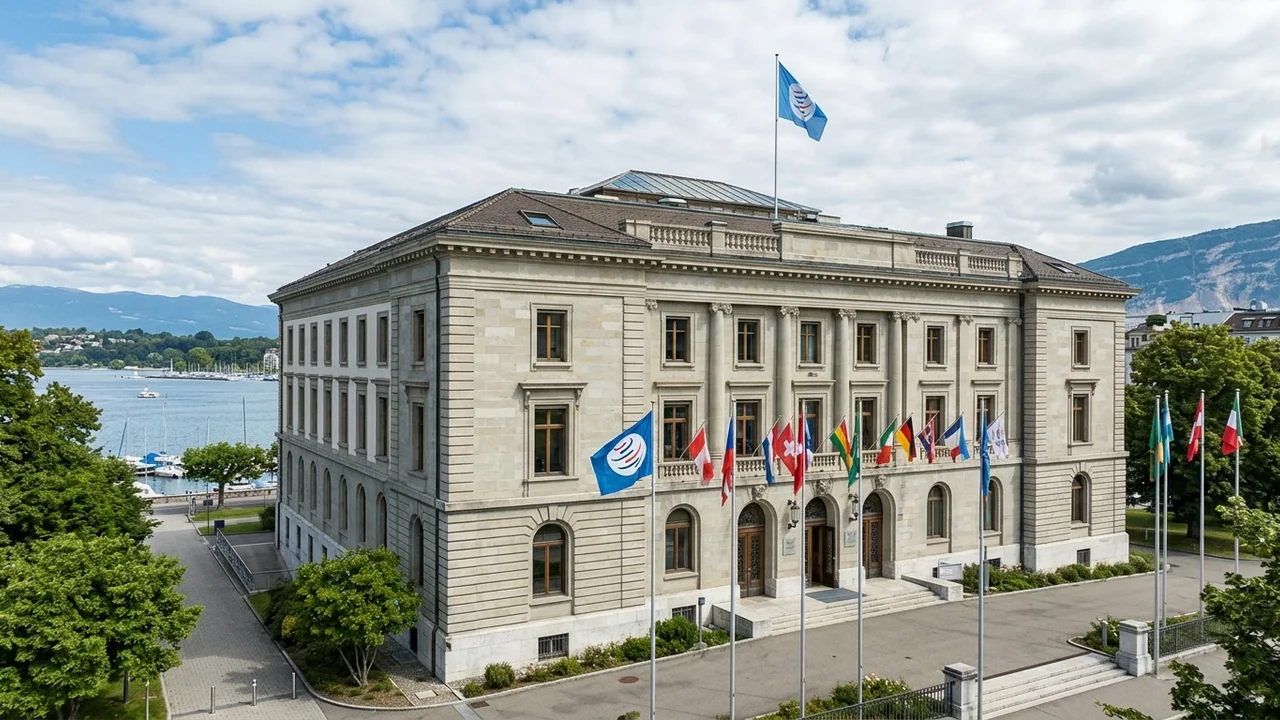
CBAM's WTO compatibility is contested across at least 3 active or anticipated dispute tracks, with Russia's formal WTO complaint (DS639) filed on May 12, 2025, making the EU carbon border adjustment mechanism the first CBAM-type measure to face a formal multilateral trade challenge. The core legal question is whether a certificate obligation linked to embedded carbon emissions constitutes a discriminatory trade barrier under GATT, or a legitimate environmental measure shielded by Article XX exceptions. The EU's answer depends on a legal architecture built on Article 192(1) TFEU and two GATT carve-outs. Challengers from Russia, India, and China argue those exceptions do not hold.
This article examines the EU's legal defense, the specific GATT provisions challengers invoke, the mechanics of DS639, and the structural limits of WTO enforcement that make this dispute as much about diplomatic leverage as binding law.
Caption: The CBAM WTO legal challenge involves four GATT articles, two EU treaty provisions, and one active formal dispute as of April 2026.
Is CBAM WTO-Compatible? The Short Answer
CBAM's WTO compatibility is contested and unresolved. The EU has structured the mechanism to rely on GATT Article XX(b) and XX(g) environmental exceptions. No WTO panel has ruled on CBAM's compatibility, and the non-functional Appellate Body means any future panel ruling faces no binding appeal mechanism. The answer depends on whether WTO adjudicators accept the EU's argument that CBAM is an environmental measure, not a discriminatory trade restriction.
The featured answer for search: CBAM's WTO compatibility is contested. The EU argues it is shielded by GATT Article XX environmental exceptions. Russia filed formal dispute DS639 in May 2025. No panel ruling has been issued. Enforcement is structurally limited by the non-functional WTO Appellate Body.
The EU's Legal Basis: Why Article 192(1) TFEU Matters for WTO
The EU's primary legal basis for the EU carbon border adjustment mechanism is Article 192(1) of the Treaty on the Functioning of the European Union, the EU's environmental policy provision. This choice is deliberate and strategically significant for WTO purposes.
Article 192(1) TFEU authorizes EU action to preserve, protect, and improve the quality of the environment. It is distinct from Article 114 TFEU, which covers internal market harmonization. The EU Commission explicitly chose the environmental legal basis when drafting Regulation (EU) 2023/956, and this choice feeds directly into the GATT Article XX defense.
The legal logic operates in two steps. First, CBAM is characterized as an environmental measure under EU law, not a trade measure. Second, because it is an environmental measure, it qualifies for the GATT Article XX exceptions that protect genuine environmental policies from WTO challenge. If the legal basis had been Article 114 TFEU (internal market), the environmental characterization would be harder to sustain at the WTO level.
The WTO-relevant consequences of this design choice are three. CBAM is positioned as necessary to protect climate policy integrity. CBAM addresses carbon leakage, a genuine policy failure that GATT Article XX(b) and XX(g) are designed to accommodate. And the measure applies equally to all third-country imports based on emissions content, not country of origin as a classification criterion.
Critics counter that the practical effect of CBAM is trade-restrictive regardless of its stated legal basis, and that WTO adjudicators look at substance over form when applying Article XX.
The GATT Articles in Play: Challenge vs. EU Defense
The WTO CBAM dispute involves four GATT articles. Three are invoked by challengers as violations; two are invoked by the EU as defenses. The table below maps the legal conflict.
| GATT Article | Content | Who Invokes It | Argument |
|---|---|---|---|
| Article I (MFN) | Most-Favored-Nation treatment | Challengers | CBAM treats third countries differently based on domestic carbon pricing, violating the requirement that all WTO members receive equal treatment |
| Article II | Tariff bindings | Russia (DS639) | CBAM constitutes a charge on imports beyond bound tariff rates, exceeding commitments in EU goods schedules |
| Article III | National treatment | Challengers | CBAM-covered imports face a charge that equivalent domestic goods (already covered by the EU ETS) do not bear in the same form, creating less favorable treatment |
| Article XX(b) | Environmental exception | EU defense | CBAM is necessary to protect human, animal, or plant life or health — covering climate policy through the health nexus |
| Article XX(g) | Natural resources exception | EU defense | CBAM relates to conservation of exhaustible natural resources, specifically the atmosphere as a climate-regulating system |
The EU's defense rests on satisfying both the specific conditions within Article XX(b) or XX(g), and the Article XX chapeau, which requires that the measure not be applied as arbitrary or unjustifiable discrimination or a disguised restriction on trade.
The chapeau is where most Article XX defenses succeed or fail. The EU needs to demonstrate that CBAM does not function as arbitrary discrimination against developing-country exporters. Critics argue the lack of adjustment for countries without carbon pricing creates exactly this discrimination, because the CBAM burden is systematically higher for nations that have prioritized different development pathways.
The SCM Agreement: Russia's Free Allocation Argument
Russia's DS639 complaint includes an argument under the WTO Agreement on Subsidies and Countervailing Measures (SCM Agreement) that targets EU ETS free allocation as a prohibited or actionable subsidy to domestic EU producers.
The argument runs as follows. EU steel, cement, and aluminium producers receive EU ETS allowances at no charge during the phase-out period from 2026 to 2034. In 2026, 97.5% of free allocation remains. These free allowances reduce the carbon cost borne by EU domestic producers relative to what they would pay at market prices. Russian exporters, who receive no such cost offset, argue this constitutes a subsidy that distorts competition in favor of EU domestic production, in violation of SCM Agreement obligations.
The EU's response focuses on the CBAM-ETS interaction design. The CBAM regulation explicitly links CBAM certificate obligations to the remaining free allocation percentage through the SEFA (Specific Embedded Free Allocation) methodology. As free allocation phases out between 2026 and 2034, the effective CBAM certificate obligation on imports increases proportionally. The system is designed to achieve carbon cost equivalence, not to subsidize domestic production.
Whether the SCM panel would accept this characterization depends on whether the free allocation during the transition period constitutes a "benefit" within the meaning of the SCM Agreement. This is an unresolved question with no direct WTO precedent.
WTO DS639: Russia's Formal Complaint in Detail
Russia filed WTO dispute DS639 on May 12, 2025, requesting consultations with the EU regarding Regulation (EU) 2023/956. The filing makes DS639 the first formal WTO dispute challenging a carbon border adjustment mechanism anywhere in the world.
The specific allegations in DS639 cover four legal instruments and four WTO agreements, as follows.
The 4 allegations filed by Russia in DS639 are listed below:
- GATT Article I violation — CBAM differentiates between third countries based on the existence and level of domestic carbon pricing, violating the MFN obligation that requires all WTO members to receive equally favorable treatment.
- GATT Article II violation — CBAM constitutes a charge on imports exceeding the tariff bindings the EU has committed to in its goods schedule, effectively increasing the cost of market access beyond agreed levels.
- GATT Article III violation — Imported goods face a CBAM certificate obligation that domestic EU goods do not bear in equivalent form, creating less favorable conditions for imported products.
- SCM Agreement violation — EU ETS free allocation to domestic producers constitutes a prohibited or actionable subsidy that disadvantages competing Russian exporters.
The EU's response on May 22, 2025, was notable: the EU declined to enter consultations, stating they "could not be fruitful." This refusal is procedurally unusual. Under WTO dispute settlement rules, consultation requests are typically accepted as a matter of course, even when the responding party is confident of its legal position. The EU's refusal signals a deliberate strategy to avoid engaging with DS639 as a legitimate WTO matter, while Russia retains the right to request panel establishment directly.
The Appellate Body Problem: Why DS639 Has No Binding Endpoint
The structural reality of WTO dispute settlement fundamentally shapes the practical significance of DS639. The WTO Appellate Body has been non-functional since December 2019, when the US blocked the appointment of new judges, reducing membership below the quorum required to hear appeals. As of April 2026, the Appellate Body remains unable to operate.
The consequence for DS639 is direct. Even if Russia successfully establishes a panel and the panel rules in Russia's favor, the EU can file an appeal into the permanent void. An appeal to a non-functional body suspends implementation of the panel ruling indefinitely. The ruling never achieves binding legal force.
A parallel mechanism exists: the Multi-Party Interim Appeal Arbitration Arrangement (MPIA), established by the EU and 50 other WTO members as a temporary substitute for the Appellate Body. The EU is a party to the MPIA. Russia is not. This means DS639 cannot proceed through the MPIA mechanism even if both parties wanted it.
The practical result is that DS639 functions primarily as a political and diplomatic tool rather than a binding legal challenge. Russia signals its opposition to CBAM, creates a public record of its legal arguments, and generates international pressure. The EU faces reputational and political costs but no enforceable legal obligation to modify CBAM regardless of any panel outcome.
How the CBAM WTO Defense Functions Under Article XX
The EU's Article XX defense involves satisfying a two-stage legal test. First, the measure must fall within the scope of at least one of the enumerated exceptions in Article XX. Second, the measure must satisfy the chapeau conditions: it must not be applied as arbitrary or unjustifiable discrimination, and it must not constitute a disguised restriction on international trade.
For Article XX(b), the EU argues that climate change causes direct harm to human health through heat stress, vector-borne disease expansion, food system disruption, and extreme weather events. Carbon leakage, which CBAM is designed to prevent, undermines EU climate policy and therefore undermines these health protections. The "necessary" standard in Article XX(b) requires the EU to demonstrate that no alternative measure consistent with WTO obligations could achieve the same policy objective with less trade impact.
For Article XX(g), the EU argues that the atmosphere, as a carbon-absorbing system with finite capacity, constitutes an exhaustible natural resource within the meaning of the provision. WTO jurisprudence since the Shrimp-Turtle case (DS58, 1998) has accepted that living and non-living natural resources can qualify, including air quality and climate-related resources.
The chapeau test is the EU's more vulnerable position. The Article XX chapeau requires that the measure not discriminate arbitrarily between countries where the same conditions prevail. Countries with comparable carbon pricing systems may argue they are treated arbitrarily compared to countries with different systems, particularly when the Article 9 deduction mechanism creates differential treatment based on domestic policy choices. India, which has argued at the WTO that CBAM violates the UNFCCC principle of Common But Differentiated Responsibilities (CBDR), frames this precisely as arbitrary discrimination against developing nations that did not historically cause atmospheric carbon accumulation.
What Countries Are Challenging CBAM at the WTO
Three countries have taken formal or informal positions against CBAM's WTO compatibility. Their concerns differ in legal basis and procedural intensity.
Caption: Russia leads the formal WTO challenge through DS639; India and China pursue bilateral and multilateral pressure tracks.
Russia filed the only formal dispute, DS639, on May 12, 2025. Russia's position combines GATT Articles I, II, and III with an SCM Agreement subsidy argument targeting EU ETS free allocation. Russia's steel and fertilizer exports face direct CBAM exposure; steel production in Russia uses blast furnace technology with embedded emissions approximately 2.0 tCO₂ per tonne, generating significant CBAM costs at current ETS prices near €70/tCO₂.
India has not filed a formal WTO complaint as of April 2026, but has communicated objections through the WTO Committee on Trade and Environment and bilateral diplomatic channels. India's position relies heavily on the CBDR principle under the UNFCCC. Indian trade officials argue that CBAM places a climate compliance burden on developing nations that bear less historical responsibility for atmospheric CO₂ accumulation. India's steel and aluminium sectors represent the primary CBAM exposure sectors.
China has challenged CBAM through bilateral negotiations and statements at WTO councils, but has not filed a formal dispute. China's primary concerns involve its developing-nation status under WTO rules, the Article 9 deduction for China's domestic ETS (which operates on an intensity basis that is methodologically incompatible with CBAM's absolute emissions framework), and the scale of Chinese steel and aluminium exports into the EU market.
The Contextual Border: How WTO Compatibility Affects CBAM Compliance Obligations
The WTO dispute status of CBAM does not suspend or modify the compliance obligations under Regulation (EU) 2023/956 as amended by Regulation (EU) 2025/2083. EU importers must proceed with compliance regardless of the DS639 outcome.
WTO disputes operate on timelines measured in years. A panel ruling, if requested and constituted, takes 18 to 36 months from panel establishment to report circulation. Even a ruling entirely in Russia's favor would not automatically require CBAM modification. WTO remedies are prospective and compliance-based: the losing party receives a reasonable period to bring its measure into conformity. Given the Appellate Body dysfunction, the realistic timeline for any binding legal outcome is indeterminate.
The compliance calendar is fixed. Certificate sales begin February 1, 2027. The first CBAM declaration covering calendar year 2026 is due September 30, 2027. These deadlines are not contingent on WTO dispute outcomes.
Could a WTO Panel Ruling Force CBAM to Change?
A WTO panel ruling against CBAM would create political pressure on the EU but would not automatically force legislative change. The EU would need to either modify CBAM to bring it into conformity or offer trade compensation to affected parties. Given the EU's political commitment to the Green Deal and CBAM as a carbon leakage prevention tool, legislative modification in response to a WTO ruling is unlikely in the near term.
The more probable outcome of a successful WTO challenge is targeted design adjustments rather than structural elimination. These adjustments could include differentiated treatment for countries with recognized carbon pricing systems (already partially addressed by Article 9), strengthened procedural safeguards to satisfy the Article XX chapeau, or bilateral climate cooperation agreements that effectively neutralize the WTO challenge.
Is CBAM a Tariff or a Carbon Price Mechanism?
CBAM is not a tariff. CBAM is a certificate obligation linked to the EU ETS carbon price. The distinction matters for WTO analysis because tariffs are subject to binding commitments in goods schedules, while internal charges affecting products in a non-discriminatory way are governed by GATT Article III (national treatment) rather than Article II. The EU structures CBAM as an Article III-type charge, arguing it replicates domestically what EU producers already pay under the ETS.
How Does CBAM's WTO Exposure Compare to Similar Measures?
No prior carbon border adjustment mechanism has been adjudicated at the WTO. The closest precedent is the WTO Appellate Body ruling in the Brazil-Retreaded Tyres case (DS332, 2007), which upheld a Brazilian import restriction as justified under Article XX(b) for health reasons, but only after finding the restriction not applied arbitrarily. The EU relies heavily on this precedent and the Shrimp-Turtle ruling in structuring its Article XX defense.
The EU has also studied the 2012 EU aviation ETS case (which involved third-country airline challenges) as a reference point for defending environmental measures with trade effects. That case was resolved through bilateral negotiation rather than WTO adjudication, a pattern the EU may seek to replicate with CBAM challengers.
What Is the CBDR Principle and Why Do India and Developing Countries Invoke It?
The Common But Differentiated Responsibilities principle, embedded in the UNFCCC and the Paris Agreement, holds that developed countries bear greater historical responsibility for climate change and must take stronger mitigation action. India and other developing-country challengers argue that CBAM imposes a climate compliance burden on exporters from nations that did not drive the historical atmospheric CO₂ accumulation that now requires decarbonization.
The EU's response is that CBAM does not discriminate by country development status; it applies uniformly based on embedded emissions, with an Article 9 deduction for any carbon price paid in the country of origin. Countries that implement domestic carbon pricing reduce their CBAM exposure. The EU frames this as an incentive for climate policy adoption, not discrimination against the developing world.
Whether the CBDR principle constitutes a binding WTO obligation rather than a general international law aspiration is itself unresolved. WTO adjudicators have generally been reluctant to incorporate UNFCCC principles directly into GATT analysis.
Does DS639 Affect CBAM Russia Compliance?
Russian exporters remain subject to full CBAM obligations under Regulation (EU) 2023/956 regardless of DS639 proceedings. For details on how Russia-origin goods are categorized under CBAM, the specific default values that apply, and the interaction between Russia's WTO challenge and export strategy, see WTO DS639 and CBAM Russia.
Exporters from India seeking to understand whether India's WTO objections affect their compliance obligations will find sector-specific analysis at CBAM India. For Chinese exporters dealing with the Article 9 deduction complexity created by China's intensity-based ETS, CBAM China covers the full calculation challenge.
Frequently Asked Questions
Is CBAM legal under WTO rules?
CBAM's WTO legality remains unresolved. No WTO panel has ruled on CBAM. The EU argues it is legal under GATT Article XX environmental exceptions. Russia's DS639 challenge alleges GATT Article I, II, and III violations. A definitive ruling is unlikely for years, and even then faces enforcement limits from the non-functional WTO Appellate Body.
What is GATT Article XX and how does it protect CBAM?
GATT Article XX provides exceptions that allow WTO members to maintain trade-restrictive measures when they are necessary to protect human, animal, or plant life or health (Article XX(b)) or relate to conservation of exhaustible natural resources (Article XX(g)). The EU argues CBAM qualifies under both exceptions as a climate protection measure. The measure must also pass the Article XX chapeau test, which prohibits arbitrary or unjustifiable discrimination.
What is WTO DS639?
WTO DS639 is a formal dispute filed by Russia on May 12, 2025, requesting consultations with the EU over CBAM. Russia alleges CBAM violates GATT Articles I, II, and III, and that EU ETS free allocation violates the SCM Agreement. The EU declined consultations on May 22, 2025. Russia may request panel establishment. DS639 is the first formal WTO challenge to any carbon border adjustment mechanism.
Does the WTO dispute affect my CBAM compliance obligations?
No. WTO disputes operate on multi-year timelines and produce no immediate legal effect on Regulation (EU) 2023/956. EU importers must comply with all CBAM obligations regardless of DS639 status. Certificate sales begin February 1, 2027, and the first declaration is due September 30, 2027.
Why can't the WTO Appellate Body hear the DS639 case?
The WTO Appellate Body has been non-functional since December 2019 because the United States blocked new judge appointments, reducing membership below the minimum quorum of three judges needed to hear appeals. Any panel ruling can be appealed into this void, suspending implementation indefinitely. Russia and the EU are not both parties to the MPIA alternative mechanism.
What is the CBAM legal basis under EU law?
CBAM's legal basis under EU law is Article 192(1) TFEU, the EU's environmental policy provision. The EU Commission chose this basis deliberately over Article 114 TFEU (internal market) to characterize CBAM as an environmental measure. This characterization supports the GATT Article XX defense at the WTO level.