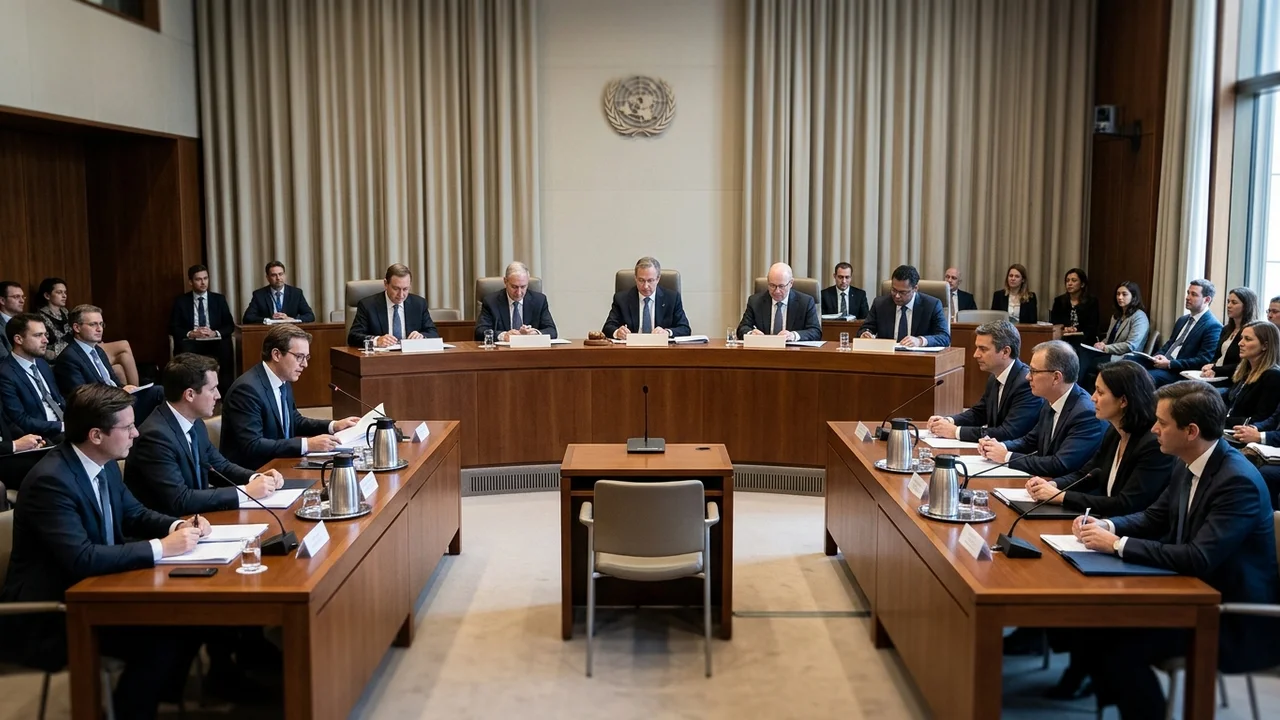
WTO DS639 stands as the only formal WTO challenge to EU CBAM filed by any country globally, with Russia submitting its request for consultations on May 12, 2025, targeting the EU carbon border adjustment mechanism as a violation of core GATT disciplines. On July 10, 2026, Russia escalated the dispute by requesting establishment of a panel, making DS639 the first border carbon adjustment dispute to reach the panel-request stage anywhere. The EU blocked that first request at the DSB meeting of July 24, 2026, so no panel has been established yet; Russia can resubmit at the next regular DSB meeting, scheduled for September 25, 2026, where establishment would be quasi-automatic under DSU Article 6.1. As of September 4, 2026, Russia has not yet formally filed a second panel request. Russia's claims span GATT Articles I, II, III, X and XI, the Import Licensing Agreement, and the SCM Agreement. Understanding DS639 requires mapping the legal arguments on both sides, the procedural history, and why the absence of a functioning WTO Appellate Body fundamentally limits what this dispute can achieve.
What Is WTO DS639?
WTO DS639 is Russia's formal complaint against EU CBAM filed under the WTO Dispute Settlement Understanding (DSU), requesting consultations on May 12, 2025, making it the first and currently only formal CBAM WTO challenge anywhere in the world. Russia's Ministry of Economic Development submitted the request to the WTO Dispute Settlement Body (DSB), identifying Regulation (EU) 2023/956 as the measure at issue, along with the EU ETS free allocation framework under Directive 2003/87/EC.
The dispute arose directly from Russia's structural position as an exporter of carbon-intensive goods (principally steel from producers including Severstal and NLMK, aluminium from RUSAL, and fertilizers from EuroChem and PhosAgro) to EU markets. Russia has no domestic carbon pricing mechanism that qualifies for the Article 9 deduction under CBAM, meaning Russian exporters face the full CBAM certificate obligation with no offset. At an EU ETS price of approximately €75 per tonne CO₂e as of early April 2026, this creates substantial cost exposure across the 3 main export sectors.
The EU declined Russia's consultation request on May 22, 2025, stating that consultations "could not be fruitful." This refusal is procedurally unusual. Under the WTO DSU, consultation requests are almost always accepted as a diplomatic first step. The EU's refusal effectively accelerated the dispute toward a formal panel request, which Russia filed on July 10, 2026, more than a year later.
Certificate price alerts and the regulatory changes that matter. Get weekly updates on what happens regarding anything CBAM-related. No spam, unsubscribe anytime.
We store only your email address for these alerts. Privacy policy
Russia's Legal Arguments in WTO DS639
Russia's case in WTO DS639 rests on 4 distinct legal claims first set out in the May 2025 consultation request. The first 3 target GATT 1994; the fourth invokes the Agreement on Subsidies and Countervailing Measures (SCM Agreement). The panel request of July 10, 2026 carries the full set of cited provisions forward into litigation: GATT Articles I, II, III, X and XI, the Import Licensing Agreement, and the SCM Agreement, all of which were already named in the May 2025 consultation request.
The 4 core legal claims Russia advances in DS639 are listed below.
-
GATT Article I (Most-Favored-Nation) violation: Russia argues that EU CBAM treats third-country exporters differently based on whether their home country has a carbon pricing scheme. Countries with carbon pricing receive a cost deduction under Article 9 of CBAM; Russia, without qualifying carbon pricing, receives no deduction. Russia contends this creates an MFN violation because the trade advantage (cost deduction) is not extended equally to all WTO members.
-
GATT Article III (National Treatment) violation: Russia argues that CBAM imposes a burden on imported goods that has no precise parallel in the burden placed on equivalent domestically produced EU goods. EU steel and cement producers pay into the EU ETS but receive substantial free allocation. Russian imports receive no equivalent relief. The argument is that CBAM does not neutrally equalize carbon costs but instead creates a net competitive disadvantage for imports over domestic production.
-
GATT Article X (Transparency and Publication) violation: Russia argues that the rules for determining CBAM certificate obligations (particularly the calculation of embedded emissions, the methodology for applying default values, and the criteria for Article 9 deduction eligibility) lack the clarity required under Article X, which mandates that trade-affecting measures be published promptly and administered uniformly.
-
SCM Agreement violation: Russia argues that EU ETS free allocation to domestic steel, cement, and aluminium producers constitutes a prohibited export subsidy or an actionable subsidy that causes serious prejudice to Russian producers' competitive position. This is Russia's most ambitious legal claim, because if successful it would target not just CBAM itself but the broader EU ETS free allocation framework.
The EU's Legal Defense of CBAM Under GATT Article XX
The EU defends EU CBAM primarily through the GATT Article XX general exceptions, specifically invoking 2 sub-paragraphs.
The EU's defensive arguments in WTO DS639 are structured as follows.
-
GATT Article XX(b): The EU argues CBAM is "necessary to protect human, animal, or plant life or health" by reducing global greenhouse gas emissions that drive climate change. The necessity standard under Article XX(b) requires the measure to be the least trade-restrictive option reasonably available. The EU's position is that a certificate-based mechanism linked to domestic carbon prices is precisely calibrated to equalize costs without going beyond what is necessary.
-
GATT Article XX(g): The EU argues CBAM "relates to the conservation of exhaustible natural resources" (specifically the atmospheric capacity to absorb greenhouse gases without dangerous warming) and is made effective in conjunction with domestic ETS restrictions on EU producers. The "made effective in conjunction with" requirement means the EU must show that CBAM and the EU ETS operate as a unified domestic-plus-border policy package, not a standalone trade restriction.
-
Non-discrimination argument (Article XX chapeau): Even if CBAM violates GATT obligations in some respect, the Article XX chapeau requires that the measure not constitute "arbitrary or unjustifiable discrimination" between countries where the same conditions prevail. The EU argues that countries with carbon pricing and countries without are objectively in different conditions, making differentiated treatment under Article 9 factually justified rather than arbitrary.
The EU also contests Russia's Article III claim by arguing that CBAM's legal basis is Article 192(1) TFEU (environmental policy), not trade policy, and that CBAM replicates rather than exceeds the carbon cost faced by domestic EU producers once free allocation is accounted for across the full 2026-to-2034 phase-out schedule.
WTO DS639 Proceedings Timeline
The proceedings table below captures the key events in WTO DS639 from filing through the status as of September 4, 2026.
| Date | Event | Significance |
|---|---|---|
| May 12, 2025 | Russia files DS639 consultation request with WTO DSB | First formal CBAM WTO challenge globally |
| May 22, 2025 | EU declines consultations, states they "could not be fruitful" | Unusual procedural refusal; accelerates toward panel |
| June–July 2025 | Russia becomes entitled to request panel establishment after 60 days | DSU Article 4.7 triggers after consultation failure |
| July 2025–June 2026 | Russia holds but does not exercise its right to request panel establishment | Dispute remains at the post-consultations stage for over a year |
| July 10, 2026 | Russia requests establishment of a panel | Recorded on the WTO's official DS639 case page; first panel request against a border carbon adjustment anywhere |
| July 24, 2026 | EU objects to Russia's first panel request at the DSB meeting; no panel established | A respondent can block only the first panel request; the EU also reconfirmed its refusal of consultations, citing Russia's invasion of Ukraine |
| September 25, 2026 (scheduled) | Next regular DSB meeting, at which Russia's second panel request is expected | A respondent cannot block a second request: under DSU Article 6.1 the DSB establishes the panel quasi-automatically unless it decides by consensus not to |
| As of September 4, 2026 | No panel established; Russia has not yet formally filed a second panel request | No panel composition, hearings, or reports; establishment expected at the September 25, 2026 DSB meeting if Russia resubmits |
| Post-panel (not yet reached) | Either party may appeal to Appellate Body once a panel eventually rules | Appellate Body non-functional since December 2019; no binding appeal mechanism exists |
What the July 2026 Panel Request Changes Procedurally
Russia requested establishment of a WTO panel in DS639 on July 10, 2026, moving the dispute out of the post-consultations stage where it had sat since May 2025. A panel request is not the same as a panel. Establishment occurs at a meeting of the Dispute Settlement Body (DSB), and first panel requests are typically blocked by the responding party, so a subsequent DSB meeting is usually needed before a panel actually exists. That is precisely what happened in DS639: at the DSB meeting of July 24, 2026, the EU objected to Russia's first panel request, so no panel was established. The EU also used the meeting to reconfirm its refusal of consultations, citing Russia's invasion of Ukraine. Under WTO practice a respondent can block only the first panel request. Russia can resubmit at the next regular DSB meeting, scheduled for September 25, 2026, where establishment would be quasi-automatic: under DSU Article 6.1, a panel is established at the latest at the second DSB meeting at which the request appears as an agenda item, unless the DSB decides by consensus not to establish one. As of September 4, 2026, no panel has been established and Russia has not yet formally filed its second panel request. The July 24 blocking and its procedural implications are covered in EU blocks Russia's first WTO panel request in DS639.
The panel request also defines the scope of the case Russia intends to litigate. The claims span GATT Articles I, II, III, X and XI, the Import Licensing Agreement, and the SCM Agreement, with EU ETS free allocation alleged to be a prohibited subsidy. This makes DS639 the first border carbon adjustment dispute to reach the panel-request stage anywhere in the world. The filing and its immediate implications are covered in Russia requests WTO panel establishment in DS639.
Why the Appellate Body Crisis Matters for DS639
The enforceability gap in WTO DS639 is the dispute's central structural problem. The WTO Appellate Body has been non-functional since December 2019, when the United States blocked the reappointment of new members, leaving the body without a quorum. As of early September 2026, the Appellate Body remains paralyzed.
The consequence for DS639 is direct: if a panel rules against the EU, the EU can file an appeal "into the void," a procedurally valid appeal that cannot be heard because no functioning Appellate Body exists. The appealed ruling is suspended indefinitely, with no enforcement pathway. Similarly, if a panel rules in Russia's favor, Russia cannot force compliance through an appeal-and-retaliation sequence in the traditional sense.
Russia and the EU are not parties to the Multi-Party Interim Appeal Arbitration Arrangement (MPIA), the workaround mechanism established by 53 WTO members in 2020 to provide an alternative appellate process. MPIA requires both parties to have agreed to use it before the dispute arises. Neither Russia nor the EU joined this arrangement for bilateral disputes.
The practical result: WTO DS639 is unlikely to produce a binding outcome that requires the EU to modify EU CBAM. Legal analysts at the European University Institute's Global Governance Programme have characterized disputes involving non-MPIA parties as "essentially advisory proceedings" in the current WTO institutional environment.
Certificate price alerts and the regulatory changes that matter. Get weekly updates on what happens regarding anything CBAM-related. No spam, unsubscribe anytime.
We store only your email address for these alerts. Privacy policy
Russia's Actual CBAM Exposure and Why DS639 Was Filed
Russia's decision to file WTO DS639 reflects 3 intersecting pressures rather than a single compliance calculation.
First, Russia's trade exposure to EU CBAM is compressed but concentrated. Pre-2022 sanctions, Russia represented approximately 8.7% of total EU CBAM-covered imports. Post-sanctions, that trade flow contracted sharply, but steel exports from non-sanctioned entities, RUSAL aluminium under specific license arrangements, and fertilizer shipments before the July 2025 additional tariffs maintained residual CBAM exposure. By July 2025, EU additional tariffs on Russian and Belarusian fertilizers reached €40–45 per tonne, escalating to €315–430 per tonne by July 2028, stacked on top of the 6.5% ad valorem duty and full CBAM certificate costs. Russian urea imports to the EU dropped approximately two-thirds following the July 2025 tariff imposition.
Second, Russia lacks any qualifying domestic carbon price. With no ETS and no carbon tax accepted under CBAM's Article 9 framework, Russian exporters receive zero deduction from CBAM certificate obligations. At the current EU ETS reference price of approximately €75 per tonne CO₂e, Russian BF-BOF steel faces a gross CBAM cost of approximately €150 per tonne (at ~2.0 tCO₂/t emission factor), with no offset pathway.
Third, DS639 functions as a political instrument. Russia's legal challenge signals to other exporting nations (particularly India, Turkey, and the BASIC group: Brazil, South Africa, India, and China) that WTO legal avenues remain open and that the EU cannot treat CBAM as immune from challenge. Several WTO members have raised CBAM in the WTO Committee on Trade and Environment without filing formal disputes. Russia's willingness to formally file provides a legal record and factual framework that other countries can observe and potentially join or build upon.
What WTO DS639 Means for EU CBAM Regulation Compliance
WTO DS639 does not suspend, delay, or alter EU CBAM obligations as they stand in September 2026. The CBAM regulation guide covers the full legal text of Regulation (EU) 2023/956 and its Omnibus amendments. That regulation, as amended by Regulation (EU) 2025/2083, remains fully in force. The definitive phase started January 1, 2026. The first CBAM declaration covering calendar year 2026 is due September 30, 2027. No WTO panel ruling modifies EU law directly. Only EU legislative action or a CJEU ruling could do that.
The CBAM regulation's legal basis under Article 192(1) TFEU reinforces this insulation. Because CBAM is framed as environmental legislation rather than trade legislation, the EU maintains that primary jurisdiction rests with EU courts and the EU political process, not with WTO panels. This legal architecture was deliberately chosen. An Article 114 TFEU (internal market) basis would have made the measure more vulnerable to WTO Article III challenges, while Article 192(1) grounds the measure in EU environmental competence with a more direct route to the Article XX(b) and XX(g) defenses.
For EU importers navigating compliance, the practical relevance of DS639 is limited to 2 scenarios. First, if a WTO panel ultimately finds aspects of CBAM inconsistent with WTO rules and the EU responds by modifying specific elements (such as the Article 9 deduction methodology or default value application), importers could see compliance requirement changes. Second, if DS639 accelerates diplomatic pressure on the EU to negotiate bilateral carbon pricing recognition agreements (a political response rather than a legal one), new Article 9 deduction pathways could emerge for Russian or other third-country exporters. Neither scenario is imminent as of early September 2026.
How WTO DS639 Compares to Other CBAM Trade Challenges
WTO DS639 sits within a broader landscape of CBAM trade disputes and objections, though it remains the only formal WTO case filed as of early September 2026.
Other CBAM Objections Raised at the WTO
India has filed 29 formal objections to EU CBAM at the WTO Committee on Trade and Environment and used CBAM as a point of friction during EU-India Free Trade Agreement negotiations. The FTA was concluded on January 27, 2026, with the European Commission stating explicitly that it made no commitment to change CBAM obligations or grant India more favourable treatment; the provisional FTA text reportedly includes only a non-discrimination clause ensuring India is not treated worse than any other third country if the EU grants CBAM flexibilities elsewhere. India has still not filed a formal WTO DS request. India argues CBAM violates the UNFCCC principle of Common But Differentiated Responsibilities (CBDR), which holds that developed countries bear greater decarbonization obligations than developing countries. The CBDR argument has no direct standing under GATT but could inform an Article XX proportionality analysis.
Turkey faces the highest relative CBAM exposure of any non-EU country, with approximately €19 billion in annual CBAM-affected exports representing nearly 8% of Turkey's total export value. Turkey's challenge, however, proceeds through bilateral channels rather than the WTO: Turkey argues the 1995 EU-Turkey Customs Union Agreement entitles Turkish exporters to treatment equivalent to domestic EU producers. This argument would be adjudicated through bilateral dispute mechanisms or the Court of Justice of the EU, not through WTO DS proceedings.
The United States has joined the attack on CBAM rhetorically while filing nothing at the WTO: US ambassador to the EU Andrew Puzder called CBAM a tariff "by a different name" in a Financial Times op-ed on August 12, 2026, drawing a Commission rebuttal the next day that called the mechanism non-discriminatory and WTO-compatible, an exchange covered in US ambassador calls CBAM a tariff, EU rebuts; DS639 remains the only formal WTO dispute against CBAM.
How DS639 Differs from Other Trade Disputes
WTO DS639 is notable for 3 distinguishing characteristics compared to typical WTO environmental disputes. The Appellate Body dysfunction makes it the first major CBAM challenge in a WTO environment without a functioning second-tier review. Russia's parallel SCM Agreement claim targeting EU ETS free allocation represents a broader attack on EU climate policy architecture than previous environment-trade disputes. The EU's refusal to engage in consultations from the outset signals a political judgment that engaging Russia in WTO proceedings provides legitimacy the EU is not willing to extend given the geopolitical context following the 2022 Ukraine invasion.
Contextual Border: Will WTO DS639 Lead to CBAM Modification?
WTO DS639 is unlikely to produce direct modification of EU CBAM before 2030 at the earliest, given the timeline for panel proceedings, the Appellate Body paralysis, and the EU's stated legal position. The more consequential reform pathway runs through the EU legislative process rather than WTO adjudication.
The EU Commission's own Article 30 review obligation under Regulation (EU) 2023/956 requires periodic evaluation of CBAM's WTO compatibility as part of each formal review. The COM(2025)989 proposal and subsequent downstream expansion discussions indicate that CBAM is already in active legislative evolution through EU internal processes. Any modifications arising from WTO pressure are more likely to emerge as voluntary EU adjustments framed as simplification or fairness improvements than as direct compliance with a WTO ruling.
CBAM WTO compatibility questions extend well beyond DS639. The broader question of whether CBAM can survive WTO scrutiny turns on how a panel interprets the Article XX necessity test for climate measures, an issue that has no precise WTO jurisprudential precedent. For importers and exporters assessing long-term compliance strategy, the full landscape of CBAM WTO compatibility analysis provides a more complete picture than DS639 alone.
How Does CBAM Affect Russian Exports to the EU?
CBAM affects Russian exports across 3 main sectors: steel, aluminium, and fertilizers. Russian producers receive no Article 9 deduction because Russia has no qualifying domestic carbon price. At an EU ETS price of approximately €75 per tonne CO₂e, Russian BF-BOF steel faces gross CBAM costs of approximately €150 per tonne. Combined with EU additional tariffs on Russian fertilizers (escalating to €315–430 per tonne by July 2028), CBAM significantly compresses Russian export competitiveness in EU markets. For more detail on Russia's specific CBAM exposure, see CBAM Russia.
What Are the Key Dates in WTO DS639?
Russia filed the DS639 consultation request on May 12, 2025. The EU declined consultations on May 22, 2025. Russia requested establishment of a panel on July 10, 2026. At the DSB meeting of July 24, 2026, the EU objected to this first panel request, so no panel was established; a respondent can block only the first request. Russia can resubmit at the next regular DSB meeting, scheduled for September 25, 2026, where establishment would be quasi-automatic under DSU Article 6.1; as of September 4, 2026, no second panel request has been formally filed. No panel report exists. Once a panel is established and composed, standard WTO timelines typically require 12–18 months to an interim report, meaning any ruling remains unlikely before late 2027 at the earliest.
Can WTO DS639 Result in Financial Penalties Against the EU?
WTO DS639 cannot directly result in financial penalties against the EU. WTO dispute settlement produces rulings requiring the losing party to bring measures into conformity with WTO obligations, not cash payments. Retaliation by Russia in the form of trade countermeasures is the enforcement mechanism, but this requires a final panel ruling, successful notification to the DSB, and authorization of retaliation at a proportionate level. The Appellate Body paralysis further extends this timeline. Penalties for non-compliance with CBAM by EU importers, which are entirely separate from the WTO dispute, remain €100 per tonne CO₂e for authorized declarants who fail to surrender sufficient certificates. For a complete breakdown, see CBAM penalties.
Does Russia Have a Carbon Price That Qualifies Under CBAM Article 9?
Russia does not have a domestic carbon price that qualifies under CBAM Article 9 as of early September 2026. Article 9 deductions require a legally binding carbon price effectively paid in the country of origin. Russia has no national ETS and no carbon tax mechanism meeting this threshold. This means all Russian CBAM-covered imports bear the full certificate obligation with no offset. Understanding how embedded emissions are calculated clarifies the total cost basis to which this certificate obligation applies.
Is WTO DS639 the First WTO Challenge to Any Carbon Border Measure?
WTO DS639 is the first formal WTO dispute filed against the EU CBAM specifically, and among the earliest formal WTO challenges to any systematic carbon border adjustment measure globally. Earlier WTO disputes involving domestic carbon policies (such as the EU's aviation ETS cases in 2011–2012) addressed carbon pricing applied to foreign carriers rather than a standalone border adjustment. DS639 is the first case to test a carbon border adjustment mechanism of CBAM's scope and design under GATT disciplines. With Russia's panel request of July 10, 2026, it is also the first border carbon adjustment dispute to reach the panel-request stage anywhere; the EU blocked that first request at the July 24, 2026 DSB meeting, and Russia can resubmit at the next regular DSB meeting, scheduled for September 25, 2026.
Is EU CBAM a Tariff Under WTO Rules?
EU CBAM is not a tariff under WTO rules. CBAM is a certificate-based mechanism linked to the EU ETS carbon price under Regulation (EU) 2023/956. The EU designed CBAM under Article 192(1) TFEU as an environmental measure, not a trade measure. A tariff is a fixed duty applied to goods at the border; CBAM certificates fluctuate with EU ETS auction prices and apply only to the carbon content of embedded emissions, not to the commercial value of the goods. Russia's DS639 allegation that CBAM constitutes a charge beyond bound tariff rates under GATT Article II (tariff bindings) is one of the contested legal questions the panel will evaluate. The EU disputes this characterization. The CBAM regulation contains the full legal definition and mechanism design.
Certificate price alerts and the regulatory changes that matter. Get weekly updates on what happens regarding anything CBAM-related. No spam, unsubscribe anytime.
We store only your email address for these alerts. Privacy policy