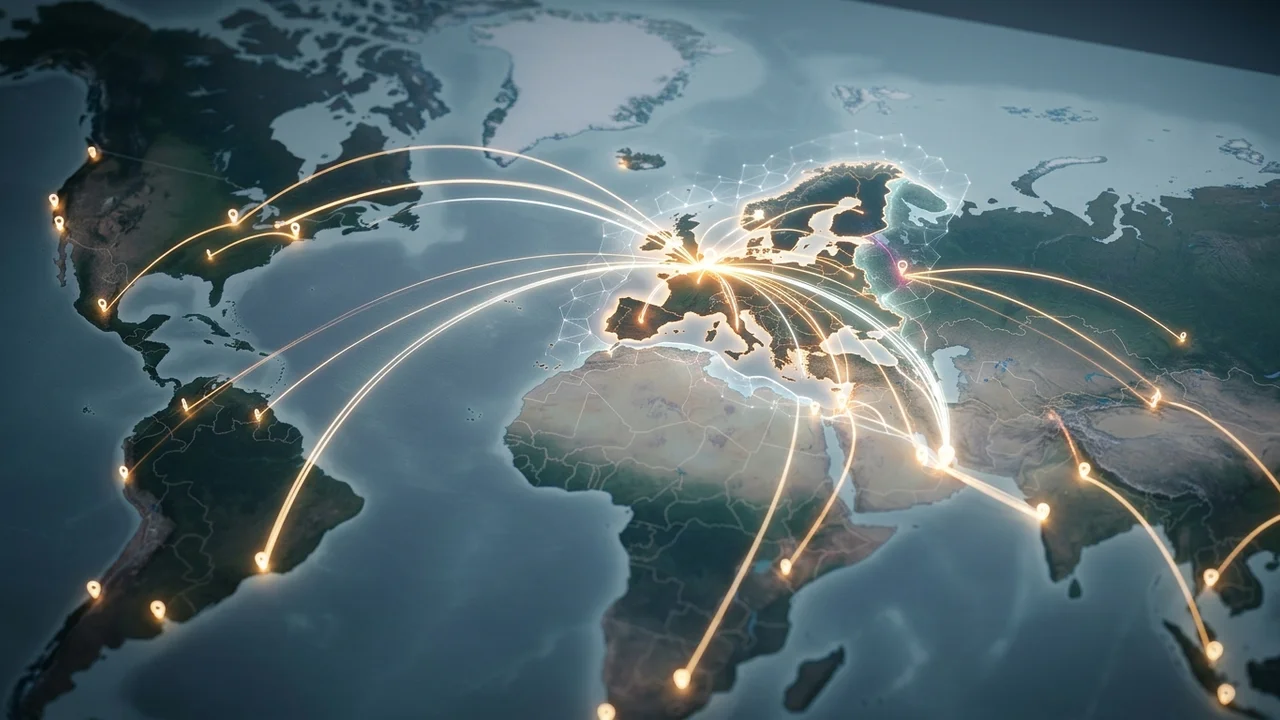
Global CBAM proliferation is accelerating: 4 jurisdictions have adopted or formally proposed carbon border adjustment mechanisms as of August 15, 2026, and at least 3 more are conducting active feasibility reviews. The EU's mechanism, now in its definitive phase, is no longer a singular experiment. It is becoming a template. Understanding which countries are following, how their designs differ, and what trade consequences follow is now essential for any business operating across carbon-regulated borders.
This article maps every confirmed and proposed carbon border mechanism worldwide, compares their structural differences, and addresses the practical question most exporters face: does paying a carbon price in one jurisdiction reduce obligations in another?
What Is a Global CBAM and Why Are Countries Adopting It?
A global CBAM refers to any national or supranational mechanism that places a carbon cost on imported goods proportional to their embedded greenhouse gas emissions, designed to prevent domestic carbon pricing from disadvantaging local producers against imports from less-regulated markets. The EU Carbon Border Adjustment Mechanism, established by Regulation (EU) 2023/956 and in force since January 1, 2026, is the first large-scale implementation of this concept. Other jurisdictions are following because the same policy logic applies wherever a domestic carbon price exists: without a border adjustment, importers undercut domestic producers on cost, and emissions migrate rather than decline.
Three economic pressures drive adoption. First, existing domestic carbon pricing systems, including emissions trading schemes and carbon taxes, create competitive imbalances. Second, trading partners with active CBAM systems create diplomatic incentives to develop equivalent mechanisms to protect export market access under bilateral deduction provisions. Third, WTO legal architecture favors environmental border measures under GATT Article XX, reducing the legal risk for governments considering adoption.
The EU Carbon Border Adjustment Mechanism covers 6 sectors, including iron and steel, cement, aluminium, fertilizers, electricity, and hydrogen. Countries designing their own mechanisms frequently reference the EU design while making deliberate modifications to suit their domestic carbon pricing architecture.
Certificate price alerts and the regulatory changes that matter. Get weekly updates on what happens regarding anything CBAM-related. No spam, unsubscribe anytime.
We store only your email address for these alerts. Privacy policy
The UK CBAM: January 2027 Launch and Key Design Differences
The UK CBAM launches January 1, 2027, making it the second major carbon border adjustment mechanism to enter operation globally. The UK mechanism applies to imports of aluminium, cement, ceramics, fertilizers, glass, hydrogen, and iron and steel products. The sector coverage is broader than the EU's initial scope, adding ceramics and glass to the list.
The UK CBAM uses a tax-based design rather than the EU's certificate-based mechanism. Importers pay a levy to HM Revenue and Customs (HMRC) based on the carbon content of their imported goods, priced against the UK Emissions Trading Scheme (UK ETS) carbon price. This structural difference has significant implications for bilateral trade flows and for the double-payment risk faced by producers exporting to both the UK and the EU.
The UK ETS operates independently from the EU ETS, with a separate cap, separate auction mechanism, and a separate price. The EU ETS has strengthened since Q1 2026, when the official CBAM quarterly reference price stood at €75.36/tCO₂e: the Q2 2026 reference price was €75.28, and the underlying futures market has rallied since, with the benchmark Dec-26 EUA contract touching a nine-month high of €88.53 intraday on 14 September 2026 and closing that day at €87.99, its highest level since January, per Emba Power daily review data. Q3 2026 auction settlements quarter to date point to a certificate price of roughly €82.50 to €83.50, about €7 to €8 above Q2 (a cbamguide.com estimate derived from published auction settlements as of September 24, 2026; the official Q3 figure is due for publication on 5 October 2026). The UK ETS has historically traded at a discount to the EU ETS, and that gap has been narrowing over the course of 2026 amid formal UK-EU talks, running since January 2026, on linking the two systems, though no linkage agreement had been concluded as of 11 July 2026. The price divergence means that UK CBAM obligations will differ from EU CBAM obligations even for identical goods from identical production installations.
For a detailed breakdown of the structural and compliance differences between the two mechanisms, the UK vs EU CBAM comparison covers each design parameter in full.
Does the UK CBAM Apply to EU-Origin Goods?
Goods originating in the EU are subject to the UK CBAM, because the UK and EU carbon markets are not linked. EU producers exporting to the UK already bear EU ETS costs on their production. Whether those EU ETS costs count as a qualifying carbon price deduction under the UK CBAM remains an open policy question as of July 2026. HMRC's second technical consultation, covering embedded-emissions calculation, verification, and per-sector system boundaries, closed on 21 May 2026, and the government has said the final secondary legislation will be laid in autumn 2026, with HMRC registration expected to open via the Government Gateway in the final quarter of 2026. The specific list of qualifying carbon-pricing schemes for a UK CBAM deduction mechanism has still not been published. Separately, formal UK-EU negotiations on linking the two emissions trading systems have been running since January 2026, and a linkage agreement would be a precondition for any mutual CBAM exemption, but as of 11 July 2026 no linkage agreement has been concluded.
The Double-Payment Problem for UK-EU Trade
Exporters operating across the UK-EU trade corridor face a potential double-payment scenario that has no current regulatory resolution. A UK manufacturer importing steel from Turkey pays UK ETS costs on production and UK CBAM obligations on the imported Turkish steel content. When that UK manufacturer then exports finished goods to the EU, EU CBAM applies to the steel content embedded in those goods. The EU's Article 9 deduction mechanism requires that the carbon price was "effectively paid" in the country of origin. The Commission published a draft implementing regulation on 13 May 2026 setting out how third-country carbon prices will be recognized under Article 9, covering four pathways (emissions trading systems, point-source carbon taxes, fuel-based carbon taxes, and mixed-compliance systems); the consultation on that draft closed 10 June 2026, but the regulation had not been adopted as of 11 July 2026 and does not yet specifically address UK CBAM charges. Whether UK CBAM charges paid on inputs qualify for EU Article 9 deduction therefore remains unresolved as of July 2026.
Exporters should note that this is not a theoretical edge case. The UK-EU trade corridor represents one of the highest-volume bilateral goods flows in the world, covering goods in all 7 UK CBAM sectors.
Canada's Carbon Border Mechanism: Design and Timeline
Canada's carbon border adjustment approach differs from both the EU and UK models because Canada already operates a domestic carbon pricing system that applies to industrial facilities through the Output-Based Pricing System (OBPS). The OBPS covers approximately 700 large industrial emitters and sets sector-specific output-based performance standards.
The Canadian government has studied carbon border adjustment mechanisms since 2021 and published formal consultations in 2022 and 2023. As of July 2026, Canada has not enacted a carbon border adjustment law; the live federal process is a 2026 review of the Output-Based Pricing System's industrial carbon-pricing benchmarks, which could lay groundwork for a future border measure, while the 2021 Finance Canada border-carbon-adjustment consultation remains without a successor instrument. The primary design challenge Canada faces is compatibility with the Canada-United States-Mexico Agreement (CUSMA/USMCA). The United States does not have a comparable federal carbon pricing system, and any Canadian carbon border measure affecting US imports would face significant political and legal friction under the trade agreement.
Canada's current approach focuses on 3 parallel tracks rather than immediate CBAM legislation. First, domestic OBPS stringency increases that raise the carbon cost on Canadian industrial production, reducing the competitive disparity without a border measure. Second, bilateral diplomatic engagement with the US on developing compatible climate trade policies. Third, formal study of a CBAM framework that could apply to non-CUSMA partners without triggering CUSMA dispute mechanisms.
The absence of a Canadian CBAM as of 2026 creates a practical issue for Canadian exporters to the EU. Canadian goods face full EU CBAM obligations under Regulation (EU) 2023/956. The OBPS carbon price paid by Canadian industrial producers can reduce EU CBAM obligations under Article 9, but the calculation methodology for converting the OBPS price to an EU-equivalent deduction requires verification and is subject to the same unresolved methodological questions affecting all Article 9 deductions.
Other Countries Reviewing Carbon Border Mechanisms
Four additional jurisdictions, namely Australia, New Zealand, Japan, and South Korea, are weighing carbon border adjustment mechanisms, each at a different stage of policy development.
Australia's Carbon Leakage Review, led by economist Frank Jotzo for the Department of Climate Change, Energy, the Environment and Water, released its final report on 13 February 2026 and recommends an Australian border carbon adjustment for high-leakage-risk commodities, with a staged rollout starting with cement and clinker, then extending to ammonia and derivatives, glass, lime, and steel. The Safeguard Mechanism, whose scope the recommended border adjustment would mirror, covers 215 large industrial facilities emitting above 100,000 tonnes CO₂e per year. The 2026-27 Safeguard Mechanism review formally opened on 7 August 2026, when the government released its discussion paper with written submissions invited until 18 September 2026; the consultation puts the Carbon Leakage Review's border carbon adjustment recommendation under consideration, with cement and clinker first in any staged rollout. The border measure is under consultation, not decided; as of August 15, 2026, no legislation has been introduced and no start date has been set. Our report on Australia's Safeguard Mechanism review opening covers the discussion paper and the submission window.
New Zealand has signalled for the first time that it would move in step with Australia rather than alone. Climate change minister Simon Watts said on 5 August 2026, speaking at the Carbon Forestry 2026 conference in Rotorua, as reported by Argus Media, that any New Zealand CBAM would be developed "in conjunction with Australia" and would likely come "later next year". No New Zealand mechanism has been proposed or legislated; the significance lies in the explicit trans-Tasman alignment, which would tie New Zealand's timeline to the outcome of Australia's Safeguard Mechanism review. Our report on the New Zealand-Australia aligned CBAM signal covers the statement in full.
Japan's GX-ETS (Green Transformation Emissions Trading Scheme) moved from its voluntary pilot to a mandatory phase on 1 April 2026 under the GX Promotion Act as amended in May 2025, covering roughly 300-400 companies with average annual direct CO₂ emissions of at least 100,000 tonnes, an estimated 60% of national GHG emissions; baseline allocations and the effective emissions cap are expected to be published in autumn 2026 or later. Separately, Japan plans a GX Carbon Levy on fossil fuel imports from fiscal year 2028 and is developing a broader border adjustment concept within its GX decarbonization framework. Japan's border-adjustment mechanism, if enacted, would differ fundamentally from the EU model because it applies upstream to fossil fuel imports rather than to goods by embedded emissions.
South Korea operates the Korea Emissions Trading Scheme (K-ETS), one of Asia's most developed carbon markets. South Korea has conducted formal studies of a CBAM equivalent since 2023. The primary driver is the EU's actual CBAM exposure for South Korean steel and aluminium exports, which creates both a financial burden and a policy precedent that the Korean Ministry of Trade, Industry and Energy takes seriously.
The following table compares the confirmed and proposed carbon border mechanisms across jurisdictions:
| Jurisdiction | Mechanism Type | Status (August 2026) | Launch Date | Sectors Covered | Price Basis |
|---|---|---|---|---|---|
| European Union | Certificate-based (linked to EU ETS) | In force | January 1, 2026 | Steel, cement, aluminium, fertilizers, electricity, hydrogen | EU ETS auction price (€75.28/tCO₂ official Q2 2026 rate; Dec-26 EUA futures nine-month intraday high €88.53 on 14 September 2026) |
| United Kingdom | Tax-based levy (linked to UK ETS) | Adopted | January 1, 2027 | Steel, aluminium, cement, ceramics, fertilizers, glass, hydrogen | UK ETS price (trades independently of EU ETS; historical discount narrowing amid UK-EU linkage talks) |
| Canada | OBPS (domestic); CBAM under study | Under review (2026 OBPS benchmark review underway) | Not yet enacted | N/A (domestic system only) | Output-Based Pricing System |
| Australia | Safeguard Mechanism; BCA recommended by Feb 2026 Carbon Leakage Review | Formal consultation open: 2026-27 Safeguard Mechanism review discussion paper released 7 August 2026, submissions to 18 September 2026; not yet legislated | Not yet enacted; staged rollout under consultation starting with cement/clinker | N/A (domestic system only) | Safeguard Mechanism baselines |
| New Zealand | None; ministerial signal of a CBAM aligned with Australia | Signalled 5 August 2026, not yet proposed | Not yet enacted; minister points to development "later next year" | N/A (no mechanism proposed) | NZ ETS (domestic system only) |
| Japan | GX-ETS (mandatory from April 2026) + GX Carbon Levy (upstream); CBAM in development | Partial adoption | 2028 (levy only) | Fossil fuel imports (levy); ~300-400 large emitters under GX-ETS; broader goods TBD | GX levy rate; GX-ETS allowance price (cap due autumn 2026) |
| South Korea | K-ETS (domestic); CBAM under formal study | Under review | Not yet enacted | N/A (domestic system only) | K-ETS price |
Certificate price alerts and the regulatory changes that matter. Get weekly updates on what happens regarding anything CBAM-related. No spam, unsubscribe anytime.
We store only your email address for these alerts. Privacy policy
How Multiple CBAMs Affect Global Trade Flows
Multiple carbon border mechanisms in force simultaneously create 3 categories of trade impact for exporters and importers operating across jurisdictions, with cost accumulation, compliance fragmentation, and investment signal distortion being the primary concerns.
Cost accumulation occurs when goods cross two or more CBAM-applying borders or when inputs subject to a domestic CBAM are incorporated into goods exported to a second CBAM jurisdiction. The UK-EU corridor is the most immediate example, but supply chains routing through multiple CBAM jurisdictions will face compounding obligations as more mechanisms come into force.
Compliance fragmentation results from the structural differences between mechanisms. The EU uses a certificate-based system requiring authorized declarant status, quarterly holding requirements of at least 50% of cumulative embedded emissions, and an annual CBAM declaration by September 30 each year. The UK uses a direct tax payment to HMRC. A producer exporting to both markets maintains two separate compliance systems with different calculation methodologies, different verification standards, and different administrative deadlines.
Investment signal distortion arises when carbon prices differ across CBAM jurisdictions. A decarbonization investment that satisfies EU CBAM expectations at €75/tCO₂ may not produce the same financial return when exporting to a market with a lower carbon price reference. Producers cannot optimize simultaneously for all jurisdictions without detailed modeling of each mechanism's price trajectory.
The EU CBAM certificate obligation structure, including the surrender mechanism and the interaction with Article 9 deductions, is covered in detail in the EU CBAM certificate obligations section.
How Global CBAM Expansion Affects Developing Nations
Carbon border mechanisms concentrate cost pressure on the economies least able to absorb it. Countries, including India, Brazil, South Africa, Mozambique, and Vietnam, export significant volumes of steel, aluminium, and fertilizers to CBAM jurisdictions and face full border adjustment obligations without the compensatory green investment infrastructure that EU and UK domestic producers receive through ETS reforms and Green Deal funding.
The IMF has estimated that Mozambique could face a 1.6% GDP decline from EU CBAM. The GMK Center has projected $2.7 billion in investment losses and $4.7 billion in export losses for Ukraine's steel industry between 2026 and 2030. As the UK CBAM adds a second layer of cost pressure from January 2027, and as Japan and Australia potentially follow, the cumulative burden on major exporting economies becomes more significant.
The BASIC countries, representing Brazil, India, South Africa, and China, have argued formally in WTO and UNFCCC contexts that CBAM revenue should be recycled to developing nations to fund decarbonization. The EU's current revenue distribution directs 75% of CBAM receipts to the EU budget and 25% to member states, with no international recycling mechanism in the current regulation. The CBAM impact on developing nations covers the specific country-by-country exposure data and diplomatic response strategies.
What to Watch: The Next 24 Months in Global CBAM Development
Three developments in the next 24 months will determine whether global CBAM proliferation accelerates or stalls.
The UK CBAM launch on January 1, 2027 is the most immediate milestone. The UK will become the first country to operate a carbon border mechanism in parallel with the EU's, creating the first real-world test of dual CBAM compliance. The technical and administrative challenges that emerge in 2027 will inform Australia, New Zealand, Canada, Japan, and South Korea's assessment of whether and how to proceed.
The EU's downstream product expansion, originally proposed by the Commission as COM(2025)989 with roughly 180 additional product categories, has advanced through the legislative process during 2026. The Council adopted a general approach on 12 June 2026 that widens the list to roughly 200 steel- and aluminium-containing products, and the European Parliament's ENVI committee adopted its own position on 6 July 2026 (56-11-12) that goes further still, extending coverage to an estimated 457 downstream products (trade-press figure, including finished steel and aluminium goods such as fasteners, wire, springs, household articles, solar panels, and kitchen utensils) alongside tighter anti-circumvention rules. Parliament's plenary is expected to adopt its first-reading negotiating mandate at its 14-17 September 2026 sitting, after which trilogues with the Council would begin, with the institutions targeting a final deal in late 2026 or early 2027 so the extension can apply from January 2028. The final product list, one of the key open trilogue issues, will land somewhere between the Council's roughly 200 and Parliament's roughly 457. This expansion would substantially increase the number of exporters affected and the complexity of embedded emissions calculations across global supply chains.
WTO dispute DS639, filed by Russia in May 2025, remains unresolved. The WTO Appellate Body has been non-functional since December 2019, meaning any panel ruling can be appealed indefinitely without binding resolution. The political signal from DS639 is more significant than any likely legal outcome: if the WTO system cannot adjudicate CBAM legality, countries adopting their own mechanisms face no binding multilateral constraint.
Frequently Asked Questions on Global CBAM
Does having a domestic carbon price exempt a country's exports from the EU CBAM?
No domestic carbon price automatically exempts a country's exports from EU CBAM. Exemptions apply only to countries listed in Annex III of Regulation (EU) 2023/956, which includes EU member states, Iceland, Liechtenstein, Norway, and Switzerland, because these countries are either part of the EU ETS or have linked their domestic carbon markets to the EU ETS. Norway has since gone a step further, with its Storting passing a law that makes Norway the first non-EU country to adopt the EU's CBAM directly rather than building a separate mechanism. All other countries, regardless of whether they operate a carbon price, face EU CBAM obligations. Carbon prices paid in third countries can reduce the certificate obligation under Article 9, but they do not eliminate it.
Is the UK CBAM the same as the EU CBAM?
The UK CBAM is not the same as the EU CBAM. The two mechanisms share the same policy objective of carbon leakage prevention but differ in design, legal structure, and price basis. The EU CBAM is a certificate-based mechanism linked to the EU ETS price, administered by authorized declarants, with an annual declaration due September 30 each year. The UK CBAM is a tax-based levy paid directly to HMRC, priced against the UK ETS. The sector coverage also differs: the UK adds ceramics and glass to the sectors covered under the EU's initial scope. Compliance with one does not satisfy the other.
Will Canada introduce a CBAM?
Canada has not enacted a carbon border adjustment mechanism as of July 2026. The Canadian government has conducted formal consultations on the topic and acknowledges the border leakage risk created by the Output-Based Pricing System. The primary obstacle is CUSMA compatibility with respect to US imports. Canada has not set a legislative timeline for enacting a CBAM; the live process in 2026 is a federal review of OBPS benchmarks, which could lay groundwork for a future border measure, and current policy direction otherwise focuses on increasing OBPS stringency rather than implementing a border measure in the near term.
Do global CBAM mechanisms recognize each other's carbon prices?
Global CBAM mechanisms do not automatically recognize each other's carbon prices. Each mechanism operates its own deduction or recognition rules. The EU CBAM Article 9 deduction requires that a carbon price was "effectively paid" in the country of origin under a legally binding government scheme. Whether UK ETS costs qualify for EU Article 9 deduction on UK-origin goods, or whether EU ETS costs qualify for UK CBAM deduction on EU-origin goods, remains unresolved as of July 2026. The Commission's draft Article 9 implementing regulation, published 13 May 2026 and out for consultation until 10 June 2026, sets out general recognition pathways for third-country carbon prices but had not been adopted as of 11 July 2026 and does not name the UK specifically. Bilateral recognition agreements would still require explicit regulatory action by both jurisdictions, and none have been concluded, though formal UK-EU talks on linking the two emissions trading systems, running since January 2026, could eventually open the door to mutual CBAM exemption once the systems are fully linked.
Is a global CBAM agreement possible through the WTO or UNFCCC?
A binding global agreement on carbon border adjustment is not currently in progress through either the WTO or the UNFCCC. The WTO's dispute settlement mechanism is impaired by the non-functional Appellate Body, and WTO rules do not require equivalence in environmental border measures. The UNFCCC Paris Agreement framework is based on nationally determined contributions with no enforcement mechanism for trade measures. The most likely near-term coordination occurs bilaterally, through Article 9-style recognition provisions, rather than through a multilateral CBAM framework.
How Does the UK CBAM Fit Within Global Decarbonization Strategy?
The UK Carbon Border Adjustment Mechanism fits within a broader decarbonization strategy that includes the UK ETS cap trajectory, net zero commitments under the Climate Change Act, and sector-specific industrial decarbonization pathways. The mechanism is designed to prevent carbon leakage from the UK ETS as its price rises over time, rather than to generate revenue or restrict trade as primary objectives.
Does the CBAM Legal Framework Allow Multiple Bilateral Agreements?
The Regulation (EU) 2023/956 legal framework under Article 9 is structured to allow bilateral recognition of foreign carbon prices through implementing measures rather than requiring full treaty agreements. This means the EU Commission can recognize qualifying carbon pricing schemes in specific third countries through delegated acts, without amending the primary regulation. The same architecture could enable recognition of UK ETS costs for UK-origin goods, but no such recognition has been published as of 11 July 2026; the Commission's draft Article 9 implementing regulation on recognizing third-country carbon prices, published 13 May 2026 and out for consultation until 10 June 2026, had not been adopted by that date and does not single out the UK.
Are Developing Nations Exempt from CBAM Obligations?
Developing nations are not exempt from EU CBAM obligations under Regulation (EU) 2023/956 unless they appear in Annex III. Least developed countries (LDCs) as classified by the United Nations receive no structural exemption under the current regulation. The EU has stated that it will monitor the impact on developing countries under the Article 30 review obligation and may consider targeted measures, but no exemption mechanism is in force. The CBAM legal framework and the absence of a developing country exemption are among the primary complaints in UNFCCC negotiations and WTO dispute strategy.
Certificate price alerts and the regulatory changes that matter. Get weekly updates on what happens regarding anything CBAM-related. No spam, unsubscribe anytime.
We store only your email address for these alerts. Privacy policy