CBAM pre-verification

Before a verifier will look at your CBAM data, all of this has to exist

A verifier checks; it does not prepare. Below is everything an installation needs in place before verification, what happens when it is not, and how to find the gaps before the verifier does.

Request a pre-verification

Many companies that ask us for a CBAM verifier are asking for the last step first. An accredited verifier does not build your emissions data. It tests data that must already exist, complete, documented and in English, and it writes down every gap it finds.

This is what has to be ready before a verifier starts, for every installation that makes your goods.

  1. Must exist

    A monitoring plan for the installation

    • The system boundary: what belongs to the installation and what does not.
    • Every production process and production route, named the way Implementing Regulation (EU) 2025/2547 names them.
    • Every emission source and source stream: each fuel, each raw material, each process input.
    • Every measuring instrument and data source behind each figure.
  2. Must exist

    The full operator's emissions report

    Thirty-five numbered items, including activity data per production process, calculation factors, data gaps and the parameters specific to your sector. Calculated with the methods of Annex II to Implementing Regulation (EU) 2025/2547, with emission factors taken from the standard factors in its point G or from your own laboratory analyses.

  3. Must exist

    The summary emissions report: 16 data points

    The part your EU customer actually receives, attached to the verification report:

    • Operator identity, and installation identity with coordinates to six decimals.
    • Production processes and routes, and for every good its specific embedded emissions and free allocation.
    • Total direct emissions and the installation's indirect emissions.
    • Measurable heat flows, zero-rated fuels, waste gases, CO2 capture and on-site electricity generation.
    • Precursors on default values, precursors on actual values, the precursor averages across reporting periods and across installations, and the origin of each precursor.
  4. Must exist

    The evidence behind every number

    • Fuel and material invoices for the whole reporting period.
    • Production records that add up to the reported output.
    • Laboratory analyses for every factor you did not take from the standard tables.
    • Calibration certificates for every meter the figures rely on.
  5. Must exist

    Data from your own suppliers

    A purchased precursor, such as pig iron, crude steel, clinker, ammonia or unwrought aluminium, counts with its actual value only if that value comes from a verification report on the installation that produced it. Without one, the precursor falls back to a default value, and where the country of production is unknown, to the default of the country with the highest emission intensity.

  6. Must exist

    The paperwork around it

    • Everything in English: Article 10(4) of Implementing Regulation (EU) 2025/2547.
    • For any carbon price paid outside the EU that your customer wants deducted: documentation certified by a person independent of the declarant and of the third-country authorities (Article 9(2) of Regulation (EU) 2023/956).
    • To share verified data with EU customers through the CBAM Registry: the installation registered in its O3CI section (Article 10).
    • Records kept for at least six years after the reporting period.
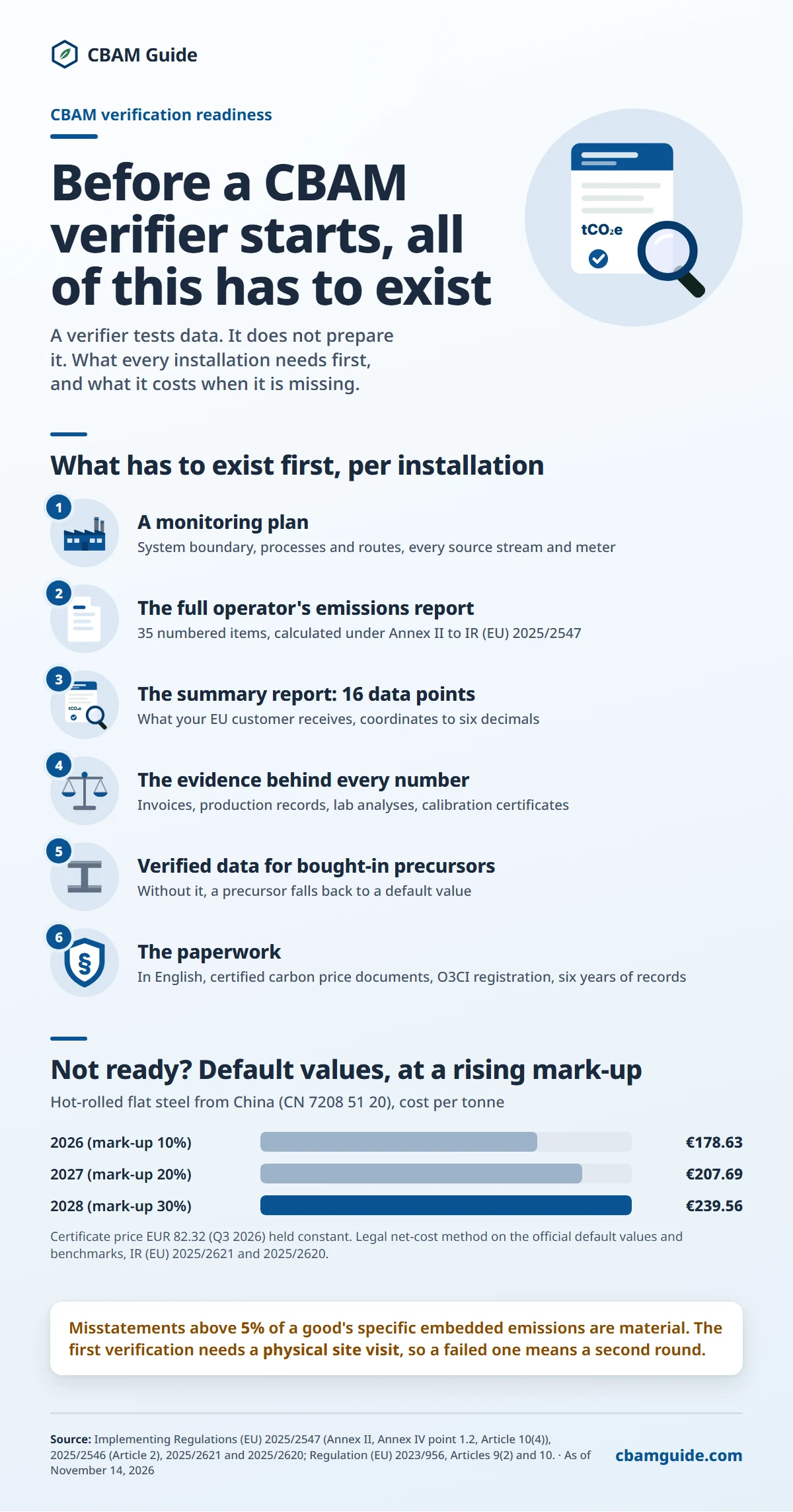
Infographic: before a CBAM verifier starts, six things have to exist for every installation. 1. A monitoring plan: system boundary, production processes and routes, every source stream and measuring instrument. 2. The full operator's emissions report, 35 numbered items, calculated under Annex II to Implementing Regulation (EU) 2025/2547. 3. The summary emissions report with its 16 data points, coordinates to six decimals. 4. The evidence behind every number: invoices, production records, laboratory analyses, calibration certificates. 5. Verified data for purchased precursors, otherwise they fall back to default values. 6. The paperwork: English, certified carbon price documents, O3CI registration, six years of records. If it is not ready, the importer declares default values: hot-rolled flat steel from China (CN 7208 51 20) costs EUR 178.63 per tonne in 2026, EUR 207.69 in 2027 and EUR 239.56 in 2028 at the Q3 2026 certificate price of EUR 82.32 held constant. Misstatements above 5% are material, and the first verification needs a physical site visit.
The checklist and the cost example at a glance. Sources and the full text are on this page.

What happens when it is not ready

The verifier visits the plant. The first verification of an installation needs a physical site visit (Article 2 of Implementing Regulation (EU) 2025/2546). It traces each figure back to meters and invoices. Misstatements above 5% of a good's specific embedded emissions are material, and a material misstatement stands in the way of a positive opinion.

Then one of three things follows, and none of them is cheap.

Consequence 1

a second round

The operator corrects the data and the verifier comes back, on its own calendar and at its own rates. Verification vendors quote EUR 5,000 to 50,000 per installation (a market estimate, not an official figure); the second round comes on top. And the calendar is short: seven verification bodies were documented as accredited on November 12, 2026, each for certain goods only.

Consequence 2

back to default values, at a growing mark-up

Without verified actual values, the importer declares default values, and those carry a mark-up of 10% in 2026, 20% in 2027 and 30% from 2028 (1% for fertilisers). One example, hot-rolled flat steel from China (CN 7208 51 20) on default values, at the Q3 2026 certificate price of EUR 82.32 held constant:

  • 2026: 2.17 certificates per tonne, EUR 178.63 per tonne.
  • 2027: 2.52 certificates per tonne, EUR 207.69 per tonne.
  • 2028: 2.91 certificates per tonne, EUR 239.56 per tonne.

For 10,000 tonnes a year that is EUR 1.79 million in 2026 alone. Every tonne of CO2e per tonne of steel that verified actual values take off the default saves EUR 82.32 per tonne of steel at that price. These figures are an estimate built on the official default values and benchmarks (Implementing Regulations (EU) 2025/2621 and 2025/2620); the binding figure is the one in the CBAM declaration.

For a producer outside the EU, that bill lands on the EU customer. The customer can absorb it, pass it back in the price, or buy from a plant whose data is verified.
Consequence 3

the error is found later

A wrong actual value that slips through does not stay hidden. The Commission and the national authority may review a CBAM declaration until the end of the fourth year after it was due (Article 19(2)). If the number of certificates was too low, the declarant must surrender the missing ones within one month (Article 19(5)), and every certificate not surrendered carries a penalty of EUR 100, increased by inflation indexation (Article 26(1)). The Regulation even provides for reducing that penalty where the shortfall comes from incorrect information from an operator or a verifier (Article 26(1a)). Wrong operator data is a risk the law expects.

The fix: find the gaps before the verifier does

A pre-verification is a dry run of the verification, done by a CBAM consultancy that is independent of your future verifier. It goes through the same evidence the verifier will: the monitoring plan, the full report and its 16-point summary, the data flow behind every figure, the meters and invoices, and the data from your own suppliers.

You get a written list of every gap, what closes each one, and for each good whether actual values or default values are the better route. Then you book the verifier with data that is ready. The two jobs stay apart on purpose: a verifier has to stay impartial towards the data it verifies, so it cannot be the one that prepared it.

Find my gaps before the verifier does

How it works

  1. Send the short form below: company, name and email. It takes under a minute.

  2. A consultancy contacts you, asks about goods, installations and production routes, and quotes a price.

  3. You share the documents and receive the gap list with what closes each gap.

  4. You book the accredited verifier. If you want, we pass your request to verifiers whose accreditation covers your goods.

The calendar is fixed

  1. January 2027Verification reports issued in the CBAM Registry
  2. September 30, 2027First CBAM declaration, for 2026 imports

Verification reports are issued in the CBAM Registry from January 2027, and the first CBAM declaration, for 2026 imports, is due on September 30, 2027. Every verifier fills its diary from the same short list of plants. Data that is right the first time is the quickest way through.

Only need a verifier? Tick "An accredited verifier for actual emissions" in the form below and we pass your request on as usual.

Find my gaps before the verifier does

Request an introduction

The more precise the job, the better the match.

What do you need?

Free for you.

How it works

1. Describe the job

Under a minute: what you need, your company, name and email. No account.

2. We match it

We check your request against the providers we track, by sector, country, language and, for verifiers, accreditation scope.

3. The providers contact you

We pass your request to one to three providers that fit, as you agreed in the form. They contact you directly.

Questions

Is pre-verification required by law?

No. Regulation (EU) 2023/956 requires verification by an accredited verifier only where embedded emissions are declared on actual values (Article 8(1)). Pre-verification is an optional check before that step; a declaration on default values needs neither.

Who is it for?

Producers outside the EU whose EU customers ask for verified actual values, and EU importers who declare actual values for their suppliers. Verification reports are issued in the CBAM Registry from January 2027, and the first CBAM declaration, for 2026 imports, is due on September 30, 2027.

What does the pre-verification itself cost?

The provider quotes after a short call; the price depends on the number of installations, goods and production routes. Asking through this page costs you nothing.

What does it cost?

Nothing for you. If you hire a provider we passed your request to, that provider may pay cbamguide.com a referral fee.

Does a fee decide who you recommend?

No. We name the providers that fit the job, including ones that pay us nothing. Our directories and reviews are editorial: nobody pays to be listed, ranked or described.

Who sees my request?

cbamguide.com, and the providers we pass it to, up to three. Nobody else. We do not add you to a mailing list.

Do you give CBAM advice yourselves?

No. cbamguide.com publishes reference material and tools. Advice, verification, training and filing come from the provider you choose.

Looking for something else?

All requestsVerifierConsultantDeclarant serviceSoftwareSupplier dataTrainingEmissions calculation

Prefer to look yourself?

The directories and guides are free and open: find an accredited verifier, how CBAM verification works and accredited CBAM verifiers.