CBAM circumvention is one of 3 categories of conduct that Article 27 of Regulation (EU) 2023/956 explicitly prohibits, covering shipment splitting, origin rerouting, and minor-processing schemes designed to avoid the certificate obligation. Understanding the boundary between legitimate trade optimization and illegal circumvention is now a compliance priority for every EU importer sourcing from high-risk jurisdictions, particularly those purchasing steel and aluminium from supply chains that pass through Vietnam, Turkey, or the UAE. This article explains precisely what the regulation prohibits, what the Commission is monitoring in 2026, and what consequences follow when circumvention is detected.
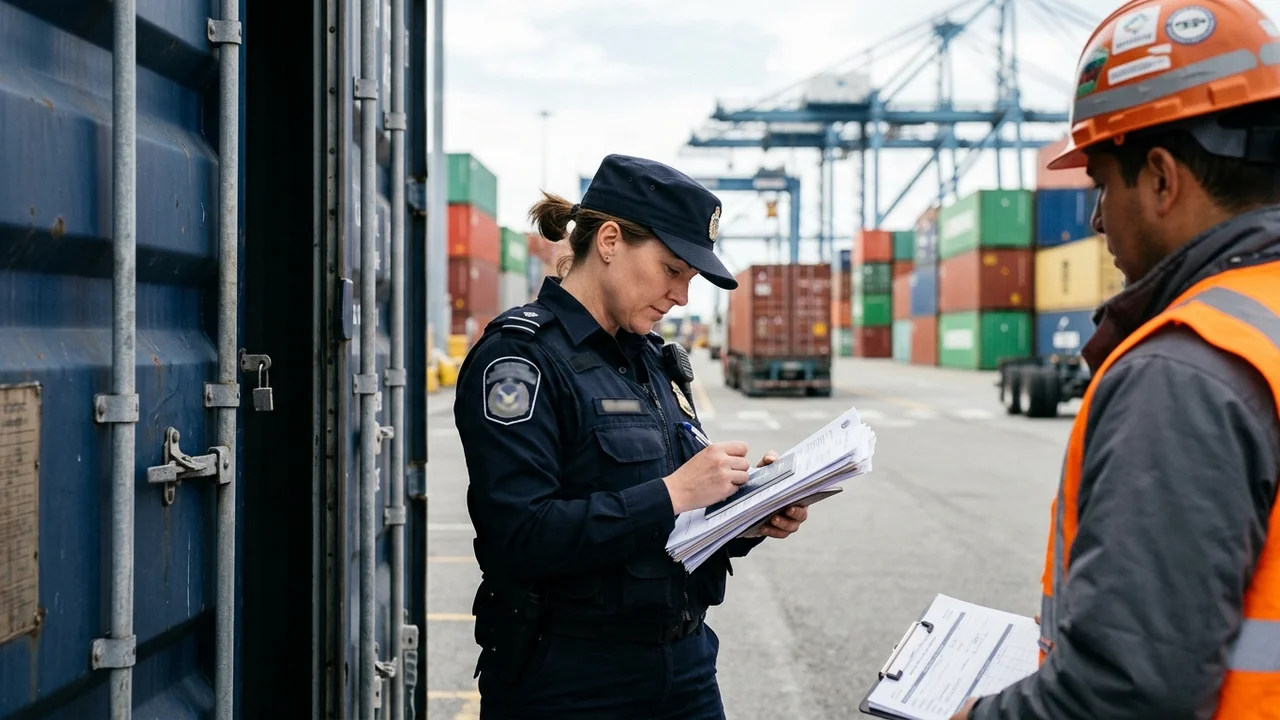
Caption: EU customs authorities validate CBAM authorization status in real time before releasing Annex I goods into free circulation.
For a complete grounding in the broader regulatory framework, the EU CBAM guide covers all six covered sectors and the certificate mechanism in full.
What CBAM Anti-Circumvention Rules Prohibit
CBAM anti-circumvention rules prohibit conduct that artificially reduces or eliminates the certificate obligation without genuinely reducing the embedded carbon emissions of imported goods. Article 27 identifies three specific prohibited practices, each targeting a different evasion mechanism.
The three prohibited practices operate across distinct points in the supply chain. Two of them (shipment splitting and origin rerouting) manipulate the administrative facts of the import (volume per shipment, declared country of origin) without touching the physical production of the goods. The third, minor processing, intervenes at the production stage but uses superficial transformation to reclassify goods as outside CBAM scope.
Artificial Shipment Splitting
Artificial shipment splitting occurs when a single commercial transaction is divided into two or more separate consignments, each below the 50-tonne annual de minimis threshold under Article 2(3a) of Regulation (EU) 2023/956, inserted by Regulation (EU) 2025/2083. The de minimis threshold exempts importers whose total annual imports of CBAM goods fall below 50 tonnes per importer per calendar year. Splitting one 90-tonne annual order into two 45-tonne consignments from the same supplier, shipped to the same buyer, with no commercial justification for the split, constitutes this violation.
The regulation treats the aggregate annual volume per importer as the controlling metric. The Commission has stated that patterns of repetitive near-threshold consignments from the same origin to the same authorized declarant will trigger audit flags in the CBAM Registry. Customs data transmitted to the registry under Article 25 gives the Commission the transaction-level visibility to identify these patterns without requesting any additional information from the importer.
Origin Rerouting to Change Declared Country of Origin
Origin rerouting is the practice of shipping high-carbon goods through a third country to obtain a different, potentially more favorable country of origin under EU customs rules. The country of origin for CBAM purposes is determined using standard EU rules of origin under the Union Customs Code, not the country of the final export shipment. A Chinese steel product shipped through Malaysia does not acquire Malaysian origin unless substantial transformation occurred in Malaysia.
The Commission's active monitoring focuses specifically on Vietnamese processing of Chinese steel and Turkish reprocessing of Russian aluminium ingots. Both patterns involve sending raw or semi-processed CBAM goods to an intermediate country, performing processing insufficient to meet the substantial transformation threshold, and then shipping into the EU with a revised origin certificate. The monitoring priority assigned to these two corridors reflects the volume of EU import flows from Vietnam and Turkey in steel and aluminium respectively.
Minor Processing to Reclassify Goods
Minor processing involves shipping a CBAM-covered precursor to a non-CBAM jurisdiction for superficial transformation into a product classified under a CN code not listed in Annex I of Regulation (EU) 2023/956. Steel hot-rolled coil (a CBAM good) becomes steel tubes or pipes (potentially outside the specific covered CN codes) through processing that does not substantially alter the carbon content of the material. The regulation recognizes this pattern and prohibits imports where the Commission determines that "minor processing" was the predominant purpose of the third-country operation.
Article 27 gives the Commission the power to adopt delegated acts to specify what constitutes minor processing for each sector. As of April 2026, no sector-specific delegated acts have been published, but the regulation text establishes the principle and confirms that the absence of specific guidance does not prevent enforcement. The forthcoming downstream product expansion proposed in COM(2025)989 addresses part of this gap by bringing approximately 180 steel- and aluminium-intensive downstream products within CBAM scope from January 2028, which would eliminate many of the downstream reclassification pathways currently exploited.
The Three Prohibited Practices: Summary Table
The table below summarizes the three prohibited practices under Article 27, their mechanics, and the monitoring signals the Commission uses to identify each.
| Prohibited Practice | Mechanism | Key Indicator for Detection |
|---|---|---|
| Artificial shipment splitting | Divides annual volume into sub-50-tonne consignments | Repetitive near-threshold shipments, same supplier, same buyer |
| Origin rerouting | Ships through third country to change declared origin | Mismatch between actual production origin and declared origin; processing time too short for substantial transformation |
| Minor processing | Superficial transformation of CBAM goods to reclassify by CN code | Processing step adds minimal value; carbon content of output equals input; no change in material composition |
What the Commission Is Actively Monitoring in 2026
Three supply chain corridors are the primary focus of Commission monitoring under the anti-circumvention provisions in the first year of the definitive phase.
The first is Vietnamese processing of Chinese steel. China produces blast furnace steel (BF-BOF route) with embedded emissions of approximately 2.0 tCO₂ per tonne. Hot-rolled coil and other semi-finished steel products flow from Chinese mills to Vietnamese processing facilities, where they undergo slitting, cutting, or light forming before being exported to the EU as Vietnamese-origin goods. The key question in each case is whether the processing in Vietnam reaches the substantial transformation threshold. Commission data shared with the European Steel Association in early 2026 identified this corridor as the highest-volume circumvention risk for steel.
The second monitored corridor is Turkish reprocessing of Russian aluminium. Russian primary aluminium ingots carry approximately 1.5 tCO₂ per tonne of direct embedded emissions. Turkish facilities remelt and re-cast those ingots into extrusion billets or sheet ingots, which then enter the EU with Turkish origin certificates. The remelting step can qualify as substantial transformation in some customs assessments, which creates genuine legal ambiguity. Turkey's lack of a qualifying carbon pricing scheme means no Article 9 deduction applies regardless of origin, but the circumvention concern is that Russian-origin product enters with Turkish origin documentation after insufficient transformation.
The third area of Commission monitoring involves the sale of CBAM goods as downstream products not yet in scope. Before the COM(2025)989 expansion takes effect, importers have an incentive to import CBAM-affected steel or aluminium in a form that falls outside the specific CN codes listed in Annex I. This is not illegal under current rules if the product genuinely falls outside scope, but the Commission monitors import flows for evidence that goods are being processed to the minimum degree necessary to exit CBAM classification without any genuine commercial rationale beyond scope avoidance.
The CBAM Registry, operated by DG TAXUD, receives automatic import data from customs authorities under Article 25 for every shipment of Annex I goods. This data includes the EORI number of the importer, the CN code, the net mass, and the country of origin. Cross-referencing this data with historical supplier relationships, trade flow patterns, and processing facility certifications allows the Commission to flag anomalies across the 27-member-state customs area without relying on individual national competent authorities to identify the patterns independently.
Caption: DG TAXUD cross-references EORI numbers, CN codes, and declared origin data across all 27 member states to identify anomalous supply chain patterns.
Penalties for Unauthorized Importing
Penalties for CBAM circumvention that results in unauthorized importing reach €300 to €500 per tonne CO₂e under Article 26(2) of Regulation (EU) 2023/956, as amended by Regulation (EU) 2025/2083. This range represents 3 to 5 times the standard penalty rate of €100 per tonne CO₂e that applies to authorized declarants who fail to surrender sufficient certificates. The penalty for unauthorized importers is intentionally punitive to deter the deliberate choice to operate outside the authorization system.
A concrete example illustrates the exposure. An importer brings 500 tonnes of blast furnace steel (embedded emissions approximately 2.0 tCO₂ per tonne, giving 1,000 tCO₂ total) without CBAM authorization. The minimum penalty is €300 per tCO₂ applied to 1,000 tCO₂, totaling €300,000. The maximum penalty is €500,000 for the same shipment. These penalties apply in addition to the underlying certificate obligation, which remains outstanding. The importer must still procure and surrender the certificates corresponding to the full embedded emissions.
For authorized declarants who engage in circumvention through misrepresentation of origin or emissions data, the penalty structure includes not only the €100 per tonne CO₂e for any shortfall in certificate surrender but also the risk of authorization revocation. Authorization revocation removes the legal basis for importing CBAM goods entirely, converting the importer into an unauthorized actor subject to the €300 to €500 range on all subsequent imports.
The full penalty framework, including the inflation adjustment mechanism and the appeals process through national courts, is detailed in the CBAM penalties article.
How the Regulation Defines the Circumvention Boundary
Article 27 is structured around an objective test: whether the conduct in question has the "predominant purpose" of avoiding CBAM obligations rather than reflecting genuine commercial decisions. This purposive test creates interpretive space that neither the regulation text nor the implementing regulations have fully resolved as of April 2026.
The predominant purpose test means that legitimate commercial decisions which happen to reduce CBAM exposure are not prohibited. A supplier that moves manufacturing from China to Vietnam for genuine cost or labor reasons, achieves substantial transformation of the goods in Vietnam, and exports to the EU with correct Vietnamese origin documentation is not circumventing CBAM. The embedded emissions of the Vietnamese production process apply, which may be lower than the Chinese production process depending on the energy mix and production route used at the Vietnamese facility.
The challenge for compliance officers is that the regulation does not specify a bright-line test for substantial transformation in the context of CBAM. EU customs rules on substantial transformation under the Union Customs Code apply as the starting point, but CBAM's environmental purpose adds a dimension that pure customs law does not address: even a legally sufficient substantial transformation may be insufficient if the primary purpose was circumvention rather than genuine production. The Commission retains authority under Article 27 to investigate and refer cases to member state competent authorities for penalty assessment, but no formal enforcement decisions have yet been published as of April 2026.
How Circumvention Interacts with CBAM Verification
Circumvention and verification failures often overlap in practice. An importer relying on rerouted goods with fraudulent origin certificates typically also lacks credible emissions data for the actual production installation. A verifier conducting a mandatory physical site visit to the declared production facility will find no evidence of the goods' actual production if the production occurred at a different, undisclosed installation.
The verification system under Delegated Regulation (EU) 2025/2551 requires physical site visits to non-EU production installations for the first verification period (calendar year 2026). Verifiers must observe the production process, review monitoring plans, and sample supporting data. A facility in Vietnam that received Chinese hot-rolled coil and performed light processing cannot generate a verification report that accurately reflects the embedded emissions of that coil, because the Chinese production installation where the high-emission work occurred is not the installation being verified.
Importers who discover mid-cycle that their supply chain involves origin rerouting face a difficult choice: disclose the problem to their national competent authority and face potential penalty exposure, or continue with a verification process that is structurally incapable of producing accurate emissions data. The CBAM verification article covers the physical site visit requirement and the consequences of incomplete or inaccurate verification reports in full.
The Proposed "Emergency Brake" and Its Anti-Circumvention Function
COM(2025)989, published December 17, 2025, proposes inserting Article 27a into Regulation (EU) 2023/956. Article 27a would allow the Commission to suspend CBAM application to specific goods when "serious and unforeseen circumstances" cause "severe harm" to the EU internal market. This is not a standard anti-circumvention measure, but it functions as a backstop for situations where circumvention or import surges create market disruption before the formal Article 27 enforcement process can respond.
The proposal remains in the legislative process as of April 2026. Neither the quantitative threshold for "severe harm" nor the evidentiary standard required to trigger suspension is defined in the current proposal text. The absence of objective criteria is a significant concern for non-EU exporters who have invested in decarbonization based on the expectation that CBAM would apply consistently and predictably.
What the Downstream Expansion Means for Circumvention Risk
The proposed downstream scope expansion in COM(2025)989 targets approximately 180 products from January 2028, including vehicle parts, industrial machinery, and metal structures with significant steel or aluminium content. This expansion directly addresses the minor processing circumvention pathway by eliminating many of the downstream product categories that currently serve as reclassification targets.
If adopted, the expansion means that a steel tube (currently covered) cannot be avoided by importing vehicle frame components made from that tube (currently not covered). The compliance chain extends further downstream, requiring embedded emissions tracking through more complex supply chains and more processing steps. The calculation methodology for downstream products covering inputs from multiple countries and production stages is not yet defined, which represents one of the significant open questions in COM(2025)989.
The CBAM regulation (EU) 2023/956 article covers the full legislative history from the original 2023 text through the Omnibus amendments and the current COM(2025)989 proposal.
The Contextual Border: CBAM Circumvention Within the WTO Framework
CBAM anti-circumvention rules operate within an international trade law framework that is itself contested. WTO dispute DS639, filed by Russia on May 12, 2025, challenges CBAM under GATT Articles I, II, and III, and challenges EU ETS free allocation under the SCM Agreement. If Russia succeeds in establishing a WTO panel, the question of whether anti-circumvention measures constitute additional discriminatory treatment will likely be part of the dispute's scope.
The EU's legal defense relies on GATT Article XX(b) and Article XX(g) exceptions, arguing that CBAM is necessary to protect life and health and to conserve exhaustible natural resources. Anti-circumvention provisions are inherent to any legitimate environmental measure: without them, the measure would not achieve its stated goal. The EU position is that Article 27 is not an additional trade restriction but a necessary integrity mechanism.
The WTO and CBAM article covers the DS639 dispute timeline, the EU's legal defense strategy, and the enforceability gap created by the non-functional WTO Appellate Body.
How Do Circumvention Rules Apply to Countries With Low CBAM Exposure?
Countries with low embedded emissions or qualifying carbon pricing schemes have less financial incentive to circumvent CBAM, but the anti-circumvention rules apply equally regardless of the country of origin. A country whose exporters produce steel at 0.5 tCO₂ per tonne (EAF scrap route) faces a CBAM obligation approximately 4 times lower than a BF-BOF producer, but the legal boundary between legitimate and prohibited conduct is identical. The circumvention risk is elevated for countries where the CBAM cost differential between actual production and reclassified downstream product is large enough to justify the administrative effort.
Does the De Minimis Threshold Apply Differently for Anti-Circumvention Purposes?
The 50-tonne annual de minimis threshold under Article 2(3a) applies per importer per calendar year, aggregated across all CBAM good types. An importer that splits imports between two affiliated entities to place each below the threshold may face anti-circumvention scrutiny if the Commission determines the split lacks commercial justification. The regulation does not define what level of affiliation triggers aggregation, but the purposive test in Article 27 covers arrangements that achieve de minimis status through artificial corporate structuring rather than genuine business separation. The CBAM de minimis threshold article covers the technical scope of the exemption and its exclusions for electricity and hydrogen.
Is Processing in a Third Country Always a Circumvention Risk?
Processing in a third country is not inherently a circumvention risk. Genuine manufacturing operations that produce real value-added transformation, employ local workforces, use local production inputs, and create products meaningfully different from their inputs are not circumventing CBAM. The circumvention test focuses on whether the third-country processing achieves substantial transformation or whether it is superficial work performed primarily to change CN codes or origin certificates. Importers with legitimate third-country supply chains protect themselves by documenting the genuine commercial rationale for each production stage, retaining evidence of the transformation process, and ensuring that embedded emissions are tracked back to the original production installation, including any precursor emissions from earlier in the chain.
Can an EU Importer Be Liable for Circumvention by Their Supplier?
An EU importer bears direct legal liability under CBAM regardless of whether the circumvention was arranged by the supplier. The authorized CBAM declarant is responsible for the accuracy of the CBAM declaration, including the declared country of origin and the declared embedded emissions. If a supplier provides fraudulent origin certificates or emissions data, the declarant's liability under Article 26 is not automatically extinguished. The regulation does not contain a good-faith defense that protects importers who relied on supplier-provided information that later proves false. This places a premium on supply chain due diligence: importers should conduct independent verification of supplier claims, particularly for supply chains passing through the high-risk corridors the Commission actively monitors.
Are Vietnam and Turkey Specifically Named in the Regulation as Circumvention Risks?
Neither Vietnam nor Turkey is named in Regulation (EU) 2023/956 as a circumvention risk jurisdiction. The Commission's monitoring of Vietnamese and Turkish supply chains is based on trade flow analysis and intelligence gathered during the transitional period (October 2023 to December 2025), not on country-specific designation in the regulation text. Article 27 applies universally. Countries that handle significant volumes of CBAM-affected goods as transit or processing points are subject to the same monitoring intensity as any other third country. The CBAM China analysis article covers the specific circumvention dynamics created by Chinese steel and aluminium export flows. Analysis of Vietnamese supply chain dynamics and the specific processing corridors from China through Vietnam is covered in the CBAM Vietnam analysis.
Does Circumvention Affect Access to the Article 9 Carbon Price Deduction?
An importer who has engaged in origin rerouting cannot claim the Article 9 carbon price deduction based on carbon pricing paid in the declared (rerouted) country of origin, because the carbon price must have been "effectively paid" in the country where the goods were actually produced. If Chinese-produced steel enters the EU with Vietnamese origin documentation, any deduction calculation must reference the carbon pricing scheme applicable to the Chinese production installation, not Vietnamese environmental policy. China's ETS covers the electricity sector and does not currently cover steel production, meaning no Article 9 deduction would apply in any case for BF-BOF Chinese steel.